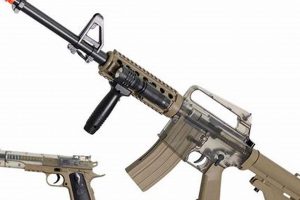
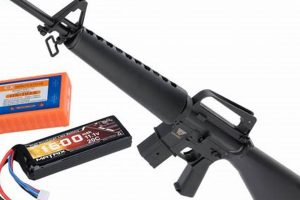
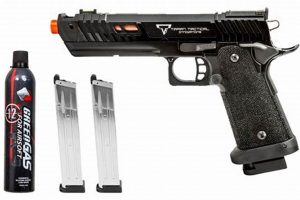
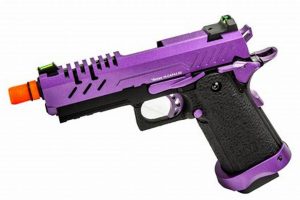
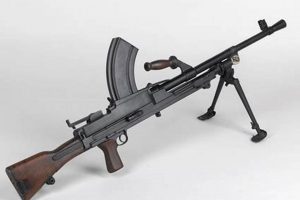
The selection of appropriate airsoft weaponry is crucial for both novice and experienced players seeking to enhance their gameplay. This selection encompasses various models designed for different combat styles, field types, and budget considerations. Performance characteristics, durability, and user-friendliness are key factors when evaluating options.
Choosing dependable equipment impacts a player’s accuracy, range, and overall effectiveness during simulated combat scenarios. Historically, advancements in airsoft technology have led to improved realism and performance, thereby increasing the appeal and accessibility of the sport. Investing in quality equipment can also lead to greater longevity and reduced maintenance costs in the long run.
The following sections will explore specific types of airsoft guns, including their features, advantages, and suitability for different player preferences and tactical situations. These explorations will cover electric-powered (AEG), gas-powered (GBB), and spring-powered models, providing a foundation for making informed purchasing decisions.
Selecting Effective Airsoft Armaments
Considerations when choosing an appropriate airsoft replica are multifaceted. The following guidelines provide a framework for evaluating potential purchases based on performance, reliability, and intended use.
Tip 1: Assess Field Regulations. Prioritize compliance with the velocity restrictions and ammunition requirements specific to the intended playing field. This ensures legal and safe gameplay.
Tip 2: Evaluate Power Source Options. Differentiate between electric (AEG), gas (GBB), and spring-powered mechanisms. Electric models offer consistent performance, gas models provide realism, and spring models offer simplicity and affordability.
Tip 3: Consider Internal Component Quality. Examine materials and construction. Metal gearboxes and reinforced internals contribute to durability and longevity, especially under prolonged use.
Tip 4: Research Accuracy and Range. Investigate the gun’s hop-up system, which influences trajectory and distance. Adjustable hop-up units allow for fine-tuning accuracy.
Tip 5: Determine Ergonomics and Weight. Handle the replica, if possible, to assess comfort and maneuverability. Weight distribution affects fatigue during extended gameplay.
Tip 6: Examine Magazine Capacity. The magazine size dictates the amount of rounds available before reloading. Consider your gameplay style and the need for frequent reloads.
Tip 7: Read User Reviews. Consult online forums and product reviews to gauge the experiences of other airsoft players regarding reliability and performance.
Applying these recommendations ensures a more informed selection process, aligning the chosen airsoft gun with individual needs and field requirements. This approach contributes to enhanced gameplay and overall satisfaction.
The subsequent sections will delve into specific airsoft gun models and categories, providing further context for making an effective and tailored selection.
1. Performance

Performance constitutes a central criterion in evaluating the suitability of airsoft replicas. It directly influences a player’s effectiveness, tactical options, and overall enjoyment of the sport. The following details elucidate specific facets of performance as they relate to selecting effective airsoft weaponry.
- Firing Rate and Consistency
Firing rate, measured in rounds per minute (RPM), determines the volume of projectiles delivered within a given timeframe. Consistency refers to the uniformity of muzzle velocity between shots. High firing rates paired with consistent velocity provide a competitive advantage in engagements, ensuring rapid target acquisition and accurate shot placement. An airsoft gun exhibiting significant velocity fluctuations will negatively impact accuracy, even at close ranges. Quality internal components and proper maintenance contribute to improved firing rate consistency.
- Range and Accuracy at Distance
Range denotes the effective distance at which a projectile can accurately reach a target. Accuracy, in this context, refers to the concentration of shots within a specified area at a given range. An airsoft replica’s hop-up unit significantly impacts range and accuracy. Properly adjusted hop-up systems impart backspin to the BB, increasing its flight distance and stability. Internal barrel quality and consistent air seal contribute to enhanced accuracy at longer ranges, facilitating effective engagement of opponents at a distance.
- Trigger Response and Cycle Time
Trigger response characterizes the delay between trigger pull and the firing of a projectile. Cycle time denotes the time required for the internal mechanism to complete a firing cycle. Rapid trigger response is essential for quick reactions in fast-paced combat scenarios. Efficient motor and gearbox configurations contribute to reduced cycle times and improved trigger response. Upgrading internal components, such as motors and MOSFETs, can significantly enhance trigger response and cycle time.
- Gas Efficiency and Reliability
In gas-powered airsoft guns (GBB/NBB), gas efficiency determines the number of shots obtainable from a single gas fill. Reliability refers to the consistent operation of the mechanism without malfunctions or failures. Gas efficiency directly impacts operational costs and gameplay sustainability. Durable seals, efficient valve systems, and temperature-stable gas formulations contribute to improved gas efficiency. Regular maintenance and proper lubrication of internal components ensure reliable operation and minimize the risk of malfunctions.
The facets detailed above collectively determine the overall performance profile of an airsoft replica. A comprehensive assessment of these factors is necessary for selecting airsoft guns that align with individual playing styles and tactical requirements. Understanding the interplay between firing rate, range, trigger response, and gas efficiency enables players to make informed purchasing decisions and optimize their performance on the airsoft field.
2. Durability
Durability is a paramount characteristic when evaluating the suitability of airsoft replicas. Robust construction directly correlates with operational longevity, reduced maintenance requirements, and consistent performance under varied conditions, thereby contributing significantly to overall value.
- Material Composition and Construction
The materials used in the construction of an airsoft gun directly influence its ability to withstand physical stress and environmental factors. High-quality polymers, reinforced metals, and durable composites offer superior resistance to impacts, abrasion, and temperature fluctuations. For example, a full metal gearbox, as opposed to a plastic one, can withstand greater stress from the gears turning at a high rate. The manner in which these materials are assembled and joined also impacts structural integrity. Models with robust construction, employing reinforced seams, tight tolerances, and secure fastenings, are less susceptible to damage from routine use and accidental impacts.
- Internal Component Strength
The robustness of internal components, such as gears, pistons, and springs, directly impacts the longevity and consistent performance of the mechanism. Components manufactured from high-strength materials, such as hardened steel or reinforced polymers, exhibit greater resistance to wear and tear, extending the operational lifespan of the airsoft gun. For example, hardened steel gears are less likely to strip or break under stress. A reinforced piston head will withstand the impact of the piston hitting the cylinder head. Conversely, models with substandard internal components are prone to premature failure, resulting in diminished performance and increased maintenance needs.
- Environmental Resistance
Airsoft guns are often utilized in outdoor environments, exposing them to a range of weather conditions, including moisture, dust, and temperature extremes. Models with environmental resistance features, such as sealed electronics, corrosion-resistant coatings, and weather-resistant materials, exhibit greater resilience in adverse conditions. For example, O-ring seals prevent moisture from entering the internal components. Airsoft guns with inadequate environmental protection are susceptible to corrosion, component degradation, and operational malfunctions when exposed to moisture or extreme temperatures.
- Impact Resistance
Airsoft gameplay inherently involves physical activity and the potential for accidental impacts. Models constructed with impact-resistant materials and reinforced structures are better equipped to withstand accidental drops, collisions with obstacles, and other forms of physical stress. For example, a reinforced outer barrel protects the inner barrel from damage if the gun is dropped. The ability to withstand impacts without sustaining damage contributes to the overall durability and extends the operational lifespan of the airsoft gun. Impact resistance ensures functionality is retained even after unintentional physical contact.
The aspects detailed above underscore the critical importance of durability in the selection of effective airsoft weaponry. Airsoft guns exhibiting robust construction, high-strength internal components, environmental resistance features, and impact resistance offer superior longevity, reduced maintenance needs, and consistent performance under diverse conditions. A focus on durability translates to a more cost-effective investment and a more reliable platform for gameplay.
3. Accuracy
Accuracy, in the context of airsoft weaponry, refers to the degree to which projectiles consistently strike the intended target. It is a critical performance parameter directly influencing a player’s effectiveness in simulated combat scenarios. The correlation between accuracy and a good airsoft gun is strong: an inherently inaccurate model, irrespective of other features, compromises its utility. In essence, the capacity to deliver projectiles precisely where aimed defines a weapon’s practical value on the field. The interaction of several factors contributes to accuracy, including the quality of the internal barrel, the consistency of the hop-up system, and the precision of the aiming apparatus. For example, a high-quality inner barrel with tight bore tolerances reduces projectile deviation during launch, thereby increasing accuracy at extended ranges. In contrast, an airsoft gun with a poorly manufactured barrel will exhibit unpredictable shot patterns, rendering accurate targeting exceedingly difficult.
The hop-up system imparts backspin to the projectile, extending its range and promoting a flatter trajectory. Consistent backspin is crucial for maintaining accuracy; variations in hop-up pressure can induce erratic projectile flight paths. Many highly regarded airsoft guns feature adjustable hop-up systems, enabling players to fine-tune the backspin to match the projectile weight and environmental conditions. Further, the aiming system employed, whether iron sights, red dot sights, or magnified scopes, influences the precision with which a target can be acquired and engaged. A clear, well-calibrated aiming device is essential for maximizing accuracy, particularly at longer distances. For example, a crisp, adjustable red dot sight allows for rapid target acquisition and precise shot placement in dynamic scenarios. In the case of a spring sniper rifle, a high power scope would offer the user the accuracy at long range.
In summary, accuracy is an indispensable attribute of a well-performing airsoft gun. Its achievement relies on the synergistic function of high-quality internal components, a consistent hop-up system, and a precise aiming apparatus. An airsoft gun excelling in these areas provides a distinct advantage in gameplay, allowing players to effectively engage targets and achieve desired outcomes. Compromises in any of these areas inevitably lead to a diminished accuracy profile, rendering the weapon less effective and, ultimately, less desirable. Thus, any discussion on good airsoft guns must include a comprehensive analysis of the accuracy performance.
4. Range
Effective range constitutes a critical performance parameter for airsoft weaponry. It directly impacts a player’s ability to engage opponents from a distance, influencing tactical options and overall battlefield effectiveness. An airsoft gun’s capacity to accurately project projectiles over extended distances is, therefore, a defining characteristic of what constitutes a superior model.
- Hop-Up System Efficiency
The hop-up system imparts backspin to the projectile, counteracting gravitational forces and extending its flight path. Efficient hop-up units, characterized by consistent pressure and optimal contact surface, significantly enhance range. For example, a well-designed hop-up system can increase an airsoft gun’s effective range by 30-50% compared to models lacking this feature. The hop-up adjustment allows users to fine-tune the backspin to maximize the range for a particular weight BB. The quality of the hop-up system is, therefore, a key differentiator among airsoft models. A replica without a suitable hop-up will only be effective in very close-quarters combat.
- Internal Barrel Length and Bore Diameter
Inner barrel length influences projectile acceleration and muzzle velocity. Longer barrels generally facilitate greater range, provided that other factors, such as air seal and gas volume, are optimized. The bore diameter, or internal barrel width, affects projectile stability and consistency. Tight-bore barrels, with diameters ranging from 6.01mm to 6.03mm, can enhance accuracy and range by minimizing projectile wobble. However, tight-bore barrels necessitate high-quality projectiles to prevent jamming. An airsoft sniper rifle usually comes with a longer barrel to maximize range and accuracy.
- Muzzle Velocity and Power Output
Muzzle velocity, measured in feet per second (FPS), directly correlates with the projectile’s initial kinetic energy and, consequently, its range. Higher muzzle velocities generally translate to greater range, although adherence to field regulations is essential. However, excessive muzzle velocity can compromise accuracy by increasing projectile instability. The type of ammunition influences power output. Lighter BBs will often provide a higher FPS. The optimal balance between muzzle velocity and projectile stability is, therefore, crucial for maximizing effective range while maintaining accuracy. Most airsoft guns shoot in the 300-450 FPS range.
- Ammunition Weight and Quality
Ammunition weight affects projectile trajectory and wind resistance. Heavier projectiles generally exhibit greater stability in flight and are less susceptible to wind drift, resulting in improved accuracy and range, especially in outdoor environments. However, heavier projectiles require greater power output to achieve optimal velocities. High-quality ammunition, characterized by uniform shape and consistent weight, is essential for maximizing range and accuracy. For example, using high-quality, heavier BBs can improve an airsoft gun’s effective range and reduce the impact of wind on projectile trajectory. The general weights are .20g – .32g.
The factors outlined above collectively determine the effective range of an airsoft gun. Superior models incorporate efficient hop-up systems, optimized barrel configurations, and consistent power output, facilitating accurate projectile projection over extended distances. Careful consideration of these parameters is, therefore, essential when selecting an airsoft gun optimized for range performance. These considerations lead to increased effectiveness and a tactical advantage on the field.
5. Ergonomics

Ergonomics, defined as the science of designing and arranging items for efficient and safe use by people, constitutes a crucial, albeit sometimes overlooked, factor when evaluating airsoft weaponry. The connection between ergonomics and the selection of effective airsoft guns stems from the direct influence of weapon design on user comfort, maneuverability, and overall performance. An airsoft gun with poor ergonomics can lead to fatigue, discomfort, and reduced accuracy, negating the benefits of superior internal components or power output. Conversely, a well-designed airsoft gun enhances the user’s ability to handle the weapon effectively, promoting improved accuracy, faster target acquisition, and sustained performance during extended gameplay scenarios. For example, an excessively heavy or poorly balanced airsoft rifle can quickly lead to muscle fatigue, hindering the user’s ability to maintain a stable firing position. Conversely, a lightweight and ergonomically designed model allows for prolonged use with minimal fatigue, enabling more accurate and consistent shots.
The ergonomic design of an airsoft gun encompasses several key aspects, including grip design, stock adjustability, and the placement of controls. A comfortable and secure grip promotes better weapon control and reduces hand fatigue. Adjustable stocks allow users to customize the length of pull, ensuring a proper fit and optimal firing stance. The intuitive placement of controls, such as the magazine release and selector switch, facilitates rapid manipulation and reduces the time required to perform critical actions. For instance, an airsoft rifle with an ambidextrous magazine release allows both right- and left-handed users to quickly reload the weapon without awkward or time-consuming manipulations. In contrast, a model with poorly placed controls may require the user to shift their grip or fumble with the weapon, potentially compromising their position and reaction time. These considerations are particularly relevant in fast-paced, dynamic gameplay scenarios where quick and efficient weapon handling is paramount.
In conclusion, the ergonomic design of an airsoft gun is intrinsically linked to its overall effectiveness. User comfort, maneuverability, and efficient weapon handling are directly influenced by ergonomic considerations. While internal components and power output are important factors, they are secondary to the user’s ability to effectively wield the weapon. Therefore, a comprehensive evaluation of ergonomics is essential when selecting an airsoft gun, ensuring a comfortable, efficient, and ultimately more enjoyable and effective gameplay experience. Neglecting this aspect can lead to diminished performance and a reduced return on investment, regardless of the weapon’s other features or specifications.
6. Realism
Realism, in the context of airsoft weaponry, pertains to the degree to which a replica replicates the form, function, and handling characteristics of its real firearm counterpart. While not always a primary performance factor, it significantly contributes to the immersive experience and tactical training value associated with airsoft. The extent to which an airsoft gun mirrors the appearance and operation of a real firearm influences user engagement and the perceived authenticity of simulated combat scenarios.
- External Appearance and Dimensions
The accuracy of an airsoft gun’s external appearance, including its dimensions, markings, and finish, directly impacts its realism. Replicas that closely resemble their real firearm counterparts in terms of aesthetics enhance the immersive experience for users. For example, an airsoft M4 carbine with authentic Colt markings and a faithful replication of its dimensions and component layout will be perceived as more realistic than a generic, stylized alternative. The use of high-quality materials and finishes further contributes to the verisimilitude of the replica.
- Weight and Balance
The weight and balance of an airsoft gun significantly influence its handling characteristics and perceived realism. Replicas that approximate the weight distribution of their real firearm counterparts provide a more authentic shooting experience. For example, an airsoft AK-47 with a similar weight and balance to the real firearm will feel more familiar and natural to users accustomed to handling the real weapon. Achieving accurate weight distribution often necessitates the use of internal weights or the incorporation of realistic internal components.
- Operating Mechanism and Functionality
The degree to which an airsoft gun’s operating mechanism and functionality mirror those of the real firearm significantly impacts its realism. Replicas with functional charging handles, bolt stops, and disassembly procedures provide a more authentic user experience. For example, a gas blowback (GBB) airsoft pistol with a functioning slide and realistic recoil impulse will be perceived as more realistic than a non-blowback (NBB) model. The inclusion of realistic magazine capacities and reloading procedures further enhances the realism of the replica.
- Sound and Recoil
The sound produced by an airsoft gun during operation and the level of recoil it generates contribute significantly to its perceived realism. GBB models, in particular, often incorporate mechanisms to simulate the recoil impulse of a real firearm. The sound signature of the airsoft gun, including the report of the muzzle and the mechanical sounds of the internal components, also influences its realism. For example, a GBB rifle with a loud report and noticeable recoil will be perceived as more realistic than a spring-powered model with minimal sound and no recoil.
These elements collectively contribute to the overall realism of an airsoft gun. While realism may not directly influence performance in terms of accuracy or range, it significantly enhances the immersive experience and training value for users. Airsoft guns that prioritize realism often command a premium price, reflecting the additional engineering and manufacturing costs associated with replicating the form, function, and handling characteristics of real firearms. For some players, the pursuit of realism is a primary driver in their selection of airsoft equipment.
7. Cost
The financial aspect is an unavoidable factor when considering suitable airsoft armaments. The price range for airsoft guns varies significantly, reflecting differences in build quality, features, and performance. The correlation between cost and quality is generally positive, though not absolute. Careful evaluation is necessary to ensure value for money.
- Initial Purchase Price
The initial purchase price represents the upfront investment required to acquire an airsoft gun. Entry-level models, often constructed from less durable materials and featuring basic internal components, are typically the least expensive. Mid-range models offer a balance between performance and affordability, while high-end models, constructed from premium materials and incorporating advanced features, command the highest prices. It is important to establish a budget and identify models that fall within the desired price range, considering long-term needs and anticipated usage. Often, a lower initial purchase price can be offset by frequent repairs or replacements.
- Maintenance and Repair Expenses
Maintenance and repair expenses constitute an ongoing cost associated with owning an airsoft gun. Regular maintenance, such as cleaning, lubrication, and component replacement, is essential for ensuring optimal performance and longevity. High-quality models, constructed from durable materials and featuring robust internal components, typically require less frequent repairs. Conversely, less expensive models may be prone to premature failure, resulting in increased maintenance and repair expenses. Considering the potential for long-term maintenance costs is crucial when evaluating the overall financial investment.
- Ammunition and Consumables
Ammunition, typically in the form of 6mm BBs, represents a recurring expense for airsoft gun owners. The cost of ammunition varies depending on the material, quality, and quantity purchased. High-quality BBs, characterized by uniform shape and consistent weight, are essential for maximizing accuracy and minimizing the risk of jamming. Gas-powered airsoft guns also require a propellant, such as green gas or CO2, which constitutes an additional consumable expense. Budgeting for ammunition and propellant is essential for ensuring sustainable gameplay.
- Upgrades and Modifications
Many airsoft gun owners choose to upgrade or modify their equipment to enhance performance, improve realism, or customize the weapon to their specific preferences. Upgrades can range from simple modifications, such as replacing the hop-up bucking, to more complex alterations, such as installing a new motor or gearbox. The cost of upgrades and modifications can vary significantly depending on the components selected and the complexity of the installation. It is important to factor in the potential for future upgrades when evaluating the initial purchase price, as these modifications can significantly increase the overall investment.
In conclusion, cost is a multifaceted consideration when evaluating the suitability of airsoft guns. The initial purchase price is just one component of the overall financial investment, which also includes maintenance, ammunition, and potential upgrades. A thorough assessment of these factors is essential for making informed purchasing decisions that align with individual budgets and performance requirements. Balancing cost with desired features and long-term value is key to selecting an airsoft gun that provides optimal performance and satisfaction.
Frequently Asked Questions
The following questions address common inquiries and misconceptions surrounding the selection of airsoft guns, providing clarified insights for informed decision-making.
Question 1: What criteria define the “good” airsoft gun?
An effective airsoft gun demonstrates a confluence of traits: robust construction for durability, precise hop-up mechanics for accuracy, acceptable range for engagement, and a suitable ergonomic design for comfortable handling.
Question 2: Does a higher price always equate to a better airsoft gun?
While a positive correlation often exists between price and quality, exorbitant costs do not guarantee superior performance. Scrutinize specifications and reviews to assess true value.
Question 3: Are gas-powered airsoft guns inherently more accurate than electric models?
Accuracy is not solely determined by the power source. The quality of the internal barrel, hop-up unit, and projectile weight significantly influence shot placement, irrespective of gas or electric propulsion.
Question 4: How important is realism when selecting an airsoft gun?
Realism primarily affects the immersive experience and does not directly impact performance metrics such as accuracy or range. Prioritize performance if practical application is paramount.
Question 5: Is maintaining an airsoft gun a difficult task?
Basic maintenance, including cleaning and lubrication, is generally straightforward. Regular care extends the lifespan and sustains performance. Complicated repairs may require professional expertise.
Question 6: Does the weight of the airsoft BB impact the shooting range?
Ammunition weight affects projectile trajectory and wind resistance. Heavier BBs typically exhibit greater stability and improved range in outdoor environments, though sufficient power output is necessary.
The selection of suitable airsoft weaponry requires a nuanced understanding of performance characteristics, build quality, and personal preferences. Informed decision-making enhances the gameplay experience and optimizes on-field effectiveness.
The subsequent section will provide specific recommendations for airsoft guns based on different play styles and budget levels, offering further guidance in the selection process.
Determining Optimal Airsoft Weaponry
The preceding analysis has presented a detailed exploration of factors crucial in identifying suitable airsoft equipment. Considerations encompassing performance metrics, durability assessments, ergonomic evaluations, and cost analyses have been examined to provide a comprehensive framework for discerning optimal choices. This analysis highlights that there is not a single answer for what are some good airsoft guns, as suitability is dependent on many factors.
Armed with a refined understanding of these interconnected variables, prospective purchasers are empowered to approach equipment selection with heightened discernment. Continued advancements in airsoft technology necessitate ongoing evaluation and adaptation to ensure the consistent utilization of effective and appropriate weaponry. Diligence in this pursuit promotes both individual success and the sustained integrity of airsoft as a tactical simulation.