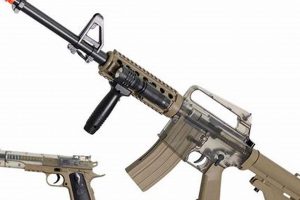
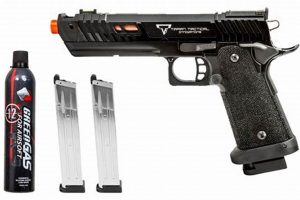
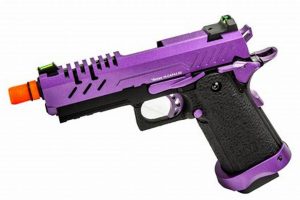
The mechanism that imparts backspin to an airsoft BB, influencing its trajectory and range, requires precise calibration for optimal performance. This adjustment counteracts gravity, enabling a flatter flight path and increased distance. A common example involves observing the BB’s flight; if it curves upwards excessively, it indicates over-hopping, while a downward curve signifies under-hopping.
Proper calibration is crucial for achieving accuracy and maximizing the effective range of an airsoft rifle or pistol. A well-tuned system allows the BB to travel a more predictable and consistent path, providing a competitive edge. Early designs were often rudimentary, but advancements in materials and engineering have led to increasingly sophisticated and precise adjustment systems.
The following sections detail the practical steps involved in achieving this precise calibration, covering the location of adjustment mechanisms, the process of fine-tuning, and troubleshooting common issues. Understanding these elements is key to maximizing the potential of any airsoft weapon.
Optimizing Airsoft Trajectory
Achieving consistent and accurate shots requires careful attention to several factors beyond the adjustment itself. The following tips offer guidance on maximizing performance.
Tip 1: BB Weight Matters: Heavier BBs generally benefit from more upward force. Experiment with different weights to find the optimal match for the specific airsoft gun and desired range.
Tip 2: Consistency is Key: Make adjustments incrementally. Small changes can have a significant impact on the BB’s flight path. Adjust, test, and repeat.
Tip 3: Observe BB Trajectory: Pay close attention to the BB’s flight. A gradual upward curve followed by a straight path is ideal. Avoid over-hopping, which causes a sharp upward trajectory and reduced range.
Tip 4: Cleanliness Improves Performance: Regularly clean the inner barrel. Dirt and debris can affect BB consistency and trajectory, requiring more frequent adjustment.
Tip 5: Temperature Sensitivity: Temperature fluctuations can alter the system’s performance. Be prepared to make minor adjustments based on the environment.
Tip 6: Lubrication Impacts Consistency: Ensure the system is properly lubricated. Friction can negatively affect BB velocity and consistency, influencing the effectiveness of the adjustment.
Tip 7: Aftermarket Upgrades: Consider upgrading the bucking (rubber piece inside) for improved consistency and air seal. This can improve the overall effectiveness of your adjustments.
By consistently applying these tips and paying close attention to the behavior of the BB, one can achieve enhanced accuracy and range. These principles are universally applicable, enhancing the performance of any compatible weapon.
The concluding section will summarize the key steps in understanding this procedure.
1. Access Adjustment Mechanism
The ability to physically reach and manipulate the device responsible for applying backspin is fundamental to the calibration process. Without access, precise tuning, and therefore, optimal trajectory, becomes unattainable. The location and type of access point varies widely across different airsoft gun models.
- Hop-Up Unit Location
The physical location of the adjustment mechanism typically resides near the barrel of the airsoft gun. Common locations include behind the mock ejection port on some rifle models or within the magazine well on certain pistol designs. Understanding the specific location on the firearm is the initial step to effective calibration.
- Adjustment Wheel or Slider Identification
The adjustment mechanism often manifests as a small wheel or slider. Wheels typically offer a finer degree of adjustment compared to sliders, which might have more defined, stepped settings. Correctly identifying which component controls the spin application is crucial to avoid inadvertently adjusting other settings.
- Tools for Access
Certain models require tools for access. This might include a small Allen wrench to remove a protective cover or a specialized tool to reach recessed adjustment points. Attempting adjustment without the correct tool can damage the mechanism or the airsoft gun itself.
- Potential Obstructions
External components like scopes, sights, or rail attachments can obstruct the access point. Removing or repositioning these accessories may be necessary to gain a clear view of and access to the wheel or slider. Always ensure that any removed components are reinstalled securely after the calibration process is complete.
The accessibility of this crucial component dictates the ease and precision with which trajectory can be controlled. Variations in design and potential obstructions must be considered to effectuate accurate calibration. Overlooking this initial step renders further tuning efforts futile.
2. Incremental Tuning Process

The incremental tuning process forms the core of how the backspin effect is calibrated for optimal airsoft projectile trajectory. Its significance lies in the delicate balance required to impart the precise amount of backspin needed to counteract gravitational forces. Over-adjustment can cause the projectile to rise excessively and stall, while under-adjustment results in a rapid drop and diminished range. The relationship is causal: the degree of adjustment directly affects the projectile’s flight path. Without a gradual, iterative approach, achieving accurate and consistent shots is unlikely. For instance, a player experiencing a significant drop in range might make a large, ill-advised adjustment, potentially leading to extreme over-hopping and even shorter effective range.
A systematic methodology for incremental tuning begins with a baseline assessment of the airsoft gun’s current settings. Subsequent adjustments should be small, followed by test shots to observe the resulting trajectory. This process is repeated, with minute changes made until the desired flat trajectory is achieved at the intended range. Practically, this might involve adjusting the wheel or slider one or two clicks at a time, carefully noting the changes in BB flight. This approach minimizes the risk of drastic over- or under-hopping and allows for a more nuanced understanding of how the adjustment mechanism interacts with the projectile’s flight. This becomes even more important when different weight BBs are used and the system needs to be re-calibrated to maximize range for those BBs.
In summary, the incremental tuning process is not merely a suggested technique but an integral element for system adjustment. It mitigates the risks associated with large, unsubstantiated changes, promotes a deeper understanding of system dynamics, and ultimately contributes to increased accuracy and extended effective range. Although time-consuming, this methodical approach proves to be the most reliable path to achieving optimal performance. Its mastery is essential for any airsoft enthusiast seeking a competitive edge.
3. Observe BB Trajectory

The observation of projectile trajectory functions as the primary feedback mechanism in achieving optimal airsoft gun performance. It dictates the direction and magnitude of adjustments required. The flight path serves as a visual representation of the interplay between gravity, projectile velocity, and the backspin imparted by the system. Erroneous interpretations of this trajectory lead to incorrect adjustments, hindering accuracy and range. For example, failing to recognize a slight upward curve at the end of the projectile’s flight as an indication of over-hopping, and instead increasing the adjustment, results in further deviation from the desired flat trajectory. The process of system calibration hinges directly on the accurate analysis of the projectile’s path.
Accurate assessment of projectile trajectory necessitates consistent conditions. Factors such as wind, projectile weight inconsistencies, and barrel obstructions introduce variables that confound analysis. To mitigate these, test shots should be conducted in a controlled environment whenever possible, and high-quality projectiles with minimal weight variation should be used. Understanding the expected effects of external factors on projectile flight is crucial. For instance, crosswinds cause lateral deviation, which can be misinterpreted as a symptom of improper adjustments, leading to unnecessary alterations to the settings. Practical application of this knowledge involves discerning between flight anomalies caused by the device settings and those induced by external influences.
In summary, the observation of projectile trajectory constitutes an indispensable component in the calibration process. It provides the information necessary to make informed adjustments and achieve the desired projectile flight path. Understanding external influences and maintaining consistent test conditions is essential for accurate analysis. Failure to properly observe and interpret the BB’s flight undermines the entire adjustment process, negating any potential performance gains. Proficiency in flight path analysis is, therefore, paramount for effective calibration.
4. Weight of BB

The weight of the projectile directly influences the required amount of backspin for achieving optimal trajectory. Heavier projectiles possess greater inertia and are, therefore, more resistant to changes in their flight path caused by gravity. Consequently, a heavier BB necessitates a greater degree of backspin than a lighter one to maintain a flat trajectory over a given distance. The relationship is one of direct proportionality: as BB weight increases, the necessary amount of backspin for a consistent flight path also increases. A failure to account for BB weight during the adjustment process results in inaccurate shots and reduced effective range. For instance, if an airsoft gun is calibrated for 0.20g BBs and then loaded with 0.28g BBs without adjustment, the heavier projectiles will likely drop significantly at longer ranges due to insufficient backspin.
Practical application of this understanding involves re-calibrating the system each time the BB weight is changed. This can be achieved through the incremental tuning process, observing the BB’s flight path and adjusting the system until the desired trajectory is achieved. Using heavier BBs offers advantages in windy conditions, as they are less susceptible to deviation. However, they also require more energy to propel, potentially reducing the airsoft gun’s range if the power output is not sufficient. The choice of BB weight is therefore a trade-off between range, accuracy, and wind resistance, and the system should be adjusted accordingly to maximize the benefits of the selected weight. For example, snipers using high-powered airsoft guns often employ heavier BBs (0.30g or higher) to improve long-range accuracy, but they meticulously calibrate the setting to ensure proper trajectory.
In summary, BB weight is a critical parameter in relation to achieving optimal projectile flight. The required amount of backspin is directly proportional to BB weight, and changes in weight necessitate re-calibration of the system. While heavier BBs offer advantages in certain scenarios, their use must be balanced against potential drawbacks in range and energy efficiency. Understanding the interplay between BB weight and adjustment mechanisms is essential for any airsoft user seeking to maximize the accuracy and effective range of their equipment.
5. Clean Inner Barrel

The state of the inner barrel bears directly on the effectiveness of the adjustment system. Residue buildup within the barrel, resulting from BB friction and environmental contaminants, creates inconsistencies in projectile launch. These inconsistencies manifest as deviations in trajectory, rendering precise calibration efforts futile. The adjustment mechanism, designed to impart consistent backspin, is undermined by unpredictable variations in BB exit velocity and spin caused by a dirty barrel. In essence, a clean inner barrel provides a stable foundation upon which the adjustment system can function as intended. For instance, an airsoft gun that consistently shoots accurately after calibration might suddenly exhibit erratic behavior due to accumulated dirt within the barrel, regardless of the settings.
The practical implication of this relationship is the necessity of regular barrel cleaning as a component of maintaining optimal performance. A cleaning rod, typically with a soft, lint-free cloth, is used to remove debris from the barrel’s interior. The frequency of cleaning depends on usage and environmental conditions; however, periodic cleaning is advised even with minimal use. Neglecting barrel maintenance necessitates more frequent and drastic settings adjustments to compensate for inconsistencies, ultimately masking the underlying issue and reducing the gun’s accuracy potential. Furthermore, attempting precise calibration on a dirty barrel wastes time and resources, as the achieved settings will not hold true once the barrel is cleaned.
In summary, maintaining a clean inner barrel is not merely a maintenance task but an integral step in maximizing the effectiveness of the adjustment system. A dirty barrel introduces variables that negate the precision intended by the system design. Incorporating regular cleaning into airsoft gun maintenance protocols ensures consistent projectile launch and allows for accurate and reliable calibration. Failure to address this factor undermines the entire system, irrespective of the operator’s adjustment expertise.
6. Temperature Considerations
Temperature exerts a considerable influence on the performance of airsoft gun components, directly affecting the backspin effect generated. Temperature variations alter the properties of the bucking, typically made of rubber or silicone, which interfaces with the BB and imparts backspin. In colder temperatures, the bucking material becomes less pliable, reducing its ability to grip the BB effectively. This diminished grip results in reduced backspin, leading to a downward trajectory and decreased range. Conversely, higher temperatures can cause the bucking to soften, increasing its grip and potentially resulting in over-hopping and an upward trajectory. This sensitivity necessitates adjustments to compensate for these temperature-induced variations.
Practical application of temperature considerations involves understanding the relationship between ambient temperature and projectile flight. In colder conditions, an increase in the adjustment setting is typically required to compensate for the reduced bucking grip. Conversely, in warmer conditions, a decrease in the setting is necessary to prevent over-hopping. For example, an airsoft player transitioning from indoor play at a stable temperature to an outdoor field on a cold day should expect to adjust the setting upwards to maintain a consistent trajectory. Furthermore, fluctuations in temperature throughout a day of play may necessitate periodic adjustments to ensure consistent performance. Experienced players often monitor temperature conditions and make preemptive adjustments based on past observations.
In summary, temperature is a significant environmental factor that influences the mechanics of backspin generation. Variations in temperature alter the properties of the bucking, thereby affecting projectile trajectory. Understanding this relationship and implementing appropriate adjustments are essential for maintaining consistent performance across diverse environmental conditions. Failure to account for temperature variations can lead to unpredictable projectile flight and reduced accuracy, regardless of initial calibration efforts. Recognizing and addressing this factor is crucial for achieving optimal results in any airsoft environment.
Frequently Asked Questions
The following addresses commonly encountered questions regarding the procedures for enhancing projectile trajectory. Clarity in these matters facilitates optimal performance.
Question 1: How often should the adjustment be calibrated?
The adjustment requires recalibration whenever BB weight is changed, after cleaning the inner barrel, or when significant temperature fluctuations occur. Visual observation of the BB’s flight path is the primary indicator for when adjustment is needed.
Question 2: Is there a universal setting that works for all airsoft guns?
No. Each airsoft gun model possesses unique characteristics, and component wear will change over time. A setting optimized for one gun will likely not be suitable for another, even of the same model.
Question 3: Can too much backspin damage an airsoft gun?
While it is unlikely to cause catastrophic damage, excessive backspin reduces range and accuracy, rendering the airsoft gun ineffective. Focus on achieving a flat trajectory, not maximizing the adjustment setting.
Question 4: What tools are needed for this type of adjustment?
The tools required vary depending on the model of the airsoft gun. Some models feature easily accessible adjustment wheels, while others may require small Allen wrenches or specialized tools to access recessed adjustment points. Consult the airsoft gun’s manual for specific tool requirements.
Question 5: Can upgrades to the bucking improve consistency?
Yes. Aftermarket buckings constructed from higher-quality materials and featuring improved designs can enhance consistency in backspin application. This translates to more predictable projectile flight and improved accuracy.
Question 6: What does it mean when a BB curves severely to the left or right?
A severe curve typically indicates an issue beyond simple adjustment. It may be caused by inconsistencies in the BB itself, damage to the bucking, or a misaligned inner barrel. Inspect these components for damage or defects.
Correct understanding and practical application are crucial to ensure optimum results in enhancing projectile trajectory. Consistent attention to equipment and flight path are crucial.
This article concludes with a summary of best practices, offering actionable insights for consistent performance enhancement.
Optimizing Airsoft Projectile Trajectory
This exploration of the mechanics that influence projectile trajectory in airsoft guns has highlighted several critical factors. The incremental tuning process, accurate observation of the projectile’s flight, appropriate BB weight selection, maintenance of a clean inner barrel, and awareness of temperature effects all play crucial roles in achieving optimal performance. Mastery of these elements enables consistent and accurate shot placement.
Continued dedication to refining these skills enhances a player’s effectiveness and proficiency. Consistent attention to detail, combined with practical experience, yields a deeper understanding of airsoft gun dynamics. The pursuit of optimal projectile trajectory remains an ongoing process, demanding diligence and a commitment to continuous improvement to unlock true potential.