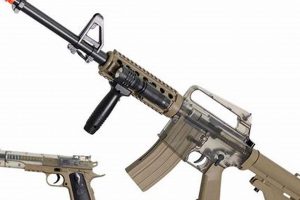
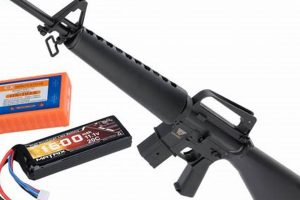
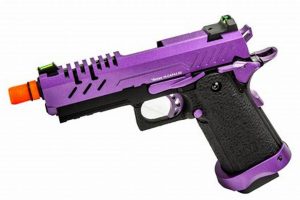
These replicas, often constructed from plastic or metal, propel spherical projectiles, typically 6mm in diameter, using compressed gas or spring mechanisms. Such devices are frequently utilized in recreational activities simulating tactical scenarios or target practice. One common example includes spring-powered pistols designed for casual backyard skirmishes.
Their value lies in providing a relatively safe and controlled environment for participants to engage in simulated combat, fostering teamwork, strategic thinking, and physical activity. Historically, these items have evolved from simple playthings to sophisticated training tools employed by law enforcement and military personnel in some contexts. This evolution highlights the growing recognition of their potential beyond mere entertainment.
The subsequent sections will delve into various aspects, encompassing safety considerations, different types available on the market, legal regulations governing their ownership and use, and the communities that have formed around the hobby. Detailed examination of these topics will offer a comprehensive understanding of this recreational activity.
Operational Guidance
The following suggestions are intended to enhance the safe and effective utilization of these devices in recreational or training environments.
Tip 1: Protective Gear is Paramount: Eye protection, specifically ANSI Z87.1 rated goggles, is absolutely essential. Facial injuries are a preventable risk. Full-face masks are recommended for enhanced safeguarding.
Tip 2: Adherence to Velocity Limits: Chronograph devices must be used to confirm adherence to established field velocity restrictions (typically measured in feet per second, FPS). Exceeding these limits jeopardizes the safety of all participants.
Tip 3: Safe Zones and Weapon Handling: Designate clearly defined safe zones where replicas are unloaded and magazines are removed. Muzzle awareness is crucial; never point the barrel at anything one is not prepared to engage.
Tip 4: Understand the Replica’s Operation: Familiarize oneself thoroughly with the specific mechanics of the chosen device, including loading, firing, and safety mechanisms. Misuse often stems from a lack of knowledge.
Tip 5: Consistent Communication: Employ clear and concise communication, especially call-out terminology during simulated engagements. This helps prevent accidental encounters and fosters a safe, organized environment.
Tip 6: Legal Compliance: Research and adhere to all applicable local, regional, and national regulations regarding ownership, transportation, and use. Ignorance of the law is not an acceptable defense.
Adherence to these practices significantly minimizes risk and cultivates a more enjoyable and responsible recreational experience.
The subsequent section will address the legal landscape surrounding these devices in greater detail.
1. Regulation
The legal framework governing these devices is complex and varies considerably across different jurisdictions. Understanding and adhering to these regulations is paramount for responsible ownership and use, preventing potential legal ramifications.
- Definition and Classification
Regulations frequently hinge on the classification of these items. Some jurisdictions categorize them as imitation firearms, subjecting them to laws governing real firearms, while others treat them as toys or sporting goods with separate, less stringent rules. This classification significantly influences the scope of permitted activities and ownership restrictions.
- Age Restrictions and Purchase Requirements
Many regions impose age restrictions on purchasing these devices, typically mirroring those for tobacco or alcohol. Additionally, some locations mandate background checks or permits for ownership, similar to firearms regulations. These measures aim to prevent misuse by minors and individuals with criminal records.
- Transportation and Storage Laws
Regulations often dictate how these items must be transported, frequently requiring them to be stored in cases or containers separate from ammunition or power sources. Public display is often prohibited to avoid alarming the public or being mistaken for a real firearm, which could trigger law enforcement intervention.
- Use Restrictions and Field Regulations
Specific regulations govern where these devices can be used. Many jurisdictions restrict their use to private property or designated airsoft fields. These fields often have their own rules regarding velocity limits, protective gear, and engagement distances to ensure participant safety and compliance with local ordinances.
Compliance with these diverse regulations is essential for responsible participation in the sport or hobby. Failure to adhere to applicable laws can result in fines, confiscation of the device, or even criminal charges. Thorough research and due diligence are therefore crucial for all owners and users of these devices.
2. Safety

The inherent nature of these devices, propelling projectiles at measurable velocities, necessitates a paramount emphasis on safety. A direct causal relationship exists between neglecting safety protocols and the potential for injuries, ranging from minor bruising to more severe ocular or dental trauma. The incorporation of robust safety measures is not merely a suggestion but a critical component of responsible usage. For example, the consistent use of ANSI Z87.1 rated eye protection is proven to drastically reduce the incidence of eye injuries during gameplay. Similarly, adherence to established velocity limits, verified through chronograph testing, minimizes the force of impact and reduces the risk of harm.
Practical significance of comprehensive safety protocols extends beyond individual well-being. Organized events and dedicated fields often mandate stringent safety rules to ensure a secure environment for all participants. These rules may include minimum engagement distances, restrictions on projectile types, and mandatory briefings before gameplay. Furthermore, responsible manufacturers and retailers prioritize safety by incorporating features such as orange tip markings to differentiate these devices from real firearms, thereby preventing potential misidentification by law enforcement or the public. Failure to adhere to these guidelines not only increases the risk of injury but can also result in expulsion from organized events or legal repercussions.
In summary, safety forms an indispensable cornerstone of responsible utilization. Challenges arise from user complacency, inadequate enforcement of safety regulations, and a lack of comprehensive education. Linking back to the broader theme of responsible ownership, a proactive approach to safety, characterized by consistent adherence to established protocols and continuous education, is essential for mitigating risks and fostering a safe, enjoyable experience for all participants.
3. Mechanics
The operational mechanics of these devices dictate their performance, reliability, and suitability for various applications. Different mechanisms propel projectiles, each exhibiting distinct advantages and disadvantages in terms of power, accuracy, and maintenance requirements. Understanding these mechanical principles is fundamental to informed selection and responsible use.
- Spring-Powered Systems
These systems utilize a pre-compressed spring to propel the projectile. Operation requires manual cocking before each shot, limiting rate of fire. Advantages include simplicity, affordability, and independence from external power sources. Disadvantages include lower power output compared to other systems and the necessity for manual operation before each shot. Examples include basic pistols and rifles often used for introductory play.
- Gas-Powered Systems
These systems utilize compressed gas, typically carbon dioxide (CO2) or green gas (propane with silicone lubricant), to propel the projectile. Operation can be semi-automatic or fully automatic, depending on the design. Advantages include higher power output and realistic recoil simulation in some models. Disadvantages include reliance on external gas sources, temperature sensitivity affecting performance, and potential for gas leaks. Examples include pistols and rifles designed for competitive play and realistic training simulations.
- Electric-Powered Systems (AEGs)
These systems utilize an electric motor, battery, and gearbox to power a piston that compresses air and propels the projectile. Operation is typically fully automatic or semi-automatic. Advantages include high rate of fire, consistent performance, and rechargeable power sources. Disadvantages include higher initial cost, complexity of internal components, and potential for battery failure. Examples include rifles and submachine guns used extensively in organized games and tactical scenarios.
- Hybrid Systems
Certain devices combine elements of multiple systems to achieve specific performance characteristics. For example, a system might use a gas-powered blowback mechanism coupled with an electric hop-up unit for improved range and accuracy. These systems often represent specialized designs catering to niche applications.
The choice of mechanical system significantly impacts the user experience, dictating the device’s capabilities and maintenance requirements. From the simplicity of spring-powered models to the complexity of electric-powered systems, each mechanism presents distinct trade-offs that influence its suitability for different play styles and environments. Careful consideration of these factors is essential for selecting the most appropriate device for a given application.
4. Maintenance

The operational longevity and consistent performance of these recreational devices are directly proportional to the diligence applied to regular maintenance. Neglecting upkeep can lead to malfunctions, reduced accuracy, and, in extreme cases, complete inoperability. The connection between maintenance and operational effectiveness is therefore not merely a suggestion but a fundamental requirement for responsible ownership. For example, internal components within gas-powered replicas require periodic lubrication to ensure proper sealing and smooth cycling, preventing gas leaks and maintaining consistent velocity. Similarly, cleaning the inner barrel of any projectile-launching device is essential for removing accumulated residue that can impair accuracy and reduce range.
Practical applications of proper maintenance extend beyond individual use. Organized airsoft fields often implement maintenance schedules for rental equipment to ensure safe and reliable operation for all participants. This can involve routine inspections, cleaning, and repairs performed by trained technicians. Furthermore, manufacturers typically provide maintenance guidelines and recommended service intervals in their product documentation. Adhering to these recommendations can extend the lifespan of the device and prevent voiding the warranty. A real-world example involves electric-powered (AEG) replicas, which require regular cleaning and lubrication of the gearbox to prevent premature wear and tear of the internal gears. Failure to do so can result in costly repairs or replacement of the entire gearbox assembly.
In summation, the proactive and consistent application of proper maintenance procedures is crucial for sustaining the operational integrity and maximizing the lifespan of these recreational devices. Challenges stem from user negligence, a lack of readily accessible maintenance resources, and the complexity of certain internal components. By prioritizing maintenance and adhering to manufacturer recommendations, users can mitigate risks, ensure consistent performance, and promote responsible ownership within the broader context of the hobby.
5. Community

The social structures surrounding these recreational devices are substantial, facilitating engagement, knowledge dissemination, and the establishment of norms. These communities, both online and offline, provide crucial platforms for enthusiasts, influencing practices and perceptions associated with these activities.
- Organized Play and Events
Local and regional organizations host events ranging from casual skirmishes to elaborate, multi-day simulations. These gatherings offer participants structured opportunities to engage in the activity, often incorporating specific rules, scenarios, and objectives. Such organized play fosters teamwork, strategic thinking, and adherence to safety regulations, reinforcing responsible conduct within the community.
- Online Forums and Discussion Groups
Numerous online platforms exist where enthusiasts share information, discuss equipment, and organize events. These forums serve as vital resources for newcomers seeking guidance on safety, maintenance, and legal regulations. Furthermore, these digital spaces facilitate the exchange of ideas and experiences, contributing to the ongoing evolution of the hobby.
- Manufacturers and Retailers as Community Hubs
Many manufacturers and retailers actively engage with the community by sponsoring events, providing technical support, and soliciting feedback on product development. This interaction fosters a sense of connection between consumers and businesses, promoting brand loyalty and shaping the industry’s direction. Furthermore, these entities often serve as conduits for disseminating safety information and promoting responsible usage.
- Mentorship and Skill Development
Experienced participants often mentor newer players, providing guidance on tactics, equipment, and ethical conduct. This mentorship is crucial for fostering a culture of responsible play and ensuring that newcomers are properly educated on safety regulations and community norms. Moreover, advanced players often share their knowledge through workshops and training sessions, contributing to skill development and promoting a higher level of expertise within the community.
These interconnected facets underscore the significant role community plays in shaping engagement with these devices. From organized events to online forums and mentorship programs, these social structures contribute to the development of responsible practices, the dissemination of knowledge, and the fostering of a shared passion for the activity.
6. Upgrades
The modification and enhancement of these devices represent a significant facet of the recreational activity. The availability of replacement parts and performance-enhancing components directly influences the achievable capabilities, reliability, and customization options. This potential for modification necessitates careful consideration of both the technical implications and ethical responsibilities associated with altering a manufactured product. For example, a spring-powered device can be upgraded with a stronger spring to increase projectile velocity, directly affecting its potential for causing injury. Conversely, precision inner barrels improve accuracy, enhancing target engagement without necessarily increasing the risk of harm. Such examples underscore the importance of understanding the ramifications of each modification.
Practical application of these upgrades extends from enhancing competitive performance to tailoring devices for specific roles within simulated combat scenarios. A common example involves upgrading an electric-powered system (AEG) with a high-torque motor and improved gear set to increase rate of fire and trigger response time, crucial for close-quarters engagements. Conversely, a designated marksman might focus on upgrading the hop-up unit and installing a longer, more precise inner barrel to improve accuracy at longer ranges. These modifications require a thorough understanding of the device’s internal mechanics and the potential impact on reliability and performance. Furthermore, the use of upgraded components often necessitates adjustments to other parts of the system to ensure compatibility and prevent premature wear.
In summary, the option for upgrades plays a vital role in extending the lifespan, performance, and personalization of these recreational devices. However, the potential for misuse or unintended consequences necessitates a responsible approach to modification. Challenges include ensuring compatibility between components, understanding the technical implications of alterations, and adhering to safety regulations. Linking back to the broader theme of responsible ownership, users must prioritize safety, ethical considerations, and a comprehensive understanding of the device’s mechanics when considering any modifications or enhancements.
Frequently Asked Questions Regarding Airsoft Devices
The subsequent section addresses common inquiries and clarifies misconceptions surrounding the use, safety, and legality of airsoft devices.
Question 1: What constitutes the primary distinction between these devices and actual firearms?
The fundamental differentiation resides in the projectile propelled. Airsoft devices utilize spherical plastic projectiles, typically 6mm in diameter, whereas firearms discharge lethal projectiles propelled by the rapid expansion of gases resulting from ignited gunpowder. The lower muzzle velocity and non-lethal projectiles of airsoft devices significantly reduce the potential for serious injury.
Question 2: Is the operation of these devices permissible in any location?
No. Usage is frequently restricted to private property with the owner’s explicit consent or designated airsoft fields. Discharge in public areas is generally prohibited due to safety concerns and the potential for misidentification with actual firearms, which could elicit law enforcement intervention.
Question 3: What protective equipment is deemed essential during these activities?
ANSI Z87.1 rated eye protection is mandatory to prevent potential ocular injuries. Full-face masks offer enhanced protection. Additional protective gear, such as vests and gloves, is recommended to minimize the risk of bruising and other minor injuries.
Question 4: How does one ensure adherence to established velocity limits?
A chronograph, a device that measures projectile velocity, must be used to verify compliance with field-specific restrictions, typically measured in feet per second (FPS). Exceeding velocity limits compromises participant safety and is strictly prohibited.
Question 5: What legal ramifications could result from misuse?
Misuse, including discharging these devices in unauthorized areas or modifying them to exceed legal velocity limits, can result in fines, confiscation of the device, or even criminal charges, depending on local regulations and the severity of the infraction.
Question 6: What role does community engagement play in responsible use?
Active participation in organized events and online forums facilitates knowledge sharing, promotes adherence to safety regulations, and fosters a culture of responsible conduct within the community. These social structures provide valuable resources for newcomers and experienced participants alike.
Understanding the nuances of these frequently asked questions contributes to a safer and more responsible approach to the utilization of airsoft devices.
The subsequent section will provide a concluding summary, consolidating key insights and reinforcing responsible ownership principles.
Toy Gun Airsoft
This exploration has illuminated the multifaceted nature of toy gun airsoft, ranging from its operational mechanics and safety protocols to the complex legal landscape and the vibrant communities that surround it. Key aspects emphasized include the critical importance of protective gear, adherence to velocity limits, and compliance with all applicable regulations. Understanding the nuances of different propulsion systems, maintaining equipment properly, and engaging responsibly within the community are also vital components of safe and ethical participation.
The information presented underscores that responsible ownership transcends mere possession. It demands informed decision-making, diligent maintenance, and a steadfast commitment to safety and legal compliance. As the technology and popularity of toy gun airsoft continue to evolve, a proactive and educated approach is paramount to ensuring its continued acceptance and responsible utilization within society.