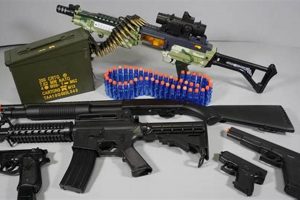
The construction of projectile-launching devices from readily available materials, intended to replicate the function of commercially manufactured airsoft replicas, involves a range of construction techniques. These projects generally aim to propel small, typically 6mm plastic pellets using compressed air or elastic force. Examples include designs incorporating PVC piping, repurposed springs, and rudimentary trigger mechanisms.
Engaging in such construction can be seen as an exercise in practical engineering and resourcefulness, allowing individuals to explore fundamental principles of mechanics and pneumatics. Historically, similar projects have served as learning tools and demonstrated an understanding of basic physics. However, it is crucial to recognize the potential dangers and legal ramifications associated with creating devices that project objects. Many jurisdictions have strict regulations regarding the manufacture and use of such items, especially if they can be mistaken for or modified to function as real firearms. Safety considerations are paramount, as improperly constructed devices may malfunction, causing injury to the user or others.
The following information will outline the general principles often employed in these types of projects, emphasizing the importance of responsible construction and awareness of potential risks and legal constraints. It is essential to prioritize safety and adhere to all applicable laws and regulations throughout any such endeavor.
Construction Considerations for Improvised Projectile Launchers
The following points offer critical guidance regarding the undertaking of constructing a device with capabilities similar to a manufactured airsoft replica. These considerations highlight potential challenges and areas where attention is paramount.
Tip 1: Material Selection: The choice of materials significantly impacts the device’s performance and durability. PVC piping, while readily available, may not withstand high pressure. Springs should be chosen based on their compression rate and resistance to fatigue. The selected materials should ideally resist degradation from common environmental factors.
Tip 2: Pressure Regulation: A method for controlling the release of compressed gas is essential for consistent performance and safety. Over-pressurization can lead to material failure and potential injury. Consider integrating a pressure relief valve or a controlled release mechanism.
Tip 3: Projectile Compatibility: Ensure the projectile is appropriately sized for the barrel diameter to achieve optimal velocity and accuracy. Using projectiles that are too large may cause the mechanism to jam, while projectiles that are too small will result in reduced performance.
Tip 4: Sealing Techniques: Air leaks will drastically reduce the device’s power and efficiency. Apply appropriate sealing methods, such as Teflon tape or rubber O-rings, at all connection points. Regularly inspect seals for wear and tear.
Tip 5: Trigger Mechanism Design: The trigger should be designed for reliable and predictable activation. A simple lever system can be employed, but must be carefully constructed to prevent accidental discharge. Safety mechanisms should be incorporated to mitigate the risk of unintentional firing.
Tip 6: Legal and Ethical Compliance: Before initiating any construction, research and understand the local laws regarding such devices. Consider the ethical implications of creating potentially harmful objects and prioritize responsible use and storage.
Tip 7: Safety Protocols: Implement stringent safety measures during construction and operation. Wear appropriate eye protection and handle the device with extreme care. Never point the device at any person or object that could be damaged or harmed.
Adhering to these guidelines can potentially minimize risks and enhance understanding of the underlying principles. Prioritizing safety and responsible practices is critical throughout the entire process.
This information should be considered as a starting point for further research and diligent adherence to safety and regulatory mandates.
1. Air compression source
The air compression source is a pivotal element in the functionality of any improvised projectile device intended to replicate the operation of a manufactured airsoft replica. The method by which air is compressed and subsequently released determines the velocity and range of the projectile, thereby directly affecting the overall performance of the device.
- Spring-Piston Mechanism
This mechanism employs a spring-loaded piston within a cylinder. When the trigger is activated, the spring propels the piston forward, compressing air in front of it and forcing the projectile out of the barrel. Examples include designs using repurposed bicycle pumps or modified air cylinders. The strength and travel distance of the spring dictate the potential air pressure and, consequently, the projectile’s velocity.
- Elastic Band Propulsion
Elastic bands, such as those found in slingshots or surgical tubing, can be used to create a rudimentary propulsion system. The elastic band is stretched and then released, transferring its stored energy to the projectile. The thickness and elasticity of the band directly influence the projectile’s velocity. Simple, hand-held designs are common applications of this method.
- Pneumatic Accumulation
This system involves pre-compressing air in a reservoir, such as a sealed PVC pipe, using an external pump. Upon trigger activation, a valve releases the compressed air behind the projectile. The pressure within the reservoir, combined with the valve’s opening speed, determines the projectile’s acceleration and range. Designs often incorporate pressure gauges and release valves for safety and control.
- Manual Bellows System
A bellows system relies on the manual compression of air via a flexible chamber. Compressing the bellows forces air into the barrel behind the projectile. The force and speed with which the bellows are compressed directly influence the projectile’s velocity. Examples include designs utilizing repurposed camera bellows or inflatable toy components.
The selection of an appropriate air compression source necessitates a careful evaluation of factors such as material availability, desired performance characteristics, and safety considerations. Each method presents unique challenges and limitations that must be addressed to achieve a functional and reasonably safe device. Proper construction techniques and safety precautions are critical regardless of the chosen compression method.
2. Projectile trajectory control

Effective projectile trajectory control is a critical factor in determining the functionality and utility of any improvised projectile device designed to emulate the characteristics of a commercial airsoft replica. Achieving a predictable and accurate trajectory requires careful consideration of several design elements and construction techniques.
- Barrel Material and Smoothness
The barrel material, typically rigid tubing, must be smooth and consistent in diameter to minimize friction and ensure a consistent path for the projectile. Irregularities or imperfections in the barrel’s inner surface can impart unintended spin or deviations, resulting in unpredictable flight paths. Examples include polished PVC or metal tubing, selected for their dimensional stability. The interior finish quality directly correlates to the predictability of the projectile’s flight.
- Barrel Length Optimization
The length of the barrel influences the duration of the force applied to the projectile. A barrel that is too short may not allow for complete acceleration, while a barrel that is excessively long can introduce friction and reduce velocity. Optimal barrel length is typically determined empirically through experimentation and is dependent on the air compression mechanism and projectile weight. Precision barrel length contributes significantly to consistent trajectory.
- Projectile Weight and Shape Standardization
Variations in projectile weight and shape will directly affect aerodynamic properties and flight characteristics. Consistent projectile specifications, such as weight and spherical uniformity, are necessary for achieving repeatable trajectories. Commercially available airsoft BBs are designed for this purpose, but using inconsistent or irregularly shaped projectiles will introduce significant variations in flight path. Standardized projectiles ensure predictability.
- Aerodynamic Stabilization Methods
Certain design modifications can enhance projectile stability during flight. Rifling, or internal grooves within the barrel, imparts spin to the projectile, which gyroscopically stabilizes it and reduces the effects of external forces like wind. While complex to implement in improvised devices, analogous methods like external fins or strategically placed weights can improve stability. Improved aerodynamics minimizes deviation from the intended path.
The effectiveness of these trajectory control elements is inextricably linked to the overall design of the projectile device. While achieving the precision and consistency of commercially manufactured airsoft replicas is challenging, careful attention to these factors can significantly improve the accuracy and predictability of improvised devices, ultimately influencing their usefulness and safety.
3. Trigger mechanism safety

The trigger mechanism is a critical sub-system in any improvised projectile device, and its safety is of paramount importance. A poorly designed or constructed trigger can lead to unintended discharges, posing a significant risk of injury. The connection between trigger mechanism safety and the overall process of crafting a device of this type is one of direct cause and effect. An unsafe trigger directly causes the potential for accidental harm. The trigger’s role is to reliably initiate projectile launch only when intended, therefore its safe operation is a fundamental design requirement. For example, a trigger lacking a positive engagement can be jarred or vibrated into releasing the projectile, especially concerning devices utilizing stored pneumatic energy. Failure to address trigger safety negates any potential benefit from the device’s functionality.
In practical applications, trigger safety is achieved through several design elements. These include incorporating a trigger block or safety catch that physically prevents the trigger from being activated unless disengaged by the user. Over-travel stops limit trigger movement beyond the firing point, preventing damage to the mechanism and ensuring consistent operation. Trigger pull weight, the amount of force required to activate the trigger, is a crucial consideration. A trigger pull that is too light can increase the risk of accidental discharge, while one that is too heavy can hinder accurate aiming. Real-world examples from existing firearm safety designs, such as those involving a transfer bar or a drop safety, can be adapted, albeit often in simplified forms, to enhance the safety of improvised mechanisms. Careful thought must go into the practical constraints of the available materials and skills, while never compromising the core function of preventing accidental discharge.
In summary, trigger mechanism safety is not merely an ancillary consideration but an integral aspect of responsible design and construction. The challenges inherent in replicating complex mechanisms from limited resources are significant, and require a focus on simplified designs that nonetheless prioritize safety over other features such as rate of fire or trigger feel. The ramifications of neglecting this area extend far beyond the functionality of the device, underscoring the necessity for comprehensive safety measures. This emphasis on trigger mechanism integrity reflects the ethical responsibility associated with the entire construction process.
4. Material structural integrity
Material structural integrity is paramount in the context of constructing improvised projectile devices. The selection and application of suitable materials directly determine the device’s ability to withstand internal pressures and external stresses, influencing its reliability, longevity, and, most critically, the safety of both the operator and bystanders.
- Pressure Vessel Containment
Components intended to contain compressed air or gas must possess adequate tensile strength and resistance to bursting. Materials such as thin-walled PVC piping, if subjected to pressures exceeding their design limitations, can catastrophically fail, resulting in fragmentation and potential injury. The safe operational pressure of the chosen materials must be rigorously calculated and adhered to. For example, Schedule 40 PVC, while commonly available, possesses specific pressure ratings that decrease with increasing temperature. Exceeding these ratings compromises structural integrity.
- Impact Resistance of Load-Bearing Components
Parts that experience direct impact or stress during operation, such as the trigger mechanism or projectile retention system, necessitate materials capable of withstanding repeated forces without deformation or fracture. Brittle materials, such as some types of inexpensive plastics, are prone to failure under sudden stress, leading to malfunction or breakage. Stronger polymers, metals, or reinforced composites are often preferred for these critical components. Real-world parallels include the use of hardened steel in firearm triggers and sears to resist wear and prevent accidental discharge.
- Environmental Degradation Considerations
Exposure to environmental factors, such as ultraviolet radiation, moisture, and temperature fluctuations, can significantly compromise the structural integrity of certain materials over time. PVC, for example, becomes brittle and susceptible to cracking upon prolonged exposure to sunlight. Metal components can corrode if not properly protected. Material selection must account for anticipated environmental conditions to ensure the device’s continued safe operation. This may involve applying protective coatings or selecting materials inherently resistant to degradation.
- Fastener Strength and Joint Integrity
The methods used to join components, such as adhesives, screws, or welds, must be robust enough to withstand the forces generated during operation. Weak or improperly executed joints can become points of failure, leading to separation of components and potential hazards. Adhesive selection must consider material compatibility and shear strength, while mechanical fasteners must be properly sized and torqued. Welding, if employed, requires specialized skills and equipment to ensure adequate penetration and fusion of the materials. The overall structural integrity is only as strong as its weakest joint.
These facets highlight the direct correlation between material selection and the safe and reliable operation of improvised projectile devices. A comprehensive understanding of material properties and their limitations is essential for minimizing risks and maximizing the device’s functional lifespan. Neglecting material structural integrity undermines all other design considerations and introduces unacceptable safety hazards into the process.
5. Sealing effectiveness design
Sealing effectiveness design is a critical factor influencing the performance of improvised projectile devices. The ability to contain and direct compressed air or gas is fundamental to achieving the desired velocity and range. Losses due to inadequate sealing directly translate to diminished performance and potential operational inconsistencies.
- Piston-Cylinder Interface Sealing
In designs employing a piston-cylinder arrangement for air compression, the interface between these components must provide a tight seal to prevent leakage during the compression stroke. O-rings or other flexible sealing elements are commonly used. Material selection is critical, as the seal must withstand repeated compression cycles and resist wear from friction. Real-world examples include the use of specialized polymers in pneumatic cylinder seals to maintain integrity under high pressure and dynamic conditions. Poor sealing leads to reduced compression efficiency and decreased projectile velocity.
- Valve Seat Sealing
Valve seat sealing is essential for maintaining pressure within the reservoir until the trigger is activated. Imperfect sealing at the valve seat results in pressure bleed-off, reducing the force available to propel the projectile. Precision machining and lapping techniques are often employed to ensure a tight seal between the valve and its seat. Examples include the use of conical valve designs, which provide a self-centering effect to enhance sealing. Leakage at the valve seat diminishes performance and can cause inconsistent firing.
- Threaded Connection Sealing
Threaded connections, commonly found in improvised devices utilizing PVC or metal piping, require effective sealing to prevent air leaks. Teflon tape or liquid thread sealants are typically applied to the threads to fill microscopic gaps and create an airtight seal. Proper application technique is crucial, as over-tightening can damage the threads and compromise the seal’s integrity. Analogous sealing methods are widely used in plumbing and industrial piping systems to prevent leaks under pressure. Inadequate sealing at threaded connections reduces overall efficiency and creates potential safety hazards.
- Projectile Retention Sealing
The seal around the projectile before firing directly affects efficiency. A loose fit allows air to escape around the projectile, reducing the force applied to it. Precisely sized barrels and projectile retention methods, such as rubber washers or detents, are employed to minimize air leakage. The projectile must fit snugly enough to prevent air loss but not so tightly that it impedes smooth acceleration. Achieving this balance is crucial for maximizing projectile velocity and range. Compromised projectile retention sealing diminishes energy transfer and affects accuracy.
The design of effective sealing methods is integral to optimizing the performance of improvised projectile devices. Addressing sealing challenges throughout the system enhances efficiency, consistency, and safety. The application of appropriate sealing techniques, coupled with careful material selection and precise construction, is essential for maximizing the potential of such projects and avoiding performance-limiting air losses.
6. Legal compliance

Legal compliance, within the context of constructing improvised projectile devices analogous to commercial airsoft replicas, represents a complex intersection of regulatory frameworks and ethical responsibilities. Adherence to applicable laws and regulations is paramount to mitigating potential legal ramifications and ensuring responsible construction and operation.
- Federal and State Firearms Regulations
Many jurisdictions have specific laws governing the manufacture, possession, and use of firearms, including those that may be construed to encompass devices capable of launching projectiles. Constructing a device that closely resembles a firearm, even if intended for non-lethal purposes, can potentially trigger these regulations. For example, devices that can be readily converted to expel a projectile by the action of an explosive may be classified as firearms under federal law. Understanding and complying with these regulations is critical to avoiding legal penalties.
- Airsoft-Specific Legislation
Some states and municipalities have enacted specific legislation pertaining to airsoft guns, including regulations regarding their sale, transportation, and use. These laws often prescribe minimum age requirements, permissible locations for use, and restrictions on modifications that could increase the device’s power or realism. Failure to comply with airsoft-specific laws can result in fines, confiscation of the device, or other legal consequences. It is imperative to be aware of and adhere to any such regulations in the relevant jurisdiction.
- Public Nuisance and Disorderly Conduct Laws
Even if a device does not meet the legal definition of a firearm or airsoft gun, its use in public areas can potentially violate public nuisance or disorderly conduct laws. Discharging a projectile in a manner that causes alarm, endangers others, or disrupts public order can result in criminal charges or civil liability. Responsible use of the device, in designated areas and with appropriate safety precautions, is essential to avoiding such legal repercussions. Examples of such violations would include discharging the device in a crowded public park or residential area.
- Product Liability and Negligence
Individuals who construct and utilize improvised projectile devices may be subject to product liability or negligence claims if the device malfunctions and causes injury or damage. If the device is constructed negligently or without adequate safety features, the builder may be held liable for any resulting harm. Proper design, construction, and testing are essential to minimizing the risk of product liability claims. This would include ensuring the device incorporates safety mechanisms to prevent accidental discharge and using materials that are appropriate for the intended application.
These legal considerations underscore the necessity of conducting thorough research and seeking legal counsel when contemplating the construction of improvised projectile devices. Understanding and complying with all applicable laws and regulations is paramount to mitigating potential legal risks and promoting responsible and ethical conduct. Disregarding these considerations can lead to serious legal and personal consequences.
Frequently Asked Questions
The following questions address common inquiries and potential misconceptions regarding the construction and use of devices intended to replicate the function of commercially manufactured airsoft replicas. The information provided is for informational purposes only and does not constitute legal advice.
Question 1: Is constructing such a device legal?
The legality of constructing a device capable of launching projectiles varies significantly based on jurisdiction. Federal, state, and local laws may regulate the manufacture, possession, and use of such devices, potentially classifying them as firearms or imposing restrictions on their use in public areas. Prior to construction, thorough research of all applicable laws is essential.
Question 2: What materials are suitable for constructing the pressure vessel?
Materials used for containing compressed air or gas must possess adequate tensile strength and resistance to bursting. Common materials such as PVC piping may be unsuitable for high-pressure applications. The safe operational pressure of the chosen material must be rigorously calculated, and safety factors must be applied to account for potential material degradation or imperfections.
Question 3: What safety precautions should be implemented during construction and operation?
Stringent safety measures are critical throughout the construction and operation of improvised projectile devices. These include wearing appropriate eye protection, ensuring a safe testing environment free from bystanders, and implementing a functional trigger safety mechanism to prevent accidental discharge. Safe handling practices must be consistently enforced.
Question 4: How can projectile trajectory be controlled effectively?
Effective projectile trajectory control requires careful consideration of barrel material and smoothness, barrel length optimization, projectile weight and shape standardization, and potentially, aerodynamic stabilization methods. Minimizing friction, ensuring consistent projectile specifications, and potentially imparting spin to the projectile can improve accuracy and predictability.
Question 5: What are the potential consequences of accidental discharge?
Accidental discharge of an improvised projectile device can result in serious injury to the operator or bystanders. Projectiles propelled with sufficient force can cause eye injuries, lacerations, and other forms of bodily harm. In addition to physical injuries, accidental discharge can also lead to legal repercussions, including criminal charges and civil liability.
Question 6: What ethical considerations should be taken into account?
Ethical considerations are paramount. The potential misuse of improvised projectile devices necessitates a responsible and ethical approach. Constructing such devices with the intent to cause harm or disrupt public order is ethically reprehensible. Proper storage, responsible handling, and adherence to all applicable laws and regulations are essential to ethical use.
This FAQ highlights critical aspects of the construction and operation of improvised projectile devices. Strict adherence to safety protocols, thorough legal research, and a strong ethical framework are essential for responsible engagement with these types of projects.
The following section will delve into [Next Section Topic].
Concluding Remarks on Improvised Projectile Device Construction
This exposition has delineated critical elements associated with the construction of devices intended to replicate the functionality of commercially available airsoft replicas. The examination encompassed material selection, pressure regulation, projectile compatibility, sealing techniques, trigger mechanism design, legal and ethical compliance, and safety protocols. Each of these factors directly influences the device’s performance, reliability, and the potential for harm. An understanding of these principles is essential for informed decision-making concerning such endeavors.
While the prospect of creating a functional projectile device from readily available materials may present an appealing exercise in ingenuity, potential builders must acknowledge the significant safety risks and legal ramifications inherent in such activities. A responsible approach necessitates thorough research, meticulous planning, and unwavering adherence to all applicable regulations. The information provided herein serves as a cautionary guide, emphasizing the importance of informed judgment and the potential consequences of disregarding safety and legal considerations in the pursuit of such projects. The construction of any device with the potential for harm should be undertaken only with the utmost deliberation and a full awareness of the associated responsibilities.