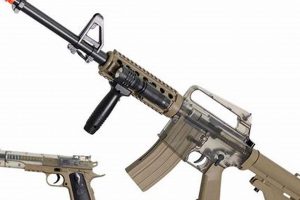
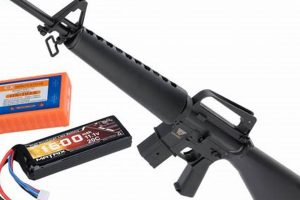
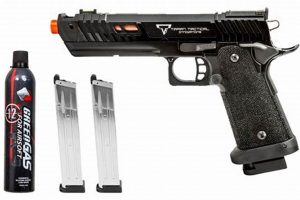
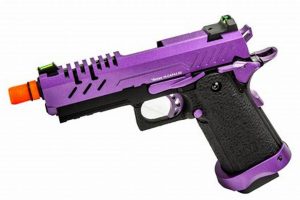
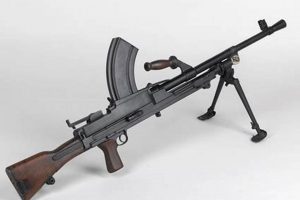
Entry-level airsoft weaponry represents a category of recreational implements designed for novice participants. These devices, typically spring-powered or electric-powered, prioritize ease of use, affordability, and safety. An illustrative example would be a polymer-bodied electric rifle with a low rate of fire and adjustable hop-up.
The acquisition of appropriate initial equipment is critical for a positive introduction to the sport. It allows players to develop fundamental skills, familiarize themselves with safety protocols, and experience simulated combat scenarios without a substantial financial investment. Historically, the availability of accessible and reliable equipment has expanded the participant base and contributed to the growing popularity of airsoft as a recreational activity.
Subsequent sections will explore factors influencing equipment selection, including power source options, common designs, and essential safety considerations for individuals beginning their involvement in the simulated combat sport.
Essential Guidelines for Selecting Initial Airsoft Equipment
The following directives offer guidance in the selection process, aimed at ensuring a beneficial and secure introduction to the sport.
Tip 1: Prioritize Safety Equipment: Before considering weaponry, procure essential protective gear. Eye protection, specifically ANSI Z87.1 rated goggles or a full face mask, is non-negotiable. Neglecting this aspect poses a significant risk of ocular injury.
Tip 2: Begin with Electric (AEG) or Spring-Powered Options: These variants are generally more user-friendly and require less maintenance compared to gas-powered counterparts. AEGs provide consistent performance and are suitable for various engagement distances, while spring-powered models offer a simplified operating mechanism.
Tip 3: Consider Weight and Ergonomics: Select a model that is manageable in terms of weight and comfortable to hold. Extended gameplay necessitates a weapon that does not induce undue fatigue.
Tip 4: Evaluate Magazine Capacity: Opt for a model with a magazine capacity that aligns with the intended style of play. A larger capacity can reduce the frequency of reloading during simulated combat scenarios.
Tip 5: Understand Hop-Up Systems: Familiarize oneself with the concept of hop-up, a mechanism that imparts backspin to projectiles, increasing range and accuracy. Many models feature adjustable hop-up systems for fine-tuning performance.
Tip 6: Research Reputable Brands: Investigate established manufacturers known for producing reliable and durable equipment. Customer reviews and online forums can provide valuable insights into product quality and performance.
Tip 7: Budget Wisely: Allocate resources prudently, prioritizing essential features and build quality over purely aesthetic considerations. Entry-level models are available at various price points, allowing for a balance between affordability and performance.
Adhering to these guidelines contributes to a safe, enjoyable, and productive initiation into the airsoft sport. Focus should remain on familiarizing oneself with the fundamental aspects of the activity before pursuing more advanced or specialized equipment.
Subsequent discourse will address maintenance procedures and further considerations for enhancing the performance and longevity of equipment.
1. Affordability

Affordability serves as a primary determinant in the accessibility and adoption of entry-level airsoft equipment. Its influence extends across various facets of the purchase decision, impacting the overall experience for new participants.
- Price Point and Initial Investment
The initial cost represents a significant barrier for individuals considering participation in airsoft. A lower price point increases the likelihood of adoption, as it reduces the financial risk associated with trying a new hobby. Entry-level models are often priced to be accessible to a wider audience.
- Lifecycle Costs and Maintenance
Affordability encompasses not only the initial purchase but also the ongoing expenses associated with maintenance and consumables. Equipment requiring frequent repairs or specialized ammunition can negate the benefits of a lower initial price. A focus on durability and readily available parts contributes to long-term affordability.
- Value Proposition and Feature Set
The value proposition of an entry-level model is determined by the features offered relative to its price. A product that provides a reasonable level of performance, reliability, and safety features at a competitive price point represents a strong value proposition. Balancing essential features with cost considerations is crucial.
- Market Competition and Availability
A competitive marketplace, characterized by a variety of affordable options, benefits consumers by driving down prices and increasing choice. Widespread availability through online retailers and local stores further enhances accessibility and affordability.
The interplay of these factors dictates the overall affordability and attractiveness of introductory airsoft equipment. A focus on delivering a well-balanced product that prioritizes value, durability, and reasonable lifecycle costs is essential for encouraging participation and fostering a positive experience for new entrants to the sport.
2. Ease of Use

Ease of use is a critical attribute of effective initial airsoft implements. The operational simplicity directly impacts a novice participant’s ability to quickly grasp the fundamentals of the sport and participate meaningfully in simulated combat scenarios. Complex mechanisms or intricate maintenance procedures can create frustration and hinder the learning process. A model characterized by straightforward operation, clear instructions, and minimal setup requirements fosters a more positive and engaging experience. For example, a spring-powered rifle requiring manual cocking before each shot, while simple in design, may become tiresome for extended use compared to an electric-powered automatic rifle (AEG) with a simple on/off switch and easily replaceable battery.
The connection between operational simplicity and user experience is further exemplified by the design of magazine loading mechanisms and hop-up adjustment systems. A difficult-to-load magazine can disrupt gameplay, especially for inexperienced users. Similarly, a complex hop-up system requiring specialized tools or extensive adjustments can be a deterrent. Models incorporating user-friendly features, such as speed loaders for magazines and easily accessible hop-up adjustment dials, promote a more seamless and enjoyable introductory experience. Furthermore, readily available online tutorials and support resources addressing common operational questions contribute to a heightened sense of user-friendliness.
In summary, the integration of user-friendly design elements is essential for optimizing the introductory airsoft experience. Models prioritizing simplicity in operation, maintenance, and adjustment promote a smoother learning curve, reduce frustration, and encourage continued participation in the sport. Overly complex or cumbersome equipment can deter novice players, highlighting the practical significance of prioritizing ease of use when selecting equipment for entry-level participants.
3. Safety Features

The integration of appropriate safety features is a critical consideration in the selection of viable introductory airsoft equipment. These features are designed to mitigate risks associated with the activity, protecting participants and promoting responsible usage.
- Adjustable Velocity Systems
Adjustable velocity systems permit the regulation of projectile muzzle velocity, typically measured in feet per second (FPS). This feature allows users to comply with field regulations and adjust equipment performance based on engagement distance, minimizing the potential for injury. A model lacking this capability presents a heightened risk of overshooting and causing harm.
- Clear Barrel Markings and Safety Indicators
Distinctive markings, such as brightly colored barrel tips, and visible safety indicators serve as visual cues to distinguish airsoft equipment from actual firearms. These markings aid in preventing accidental misuse and reduce the risk of misidentification by law enforcement or the general public. The absence of such markings can lead to dangerous misunderstandings and potential legal ramifications.
- Functional Safety Mechanisms
Functional safety mechanisms, including trigger locks and selector switches, prevent accidental discharge. A reliable safety mechanism ensures that the equipment remains in a safe state when not actively engaged, reducing the potential for unintended injury. Malfunctioning or absent safety mechanisms introduce a significant risk of accidental firing.
- Protective Gear Compatibility
The design of equipment should be compatible with commonly used protective gear, such as face masks and eye protection. Attachment points and ergonomic considerations should accommodate the use of safety equipment without hindering operation or compromising user comfort. Incompatible design may discourage the use of necessary protective measures.
The aforementioned safety attributes contribute to a safer and more responsible airsoft environment. Models incorporating these features demonstrate a commitment to user safety and promote ethical conduct within the sport. Conversely, the absence of appropriate safety mechanisms can expose participants to unnecessary risks and undermine the overall integrity of the activity. Selection of a suitable model necessitates careful evaluation of implemented safety measures.
4. Durability
Durability is a fundamental attribute influencing the efficacy of entry-level airsoft implements. The correlation between construction quality and longevity significantly impacts the user experience, particularly for novice participants. Inadequate durability results in equipment failure, necessitating repairs or replacements, thereby increasing long-term costs and diminishing the initial enjoyment of the sport. For instance, a rifle constructed with low-grade plastic components is susceptible to breakage during routine use or accidental impacts, hindering the learning process and dissuading continued participation.
The significance of robust construction extends beyond mere cost considerations. Reliable implements contribute to a safer environment by minimizing the risk of malfunctions that could lead to unintended consequences. Examples include gearboxes failing mid-operation, magazines prematurely ejecting, or barrels fracturing during projectile expulsion. Selecting a model manufactured with reinforced components and subjected to rigorous quality control measures mitigates these potential hazards. Furthermore, durable equipment better withstands the rigors of outdoor gameplay, including exposure to varying weather conditions and rough terrain, ensuring consistent performance over extended periods.
In summary, the integration of robust materials and sound construction practices is paramount in defining the viability of introductory airsoft equipment. A commitment to durability translates to a more reliable, cost-effective, and safer experience for new participants, fostering a positive introduction to the sport and encouraging continued engagement. Neglecting this crucial aspect compromises the overall value proposition and undermines the intended benefits of accessible entry-level weaponry.
5. Effective Range

The concept of effective range is a crucial performance metric influencing the utility of entry-level airsoft implements. Effective range denotes the distance within which a projectile fired from a device maintains sufficient kinetic energy and trajectory stability to reliably impact a target. The correlation between effective range and suitability as a viable entry-level model lies in its direct impact on participant engagement and learning progression.
Equipment with a restricted effective range limits engagement opportunities and restricts the development of fundamental skills. An example illustrating this point involves two novice players, one equipped with a device exhibiting a 50-foot effective range, and the other with a device exhibiting a 100-foot effective range. The player possessing the equipment with the extended range is inherently capable of engaging targets at a greater distance, offering a more comprehensive gameplay experience and fostering a greater understanding of trajectory, windage, and aiming techniques. Therefore, an adequate effective range is essential for allowing new players to participate effectively within typical field environments.
Selecting equipment exhibiting a suitable effective range represents a vital aspect of providing a beneficial and engaging introductory airsoft experience. While extreme long-range capabilities are not a necessity for novice participants, equipment offering sufficient range to participate effectively in common field scenarios is critical. Striking a balance between range, accuracy, and safety, while maintaining affordability and ease of use, is key to identifying equipment that effectively caters to the needs of beginner participants, maximizing their ability to learn and enjoy the simulated combat experience. A model exhibiting an excessively long or unsafe range, conversely, fails to meet the essential criteria associated with suitability as introductory equipment.
Frequently Asked Questions
The following section addresses common inquiries regarding the selection, maintenance, and safe usage of entry-level airsoft equipment, providing concise and informative answers based on established practices and safety guidelines.
Question 1: What constitutes a suitable projectile velocity (FPS) for introductory airsoft equipment?
Suitable projectile velocity is dependent upon field regulations and engagement distances. Generally, velocities ranging from 300 to 350 FPS with 0.20g BBs are acceptable for introductory models. It is imperative to adhere to site-specific velocity limits and prioritize safety.
Question 2: Is gas-powered equipment appropriate for beginners?
Gas-powered equipment, while offering enhanced realism and performance potential, generally necessitates more maintenance and technical expertise. Spring-powered or electric (AEG) equipment is typically recommended for beginners due to their ease of use and reduced maintenance requirements.
Question 3: How often should entry-level airsoft equipment undergo maintenance?
Maintenance frequency is contingent on usage and environmental conditions. Equipment should be cleaned and lubricated after each use. Periodic inspection of internal components and magazine functionality is also advised. Refer to manufacturer guidelines for detailed maintenance procedures.
Question 4: What essential safety gear is required for participation in airsoft?
Eye protection, specifically ANSI Z87.1 rated goggles or a full-face mask, is non-negotiable. Additional protective gear, such as face protection, gloves, and appropriate footwear, is strongly recommended to mitigate potential injuries.
Question 5: How should equipment be stored when not in use?
Equipment should be stored in a secure location, inaccessible to unauthorized individuals, particularly minors. It should be unloaded, with the magazine removed and the safety engaged. Protective cases or bags are recommended to prevent damage during storage.
Question 6: What are the key differences between spring-powered and electric (AEG) equipment?
Spring-powered equipment requires manual cocking before each shot, offering a single-shot firing mechanism. Electric (AEG) equipment utilizes a battery-powered motor to automatically cycle the firing mechanism, enabling semi-automatic and fully automatic firing modes. AEGs generally provide a higher rate of fire and require less physical exertion.
In summation, responsible acquisition, maintenance, and usage of initial implements is paramount for a constructive introduction to simulated combat activities. Adhering to recommended safety protocols and maintaining operational readiness maximizes player enjoyment and minimizes risk.
The subsequent section will delve into advanced equipment options and modifications for experienced participants seeking to enhance their competitive performance.
Concluding Remarks on Initial Airsoft Equipment
The preceding discourse has examined various facets pertaining to appropriate entry-level airsoft weaponry. The selection process necessitates careful consideration of factors including affordability, ease of operation, integrated safety features, overall durability, and practical effective range. A balanced approach, prioritizing these aspects, is crucial for facilitating a positive and secure introduction to the activity. Failure to adequately address these considerations may result in equipment malfunction, reduced enjoyment, or, in more severe circumstances, preventable injuries.
Ultimately, the responsible acquisition and utilization of suitable equipment contributes to the sustainable growth and ethical practice of simulated combat sports. Continued emphasis on safety protocols, equipment maintenance, and adherence to established regulations remains paramount for ensuring the continued accessibility and integrity of this recreational activity. The informed selection of initial equipment is a foundational step towards fostering a lasting and responsible engagement with airsoft.