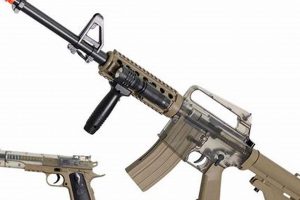
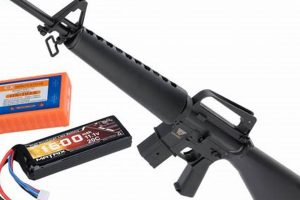
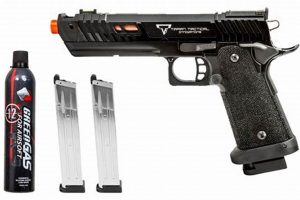
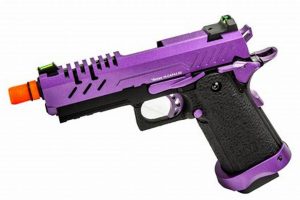
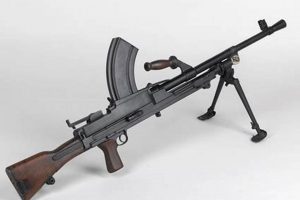
The application of personalized designs and color schemes to airsoft replicas enhances their aesthetic appeal and provides a unique visual signature. This process involves using specialized paints and techniques to alter the factory finish of the airsoft gun. Examples include camouflage patterns, vibrant color combinations, or replicating battle-worn aesthetics.
Applying personalized coloration to these items serves multiple purposes. It allows individual expression and differentiation within the airsoft community. Moreover, distinct finishes can improve concealment in diverse environments, providing a tactical advantage during gameplay. Historically, applying patterns to weaponry dates back centuries, used initially for camouflage and later evolving into artistic expression.
The subsequent sections will delve into specific painting techniques, required materials, safety precautions, and design considerations relevant to achieving high-quality, durable, and visually appealing results on airsoft replicas.
Custom Airsoft Gun Paint Jobs
Achieving a professional and durable finish on airsoft replicas requires careful planning, execution, and adherence to best practices. The following tips are designed to guide individuals through the process, ensuring optimal results and longevity of the custom paint application.
Tip 1: Disassemble Thoroughly: Prior to any painting, completely disassemble the airsoft gun. This allows access to all surfaces and prevents paint from interfering with internal mechanisms. Document the disassembly process with photographs to aid in reassembly.
Tip 2: Surface Preparation is Paramount: Thoroughly clean and degrease all surfaces to be painted. Use a specialized degreaser designed for plastics and metals. Sanding the surface lightly with fine-grit sandpaper (e.g., 400-600 grit) enhances adhesion.
Tip 3: Apply a Primer Coat: Utilize a primer specifically formulated for the material of the airsoft gun (e.g., plastic or metal primer). Primer provides a uniform base for the color coats and improves paint adhesion, preventing chipping and peeling.
Tip 4: Employ Thin, Multiple Coats: Apply paint in thin, even layers to avoid runs and drips. Allow each coat to dry completely before applying the next. Multiple thin coats result in a more durable and visually appealing finish than a single thick coat.
Tip 5: Stencil Application Techniques: For camouflage patterns or intricate designs, use high-quality stencils. Ensure stencils are securely adhered to the surface to prevent paint bleed. Consider using a stencil adhesive for added security.
Tip 6: Utilize Appropriate Paint Types: Select paints specifically designed for airsoft guns or similar applications. These paints are typically more durable and resistant to chipping and scratching. Consider using paints with a matte or satin finish to reduce glare.
Tip 7: Apply a Clear Coat for Protection: After the color coats have dried completely, apply a clear coat to protect the paint from abrasion and UV damage. Use a clear coat specifically designed for plastics or metals, depending on the material of the airsoft gun.
Tip 8: Allow Ample Drying Time: Ensure that all paint layers, including the clear coat, are completely dry before reassembling the airsoft gun. Rushing the drying process can result in a compromised finish.
By implementing these techniques, individuals can significantly improve the quality and longevity of their custom airsoft gun finish. Proper preparation, careful application, and the selection of appropriate materials are crucial for achieving professional results.
The following sections will explore advanced techniques and design considerations for individuals seeking to further refine their customization skills.
1. Preparation meticulousness

Preparation meticulousness represents a foundational element in achieving professional-quality results. The correlation between the thoroughness of preparatory steps and the final aesthetic and durability of is demonstrably strong. Insufficient preparation invariably leads to adhesion failures, uneven finishes, and premature degradation of the paint. As a cause, inadequate surface preparation creates an unstable foundation; as an effect, the applied paint is susceptible to chipping, peeling, and blistering. For example, failing to properly degrease a replica before painting leaves residual oils that impede paint bonding, resulting in a compromised finish.
The specific tasks encompassed within meticulous preparation include, but are not limited to, complete disassembly of the airsoft gun, thorough cleaning with appropriate degreasers, sanding or abrasion to create a textured surface for increased adhesion, and masking of areas not intended for painting. Surface contaminants, such as mold release agents present on new plastic components, must be effectively removed. Furthermore, proper sanding using progressively finer grits of sandpaper ensures a smooth, even surface for the primer and subsequent paint layers. Neglecting these steps significantly increases the likelihood of an unsatisfactory outcome.
In summary, preparation meticulousness is not merely a preliminary stage but an integrated component of successful implementation. The time invested in thorough preparation directly correlates with the longevity and visual appeal. This understanding is practically significant for those seeking to achieve high-quality, durable, and aesthetically pleasing customized finishes on their airsoft replicas, by mitigating potential pitfalls and enhancing the overall quality of the final product.
2. Paint type selection

Paint type selection represents a crucial determinant in the success of any effort. The properties inherent to different paint formulations directly influence the durability, adhesion, and aesthetic characteristics of the final product. Selecting an inappropriate paint type can lead to a range of issues, including premature chipping, cracking, fading, and poor resistance to solvents and lubricants commonly encountered in airsoft gun maintenance. The consequence of inadequate paint selection is a finish that degrades rapidly, diminishing the visual appeal and potentially compromising the functionality of the replica. As an example, using a paint designed for rigid metal surfaces on a flexible polymer receiver is likely to result in cracking and peeling under stress.
Specifically, paint selection must consider the substrate material. Airsoft guns are often constructed from a combination of polymers, metals (such as aluminum alloys), and composites. Paints formulated for automotive applications, for instance, may exhibit excellent durability but lack the flexibility required for polymer components, leading to eventual failure. Likewise, paints designed for interior use may not offer sufficient UV resistance, resulting in fading and discoloration when exposed to sunlight. Specialized paints designed for airsoft or model building often incorporate additives that enhance adhesion to plastics and provide increased scratch resistance. These formulations may also include properties tailored to resist solvents and lubricants commonly used in airsoft gun maintenance.
In conclusion, appropriate paint selection is integral to achieving durable and aesthetically pleasing results. Careful consideration of the substrate material, environmental factors, and operational conditions is essential. The practical significance of this understanding lies in the ability to avoid costly rework, extend the lifespan of customized finishes, and maintain the functionality and aesthetic appeal of airsoft replicas. Choosing the right paint serves not just an aesthetic purpose, but is equally important for protecting your assets.
3. Application technique

Application technique directly influences the final appearance, durability, and uniformity of . Suboptimal techniques, such as applying excessive paint in a single coat, inevitably lead to runs, drips, and an uneven surface texture. Conversely, insufficient paint application results in inadequate coverage and a translucent finish. The direct result is an aesthetically compromised product that is also prone to premature wear and tear. For example, the improper use of spray equipment, such as holding the nozzle too close to the surface or moving the spray pattern too slowly, consistently yields an undesirable result characterized by excessive paint build-up and potential surface defects.
The specific techniques employed vary depending on the desired aesthetic and the tools utilized. Airbrushing, for instance, allows for the creation of intricate details and smooth gradients, while rattle-can application is more suitable for larger areas and simpler patterns. Regardless of the chosen method, maintaining a consistent distance from the surface, applying thin, even coats, and overlapping each pass are crucial for achieving a professional finish. Furthermore, understanding the properties of the paint being used, such as its drying time and viscosity, is essential for adjusting the application technique accordingly. Another example that is a proper technique is to use a respirator and ventilation to avoid inhalation of paint, not only improve the working conditions but also the finished look of work.
In conclusion, proper application technique is an indispensable element for high-quality output. Mastering these techniques requires practice, patience, and a thorough understanding of the materials and tools involved. The practical significance of this understanding lies in the ability to consistently produce durable, aesthetically pleasing, and professional-grade output that enhances the visual appeal and longevity. The challenges associated with inconsistent application can be mitigated through careful attention to detail and adherence to established best practices.
4. Layering consistency

Layering consistency plays a pivotal role in the execution. Consistent layering, characterized by uniform thickness and even distribution of each applied coat, directly impacts the visual quality, durability, and overall success of the finished product. Irregular layering, conversely, leads to a range of undesirable outcomes, including uneven color saturation, visible brush strokes or spray patterns, and an increased susceptibility to chipping and peeling. For instance, applying a camouflage pattern with inconsistent layering can result in a distorted or blurred design, detracting from both the aesthetic appeal and potential tactical functionality.
Maintaining consistent layering involves meticulous control over several factors, including paint viscosity, application speed, and the overlap between successive passes. The application of primers, base coats, and clear coats also demand equal attention to consistency. Consider a scenario where a base coat is applied unevenly; subsequent color coats will invariably highlight these imperfections, resulting in a flawed final product. Furthermore, the use of stencils for intricate patterns necessitates careful attention to layering consistency to prevent paint bleed and ensure sharp, well-defined edges. The failure to achieve this can result in a pattern that lacks clarity and precision, thus undermining the intended aesthetic.
In conclusion, the achievement of layering consistency is an essential element in the broader context . The practical significance of this understanding lies in its direct correlation with the quality and longevity. By prioritizing careful application, meticulous control over variables, and adherence to established best practices, individuals can consistently achieve professional-grade results, enhancing the visual appeal and extending the lifespan. The challenges associated with inconsistent layering can be effectively mitigated through proper training, attention to detail, and a commitment to mastering the necessary skills and techniques.
5. Stenciling precision
Stenciling precision represents a cornerstone in achieving high-quality results. Its role is paramount in replicating intricate patterns, camouflage designs, and custom graphics on airsoft replicas, directly impacting the visual fidelity and overall aesthetic appeal.
- Edge Definition and Clarity
Precise stencil cutting and application ensure sharp, well-defined edges in the design. Inconsistent stencil application or poorly cut stencils result in blurred or feathered edges, diminishing the overall clarity and realism of the pattern. Consider replicating a digital camouflage pattern; imprecise stenciling would render the pattern indistinct and ineffective.
- Pattern Repeatability and Consistency
Stenciling allows for the accurate and repeatable application of complex designs across multiple surfaces. This is particularly important when applying camouflage patterns to multiple components of an airsoft gun, where consistency is essential for achieving a cohesive and realistic appearance. Without stenciling, achieving repeatable patterns would be significantly more challenging and time-consuming.
- Layered Application Accuracy
Many designs require layering different colors and patterns to achieve depth and complexity. Precise stencil placement is critical for accurately aligning these layers and avoiding overlaps or gaps. Consider a multi-layered camouflage pattern; misalignment of the stencils would result in a distorted and unprofessional appearance.
- Minimizing Paint Bleed
The use of appropriate stencil materials and application techniques minimizes paint bleed, which occurs when paint seeps under the edges of the stencil. Paint bleed results in fuzzy lines and a less defined pattern. Securing the stencil firmly to the surface and applying paint in thin, even coats are essential for preventing paint bleed and maintaining a clean, crisp design.
The above points are critical for individuals seeking to achieve professional-looking, durable, and visually appealing personalized finishes on their airsoft replicas. Stenciling provides the means for achieving consistent and repeatable results that cannot be easily replicated with freehand techniques. Precision is key to success, and its absence is a strong predictor of an unprofessional finished product.
6. Protective clearcoat
The application of a protective clearcoat represents a critical final stage. Its purpose is to shield the underlying layers from environmental factors, physical abrasion, and chemical exposure, thereby prolonging the lifespan and preserving the aesthetic integrity of custom paint applications. Without an adequate clearcoat, even meticulously applied paint schemes are vulnerable to premature degradation. Physical contact during gameplay, exposure to UV radiation, and contact with lubricants or cleaning agents can rapidly diminish the appearance. For example, a custom camouflage pattern applied without a clearcoat might exhibit significant wear and fading after only a few skirmishes, rendering the effort and expense of the paint job largely ineffectual. The selection of an appropriate clearcoat formulation, tailored to the specific paint types used and the anticipated environmental conditions, is paramount for optimal protection.
Various types of clearcoats are available, each offering different levels of protection and aesthetic properties. Options include gloss, satin, and matte finishes, allowing for customization of the final appearance. In addition to aesthetic considerations, the chemical composition of the clearcoat is crucial. Polyurethane clearcoats, for instance, offer excellent abrasion resistance and UV protection, while acrylic clearcoats are often more flexible and resistant to cracking on polymer components. The application technique is also significant; multiple thin layers are preferable to a single thick layer, ensuring even coverage and preventing runs or drips. Furthermore, consideration should be given to the compatibility of the clearcoat with the underlying paint layers to prevent adverse reactions, such as lifting or blistering. Careful preparation and adherence to the manufacturer’s recommendations are essential for achieving a durable and visually appealing finish.
In summary, a protective clearcoat is an indispensable component. Its application significantly extends the lifespan, protects against degradation, and enhances the overall visual appeal. The practical significance lies in the ability to preserve the investment and maintain the desired aesthetic and functionality over an extended period. By understanding the importance of clearcoats and implementing appropriate techniques, one can substantially improve the long-term durability and visual appeal, ensuring that the effort will endure the rigors of regular use and environmental exposure.
7. Drying thoroughness
Drying thoroughness represents a non-negotiable aspect of achieving durable and visually appealing finishes. The complete evaporation of solvents from paint layers is critical for the proper curing and hardening, ultimately influencing the paints resistance to chipping, scratching, and environmental degradation. Insufficient drying time compromises the integrity of the coating, leading to a weakened and potentially unstable finish.
- Adhesion Strength Development
Thorough drying allows the paint molecules to fully cross-link, creating a strong adhesive bond with the underlying substrate. Premature handling or reassembly before complete drying disrupts this cross-linking process, resulting in reduced adhesion and increased susceptibility to peeling or flaking. Consider applying a complex camouflage pattern; insufficient drying between layers would prevent proper bonding, leading to a delaminated finish under stress.
- Hardness and Durability Enhancement
Complete solvent evaporation is essential for achieving the desired hardness and durability. Residual solvents trapped within the paint film can soften the coating, making it vulnerable to scratches and abrasions. For example, if the clearcoat isn’t allowed to dry completely, the surface will remain tacky and easily marred, negating its protective properties.
- Color Uniformity and Appearance
Inadequate drying can lead to uneven color distribution and inconsistent gloss levels. Residual solvents can affect the refractive index of the paint film, resulting in a blotchy or cloudy appearance. This is particularly noticeable with metallic or pearlescent paints, where the alignment of pigment particles is crucial for achieving a uniform sheen. Improper drying will damage this consistency of metallic paints.
- Resistance to Chemical Exposure
Complete drying enhances the paints resistance to chemicals, such as lubricants, solvents, and cleaning agents commonly used in airsoft gun maintenance. Residual solvents within the paint film can dissolve or weaken when exposed to these chemicals, leading to softening, swelling, or even complete removal of the coating. Sufficient drying of the paints improve chemical resistant properties.
The connection between drying thoroughness and quality cannot be overstated. By adhering to recommended drying times and providing adequate ventilation during the curing process, individuals can significantly improve the longevity, visual quality, and overall success . The potential pitfalls associated with insufficient drying can be avoided through careful planning, patience, and a commitment to proper application techniques.
Frequently Asked Questions
This section addresses common inquiries and misconceptions concerning the application of personalized coloration and protective finishes to airsoft replicas. The following questions and answers aim to provide clarity and guidance on key aspects of the process.
Question 1: What is the expected lifespan of a well-executed custom application?
The longevity depends heavily on preparation, materials, and usage. A properly applied finish, utilizing durable paints and a protective clearcoat, can withstand moderate use for several years. However, heavy use, exposure to harsh environments, or improper maintenance can significantly reduce the lifespan.
Question 2: Is professional application necessary to achieve a satisfactory outcome?
While professional application often yields superior results, skilled hobbyists can achieve commendable outcomes with careful planning, attention to detail, and adherence to established best practices. However, professional services offer the advantage of specialized equipment, expertise, and warranty protection.
Question 3: What are the primary safety considerations during the painting process?
Adequate ventilation is paramount to prevent inhalation of harmful fumes. Respiratory protection, such as a respirator with appropriate filters, is strongly recommended. Eye protection is also essential to prevent accidental exposure to paint or solvents. Furthermore, flammable materials should be kept away from potential ignition sources.
Question 4: What is the most common cause of paint failure on airsoft replicas?
Inadequate surface preparation is the most frequent cause of paint failure. Insufficient cleaning, degreasing, or sanding compromises adhesion, leading to chipping, peeling, and premature degradation. Thorough surface preparation is essential for a durable and long-lasting finish.
Question 5: What types of paint are best suited for polymer airsoft gun components?
Paints specifically formulated for plastics are generally preferred. These paints offer greater flexibility and resistance to cracking, peeling, and chemical damage compared to paints designed for metal surfaces. Adhesion promoters may also be beneficial for enhancing the bond between the paint and the polymer substrate.
Question 6: Can the original factory finish be restored after customization?
Restoring the original factory finish after customization can be challenging and may not always be feasible. Removal of custom paint can damage the underlying surface, and replicating the original factory finish may require specialized equipment and techniques. In some cases, replacement of the affected component may be the only viable option.
In summary, successful implementation requires careful consideration of various factors, including preparation, materials, safety, and technique. By understanding these key aspects, individuals can increase the likelihood of achieving durable, aesthetically pleasing, and long-lasting results.
The subsequent sections will explore advanced techniques and design considerations for individuals seeking to further refine their customization skills.
Custom Airsoft Gun Paint Jobs
This exploration of custom airsoft gun paint jobs has underscored the multifaceted nature of the process. From meticulous preparation to precise stenciling, optimal paint selection, and the critical importance of drying thoroughness, each element contributes significantly to the final outcome. This study has emphasized that achieving durable and aesthetically pleasing results necessitates a comprehensive understanding of techniques and materials.
The information presented serves as a guide for individuals seeking to enhance the visual appeal and longevity of their airsoft replicas. While the pursuit of individual aesthetic expression is a primary driver, it is imperative to prioritize safety and adhere to best practices. Continuous learning and refinement of skills are essential for advancing in this craft, ensuring both personal satisfaction and the preservation of equipment value.