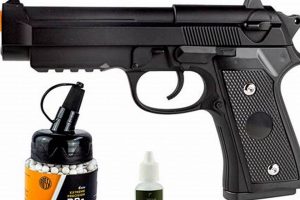
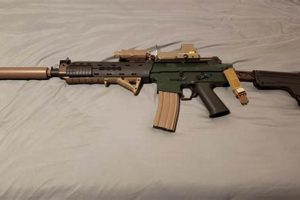
The “hop-up” system in airsoft guns introduces backspin to the projectile, known as a BB. This backspin creates a lift force, counteracting gravity and extending the effective range of the airsoft gun. The system typically consists of an adjustable rubber bucking or nub that applies pressure to the BB as it passes through the inner barrel. Varying the amount of pressure applied changes the degree of backspin imparted on the BB. For example, a player can adjust the system to achieve a flatter trajectory, enabling them to hit targets at greater distances.
This system is vital for achieving accuracy and range in airsoft gameplay. Without controlled backspin, BBs would drop significantly over longer distances, making it difficult to accurately engage targets. Historically, airsoft guns had limited range and accuracy. The introduction of this backspin system revolutionized the sport, allowing for more realistic engagement distances and improved gameplay. Its adjustability allows players to fine-tune their guns to specific BB weights and environmental conditions, maximizing performance.
Understanding the mechanics and adjusting the system effectively are key to optimizing an airsoft gun’s performance. Proper setup is crucial for achieving consistent shots and maximizing range. The following sections will delve into the various types of systems, adjustment techniques, and troubleshooting tips.
Tips Regarding Hop-Up Systems
Maximizing airsoft gun performance hinges on the correct utilization of the hop-up. The following tips provide insight into achieving optimal accuracy and range through informed adjustment and maintenance.
Tip 1: Select appropriate BB weight. Heavier BBs generally require more hop-up to achieve a flat trajectory. Experimentation is crucial to determine the ideal weight for a given setup.
Tip 2: Adjust incrementally. Small adjustments to the hop-up setting can significantly impact BB trajectory. Avoid making large adjustments, as this can lead to over-hopping or under-hopping.
Tip 3: Observe BB trajectory carefully. Pay close attention to the BB’s flight path. If the BB rises sharply, reduce the hop-up. If the BB drops quickly, increase the hop-up.
Tip 4: Ensure consistent BB quality. Using high-quality, seamless BBs is essential for consistent performance. Low-quality BBs can have inconsistencies in weight and shape, leading to erratic trajectories.
Tip 5: Maintain the hop-up bucking. The bucking is a critical component of the system. Regularly inspect it for wear and tear, and replace it when necessary. Silicone grease can help maintain its flexibility and seal.
Tip 6: Understand different bucking types. Different bucking designs offer varying levels of performance and compatibility. Researching different types can help optimize the system for specific needs.
Tip 7: Clean the inner barrel regularly. A clean inner barrel reduces friction and improves consistency. Use a cleaning rod and silicone oil to remove dirt and debris.
Employing these tips ensures optimal functionality, directly contributing to improved accuracy and range. Consistent application of these techniques will refine the user’s understanding of this vital airsoft mechanism.
The subsequent sections will explore specific adjustment techniques and troubleshooting common issues, further enhancing overall airsoft gun performance.
1. Backspin

Backspin is the foundational principle upon which the airsoft hop-up system operates. The system’s primary function is to impart a controlled rotational force, or backspin, onto the BB as it exits the inner barrel. This rotation creates a pressure differential around the BB during flight, resulting in an upward lift force, often referred to as the Magnus effect. Without backspin, the BB would follow a steeper downward trajectory due to gravity and air resistance, significantly limiting range and accuracy. The effectiveness of the hop-up directly correlates with the amount and consistency of backspin imparted.
The practical implication of controlled backspin is evident in airsoft gameplay scenarios. For instance, a properly adjusted hop-up allows a player to engage targets at distances exceeding 150 feet with reasonable accuracy, a feat impossible without a functional hop-up system. Conversely, an improperly adjusted or malfunctioning system results in erratic BB flight patterns and a drastically reduced effective range. The selection of BB weight is also intrinsically linked to backspin; heavier BBs generally require more hop-up to achieve optimal trajectory, necessitating fine-tuning of the system.
In summary, backspin is not merely a component of the hop-up system; it is the operational principle. Understanding the relationship between hop-up adjustment, BB weight, and resulting backspin is crucial for optimizing an airsoft gun’s performance. Challenges arise from the inherent variability in BB quality and environmental conditions, requiring continual adjustments to maintain optimal backspin. The hop-up effectively leverages aerodynamics to improve both range and precision.
2. Range Extension

Range extension in airsoft directly results from the application of a hop-up system. The system’s capacity to impart backspin onto a BB generates lift, counteracting gravity’s downward force. This lift sustains the BB’s trajectory over a greater distance than would otherwise be achievable. The degree of range extension is governed by factors including backspin intensity, BB weight, and aerodynamic properties of the BB. A properly calibrated hop-up, in conjunction with an appropriate BB weight, produces a flatter trajectory, effectively prolonging the BB’s flight path. In airsoft skirmishes, this extended range enables players to engage opponents from positions of greater safety and tactical advantage, increasing the effectiveness of their role on the field.
The significance of range extension becomes apparent when comparing airsoft guns with and without functional hop-up systems. A gun lacking this feature may exhibit an effective range limited to 50-75 feet, severely restricting engagement opportunities. Conversely, a gun with a well-tuned hop-up can achieve ranges exceeding 150 feet, tripling the potential engagement zone. Consider a scenario where a player employing a rifle with range extension can effectively suppress an enemy position behind cover, while an opponent with a limited-range weapon struggles to return fire from a safe distance. Such scenarios highlight the tactical benefits derived from enhanced range.
In summation, range extension constitutes a crucial operational element of the hop-up system. By manipulating the flight characteristics of the BB through backspin-induced lift, the effective range of an airsoft gun is significantly increased. This increased range translates to improved tactical capabilities and a greater potential for success in airsoft gameplay. The challenge lies in achieving optimal range while maintaining accuracy, a balance that requires careful hop-up adjustment and BB selection. The system bridges the gap between accuracy and precision for long-range BB projectile.
3. Trajectory control

Trajectory control, in the context of airsoft, refers to the ability to manipulate the flight path of a BB to achieve desired accuracy and range. The hop-up system is the primary mechanism by which trajectory control is achieved. By imparting backspin, the system allows for adjustments to the BB’s flight, compensating for gravity and air resistance. The degree of control is directly proportional to the precision of the hop-up mechanism and the user’s skill in adjusting it. For example, a marksman utilizes precise adjustments to ensure the BB follows a consistent, predictable path to the target, maximizing hit probability. Achieving this level of command over the BB’s trajectory is essential for effective engagement at varying distances.
The practical application of trajectory control extends beyond mere accuracy. It allows players to adapt to environmental factors such as wind, which can significantly deviate a BB’s path. Experienced players make minor adjustments to compensate for wind drift, maintaining accuracy in dynamic conditions. Furthermore, trajectory control enables specific tactical maneuvers, such as shooting around obstacles. By understanding how to adjust the backspin and flight path, a player can achieve indirect fire, hitting targets that are not in direct line of sight. Therefore, mastering trajectory control through the hop-up system enhances tactical flexibility and effectiveness on the field.
In summary, trajectory control is an integral function of the airsoft hop-up system, influencing both accuracy and tactical options. The systems ability to impart backspin allows players to modify the BBs flight path, extending range and compensating for environmental variables. The challenge lies in achieving consistent trajectory control, requiring both a well-maintained hop-up unit and a thorough understanding of its adjustment principles. Understanding and mastering this aspect allows players to go beyond just BB projectile.
4. BB weight compatibility

BB weight compatibility is an intrinsic element of the airsoft hop-up system. The hop-up mechanism imparts backspin to the BB, counteracting gravity and extending range. However, the optimal amount of backspin varies depending on the BB’s weight. Lighter BBs require less backspin, while heavier BBs require more. If the backspin is insufficient for a given BB weight, the projectile will drop rapidly, limiting range. Conversely, excessive backspin causes the BB to rise excessively, also diminishing accuracy. Thus, achieving optimal performance necessitates matching the BB weight to the hop-up setting. For instance, a player using a 0.20g BB will require a different hop-up adjustment than a player using a 0.28g BB in the same gun to achieve a flat trajectory. The relationship between backspin and BB weight dictates the effectiveness of the entire system.
The significance of BB weight compatibility is further amplified by the variety of BB weights available for airsoft guns. Players choose different weights based on factors such as engagement distance, wind conditions, and personal preference. Consequently, a hop-up system with a broad adjustment range is crucial for accommodating these variations. A system that cannot adequately adjust to different BB weights limits the user’s ability to adapt to changing conditions and optimize performance. Consider a scenario where a player switches from indoor to outdoor play; they might need to switch to a heavier BB to combat wind. Without a compatible hop-up, the heavier BB will perform sub-optimally, negating the intended benefit of the weight change. The compatibility factor directly influences a gun’s versatility and overall usability.
In conclusion, BB weight compatibility is not merely a peripheral consideration, but a central requirement for effective hop-up operation. The ability to fine-tune the system to accommodate varying BB weights directly impacts range, accuracy, and adaptability. The challenge lies in understanding the relationship between these variables and making appropriate adjustments to achieve peak performance. Ignoring this element compromises the entire system’s capability, leading to inconsistent results and diminished effectiveness. Therefore, an understanding of this connection provides enhanced long range BB firing capabilities.
5. Bucking condition

The condition of the hop-up bucking is paramount to the effective functioning of the airsoft hop-up system. This small, often overlooked component directly influences the consistency and accuracy of each shot. Its role in imparting backspin necessitates careful maintenance and periodic inspection.
- Material Degradation
The bucking is typically constructed from rubber or silicone, materials susceptible to degradation over time due to exposure to temperature fluctuations, lubricants, and BB friction. Hardening or cracking of the bucking diminishes its ability to effectively grip and impart consistent backspin on the BB. A deteriorated bucking can result in erratic shot patterns and a reduction in effective range. For example, a bucking exposed to excessive heat may harden, losing its elasticity and leading to inconsistent hop-up pressure.
- Seal Integrity
A proper seal between the bucking and the air nozzle is crucial for maintaining consistent air pressure behind the BB. Damage to the bucking, such as tears or deformation, can compromise this seal, resulting in air leaks and inconsistent velocities. Inconsistent velocities directly translate to variations in shot trajectory and reduced accuracy. A torn bucking, for instance, will allow air to escape around the BB, resulting in a weaker, less accurate shot.
- Surface Friction
The inner surface of the bucking is responsible for gripping the BB and imparting backspin. Excessive wear or contamination on this surface can alter the friction coefficient, affecting the amount of backspin applied. This can lead to either over-hopping (BB rising excessively) or under-hopping (BB dropping prematurely). Dirt and debris accumulating on the bucking’s surface can impede its ability to properly grip the BB, leading to inconsistent performance.
- Bucking Design
Different bucking designs exhibit varying levels of durability and performance characteristics. Some designs are more resistant to wear and tear than others, while others prioritize enhanced grip for heavier BBs. The selection of an appropriate bucking design for the specific airsoft gun and BB weight is crucial for maximizing performance and longevity. For example, a bucking designed for heavier BBs may wear prematurely if used with lighter BBs, due to the increased stress and friction.
In summary, the bucking’s condition directly influences the hop-up system’s ability to impart consistent backspin, maintain a proper air seal, and achieve optimal accuracy and range. Regular inspection and maintenance of the bucking are essential for preserving airsoft gun performance. A well-maintained bucking is a crucial, even if small and forgotten, part of the overall system.
6. Adjustability
Adjustability is a defining characteristic of the system, permitting optimization for varying BB weights, environmental conditions, and desired trajectory profiles. The ability to fine-tune the system dictates the extent to which a user can maximize the airsoft gun’s effective range and accuracy.
- Hop-Up Unit Mechanisms
Various mechanisms exist for adjusting the amount of backspin applied. These include rotary dials, sliding levers, and geared adjustment wheels. Each mechanism offers varying degrees of precision and ease of use. For example, a rotary dial allows for incremental adjustments, enabling fine-tuning of the BB trajectory. In contrast, a sliding lever may offer quicker, but less precise, adjustments, better suited for rapid adaptations in dynamic environments. The type of mechanism influences the fineness of control over the backspin.
- BB Weight Calibration
Adjustability allows for calibration to different BB weights. Lighter BBs generally require less hop-up, while heavier BBs require more. The ability to adjust the hop-up ensures the BB achieves a flatter trajectory and optimal range for a given weight. For instance, a player switching from 0.20g BBs to 0.28g BBs needs to increase the hop-up setting to compensate for the heavier projectile’s increased inertia. This ensures the BBs flight path remains consistent. If this isn’t done the BB will drop much faster than normal, limiting distance. This enables flexibility in adapting to various playing styles.
- Environmental Adaptation
Adjustability is crucial for adapting to environmental conditions, particularly wind. Crosswinds can significantly deviate the BB’s trajectory. The system allows players to compensate for wind drift by adjusting the hop-up to counteract the lateral force exerted by the wind. For example, in windy conditions, slightly increasing the hop-up can counteract the wind’s effect, keeping the BB on target. The adjustability becomes necessary for success under environmental variability.
- Trajectory Customization
Adjustability offers the opportunity to customize the BB’s trajectory. By fine-tuning the system, players can achieve a flat trajectory for maximum range or a slightly upward trajectory for clearing obstacles. For instance, a sniper might adjust the hop-up to achieve a precise, flat trajectory for long-range shots, while a CQB player might opt for a slightly upward trajectory to quickly engage targets behind cover. Trajectory is enhanced and controlled by adjusting the system.
These facets of adjustability underscore its fundamental role in optimizing airsoft gun performance. The system gives players control to maximize effective range and accuracy in diverse conditions. This component ensures an airsoft gun is more than just a replica; it is a customizable instrument. The overall system is enhanced by a user’s ability to modify the amount of backspin to each BB.
7. Accuracy enhancement

Accuracy enhancement is a primary function facilitated by the airsoft hop-up system. Without a properly adjusted hop-up, BBs experience significant trajectory deviation due to gravity and air resistance, rendering accurate long-range shots improbable. The hop-up, by imparting backspin, generates lift that counteracts these forces, resulting in a flatter, more predictable trajectory. Consequently, a properly configured hop-up is not merely an accessory, but an integral component for accuracy enhancement. For example, a standard airsoft rifle without hop-up may only achieve consistent hits within a 50-foot range; with hop-up, that range can extend to 150 feet or more, while maintaining a reasonable degree of precision. Achieving a flat BB firing range is one of the most accurate ways to tell if the hop-up is configured correctly.
The practical application of accuracy enhancement through the hop-up system is evident in various airsoft scenarios. Consider a skirmish where players engage from concealed positions. Precise shot placement becomes critical for eliminating opponents without exposing oneself to counter-fire. A gun with an accurately tuned hop-up allows a player to consistently hit targets through small openings or at longer distances, whereas an unadjusted or poorly adjusted system would result in missed shots and potential exposure. Furthermore, the hop-up system’s adjustability allows players to fine-tune their accuracy based on varying environmental factors such as wind. Skilled players adapt settings to compensate for drift, ensuring consistent accuracy regardless of external conditions. The hop-up offers a range of adjustment from a flat BB fire to long-range BB firing.
In summary, accuracy enhancement is a direct consequence of the functionality of an airsoft hop-up system. The system enables more accurate shots by counteracting factors that interfere with a BB’s trajectory. The challenge lies in the fine-tuning required to achieve optimal performance across varying distances, BB weights, and environmental conditions. Mastering hop-up adjustment is essential for maximizing accuracy and achieving a competitive edge. Ultimately, accurate shots leads to a better overall game experience, and is one of the key elements to becoming an experienced player.
Frequently Asked Questions
This section addresses common inquiries regarding airsoft hop-up systems, providing concise, factual answers to enhance understanding of this vital component.
Question 1: What is the primary function of the hop-up system in an airsoft gun?
The primary function is to impart backspin to the BB, counteracting gravity and extending its effective range. This backspin generates lift, allowing the BB to maintain a flatter trajectory over longer distances.
Question 2: How does adjusting the hop-up affect BB trajectory?
Adjusting the hop-up alters the amount of backspin applied to the BB. Increasing the hop-up increases backspin, causing the BB to rise. Decreasing the hop-up reduces backspin, resulting in a faster downward trajectory.
Question 3: Why is BB weight important in relation to the hop-up system?
BB weight dictates the amount of hop-up required for optimal performance. Heavier BBs require more hop-up to counteract their increased inertia, while lighter BBs require less to prevent over-hopping.
Question 4: What are the signs of an improperly adjusted hop-up?
Signs of an improperly adjusted hop-up include the BB rising excessively (over-hopping), dropping rapidly (under-hopping), or exhibiting inconsistent trajectory.
Question 5: How often should the hop-up bucking be replaced?
The hop-up bucking should be replaced when signs of wear and tear become evident, such as cracking, hardening, or tearing. Replacement frequency depends on usage and environmental conditions.
Question 6: Can the hop-up system improve the accuracy of an airsoft gun?
Yes, if properly adjusted, the system significantly enhances the accuracy of an airsoft gun by stabilizing the BB’s trajectory and extending its effective range.
Understanding these key aspects of the hop-up system is crucial for maximizing the performance and effectiveness of an airsoft gun.
The subsequent sections will delve into specific troubleshooting scenarios and advanced adjustment techniques, further refining the user’s knowledge of the airsoft hop-up system.
Conclusion
The preceding discussion has explored the multifaceted nature of what is airsoft hop up. As demonstrated, this system is not merely an accessory, but a fundamental component influencing an airsoft gun’s range, accuracy, and overall performance. The mechanisms, principles of operation, and impact on BB trajectory have been thoroughly examined. Correct utilization of this element offers a considerable advantage on the field of play.
The ongoing evolution of airsoft technology suggests further advancements in hop-up systems are likely. Continued engagement with research and practical experimentation will lead to an even deeper understanding of this crucial aspect of airsoft. Players are encouraged to investigate and refine their techniques to maximize their equipment’s potential. The future of this technology will continue to shape the play style and equipment used in this sport.