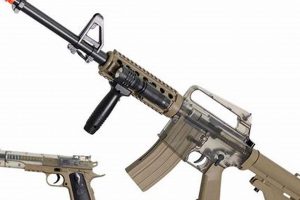
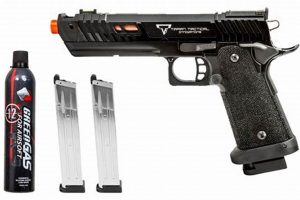
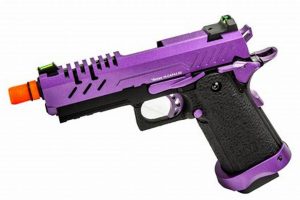
These devices are replicas that launch projectiles utilizing compressed gas or a spring-powered mechanism, typically firing 6mm or 8mm plastic BBs. They are frequently employed in recreational skirmishes, target practice, and training simulations, mirroring the appearance and handling of actual firearms.
Their significance resides in providing a controlled environment for tactical training, fostering teamwork, and promoting responsible handling practices for those interested in the shooting sports. Historically, these replicas evolved from simple toy guns to sophisticated models that simulate real-world firearm operations, enhancing their utility in training and recreational activities.
The subsequent sections will delve into specific aspects, examining various models, performance characteristics, safety considerations, and the regulatory landscape surrounding their use.
Essential Considerations for Selecting and Maintaining Performance Replicas
The following advice aims to provide crucial insights for individuals involved with performance replicas, ensuring optimal functionality and prolonged lifespan.
Tip 1: Prioritize Construction Materials. Examine the composition of internal components. Metal gears and reinforced polymer bodies generally offer greater durability compared to all-plastic alternatives, leading to enhanced longevity.
Tip 2: Maintain Internal Components. Regular disassembly, cleaning, and lubrication of internal mechanisms is paramount. Silicone oil is frequently recommended for lubricating seals and gears, preventing premature wear.
Tip 3: Select Appropriate Projectiles. Utilizing high-quality, seamless projectiles of the correct weight and diameter minimizes the risk of internal damage and maximizes accuracy. Avoid using damaged or deformed projectiles.
Tip 4: Understand Power Source Compatibility. Ensure the power source (battery or gas) is compatible with the specific model. Overcharging batteries or using incompatible gases can lead to irreversible damage or malfunctions.
Tip 5: Adhere to Recommended Maintenance Schedules. Follow the manufacturer’s recommended maintenance schedule meticulously. This may include replacing worn springs, seals, or other critical components at specified intervals.
Tip 6: Implement Proper Storage Procedures. When not in use, store performance replicas in a cool, dry environment, away from direct sunlight and extreme temperatures. This prevents degradation of materials and minimizes the risk of warping or cracking.
Tip 7: Understand Regulatory Requirements. Be aware of and adhere to all local and national regulations regarding ownership, transportation, and use. Compliance prevents legal ramifications and ensures responsible engagement.
Adhering to these guidelines will contribute significantly to the consistent operation and extended lifespan of the equipment, optimizing performance and safety.
The succeeding sections will address specific models and their performance characteristics in greater detail.
1. Accuracy

Accuracy, in the context of performance replicas, directly impacts their utility and effectiveness. Precision shot placement is paramount for competitive scenarios and realistic training exercises. The ability to consistently hit a designated target defines the functional value of these devices.
- Barrel Quality and Consistency
The internal barrel is a critical component influencing projectile trajectory. A smooth, consistent bore with minimal imperfections minimizes friction and promotes stable flight. High-quality barrels, often made of precision-machined metal, are essential for achieving consistent accuracy. Variations in barrel diameter or surface irregularities can cause unpredictable deviations in shot placement.
- Hop-Up System Functionality
The hop-up system imparts backspin to the projectile, generating lift and extending its range. A properly adjusted hop-up unit compensates for gravity and air resistance, enabling flatter trajectories and improved accuracy at longer distances. Malfunctioning or improperly calibrated hop-up systems result in erratic flight paths and reduced effective range.
- Projectile Quality and Weight
The consistency of the projectiles themselves plays a crucial role. Using high-quality, seamless BBs with uniform weight and diameter minimizes variations in flight characteristics. Inconsistent projectiles introduce unpredictable variables, negatively impacting accuracy and grouping. Variations in weight distribution can lead to erratic flight patterns and decreased precision.
- Sight Alignment and Adjustment
Proper sight alignment is vital for accurate targeting. Whether using iron sights, optics, or laser aiming devices, consistent sight alignment ensures the projectile impacts the intended point of aim. Adjustable sights allow users to compensate for environmental factors such as wind and distance, further enhancing accuracy. Misaligned or improperly adjusted sights will result in consistent misses, regardless of the device’s inherent accuracy potential.
These facets, working in conjunction, determine the overall accuracy of performance replicas. The selection of high-quality components, proper maintenance, and accurate sight alignment are all essential for achieving consistent and reliable shot placement. The inherent accuracy of these devices dictates their suitability for various applications, ranging from casual backyard target practice to professional training simulations.
2. Durability

Durability, concerning performance replicas, directly correlates with operational lifespan, reliability, and long-term value. The ability to withstand repeated use, environmental stressors, and potential impacts is paramount for sustained functionality. The construction and material composition are key determinants of overall endurance.
- Material Selection and Resistance to Stress
The selection of construction materials dictates the replica’s ability to endure stress. Metal alloys, such as aluminum or steel, offer superior resistance to impacts and cyclical loading compared to polymer alternatives. Reinforced polymers, however, can provide a balance between weight and resistance to cracking or shattering. Examples include metal gearboxes versus polymer gearboxes, the former being more resilient to the stress of high-powered springs or rapid firing. Inadequate material selection leads to premature failure under normal operational conditions.
- Internal Component Robustness
The resilience of internal components, such as gears, pistons, and springs, is critical for sustained performance. Metal gears, particularly those constructed from hardened steel, withstand greater stress and resist wear compared to polymer gears. Reinforced pistons and high-tension springs enhance reliability under prolonged use. The failure of a single internal component can render the entire device inoperable, emphasizing the importance of quality internal parts.
- Resistance to Environmental Factors
Exposure to environmental factors, such as moisture, temperature fluctuations, and ultraviolet radiation, can degrade materials and compromise functionality. Corrosion-resistant coatings and weather-sealed compartments mitigate the effects of environmental exposure. For example, moisture can cause rust and corrosion in metallic components, while extreme temperatures can warp or crack polymer parts. Adequate protection against environmental factors is essential for maintaining operational integrity over time.
- Impact Resistance and Structural Integrity
The ability to withstand impacts is critical for replicas used in dynamic environments. Reinforced bodies and impact-resistant materials minimize the risk of damage from accidental drops or collisions. Internal components must also be secured to prevent dislodgement or damage during impacts. Structural integrity is a key factor in determining the overall longevity and reliability of the device.
These facets are integral to the overall durability of a performance replica. Replicas constructed with high-quality materials, robust internal components, and effective protection against environmental factors exhibit superior longevity and reliability, maximizing their value and utility. Conversely, replicas constructed with inferior materials or lacking adequate protection are prone to premature failure and require more frequent repairs or replacements.
3. Mechanism
The mechanism of a performance replica is the core operational system that dictates its functionality, performance characteristics, and overall reliability. Understanding the nuances of these mechanisms is paramount for selecting and maintaining these devices.
- Spring-Powered Operation
Spring-powered mechanisms utilize a compressed spring to propel the projectile. The spring is typically compressed by manually cocking the device, storing potential energy that is released upon triggering. These mechanisms are characterized by their simplicity and affordability but often exhibit lower rates of fire and require manual cocking before each shot. Examples include entry-level sniper rifles and basic pistols. In the context of performance replicas, spring-powered mechanisms represent a foundational technology, providing a cost-effective entry point but lacking the advanced features and performance of more sophisticated systems.
- Gas Blowback (GBB) Systems
Gas Blowback (GBB) systems utilize compressed gas, such as CO2 or green gas, to propel the projectile and simulate the recoil action of a real firearm. The gas is released upon triggering, propelling the BB and cycling the slide or bolt. GBB mechanisms offer a more realistic shooting experience due to the simulated recoil and higher rates of fire compared to spring-powered systems. However, they require a gas source and are susceptible to performance variations based on temperature and gas pressure. Gas Blowback pistols exemplify this mechanism, offering realistic recoil and semi-automatic firing capabilities. Their performance can be affected by ambient temperature, illustrating the system’s sensitivity.
- Electric-Powered (AEG) Gearboxes
Electric-powered (AEG) gearboxes employ an electric motor to drive a series of gears that compress a spring and propel the projectile. These mechanisms are powered by rechargeable batteries and offer high rates of fire and consistent performance. AEGs are typically found in rifles and SMGs, providing a versatile platform for various combat scenarios. The gearbox represents the central processing unit of the device, orchestrating the complex sequence of actions required for firing. The reliability and efficiency of the gearbox directly impact the AEG’s overall performance and durability.
- High Pressure Air (HPA) Systems
High Pressure Air (HPA) systems utilize an external compressed air tank connected to the replica via a hose. The compressed air is regulated to a specific pressure, providing consistent power and eliminating the performance variations associated with gas-powered systems. HPA systems offer exceptional accuracy, consistency, and adjustability but require an external air tank and regulator. Examples include customized sniper rifles and specialized competition replicas. The stability and adjustability of HPA systems make them ideal for precision shooting and scenarios demanding consistent performance, though requiring external setup.
These diverse mechanisms represent distinct approaches to propelling projectiles in performance replicas. The selection of a particular mechanism depends on the desired balance between realism, performance, cost, and maintenance requirements. Understanding the advantages and limitations of each system is crucial for making informed decisions and optimizing the performance of these devices.
4. Power Source
The power source is a critical determinant of a performance replica’s operational characteristics, impacting its rate of fire, consistency, and overall performance. Different types of power sources offer distinct advantages and disadvantages, influencing the suitability of a given device for specific applications.
- Electric (Battery) Systems: Voltage and Capacity
Electric systems rely on rechargeable batteries to power an electric motor, which in turn drives the internal mechanism. Voltage (measured in volts) dictates the motor’s speed and torque, while capacity (measured in milliampere-hours or mAh) determines the battery’s runtime. Higher voltage batteries generally result in increased rates of fire and trigger response, but may also place greater stress on internal components. Higher capacity batteries provide longer operational times, reducing the need for frequent battery changes. An example is the use of a 7.4V LiPo battery versus an 11.1V LiPo battery in an electric-powered device. The 11.1V option yields a higher rate of fire, but can also accelerate wear on the gearbox components. Inadequate voltage or capacity can significantly impair performance.
- Gas (CO2/Green Gas) Systems: Pressure and Temperature Sensitivity
Gas systems utilize compressed gas, such as CO2 or green gas (propane mixed with silicone oil), to propel the projectile. Gas pressure dictates the muzzle velocity and overall power of the device. However, gas systems are susceptible to temperature sensitivity. Lower temperatures reduce gas pressure, resulting in decreased velocity and inconsistent performance. CO2 generally offers higher pressure and greater consistency compared to green gas, but may also place greater stress on internal components. The use of green gas in colder environments is a common example of temperature-related performance issues. Reduced pressure due to low temperatures results in a significant decrease in range and accuracy. Maintaining optimal gas pressure is crucial for consistent performance.
- High Pressure Air (HPA) Systems: Regulated Air Delivery
HPA systems employ an external compressed air tank connected to the device via a hose. A regulator is used to precisely control the air pressure delivered to the internal mechanism, ensuring consistent power and eliminating the performance variations associated with gas systems. HPA systems offer exceptional adjustability and are favored for their consistency and precision. The ability to fine-tune air pressure allows users to optimize performance for specific scenarios and projectile weights. These setups, common in competition replicas, exemplify the benefits of regulated air delivery. The consistent pressure allows for extremely accurate shot placement.
- Spring-Powered Systems: Mechanical Energy Storage
Spring powered systems store mechanical energy in a compressed spring. Releasing this spring transfers the stored energy to propel a projectile. The power output is directly correlated to the spring’s stiffness and the distance it is compressed. While generally less powerful and consistent than gas or electric systems, spring power offers simplicity and independence from external power sources. Bolt-action sniper rifles use spring power, requiring manual cocking to compress the spring for each shot. The reliance on manual effort and mechanical components means spring-powered systems trade rate of fire for simplicity and independence from batteries or gas.
In summary, the selection of the appropriate power source hinges on the desired balance between performance, realism, convenience, and cost. Understanding the nuances of each system allows users to optimize their performance replica for specific applications, ensuring consistent and reliable operation. The evolution of these power sources mirrors the advancements in performance replica technology, constantly striving for greater realism, performance, and user experience.
5. Materials
The selection of materials significantly influences the performance, durability, and overall quality of airsoft guns. Material choices directly impact a replica’s weight, resistance to wear and tear, and ability to withstand environmental factors.
- Receiver and Frame Materials
The receiver and frame form the structural backbone of an airsoft gun. Metal alloys, such as aluminum or zinc, provide greater rigidity and impact resistance compared to polymer alternatives. Metal receivers contribute to a more realistic weight and feel, enhancing the overall user experience. Polymer receivers, while lighter and more cost-effective, may be more susceptible to cracking or warping under stress. Examples include metal-bodied M4 variants versus polymer-bodied entry-level models. The choice between metal and polymer depends on the desired balance between realism, durability, and cost.
- Internal Component Materials
The materials used in internal components, such as gears, pistons, and barrels, are critical for performance and longevity. Steel gears offer superior durability compared to polymer gears, especially in high-stress applications. Precision-machined metal barrels contribute to improved accuracy and consistency. Piston materials, such as polycarbonate or aluminum, must withstand repeated impacts and pressure. Examples include steel gearsets in high-performance AEGs versus polymer gearsets in lower-cost models. The choice of internal component materials directly impacts the replica’s reliability and operational lifespan.
- External Finish and Coatings
The external finish and coatings protect the underlying materials from corrosion, abrasion, and environmental damage. Anodized finishes on metal parts enhance corrosion resistance and improve aesthetic appeal. Protective coatings on polymer parts minimize the risk of scratches and fading. Examples include anodized aluminum receivers versus painted steel receivers, the former offering superior corrosion resistance. The quality of the finish directly impacts the replica’s appearance and its ability to withstand harsh conditions.
- Hop-Up Bucking Materials
The hop-up bucking, a small rubber or silicone component that imparts backspin to the projectile, plays a critical role in accuracy and range. Different materials offer varying degrees of friction and resistance to wear. Silicone buckings generally provide better cold-weather performance compared to rubber buckings. The material composition of the hop-up bucking directly impacts its ability to impart consistent backspin, influencing accuracy and range. Examples include silicone buckings favored for their cold weather flexibility, impacting shot consistency and overall performance across varying climates.
The careful selection of materials is paramount for creating airsoft guns that offer a balance of realism, performance, and durability. The interplay between different materials and components determines the overall quality and suitability of a replica for various applications. By understanding the properties and limitations of different materials, manufacturers can optimize their designs to meet the demands of diverse user groups.
6. Maintenance
Consistent maintenance directly influences the longevity and operational effectiveness of airsoft guns. Neglecting essential upkeep procedures precipitates performance degradation and potential component failure. Proper lubrication, cleaning, and timely replacement of worn parts are critical determinants of a replica’s sustained functionality. For example, a failure to regularly clean and lubricate the internal components of an electric-powered airsoft gun (AEG) can lead to increased friction, reduced rate of fire, and eventual motor burnout. The correlation between diligent maintenance and optimal performance is undeniable; the cause (lack of maintenance) invariably leads to the effect (decreased performance or failure).
The importance of maintenance extends beyond mere functionality. It encompasses safety considerations. A well-maintained airsoft gun is less likely to malfunction unexpectedly, reducing the risk of unintended projectile discharge or component breakage that could cause injury. Furthermore, regular inspection during maintenance allows for the early detection of potential issues, such as cracks in the receiver or weakened springs. Early detection facilitates preventative measures, mitigating the risk of catastrophic failure during operation. For instance, identifying a frayed wiring harness during a routine inspection of an AEG allows for its replacement before it causes a short circuit or fire. Maintenance, therefore, is an integral aspect of responsible airsoft gun ownership and use.
In conclusion, the relationship between maintenance and the sustained performance and safety of airsoft guns is inextricably linked. While challenges exist, such as the time investment required for thorough maintenance, the benefits far outweigh the drawbacks. Understanding the practical significance of maintenance ensures these devices function reliably and safely, providing prolonged use and minimizing the potential for accidents. The systematic application of preventative maintenance protocols transforms a mere replica into a dependable and safe tool for recreational and training applications.
Frequently Asked Questions Regarding Performance Replicas
The following addresses common inquiries concerning the operation, maintenance, and responsible use of performance replicas.
Question 1: What constitutes appropriate storage conditions?
Appropriate storage mandates a cool, dry environment shielded from direct sunlight and extreme temperature fluctuations. Such conditions mitigate material degradation and minimize the potential for warping or cracking of components. Batteries should be disconnected and stored separately.
Question 2: How frequently should routine maintenance be conducted?
Routine maintenance frequency is contingent upon usage intensity. For regular users, monthly maintenance encompassing cleaning, lubrication, and inspection is advisable. Infrequent users should conduct maintenance prior to each operational instance and after storage periods exceeding three months.
Question 3: What are the implications of utilizing incompatible power sources?
Employing incompatible power sources, such as over-volted batteries or incorrect gas types, can induce irreversible damage to internal mechanisms. Such actions may invalidate warranties and compromise the replica’s operational safety.
Question 4: What projectile weight is optimal for maximizing accuracy?
Optimal projectile weight is model-dependent. However, a projectile weight range of 0.20g to 0.28g is generally suitable for most standard models. Experimentation within this range, considering barrel quality and hop-up settings, is recommended for achieving peak accuracy.
Question 5: How can the risk of accidental discharge be minimized?
Minimizing accidental discharge requires strict adherence to safety protocols. Maintaining the replica in a “safe” mode when not actively engaged, utilizing appropriate trigger discipline, and securely storing the replica when not in use are paramount.
Question 6: What are the legal ramifications of modifying performance replicas?
Modifying performance replicas may contravene local and national regulations. Such modifications can alter the replica’s power output or appearance, potentially blurring the distinction between a replica and a genuine firearm. Compliance with all applicable laws is mandatory.
Adherence to these principles ensures responsible and compliant operation, maximizing the lifespan and safety of these devices.
The subsequent section will examine advanced customization techniques and performance optimization strategies.
Conclusion
This exploration has dissected the pivotal elements influencing the efficacy and longevity of these devices. Rigorous material selection, meticulous attention to internal mechanisms, and adherence to comprehensive maintenance protocols are not merely suggestions but imperatives. The characteristics of accuracy, durability, and the chosen power source, are each paramount in determining its overall value.
Responsible ownership mandates a comprehensive understanding of these intricacies and a commitment to both safety and regulatory compliance. Continued diligence in these areas will ensure that the devices serve their intended purpose effectively and responsibly, be it in recreational skirmishes, tactical training, or competitive sporting events.