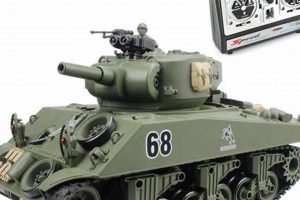
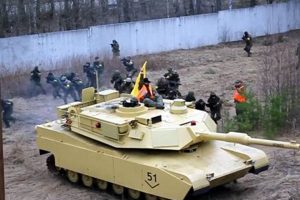
A remotely controlled armored vehicle that fires plastic projectiles is a recreational device combining elements of model engineering, radio control technology, and simulated combat. These units replicate the appearance and functionality of full-scale military tanks, offering users an interactive and engaging experience. An example of this might be a scaled-down replica of a German Tiger tank, equipped with an airsoft cannon capable of launching 6mm BBs.
These devices provide entertainment through interactive gameplay, replicating military maneuvers and simulated battles. Their use can foster interest in engineering, history, and strategy. The historical context is rooted in the development of radio control technology and the desire to recreate realistic battlefield scenarios in a safe and controlled environment. Hobbyists appreciate the detailed modeling and customization options available.
The following discussion will delve into the various aspects of these vehicles, including their construction, operation, customization options, and considerations for responsible usage. The focus will be on providing comprehensive information relevant to both newcomers and experienced enthusiasts.
RC Airsoft Tank
This section provides practical advice for the effective operation and maintenance of remotely controlled, projectile-firing armored vehicles. Adherence to these guidelines will extend the lifespan of the device and enhance the user experience.
Tip 1: Battery Maintenance: Proper battery care is critical. Overcharging or deep discharging lithium polymer (LiPo) batteries can lead to damage or, in extreme cases, fire. Always use a balance charger specifically designed for LiPo batteries. Monitor battery voltage regularly and discontinue use if the voltage drops below the recommended minimum.
Tip 2: Gearbox Lubrication: The gearbox is a vital component. Regular lubrication with a suitable grease reduces friction and wear. Inspect the gearbox every 10-15 hours of operation, applying grease as needed. Use a high-quality, non-conductive grease to prevent electrical shorts.
Tip 3: Track Tension Adjustment: Improper track tension can impact performance and cause premature wear. Ensure that the tracks are neither too tight nor too loose. Too tight, and the motor will strain; too loose, and the tracks may slip. Adjust track tension according to the manufacturer’s recommendations.
Tip 4: Airsoft Unit Maintenance: The airsoft firing mechanism requires periodic cleaning. Dust and debris can accumulate, affecting accuracy and firing range. Use a cleaning rod and appropriate cleaning solution to remove any obstructions. Ensure the hop-up unit is properly adjusted for optimal projectile trajectory.
Tip 5: Remote Control Calibration: Regularly calibrate the remote control unit to ensure accurate and responsive control. Miscalibration can lead to erratic movements or failure to execute commands. Refer to the remote control’s manual for specific calibration procedures.
Tip 6: Environmental Considerations: Avoid operating in excessively dusty or wet conditions. These environments can introduce contaminants into the internal components, leading to malfunctions. If operation in such conditions is unavoidable, perform thorough cleaning afterward.
Tip 7: Storage Practices: Store the device in a dry, climate-controlled environment when not in use. Prolonged exposure to extreme temperatures or humidity can damage electronic components and mechanical parts. Remove the batteries from the device during extended storage periods.
These tips are intended to maximize the performance and longevity of the device. By implementing these practices, users can ensure continued enjoyment and minimize the risk of equipment failure.
The following sections will explore further aspects of these vehicles, including customization and safety precautions.
1. Realism of the model

The degree of verisimilitude in remotely controlled, projectile-firing armored vehicles significantly influences their appeal and perceived value. This realism is achieved through meticulous replication of details found on full-scale military vehicles, contributing to an immersive and engaging user experience.
- Scale Accuracy and Proportions
Scale accuracy refers to the dimensional conformity of the model to its real-world counterpart. Proportions, likewise, ensure that the various components (turret, chassis, tracks) are correctly sized relative to each other. A 1/16 scale Tiger I, for example, should accurately reflect the dimensions and proportions of the original tank, deviating only within acceptable manufacturing tolerances. Accurate scaling enhances the overall visual impact and contributes to the illusion of a miniature yet authentic military machine.
- Detailed Exterior Features
Faithful reproduction of external details is crucial for realism. This includes features like weld lines, panel gaps, rivets, hatches, tools, and other surface textures. A realistic example would involve accurately depicting the Zimmerit anti-magnetic paste application found on late-war German tanks. The inclusion of such details, even at a reduced scale, significantly elevates the visual authenticity of the model.
- Operational Features Replication
Beyond aesthetics, functional replication enhances realism. This incorporates elements such as working suspension systems that allow for realistic terrain negotiation, functional smoke generators that simulate engine exhaust, and sound effects that mimic engine noises and gun firing. An example is a system where the recoil action mirrors the recoil of the original tank’s cannon, both visually and audibly. These interactive elements heighten the immersive quality.
- Painting and Markings Authenticity
Accurate paint schemes and markings are essential for completing the realistic representation. This involves researching and replicating the correct camouflage patterns, unit insignias, and vehicle-specific markings used by various military forces. The weathering of the paint, simulating the effects of wear and tear, also contributes to the overall authenticity. For instance, applying accurate desert camouflage and British Army markings to a replica of a Sherman tank used in North Africa reinforces the historical context and realism.
The combination of accurate scale, detailed features, operational functionality, and authentic markings elevates these devices from mere toys to detailed scale models capable of providing immersive and educational experiences. Attention to detail in these areas significantly influences their collectability and the degree of enjoyment derived from their operation.
2. Firing Mechanism Functionality

The operational efficacy of a remotely controlled armored vehicle that fires plastic projectiles is fundamentally determined by the functionality of its firing mechanism. This mechanism, responsible for propelling projectiles toward a designated target, directly influences the device’s practical utility in simulated combat scenarios. A malfunctioning or poorly designed firing mechanism can render the entire system ineffective, regardless of the model’s aesthetic accuracy or control system sophistication. For example, a mechanism with inconsistent firing pressure leads to inaccurate shots and reduced effective range, negating any tactical advantage the vehicle might otherwise possess.
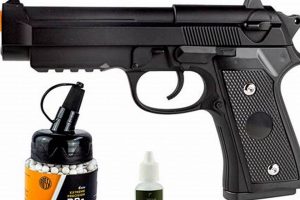
The design and implementation of the firing mechanism require careful consideration of several factors, including projectile type, power source, and safety protocols. The most common firing mechanisms utilize compressed air or spring-loaded pistons to propel 6mm BBs. Regardless of the chosen method, consistent projectile velocity and trajectory are paramount. A well-designed hop-up system, which imparts backspin to the projectile, enhances range and accuracy by counteracting the effects of gravity. Conversely, a poorly designed hop-up system can cause erratic projectile behavior and unpredictable shot placement. Practical applications necessitate that the firing mechanism withstand repeated use under varying environmental conditions. Robust materials and precise manufacturing processes are essential to ensure reliability and longevity.
In conclusion, the functionality of the firing mechanism is an integral component of a remotely controlled, projectile-firing armored vehicle. Its influence extends to the vehicle’s accuracy, range, and overall utility. The development and maintenance of a reliable and effective firing mechanism require a comprehensive understanding of mechanical principles, material science, and safety considerations. Overcoming challenges associated with projectile consistency and durability is crucial for maximizing the performance and enjoyment derived from these devices.
3. Remote control precision

Remote control precision constitutes a critical determinant of the operational effectiveness and user experience associated with remotely controlled, projectile-launching armored vehicles. The accuracy and responsiveness of the remote control system directly translate to the operator’s ability to execute intended maneuvers and accurately engage targets, impacting the overall tactical capabilities of the device.
- Proportional Control and Maneuverability
Proportional control allows for variable speed and directional adjustments, enabling nuanced movements. Unlike simple on/off controls, proportional systems permit fine-tuning of speed and steering, facilitating precise navigation through complex terrains or during tactical engagements. An example includes the ability to execute a slow, controlled turn around an obstacle versus a rapid, wide turn that could expose the vehicle to simulated enemy fire. This level of control directly impacts the vehicle’s ability to maneuver effectively and maintain a strategic advantage.
- Turret Rotation and Aiming Accuracy
Precise control of the turret’s rotational movement and elevation is essential for accurate targeting. The ability to smoothly and accurately adjust the turret’s position allows the operator to acquire and engage targets with minimal delay. For instance, a system that allows for incremental turret adjustments in fractions of a degree enables precise aiming at distant or small targets. Sluggish or imprecise turret control degrades aiming accuracy and reduces the effectiveness of the firing mechanism.
- Multi-Channel Communication and Interference Mitigation
Multi-channel communication systems reduce the likelihood of signal interference and ensure reliable communication between the remote control and the vehicle. These systems often utilize frequency-hopping spread spectrum (FHSS) technology to dynamically switch between multiple radio channels, minimizing the impact of external interference. Reliable communication is vital for maintaining control over the vehicle and preventing unintended actions. For example, robust communication prevents the vehicle from suddenly ceasing to respond or executing unintended commands due to signal interference.
- Response Time and Input Lag Reduction
Minimal response time between the operator’s input and the vehicle’s reaction is crucial for a realistic and engaging experience. Input lag, the delay between a command and its execution, can significantly impair the operator’s ability to control the vehicle effectively. Low latency systems provide a near-instantaneous response, enhancing the operator’s sense of control and immersion. For example, a system with minimal input lag allows for quick reactions to unexpected events or rapidly changing tactical situations.
The precision of the remote control system directly dictates the user’s capacity to leverage the full potential of remotely controlled, projectile-launching armored vehicles. A responsive and accurate control system empowers operators to execute intricate maneuvers, precisely target adversaries, and fully immerse themselves in the simulated combat experience, enhancing the overall enjoyment and tactical possibilities inherent in this type of device. Conversely, a sluggish or inaccurate control system diminishes the user’s ability to effectively operate the vehicle and detracts from the intended experience.
4. Durability of construction

The structural integrity of remotely controlled, projectile-firing armored vehicles is paramount to their longevity, functionality, and overall user satisfaction. The devices are often subjected to simulated combat conditions, necessitating robust construction to withstand impacts, environmental factors, and general wear and tear. Consequently, the durability of materials and assembly techniques employed directly influences the operational lifespan and perceived value of these recreational units.
- Material Selection and Impact Resistance
The choice of materials significantly impacts the capacity to withstand impacts from projectiles, collisions with obstacles, and accidental drops. Common materials include ABS plastic, metal alloys (such as aluminum or zinc), and composite materials. ABS plastic offers a balance of affordability and impact resistance, suitable for less demanding applications. Metal alloys provide superior strength and rigidity, enhancing resistance to deformation and component failure. Composite materials, such as fiberglass-reinforced polymers, offer a high strength-to-weight ratio, beneficial for maintaining maneuverability while maximizing durability. For example, a chassis constructed from die-cast aluminum is inherently more resistant to damage than one molded from thin-walled ABS plastic.
- Component Integration and Structural Reinforcement
The manner in which individual components are integrated into the overall structure plays a crucial role in distributing stress and preventing localized failures. Secure mounting of critical components, such as gearboxes, motors, and electronic control boards, minimizes vibration and reduces the risk of detachment during operation. Reinforcing stress points with additional material or structural supports enhances resistance to bending, cracking, and other forms of structural damage. For instance, incorporating internal metal bracing within a plastic chassis can significantly improve its load-bearing capacity and resistance to torsional forces.
- Environmental Resistance and Protective Coatings
Exposure to environmental factors, such as moisture, dust, and ultraviolet radiation, can degrade materials and compromise the functionality of electronic components. Sealing electronic compartments and applying protective coatings to exposed surfaces mitigate the effects of these environmental stressors. Waterproofing measures, such as O-ring seals and conformal coatings on circuit boards, prevent water ingress and corrosion. UV-resistant coatings prevent discoloration and embrittlement of plastic components, prolonging their lifespan. For instance, a device designed for outdoor use should incorporate a weather-resistant chassis and sealed electronic compartments to prevent damage from rain or humidity.
- Mechanical Stress Tolerance and Fatigue Resistance
Repeated stresses from operation, such as track movement and turret rotation, can lead to fatigue failure in critical components. The selection of appropriate materials and manufacturing processes to enhance fatigue resistance is paramount. Heat-treating metal components and using high-quality lubricants reduce friction and wear, extending the service life of moving parts. For instance, utilizing hardened steel gears in the gearbox, coupled with regular lubrication, minimizes wear and prevents premature failure under repeated stress.
The incorporation of durable materials, robust construction techniques, and environmental protection measures are essential for ensuring the longevity and operational reliability of remotely controlled, projectile-firing armored vehicles. Investing in quality construction translates to reduced maintenance requirements, increased user satisfaction, and a greater overall value proposition. Conversely, compromising on durability can lead to frequent repairs, premature component failure, and a diminished user experience. The longevity of the product is ultimately dictated by the design and manufacturing choices made during its construction.
5. Customization potential

The capacity for modification significantly augments the appeal of remotely controlled, projectile-firing armored vehicles, transforming them from mere recreational devices into platforms for individual expression and enhanced functionality. This customization potential allows users to tailor the vehicles to their specific preferences, skill levels, and simulated combat scenarios, thereby increasing their engagement and long-term enjoyment.
- Aesthetic Modifications and Scale Fidelity
Users frequently pursue aesthetic modifications to enhance the visual realism or personalize the appearance of their vehicles. This can include weathering techniques to simulate battlefield wear, application of historically accurate camouflage schemes, or the addition of scale details such as stowage, crew figures, and external equipment. For example, a user might meticulously recreate the markings and weathering patterns of a specific tank unit that served in a particular historical campaign. Such alterations elevate the model’s aesthetic appeal and demonstrate the user’s dedication to scale fidelity.
- Performance Enhancements and Mechanical Upgrades
Mechanical and electronic upgrades can significantly improve the performance characteristics of the vehicles. These enhancements may include the installation of more powerful motors for increased speed and torque, replacement of plastic gearboxes with metal alternatives for enhanced durability, or the integration of improved suspension systems for better terrain handling. An illustrative instance involves upgrading the stock airsoft unit with a higher-pressure system to increase projectile velocity and range. Such modifications not only improve performance but also increase the vehicle’s competitiveness in simulated combat.
- Electronic System Integration and Functional Additions
The integration of aftermarket electronic systems introduces new functionalities and expands the operational capabilities of the vehicles. This includes the addition of sound modules that replicate engine noises and gun firing effects, installation of LED lighting systems for improved visibility and realism, or the integration of infrared (IR) battle systems for interactive gameplay. For example, incorporating an IR battle system allows the vehicle to engage in simulated combat with other similarly equipped vehicles, registering hits and disabling functions upon receiving a certain number of strikes. These additions increase the vehicle’s interactivity and versatility.
- Control System Augmentation and Ergonomic Improvements
Modifications to the remote control system can improve ergonomics, precision, and user comfort. This might involve replacing the stock transmitter with a higher-quality unit that offers improved responsiveness and customization options, adding custom grips or extensions for enhanced comfort, or integrating telemetry systems that provide real-time data on battery voltage, motor temperature, and signal strength. For instance, upgrading to a programmable transmitter allows users to create custom control profiles tailored to their individual preferences and driving styles. These enhancements improve the overall user experience and increase the vehicle’s usability in demanding situations.
The multifaceted nature of customization potential fundamentally enhances the appeal and longevity of remotely controlled, projectile-firing armored vehicles. By allowing users to tailor the vehicles to their individual tastes and performance requirements, customization transforms these devices from static models into dynamic platforms for self-expression and continuous improvement. The possibilities for modification are extensive, limited only by the user’s creativity and technical expertise.
Frequently Asked Questions
This section addresses common inquiries regarding remotely controlled armored vehicles that fire plastic projectiles. The information presented aims to provide clarity and informed perspectives on various aspects of these devices.
Question 1: What safety precautions must be observed when operating a remotely controlled armored vehicle that fires plastic projectiles?
Eye protection is mandatory for all individuals within the operational vicinity. Firing at human beings or animals is strictly prohibited. Operation should occur in a controlled environment, away from public areas or private property where unintended projectile impact could cause damage or injury. Adherence to manufacturer safety guidelines is imperative.
Question 2: What is the typical effective range of a remotely controlled armored vehicle’s airsoft projectile?
The effective range varies depending on the specific model and the power of the firing mechanism. Typically, these devices exhibit an effective range of 20 to 50 feet. Modifications or upgrades may increase this range, but should be undertaken with careful consideration of safety and legal implications.
Question 3: Are there legal restrictions pertaining to the ownership or operation of remotely controlled armored vehicles that fire plastic projectiles?
Legality varies based on geographic location. Certain jurisdictions may regulate the ownership or operation of airsoft-type devices. Prior to purchase or operation, it is incumbent upon the individual to ascertain and comply with all applicable local, regional, and national laws. Misinterpretation of applicable regulations does not absolve the individual of responsibility.
Question 4: What are the primary maintenance requirements for remotely controlled armored vehicles that fire plastic projectiles?
Regular maintenance includes cleaning the firing mechanism, lubricating gears and moving parts, inspecting wiring and electrical connections, and ensuring proper battery charging and storage. Neglecting these maintenance procedures can lead to reduced performance, premature component failure, and potential safety hazards.
Question 5: What types of batteries are commonly used in remotely controlled armored vehicles that fire plastic projectiles, and what are the charging protocols?
Lithium polymer (LiPo) batteries are frequently employed due to their high energy density and lightweight characteristics. Proper charging protocols, including the use of a balance charger and avoidance of overcharging or deep discharging, are essential to prevent damage or fire. Adherence to manufacturer-recommended charging parameters is crucial.
Question 6: How does the scale of a remotely controlled armored vehicle impact its overall realism and performance?
Scale dictates the level of detail and the physical dimensions of the model. Larger scales (e.g., 1/16) generally allow for greater detail and more robust construction, while smaller scales (e.g., 1/35) offer increased portability and affordability. The scale also influences the types of terrain the vehicle can traverse and the overall impression of realism.
In summary, the operation of remotely controlled, projectile-firing armored vehicles necessitates a thorough understanding of safety procedures, legal considerations, and maintenance requirements. Informed operation ensures responsible usage and maximizes the longevity and enjoyment of these devices.
The following section will address advanced topics, including modification techniques and competitive gameplay strategies.
RC Airsoft Tank
This exploration has addressed various facets of the projectile-firing, remotely controlled armored vehicle, emphasizing construction, operation, customization, and safety. These devices, while offering recreational engagement, demand responsible usage and adherence to established safety protocols. Their potential for modification and adaptation to varying scenarios contributes significantly to their overall appeal.
Prospective users are encouraged to approach the acquisition and operation of the rc airsoft tank with a balanced understanding of its capabilities and limitations. Continued adherence to safety guidelines and ethical operational practices will ensure the sustained enjoyment and responsible utilization of these recreational armored vehicles.