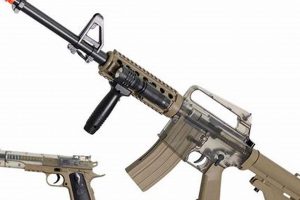
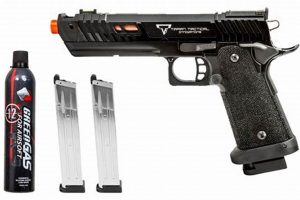
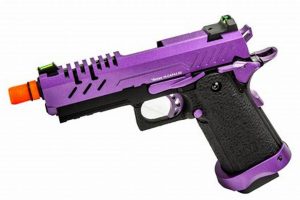
The practice of applying a painted coating to an airsoft replica firearm offers a method for customizing its aesthetic appearance and potentially enhancing its concealment in outdoor environments. This procedure generally involves disassembling the airsoft device, preparing its surfaces, and applying several layers of spray paint to achieve a desired visual outcome. Examples range from simple, single-color applications to elaborate camouflage patterns designed to mimic natural surroundings.
The application of paint to an airsoft device can serve multiple purposes. Beyond purely cosmetic customization, it can increase the realism of the replica, particularly for historical reenactments or film projects. Furthermore, a well-executed paint job can provide a degree of camouflage, making the user less visible during outdoor airsoft activities. Historically, the painting of military equipment, including firearms, has been a common practice for tactical advantage, a tradition that influences the customization choices within the airsoft community.
The subsequent sections will delve into the specific materials, tools, and techniques required for achieving a durable and visually appealing finish on an airsoft device. The information will cover disassembly, surface preparation, paint selection, application methods, and post-painting considerations.
Essential Guidelines for Airsoft Replica Painting
Achieving a professional and lasting finish on an airsoft replica requires careful planning and execution. The following guidelines outline crucial steps to ensure optimal results.
Tip 1: Disassemble Components Thoroughly: Prior to any painting, complete disassembly of the airsoft device is essential. This prevents paint from affecting internal mechanisms and allows for even coverage on all external surfaces. Documenting the disassembly process with photographs can be helpful for reassembly.
Tip 2: Degrease and Clean All Surfaces: Surface contaminants, such as oils and dirt, impede paint adhesion. Use a suitable degreaser and clean the surfaces with isopropyl alcohol or a similar solvent. Allow ample drying time before proceeding.
Tip 3: Apply a Primer Coat: Primer is essential for creating a uniform base and promoting paint adhesion, particularly on plastic or metal surfaces. Choose a primer compatible with both the airsoft material and the intended topcoat paint.
Tip 4: Use Thin, Even Coats: Multiple thin coats are superior to a single thick coat, which is prone to runs and drips. Apply the paint in smooth, sweeping motions, maintaining a consistent distance from the surface. Allow each coat to dry fully before applying the next.
Tip 5: Utilize Stencils for Camouflage Patterns: Creating camouflage patterns requires precision. Stencils, whether commercially produced or homemade, provide a clean and repeatable method for applying complex designs. Ensure stencils are securely affixed to prevent paint bleed.
Tip 6: Allow Adequate Drying and Curing Time: Paint requires sufficient time to dry and cure completely. Refer to the manufacturer’s instructions for recommended drying times. Premature handling can result in damage to the finish.
Tip 7: Consider a Clear Coat Finish: A clear coat provides an added layer of protection against scratches and wear. Choose a clear coat specifically designed for use with the chosen paint type. Apply in thin, even coats, following the same drying and curing procedures as the base paint.
Following these guidelines will contribute to a durable and aesthetically pleasing finish, enhancing the appearance and longevity of the customized airsoft replica.
The subsequent discussion will address common pitfalls encountered during the painting process and offer strategies for mitigating potential issues.
1. Disassembly

Disassembly is a foundational step when preparing to apply a painted finish to an airsoft device. It directly influences the quality, durability, and overall outcome of the customization process. Proper execution of this stage is paramount for achieving a professional and lasting result.
- Complete Component Separation
Full disassembly entails separating all removable parts of the airsoft replica. This includes the outer barrel, stock, receiver, sights, magazines, and any accessory rails. This separation ensures comprehensive paint coverage, preventing unpainted areas and allowing access to intricate details. Without complete disassembly, paint may inadvertently affect internal mechanisms, leading to malfunctions or reduced performance.
- Internal Mechanism Protection
Disassembly protects the internal workings of the airsoft device from paint intrusion. Gearboxes, hop-up units, and other sensitive components can be damaged or rendered non-functional if exposed to paint. Removing these parts before painting mitigates the risk of operational impairment. This protection also ensures that the painting process does not void any warranties or compromise the device’s long-term reliability.
- Preparation for Masking
Certain components, such as internal barrels or specific markings, may require masking to prevent paint application. Disassembly facilitates the masking process by providing unobstructed access to these areas. Precise masking ensures that critical parts remain unaffected by the painting process and that any desired markings remain visible.
- Enhanced Paint Adhesion
Disassembly allows for better surface preparation on individual components. Each part can be thoroughly cleaned, degreased, and sanded as needed to promote optimal paint adhesion. This targeted approach results in a more durable and uniform finish compared to attempting to prepare the entire assembled device.
In conclusion, disassembly serves as a crucial preparatory measure, directly impacting the quality and longevity of a customized airsoft replica. By prioritizing thorough component separation, internal mechanism protection, precise masking, and enhanced surface preparation, the individual maximizes the potential for a professional, durable, and aesthetically pleasing painted finish. This initial investment of time and effort in proper disassembly yields significant benefits in the final result.
2. Surface Preparation

The efficacy of applying a painted finish to an airsoft replica hinges significantly on proper surface preparation. This stage dictates the degree to which the applied paint adheres to the substrate, directly influencing the coating’s longevity and resistance to wear. Without adequate preparation, the applied paint is prone to chipping, peeling, or flaking, rendering the customization effort ineffective. For instance, consider an airsoft rifle constructed from ABS plastic. If the surface is not degreased and lightly abraded prior to painting, the paint film will likely detach upon impact or exposure to environmental elements. Conversely, a carefully prepared surface will provide a mechanical key for the paint, creating a bond that withstands considerable stress.
The surface preparation process typically encompasses several distinct steps: cleaning, degreasing, and abrasion. Cleaning removes loose particulate matter such as dust or debris. Degreasing eliminates oils, silicone residues, and other contaminants that interfere with paint adhesion. Abrasion, achieved through sanding or the use of abrasive pads, creates a slightly roughened surface that increases the contact area between the substrate and the paint. The choice of abrasive material depends on the substrate; finer grits are used on plastics to prevent scratching, while coarser grits may be employed on metal surfaces to achieve a more aggressive profile. In practical terms, failing to degrease an airsoft pistol grip can lead to the paint separating from the surface after only a few uses, while proper preparation can ensure a durable, comfortable, and aesthetically pleasing finish for extended periods.
In summary, surface preparation is not merely a preliminary step, but an integral component of applying a lasting and visually appealing finish to an airsoft replica. Addressing existing surface contaminants and creating an optimal profile for paint adhesion directly contributes to the project’s success. The challenges associated with incomplete preparation, such as premature paint failure, underscore the practical significance of meticulous adherence to recommended surface preparation protocols. Prioritizing this stage is essential for individuals seeking to enhance the appearance and durability of their airsoft equipment through painting.
3. Primer Application

The application of a primer coat represents a critical stage in the process, influencing the adhesion, durability, and overall appearance of the final painted surface. Primer serves as an intermediary layer between the substrate of the airsoft replica and the topcoat, facilitating a strong bond and providing a uniform foundation for subsequent color applications.
- Adhesion Promotion
Primer formulations are specifically designed to adhere effectively to a wide range of materials, including plastics, metals, and composites commonly found in airsoft devices. Its chemical composition allows it to penetrate microscopic irregularities on the surface, creating a robust mechanical bond. Without primer, the topcoat is more susceptible to peeling, chipping, or flaking, particularly under conditions of stress or abrasion. For instance, applying paint directly to a smooth polymer receiver is likely to result in poor adhesion and a compromised finish; primer bridges this gap, providing a surface the topcoat can readily adhere to.
- Surface Uniformity
Airsoft replicas often exhibit variations in surface texture, color, or porosity. Primer acts as a leveling agent, filling minor imperfections and creating a smooth, consistent surface for the topcoat. This uniformity is essential for achieving a professional-looking finish, ensuring that the color is evenly distributed and that surface defects are minimized. Imagine attempting to paint a camouflage pattern on a surface with inconsistent textures; the primer smooths those out.
- Corrosion Inhibition
Many primers incorporate corrosion-inhibiting properties, providing a protective barrier against moisture and environmental elements that can degrade the substrate over time. This is particularly relevant for airsoft replicas constructed from metallic components, where corrosion can compromise structural integrity and aesthetic appearance. For example, applying a zinc-rich primer to metal parts of an airsoft device offers a layer of protection that extends the device’s life.
- Color Enhancement
Primer influences the final color of the topcoat. Depending on the desired aesthetic, a tinted primer can be used to enhance the vibrancy or alter the hue of the topcoat. A light-colored primer can brighten pastel shades, while a dark-colored primer can deepen darker tones. Selecting an appropriate primer color allows for greater control over the final visual outcome and enhances the overall aesthetic appeal.
The facets of primer application directly relate to the overarching goal of achieving a durable and visually appealing finish. Its role in adhesion promotion, surface uniformity, corrosion inhibition, and color enhancement underscores its importance within the painting process. The utilization of a primer coat represents a fundamental step in maximizing the longevity and visual impact of the customized airsoft device.
4. Paint Technique

The relationship between painting technique and achieving a satisfactory result is central. Effective execution is not merely about applying color; it is about understanding and implementing precise methods that dictate the finish’s durability and visual appeal. Faulty technique, such as applying paint too thickly, results in runs, drips, and prolonged drying times. Conversely, optimized methods, like applying thin, even coats, contribute to a smooth, consistent finish that resists chipping and wear. Consider the application of camouflage patterns; improper technique leads to blurred lines and an indistinct pattern. Successful camouflage requires the precise application of stencils and controlled spraying to achieve sharp, defined shapes. Ultimately, the chosen paint technique represents a critical component of the procedure, influencing the longevity and the overall visual impact.
The selection of painting tools also falls under the umbrella of paint technique. The utilization of appropriate spray nozzles, air compressors, and masking materials directly impacts the quality of the final finish. For example, using a low-quality nozzle leads to inconsistent spray patterns, resulting in uneven coverage and surface imperfections. The correct masking techniques prevent overspray and ensure clean lines, particularly when applying complex camouflage patterns. The adjustment of air pressure during spraying affects the paint’s atomization, which affects the smoothness of the applied coating. Precise control of these factors is essential for achieving a professional level of aesthetic finish.
In conclusion, the integration of specific painting techniques is integral to the application of paint to an airsoft replica firearm. Precise control over spray application, combined with the strategic use of tools and materials, determines the quality and longevity of the final result. Challenges associated with improper technique underscore the necessity of meticulous execution and adherence to established painting protocols. A thorough understanding of, and proficiency in, specific painting techniques are crucial for achieving a high-quality, durable finish.
5. Protective Coating

The application of a protective coating following painting represents an essential step in the process. The protective coating functions as a sacrificial layer, shielding the underlying paint from abrasion, ultraviolet (UV) degradation, and chemical exposure. The absence of a protective clear coat significantly diminishes the longevity and aesthetic quality. For instance, a camouflage pattern applied to an airsoft rifle without a clear coat will exhibit premature wear at points of contact, such as the grip or stock, diminishing its visual effectiveness and requiring more frequent repainting. This directly impacts the investment of time and resources dedicated to the initial paint job.
Protective coatings include various types, each with specific properties suitable for different applications. Acrylic coatings offer UV resistance and are appropriate for airsoft replicas exposed to sunlight. Polyurethane coatings provide enhanced abrasion resistance and are ideal for replicas subjected to frequent handling. Epoxy coatings offer exceptional chemical resistance and are suitable for replicas exposed to solvents or cleaning agents. The selection of an appropriate coating necessitates careful consideration of the airsoft replica’s intended use and the environmental conditions to which it will be exposed. As an example, an airsoft sniper rifle primarily used in outdoor environments would benefit from a UV-resistant acrylic coating, while an airsoft pistol frequently holstered and unholstered would require a more abrasion-resistant polyurethane coating.
In summary, the protective coating serves as a critical determinant of the painted finish’s durability and visual integrity. Its application mitigates the adverse effects of abrasion, UV exposure, and chemical contact, extending the lifespan of the paint job. The selection of an appropriate coating type must align with the replica’s intended use and environmental context. Neglecting this final step exposes the paint to premature degradation and necessitates more frequent maintenance, underscoring the practical significance of incorporating a protective coating into the airsoft painting protocol.
Frequently Asked Questions
The following questions address common concerns and misconceptions surrounding the application of paint to airsoft replicas. The answers provide objective information based on standard practices.
Question 1: Is it legal to paint an airsoft replica to resemble a real firearm?
The legality of painting an airsoft replica to resemble a real firearm is dependent on local laws and regulations. Many jurisdictions require airsoft devices to be marked with orange tips or bright colors to distinguish them from actual firearms. Modifying an airsoft replica to eliminate these markings or make it indistinguishable from a real firearm may constitute a violation of local laws.
Question 2: What type of paint is best suited for airsoft replicas?
The suitability of a paint type for airsoft replicas hinges on the replica’s composition and the desired finish. Acrylic-based paints offer ease of use and versatility, while enamel paints provide increased durability. Cerakote is sometimes employed for more robust finishes. Adhesion promoters are often necessary to enhance paint bonding on plastic surfaces.
Question 3: How can paint bleed under stencils be prevented?
Paint bleed under stencils can be mitigated by ensuring the stencil is firmly adhered to the surface. Using low-tack adhesive spray on the stencil’s underside can create a tight seal. Applying thin coats of paint also minimizes the risk of bleed. Sealing the edges of the stencil with a clear coat before applying the main color can provide an effective barrier.
Question 4: What is the recommended drying time between coats of paint?
The recommended drying time between coats of paint varies depending on the paint type, ambient temperature, and humidity levels. Refer to the manufacturer’s instructions for specific drying times. Generally, allowing 15-30 minutes between thin coats is sufficient. The paint should be dry to the touch before applying the next coat.
Question 5: How can a textured finish be achieved on an airsoft replica?
A textured finish can be achieved by using textured spray paint or by adding texturing agents to regular paint. Applying multiple light coats of textured paint allows for control over the final texture intensity. Experimentation on a test piece is recommended before applying the finish to the entire airsoft replica.
Question 6: Is it necessary to disassemble the airsoft replica before painting?
Disassembly is strongly recommended before painting an airsoft replica. Disassembly allows for comprehensive paint coverage on all exterior surfaces and prevents paint from affecting internal mechanisms. Masking can be used for components that cannot be disassembled; however, complete disassembly yields the best results.
The foregoing information provides a general overview of common questions concerning airsoft replica painting. Individuals are encouraged to consult relevant resources and exercise caution when undertaking customization projects.
The subsequent section will address potential troubleshooting scenarios and offer solutions to common painting challenges.
Concluding Remarks on Airsoft Replica Customization
The preceding information details the comprehensive process for how to spray paint your airsoft gun, encompassing critical stages from disassembly and surface preparation to paint application and protective coating. The importance of adherence to recommended techniques, tool selection, and safety precautions is emphasized throughout. Successful execution of these steps is essential for achieving a durable, visually appealing, and legally compliant customized airsoft replica.
The practice of customizing airsoft replicas demands meticulous attention to detail and a thorough understanding of applicable regulations. By adhering to the outlined guidelines and prioritizing safety, individuals can enhance their airsoft devices while minimizing the risk of damage, legal repercussions, or unsatisfactory results. Continued research and responsible execution remain paramount to successful customization endeavors.