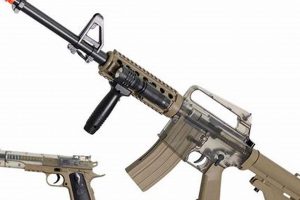
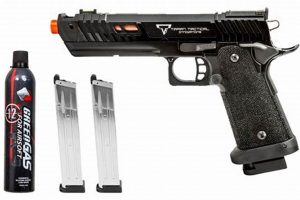
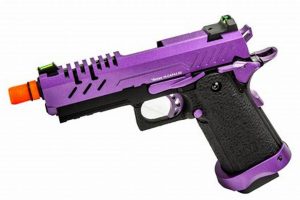
The muzzle energy of an airsoft gun, typically measured in joules, indicates the kinetic energy imparted to the projectile. This value directly influences the velocity and range of the BB. For example, an airsoft rifle might possess a muzzle energy of 1.5 joules, propelling a 0.20g BB at a certain speed.
Muzzle energy is a crucial factor because it determines the potential impact force and thereby influences safety considerations and regulations. Different regions and fields have specific limits on allowed muzzle energy to minimize the risk of injury. Understanding the energy output provides players and field operators a benchmark to ensure compliance with safety standards.
Various factors affect the energy level. These encompass the gun’s internal mechanics, the type of gas used (if applicable), and the weight of the BB. Subsequent sections will delve into these contributing factors and how they affect the overall muzzle energy of airsoft devices.
Guidance on Airsoft Gun Muzzle Energy
The following provides several key considerations regarding muzzle energy in airsoft devices to ensure responsible and informed usage.
Tip 1: Verify Field Limits: Prior to participating in any airsoft event, confirm the specific joule limits enforced by the field or organizer. These regulations are in place to ensure player safety and must be strictly adhered to.
Tip 2: Utilize a Chronograph: Employ a chronograph to accurately measure the muzzle energy of any airsoft gun. This device provides an objective measurement of the BB’s velocity, allowing for the calculation of energy output and verification of compliance with field limits.
Tip 3: Consider BB Weight: Understand that the weight of the BB affects the muzzle energy. A heavier BB will typically result in a lower velocity but can maintain a comparable or slightly reduced muzzle energy compared to lighter BBs fired from the same gun.
Tip 4: Maintain Consistent Pressure: For gas-powered airsoft guns, ensure a consistent gas pressure. Fluctuations in gas pressure can significantly impact the BB’s velocity and therefore, its energy. Regular maintenance and appropriate gas selection are critical.
Tip 5: Upgrade Components with Caution: When upgrading internal components, such as springs or inner barrels, be cognizant of the potential impact on muzzle energy. Small changes can lead to significant increases, potentially exceeding field limits. Re-chronograph the airsoft gun after any modifications.
Tip 6: Research Regulatory Compliance: Investigate the regulations pertaining to airsoft devices in relevant jurisdictions. Some areas have legal restrictions on permissible energy levels, and users must be aware of and comply with such laws.
Tip 7: Regularly Inspect: Perform regular inspections and maintenance on airsoft guns to identify and address any issues that could affect consistent operation or unexpectedly increase energy levels.
Adherence to these guidelines promotes a safer and more responsible airsoft experience by maintaining muzzle energy within accepted parameters.
The subsequent sections will further explore related aspects of airsoft gun performance and safety.
1. Velocity

Velocity is a foundational element in determining the muzzle energy of an airsoft gun. It directly correlates with the kinetic energy transferred to the BB, thus influencing the energy output.
- Velocity Measurement
Velocity is measured as the speed at which the BB exits the barrel, typically expressed in feet per second (FPS) or meters per second (MPS). This value, combined with the mass of the BB, is used in the kinetic energy calculation. A higher velocity, given a constant BB weight, translates directly to a higher energy.
- Impact on Range and Accuracy
Increased velocity generally results in a flatter trajectory and extended range. However, excessive velocity can negatively impact accuracy, particularly with lighter BBs, due to increased air resistance and deviation. Therefore, achieving an optimal balance between velocity and accuracy is crucial for effective gameplay.
- Influence of Internal Components
The velocity of an airsoft gun is largely determined by its internal components, such as the spring strength in spring-powered guns, or the gas pressure and valve system in gas-powered models. Upgrades to these components can increase velocity, but must be carefully managed to remain within safety and field regulations regarding muzzle energy.
- Relationship to BB Weight
While increasing velocity generally increases energy, the effect is intertwined with BB weight. A lighter BB will achieve a higher velocity than a heavier BB with the same energy input. However, a heavier BB retains more of its velocity downrange and is less susceptible to wind, contributing to different effective ranges and energy transfer characteristics.
The relationship between velocity and energy underscores the importance of using a chronograph to accurately measure the velocity of an airsoft gun. This enables precise calculation of energy and ensures compliance with field rules. Understanding the interplay between velocity, BB weight, and internal components is essential for optimizing performance and adhering to safety guidelines.
2. BB Weight
BB weight is a critical determinant of the energy output of an airsoft gun. The kinetic energy, measured in joules, is directly proportional to the mass of the BB. This means that for a given velocity, a heavier BB will possess greater kinetic energy than a lighter BB. For example, if two airsoft guns propel BBs at the same velocity, one firing a 0.20g BB and the other a 0.25g BB, the 0.25g BB will have a higher energy value. This difference in energy is significant in the context of field regulations, as most fields specify maximum energy limits, not just velocity limits.
The selection of BB weight also impacts accuracy and range. While a lighter BB may achieve a higher initial velocity, it is more susceptible to air resistance and wind drift, leading to reduced accuracy at longer distances. Conversely, a heavier BB retains its velocity better over distance, providing improved accuracy and range, but at the expense of a lower initial velocity. Practical application requires a compromise and the selection of BB weight is commonly based on barrel length, hop-up effectiveness and personal play style or field conditions. A longer barrel will generally allow more time to accelerate a heavier BB. A more effective hop-up will also allow heavier BB’s to be used with higher accuracy. Choosing heavier BB’s for outdoor fields and in conditions with wind will provide greater range and accuracy, whereas lighter BB’s are selected for indoor environments where range is not a factor.
In summary, BB weight is inextricably linked to muzzle energy, influencing both the joule output and the overall performance of the airsoft gun. A thorough understanding of this relationship is crucial for adhering to safety regulations, optimizing accuracy, and achieving the desired range. Compliance with field regulations means that a player using heavier BBs must often use a weaker spring or lower pressure gas to avoid exceeding the allowable muzzle energy, thus presenting trade-offs between power, accuracy, and range. Selecting the right BB weight is not merely a matter of preference, but one that profoundly affects the performance and legality of airsoft gameplay.
3. Internal Mechanics

The internal mechanics of an airsoft gun are critical in determining the kinetic energy, measured in joules, imparted to the BB. These components dictate the efficiency and force with which the BB is propelled, thus directly influencing the device’s energy output.
- Spring Strength (Spring-Powered Airsoft Guns)
In spring-powered airsoft guns, the spring stores potential energy which is released upon firing to propel the BB. A stronger spring will impart more force, resulting in higher muzzle velocity and, consequently, greater energy. However, an excessively strong spring can exceed field limits or damage internal components. The spring’s compression ratio and material properties also contribute to the overall energy output.
- Gas Pressure and Valve Systems (Gas-Powered Airsoft Guns)
Gas-powered airsoft guns rely on compressed gas (e.g., CO2, green gas, propane) to propel the BB. The gas pressure and the efficiency of the valve system control the amount of force applied to the BB. A higher gas pressure, regulated by the valve system, results in a higher velocity and, consequently, greater energy. Fluctuations in gas pressure or inefficiencies in the valve system can lead to inconsistent energy output.
- Gear Ratio and Motor (Electric Airsoft Guns)
Electric airsoft guns (AEGs) utilize a motor and gear system to compress a spring. The gear ratio determines the rate at which the spring is compressed and released. A higher gear ratio can result in a faster rate of fire but may reduce the force exerted on the BB, impacting energy. The motor’s torque and speed also influence the system’s efficiency and the BB’s velocity. Fine tuning the gear ratio and motor can change the rate of fire (ROF) or the muzzle velocity.
- Air Compression Components (All Types)
Regardless of the power source (spring, gas, or electric), the efficiency of air compression components (e.g., piston head, cylinder, air nozzle) is vital. Leaks or inefficiencies in these components reduce the amount of force applied to the BB, diminishing the overall energy. Proper sealing and maintenance of these components are essential for maintaining consistent energy output and maximizing performance.
The interplay between these internal mechanics directly dictates the energy transferred to the BB. Modifications or upgrades to these components can significantly alter the muzzle energy, potentially exceeding field limits or creating safety concerns. Therefore, a comprehensive understanding of these mechanics and their impact on energy is crucial for responsible airsoft gun ownership and use.
4. Gas Pressure
In gas-powered airsoft guns, gas pressure serves as the direct propellant force behind the BB. A higher gas pressure exerts a greater force on the BB as it accelerates through the barrel. This increased force results in a higher muzzle velocity. Given that kinetic energy, measured in joules, is directly proportional to the square of the velocity, even small increases in gas pressure can lead to substantial changes in energy output. For instance, an airsoft pistol operating with consistent gas pressure might produce a muzzle energy of 1 joule. However, if the pressure increases by 10%, the resulting muzzle energy could increase significantly, potentially exceeding field regulations.
Maintaining stable gas pressure is critical for consistent performance. Fluctuations in pressure, caused by temperature changes or inconsistencies in the gas source, lead to variability in muzzle energy. This inconsistency not only affects the accuracy of shots but also poses a safety concern if energy levels intermittently exceed established limits. Therefore, gas-powered airsoft devices typically incorporate pressure regulators designed to maintain a consistent output. Furthermore, the type of gas used (e.g., CO2, green gas, propane) influences the maximum achievable pressure and, consequently, the potential muzzle energy of the device. Different gases exhibit different pressure characteristics at varying temperatures, necessitating careful gas selection to optimize performance while adhering to safety standards.
The link between gas pressure and joule output is fundamental to understanding the operation and regulation of gas-powered airsoft guns. Proper management of pressure, achieved through regulator systems and appropriate gas selection, ensures consistent performance and adherence to safety regulations. Challenges remain in maintaining stable pressure across diverse environmental conditions. Comprehensive understanding of this relationship is crucial for safe and responsible airsoft gun ownership and usage.
5. Safety Regulations

Safety regulations directly constrain the permissible energy output of airsoft guns, influencing design, usage, and field operation. Jurisdictions and individual airsoft fields impose limits, generally measured in joules, to minimize the risk of injury. These regulations act as a crucial parameter, dictating the maximum allowable muzzle energy. For example, certain countries may restrict airsoft guns to a maximum of 1 joule, mandating manufacturers to design and market products compliant with this limitation. Failure to adhere to these regulations results in legal consequences, including fines, confiscation of equipment, and potential criminal charges.
The enforcement of safety regulations occurs through a combination of legal frameworks and self-regulation within the airsoft community. Field operators routinely use chronographs to measure the muzzle velocity of airsoft guns, converting these measurements into joule values to ensure compliance. Players modifying their airsoft guns must be acutely aware of the potential impact on muzzle energy, as even seemingly minor alterations can lead to violations of safety regulations. An understanding of these regulations is not merely a suggestion but a necessity for safe and legal participation in the sport.
The implications of safety regulations extend beyond legal compliance. Adherence fosters a culture of responsibility, promoting player safety and mitigating the risk of accidents. Challenges exist in harmonizing regulations across different jurisdictions and ensuring consistent enforcement. Nonetheless, the connection between safety regulations and muzzle energy remains fundamental to responsible airsoft practice. Prioritizing safety regulations translates to a safer environment for all involved, underscoring their importance in airsoft.
6. Field Limits

Field limits dictate the maximum allowable muzzle energy, measured in joules, for airsoft guns used on a specific playing field. These limits are implemented to ensure player safety and mitigate the risk of injuries resulting from excessive projectile force. The relationship between field limits and the potential energy output of an airsoft gun is direct: the higher the field limit, the greater the permissible energy and potential impact force. Conversely, lower field limits necessitate that airsoft guns operate at reduced energy levels.
For example, an indoor airsoft field might impose a 1-joule limit to accommodate close-quarters combat, while an outdoor field might allow up to 1.5 joules to permit longer-range engagements. Airsoft fields enforce these limits through mandatory chronograph testing, where each airsoft gun is tested to verify its muzzle velocity and calculate its energy output. Airsoft guns exceeding the specified field limit are deemed non-compliant and prohibited from use. This enforcement mechanism is critical for maintaining a safe playing environment. Many fields also impose Minimum Engagement Distances (MED). These MEDs will change based on the guns joule rating. For example, a gun shooting between 1 and 1.5 joules might be forced to adhere to a MED of 20 feet. In these cases, a player could only engage another player if the distance between them was more than 20 feet. MEDs are also implemented to ensure safety for all airsoft players, especially in fields that allow higher joule ratings.
The establishment and enforcement of field limits are crucial for responsible airsoft gameplay. These parameters regulate the maximum energy permissible during gameplay which directly influences player safety. While variations in field limits exist based on field type and intended style of gameplay, all field limits share a core commitment to minimizing the risk of injury. Maintaining awareness and adherence to field limits is essential for all participants in the sport, ensuring a secure environment for engaging in airsoft activities. Failure to adhere to field limits will, at minimum, result in the player being disallowed from using their airsoft gun, but can also lead to being disallowed from participating in the game.
Frequently Asked Questions
The following addresses common questions concerning muzzle energy of airsoft guns and its implications for safety and gameplay.
Question 1: What is the significance of measuring muzzle energy in joules?
Measuring muzzle energy in joules provides a standardized and objective assessment of the kinetic energy imparted to the BB. This measurement allows for consistent application of safety regulations and fair gameplay by providing a comparable metric across different airsoft gun types and BB weights.
Question 2: How does BB weight influence the energy output of an airsoft gun?
BB weight directly influences the energy output. A heavier BB, propelled at the same velocity as a lighter BB, possesses greater kinetic energy. Therefore, selecting an appropriate BB weight is crucial to remain within established muzzle energy limits.
Question 3: What is the role of a chronograph in airsoft?
A chronograph measures the velocity of the BB as it exits the airsoft gun barrel. This velocity reading is then used to calculate the muzzle energy, allowing players and field operators to verify compliance with field regulations and safety standards.
Question 4: Why do different airsoft fields have varying muzzle energy limits?
Different fields establish varying muzzle energy limits based on factors such as the playing environment (indoor vs. outdoor), the intended style of gameplay (close-quarters combat vs. long-range engagements), and specific safety considerations. Indoor fields typically have lower limits to minimize risk in confined spaces.
Question 5: How do modifications to an airsoft gun affect its muzzle energy?
Modifications, such as upgrading the spring, inner barrel, or gas system, can significantly alter the muzzle energy of an airsoft gun. Such modifications can inadvertently cause the airsoft gun to exceed field limits, necessitating re-chronographing and potential adjustments to ensure compliance.
Question 6: What are the potential consequences of exceeding established muzzle energy limits?
Exceeding established muzzle energy limits poses safety risks, potentially causing injury to other players. Furthermore, exceeding these limits can result in penalties such as disqualification from gameplay, fines, and, in some jurisdictions, legal repercussions.
Maintaining awareness of muzzle energy and adhering to established limits is essential for safe and responsible airsoft participation.
The following section will summarize the key aspects discussed in this article.
Conclusion
The determination of the muzzle energy that an airsoft gun possesses is a multifaceted issue, influenced by factors encompassing velocity, BB weight, internal mechanics, gas pressure, safety regulations, and field limits. Each of these aspects plays a crucial role in defining the energy output and, consequently, the potential risk associated with these devices. Comprehension of these interacting elements is vital for promoting safety, ensuring fair play, and complying with legal and regulatory frameworks.
Prioritizing a thorough understanding of the factors affecting muzzle energy remains paramount. Continual awareness and diligent adherence to established guidelines promotes a safer and more responsible approach to the sport, benefitting both individual players and the wider airsoft community. Only through such concerted effort can the potential risks be mitigated, and the integrity of airsoft as a recreational activity be preserved.