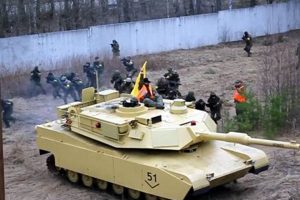
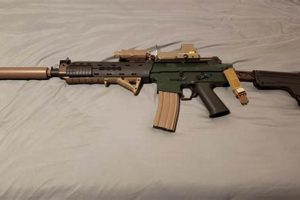
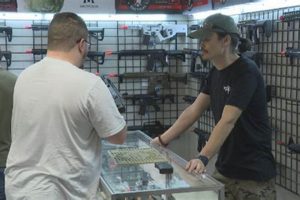
This activity simulates military combat using realistic replica firearms that discharge non-lethal, spherical plastic projectiles. Participants engage in tactical scenarios within designated areas, adhering to established safety rules and gameplay objectives. This form of recreational simulation offers a controlled environment for individuals to experience strategic planning and teamwork.
The significance of this simulation lies in its ability to foster strategic thinking, communication skills, and physical fitness. Furthermore, its origins can be traced back to Japan in the 1970s as a means of firearms training where real firearms ownership was restricted. Over time, it evolved into a popular recreational activity worldwide, offering participants an immersive and challenging experience.
The following sections will delve into the specific equipment employed, the variety of game types commonly encountered, and the paramount importance of safety regulations governing participation. This comprehensive overview aims to provide a thorough understanding of the multifaceted nature of the activity.
Strategic Considerations for Simulated Combat
Success in simulated combat environments hinges on a combination of tactical awareness, equipment proficiency, and adherence to established protocols. The following guidelines are intended to enhance understanding and improve performance.
Tip 1: Prioritize Situational Awareness: Maintaining constant awareness of surroundings is crucial. Observation of terrain, identification of potential threats, and anticipation of opponent movements are fundamental to effective decision-making.
Tip 2: Master Team Communication: Clear and concise communication is paramount for coordinated action. Utilize pre-established codes and signals to convey information efficiently and prevent misunderstandings.
Tip 3: Optimize Equipment Configuration: Proper adjustment and maintenance of equipment are essential for optimal performance. Ensure secure attachment of accessories, proper calibration of optics, and regular inspection of replica firearms.
Tip 4: Employ Cover and Concealment: Utilize available cover and concealment effectively to minimize exposure to enemy fire. Employ terrain features, artificial structures, and camouflage techniques to enhance survivability.
Tip 5: Practice Fire Discipline: Conserve ammunition and maintain accuracy by practicing controlled bursts of fire. Avoid indiscriminate firing and prioritize targeted shots on identified threats.
Tip 6: Adapt to Changing Circumstances: Remain flexible and adaptable in response to evolving tactical situations. Adjust plans and strategies as needed based on new information and emerging threats.
Tip 7: Understand Game Objectives: Familiarize oneself with the specific objectives of each scenario and prioritize actions that contribute to their completion. Collaboration with teammates is often crucial for achieving victory.
Adherence to these guidelines promotes both enhanced performance and a safer, more enjoyable experience for all participants. Strategic planning and disciplined execution are key elements of success.
The subsequent section will explore the ethical considerations and responsible practices associated with participation in simulated combat activities.
1. Tactical Simulation

Tactical simulation forms the bedrock upon which the structure of this combat activity is built. It is not merely a superficial resemblance to military operations, but rather the intentional design of scenarios, equipment selection, and rule sets that encourage participants to engage in realistic decision-making processes. The use of cover, communication protocols, and objective-based missions closely mirrors strategies employed in actual combat, influencing the manner in which participants approach the simulated conflict. Consequently, the success of the activity hinges on the extent to which these simulations accurately represent relevant tactical considerations. For instance, a scenario requiring the capture of a fortified position necessitates the application of fire and maneuver tactics, demanding coordinated movement and suppressive fire, thereby mirroring the complexities of a real-world assault.
The importance of tactical simulation within this activity extends beyond mere entertainment value. It offers a platform for individuals to develop critical thinking skills, enhance teamwork abilities, and improve their understanding of strategic planning. By confronting simulated tactical challenges, participants gain practical experience in risk assessment, resource allocation, and decision-making under pressure. This, in turn, can contribute to the development of valuable leadership qualities and an appreciation for the complexities of military operations. This facet also enables organized groups, such as military units and law enforcement teams, to use the simulation as a cost-effective and safe means of training for specific operational scenarios. This offers a distinct advantage over expensive, large-scale training exercises involving live ammunition and real-world risks.
In conclusion, tactical simulation is not simply an element, but rather the fundamental framework of this activity. Its successful implementation demands careful consideration of scenario design, equipment realism, and consistent application of safety protocols. Understanding its significance allows participants to appreciate its value as a recreational pursuit and a potential training tool. The challenges of accurately simulating the complexities of combat environments remain, but the ongoing refinement of scenarios and equipment ensures that the activity continues to evolve, offering an increasingly realistic and engaging experience.
2. Equipment Realism

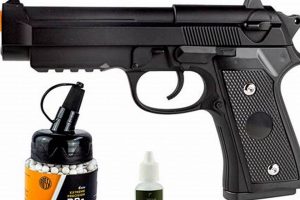
The degree of equipment realism profoundly influences the nature and perceived value of airsoft warfare. The closer replica firearms and tactical gear mirror their real-world counterparts, the greater the immersion and tactical fidelity of the simulation. This realism impacts strategic decision-making, forcing participants to consider factors such as weapon weight, sight alignment, and ammunition capacity, elements that are critical in actual combat scenarios. For example, using a replica rifle with a similar weight distribution to a real firearm affects a player’s movement speed and aiming stability, thereby influencing tactical choices such as selecting firing positions or engaging targets at varying distances. The use of authentic-looking tactical vests with functional pouches encourages the realistic distribution of magazines and other essential equipment, prompting thoughtful resource management and tactical loadout planning.
The pursuit of equipment realism has led to a proliferation of highly detailed replica firearms, accessories, and gear. Manufacturers strive to replicate the look, feel, and function of real firearms with increasing accuracy. This emphasis extends beyond aesthetics, encompassing features such as realistic blowback action, authentic markings, and compatibility with real-world accessories. The use of these realistic replicas necessitates adherence to safe handling procedures and reinforces the importance of responsible firearm ownership, even within the context of a simulated environment. Law enforcement and military organizations sometimes utilize this characteristic for training purposes, using realistic replicas to practice weapon manipulation and tactical maneuvers in a controlled setting, thereby mitigating the risks associated with live firearms training.
Ultimately, equipment realism is a crucial component that elevates airsoft warfare from a simple recreational activity to a more immersive and tactically engaging simulation. While maintaining safety and adhering to legal regulations are paramount, the pursuit of greater realism enhances the strategic depth and educational value of the activity. The balance between authentic representation and safe participation continues to shape the evolution of equipment used in the airsoft field, driving innovation and reinforcing the importance of responsible engagement.
3. Strategic Planning

Strategic planning constitutes a critical element within successful airsoft warfare engagement. The development and execution of tactical objectives, resource allocation, and adaptation to evolving circumstances on the field necessitate a structured planning process. Without effective strategic planning, teams often resort to disorganized actions, resulting in inefficiency and a diminished probability of achieving mission objectives. For example, a scenario involving the capture of a designated stronghold requires preliminary planning that encompasses team composition, route selection, identification of potential defensive positions, and contingencies for unforeseen obstacles. This planning phase directly influences the likelihood of successfully breaching the stronghold and neutralizing opposing forces.
The practical significance of strategic planning is evident in its correlation to improved performance metrics. Teams that dedicate time to pre-engagement analysis, communication protocols, and contingency planning typically exhibit superior coordination, faster response times, and a more efficient use of resources. A real-world example can be drawn from airsoft events that simulate military operations, where teams equipped with detailed maps, pre-determined communication codes, and well-defined roles consistently outperform less organized opponents. Furthermore, effective strategic planning extends beyond initial preparations, encompassing the ability to adapt to changing conditions during engagement. Identifying weaknesses in the opponent’s defense, exploiting terrain advantages, and modifying tactics in response to unforeseen challenges are all components of adaptive strategic execution.
In conclusion, strategic planning represents an indispensable aspect of effective airsoft warfare, influencing both pre-engagement preparations and real-time decision-making. The capacity to develop and execute tactical plans, allocate resources efficiently, and adapt to evolving circumstances directly correlates with improved performance and a higher probability of achieving mission objectives. Although the activity involves simulated combat, the underlying principles of strategic planning remain applicable, offering participants valuable experience in critical thinking, teamwork, and leadership.
4. Teamwork Emphasis
Teamwork is not merely a desirable attribute but a fundamental prerequisite for success in simulated combat. The complex tactical scenarios inherent to the activity necessitate coordinated action, shared responsibility, and effective communication among participants.
- Coordinated Movement
Effective coordinated movement dictates success. Players advance and retreat in unison. Without synchronized actions, individuals become vulnerable and compromise the team’s overall strategic position. A successful coordinated breach, for example, requires multiple team members to suppress enemy fire while others advance to secure a point, each relying on the actions of their comrades.
- Shared Communication Protocols
Shared communication protocols ensure a common understanding and efficient information dissemination. Pre-established signals, terminology, and reporting structures minimize confusion and enable rapid response to evolving threats. This might involve designating specific code words for identifying enemy positions or signaling the need for medical assistance, facilitating streamlined communication under pressure.
- Role Specialization and Interdependence
Role specialization and interdependence allocate responsibilities based on individual skillsets and equipment. Each player assumes a specific role, such as a scout, medic, or designated marksman, contributing to the team’s overall capabilities. This interdependence emphasizes that the success of one player is often contingent upon the performance of others, fostering a sense of shared responsibility and reliance.
- Conflict Resolution and Consensus Building
Conflict resolution and consensus building are crucial for navigating disagreements and making strategic decisions. Teams encounter situations where differing opinions and priorities require compromise and collaboration. A successful team possesses the ability to resolve conflicts constructively, ensuring that all members feel valued and that decisions are made in the best interest of the group.
These facets of teamwork, while present in many competitive activities, are magnified in the context of simulated combat, highlighting the interdependency required for mission accomplishment. The emphasis on teamwork not only enhances the overall experience but also cultivates valuable skills applicable to various real-world scenarios beyond the field of play.
5. Safety Protocols

Safety protocols are not optional addenda but rather foundational tenets upon which responsible and ethical airsoft warfare participation depends. Their rigorous implementation mitigates inherent risks, protecting participants and fostering a culture of respect and responsibility.
- Mandatory Eye Protection
Mandatory eye protection constitutes the single most critical safety measure. The high-velocity projectiles employed pose a significant risk of ocular injury. ANSI Z87.1 rated goggles or full-face masks are universally required to provide adequate protection against projectile impact. Failure to adhere to this protocol can result in severe and permanent visual impairment.
- Velocity Limits and Regulations
Velocity limits are strictly enforced to minimize the potential for injury. Chronographs are used to measure the muzzle velocity of replica firearms, ensuring they do not exceed established safety thresholds. These limits vary depending on the specific type of firearm and the proximity of engagement. Exceeding these limits significantly increases the risk of bruising, welts, and more serious injuries.
- Minimum Engagement Distances
Minimum engagement distances are implemented to prevent close-range injuries. Firing at opponents from excessively close range concentrates the impact force of the projectile, increasing the likelihood of pain and injury. Designated minimum engagement distances mandate that players maintain a safe separation distance before initiating fire, promoting responsible engagement tactics.
- Designated Safe Zones
Designated safe zones are areas where eye protection is not required and replica firearms must be rendered incapable of firing, typically through the use of barrel covers or magazine removal. These zones provide a safe haven for participants to rest, re-arm, and adjust equipment without the risk of accidental discharge or projectile impact. Strict adherence to safe zone protocols prevents accidental injuries and maintains a safe environment for all participants.
These multifaceted safety protocols, when consistently and rigorously enforced, create a responsible and controlled environment, allowing for the enjoyment of simulated combat without undue risk. Neglecting these protocols undermines the integrity of the activity and poses a direct threat to the well-being of all participants.
Frequently Asked Questions
The following section addresses common inquiries regarding airsoft warfare, providing clear and concise answers to promote a comprehensive understanding of the activity.
Question 1: What defines airsoft warfare as distinct from other recreational activities?
Airsoft warfare differentiates itself through its emphasis on realistic tactical simulation, employing replica firearms and strategic scenarios that mimic military operations. This distinguishes it from paintball or laser tag, which typically prioritize speed and immediate scoring.
Question 2: What are the primary safety precautions required in airsoft warfare?
Mandatory eye protection, adherence to velocity limits, maintenance of minimum engagement distances, and utilization of designated safe zones constitute the primary safety protocols. These measures are crucial for minimizing the risk of injury during simulated engagements.
Question 3: What is the typical range of replica firearms used in airsoft warfare?
The effective range of airsoft replica firearms varies depending on the model and configuration, but generally falls within 100-200 feet. Factors such as projectile weight, hop-up adjustment, and wind conditions can affect the range.
Question 4: What types of tactical gear are commonly used in airsoft warfare?
Tactical vests, helmets, protective eyewear, communication devices, and load-bearing equipment are common gear items. These items provide protection, facilitate communication, and enable participants to carry essential supplies.
Question 5: How is fair play and adherence to rules enforced in airsoft warfare?
Fair play relies on the honesty and integrity of participants, supplemented by marshals or referees who oversee gameplay and enforce rules. The honor system is often employed, requiring participants to self-report being hit by a projectile.
Question 6: What legal considerations govern the ownership and use of replica firearms in airsoft warfare?
Legal regulations vary by jurisdiction. Compliance with local laws pertaining to replica firearms ownership, transportation, and use is imperative. Some regions may require orange tips or other markings to distinguish them from real firearms.
In summation, airsoft warfare necessitates a comprehensive understanding of its distinct characteristics, safety requirements, and ethical considerations. Responsible participation requires strict adherence to established protocols and a commitment to fair play.
The subsequent section will explore the future trends and technological advancements shaping the evolution of airsoft warfare.
Conclusion
This exploration has illuminated the multifaceted nature of airsoft warfare, underscoring its core elements of tactical simulation, equipment realism, strategic planning, teamwork emphasis, and rigorous safety protocols. A thorough comprehension of these aspects is crucial for responsible participation and a full appreciation of the activity’s potential benefits and inherent risks. From the mandatory use of eye protection to the importance of pre-engagement strategy, each component contributes to a safe and engaging simulated combat experience.
As this activity continues to evolve with technological advancements and shifting social perspectives, adherence to ethical guidelines and the consistent enforcement of safety regulations remain paramount. Recognizing the potential for both personal development and potential risks, individuals engaging in airsoft warfare should prioritize responsible conduct and contribute to a culture of respect within the community. Further research into the long-term effects of simulated combat and the optimization of safety measures is warranted to ensure the continued growth and responsible enjoyment of this dynamic activity.