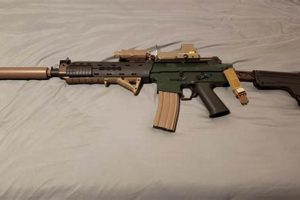
This accessory, designed for use with airsoft guns, simulates the effect of tracer rounds by illuminating specialized projectiles as they are fired. It is typically cylindrical and attaches to the muzzle of the airsoft weapon, resembling a firearm sound suppressor in appearance. The device utilizes ultraviolet (UV) light to cause the BBs, which have been coated with a phosphorescent material, to glow brightly during their flight path, making them visually trackable, especially in low-light conditions.
The primary advantage of this technology lies in enhanced gameplay. The ability to observe the trajectory of fired BBs enables users to make more accurate adjustments to their aim, particularly during nighttime or indoor skirmishes. This increases the tactical awareness of the player and can contribute to improved performance. The illumination effect also adds a visual dimension to the game, heightening the immersive experience for all participants. Historically, this technology has evolved from simple light-based systems to more sophisticated electronic units featuring motion sensors and automatic activation, increasing efficiency and battery life.
Further discussion will delve into the internal mechanisms, types of available models, considerations for purchasing, and maintenance procedures associated with this tactical airsoft accessory. Understanding these aspects is crucial for users seeking to optimize their gameplay and ensure the longevity of their equipment.
Airsoft Tracer Suppressor
Optimizing the performance and longevity of an airsoft tracer suppressor requires adherence to specific guidelines regarding its operation and upkeep. Implementing these practices will ensure reliable functionality during airsoft engagements.
Tip 1: Battery Management: Employ rechargeable batteries of the recommended voltage and amperage. Overcharging or using incompatible power sources can damage the internal electronics. Ensure the unit is switched off when not in use to prevent unnecessary battery drain.
Tip 2: BB Compatibility: Utilize tracer BBs designed for optimal illumination. The quality and phosphorescent coating of the BB significantly affect the brightness and visibility of the tracer effect. Experiment with different brands to determine the best performance for the specific unit.
Tip 3: Thread Compatibility: Verify that the airsoft tracer suppressor is compatible with the airsoft gun’s barrel threading. Incorrect threading can lead to damage to the suppressor and the airsoft gun, as well as potential misalignments. Adapters can be used where necessary.
Tip 4: Cleaning Procedures: Regularly clean the interior of the suppressor with a soft cloth or cleaning rod. Accumulated debris, such as BB fragments or dust, can obstruct the UV light and diminish the tracer effect. Avoid using abrasive cleaners or solvents that may damage the internal components.
Tip 5: Storage Practices: Store the airsoft tracer suppressor in a dry, protected environment when not in use. Exposure to moisture or extreme temperatures can compromise the internal electronics and reduce the lifespan of the unit.
Tip 6: Light Sensor Calibration: Some models feature adjustable light sensors to control activation. Adjust the sensitivity according to the ambient lighting conditions to optimize the tracer effect without premature or delayed activation.
Tip 7: Pre-Game Check: Prior to each airsoft game, verify that the airsoft tracer suppressor is securely attached to the airsoft gun and that the battery is sufficiently charged. A pre-game inspection can prevent malfunctions during gameplay.
Adhering to these guidelines will maximize the effectiveness and extend the operational life of the airsoft tracer suppressor. Proper maintenance and compatible component selection are crucial for consistent performance and reliability on the airsoft field.
The following sections will explore the various types of airsoft tracer suppressors available and their suitability for different gameplay scenarios.
1. Illumination Technology

Illumination technology forms the core functionality of the airsoft tracer suppressor. This technology enables the user to visually track the path of BBs fired from an airsoft gun, particularly in low-light or nighttime scenarios. The design and effectiveness of the illumination system are crucial determinants of the suppressor’s performance.
- UV LED Emission
Ultraviolet (UV) light-emitting diodes (LEDs) serve as the primary light source within most airsoft tracer suppressors. These LEDs emit a specific wavelength of UV light designed to activate the phosphorescent coating on tracer BBs. The intensity and consistency of the UV light emission directly impact the brightness and visibility of the illuminated BBs in flight. Different suppressors may employ varying numbers and types of UV LEDs, resulting in varying degrees of illumination power.
- Phosphorescent Material
The tracer BBs used in conjunction with an airsoft tracer suppressor are coated with a phosphorescent material. This material absorbs UV light emitted by the suppressor’s LEDs and subsequently emits visible light, causing the BB to glow. The composition and quality of the phosphorescent coating influence the brightness and duration of the BB’s glow. High-quality coatings ensure a longer and more intense illumination, enhancing the user’s ability to track the BB’s trajectory.
- Activation Mechanisms
Airsoft tracer suppressors typically incorporate activation mechanisms to trigger the UV LED illumination. These mechanisms may include motion sensors, which detect the movement of the BB as it passes through the suppressor, or sound sensors, which respond to the firing sound of the airsoft gun. The responsiveness and reliability of the activation mechanism are critical for ensuring that the UV LEDs are activated precisely when a BB is fired, maximizing battery life and minimizing unnecessary light emission.
- Power Source and Efficiency
The power source of the airsoft tracer suppressor, typically a rechargeable battery, directly affects its operational duration and overall performance. The efficiency of the illumination technology, including the LEDs and activation mechanism, determines the amount of power required to achieve adequate illumination. Energy-efficient designs prolong battery life and reduce the need for frequent recharging, enhancing the user’s experience during extended airsoft games.
The interplay between UV LED emission, phosphorescent material properties, activation mechanisms, and power source efficiency ultimately dictates the effectiveness of an airsoft tracer suppressor’s illumination technology. Optimizing these components ensures enhanced BB tracking, improved gameplay, and extended operational life of the device. The continuing development of more efficient and robust illumination systems contributes to the ongoing evolution of airsoft tracer technology.
2. BB Compatibility

BB compatibility is a paramount consideration when employing an airsoft tracer suppressor. The performance of the suppressor is intrinsically linked to the type and quality of BBs used. Selecting inappropriate BBs can compromise the illumination effect and potentially damage the suppressor itself.
- Phosphorescent Coating Quality
Tracer BBs designed for use with suppressors feature a phosphorescent coating that reacts to ultraviolet (UV) light emitted by the suppressor. The quality of this coating directly influences the brightness and duration of the BB’s illumination. Inferior coatings may result in dim or short-lived tracer effects, diminishing the tactical advantage provided by the suppressor. Examples include BBs with uneven coatings, leading to inconsistent illumination, or coatings that degrade quickly, reducing effectiveness over time.
- BB Weight and Consistency
BB weight affects the trajectory and range of the projectile. Using BBs that are either too light or too heavy for the airsoft gun’s specifications can lead to inaccurate shots and inconsistent performance. Furthermore, variations in BB weight within a single batch can exacerbate these issues. In the context of a tracer suppressor, consistent BB weight is crucial for predictable flight paths and reliable illumination, enabling effective target tracking and aiming adjustments.
- BB Material and Hardness
The material composition and hardness of BBs impact their durability and potential to damage the suppressor’s internal components. BBs made from brittle or low-quality materials may shatter upon firing, leaving fragments inside the suppressor that obstruct the UV light source or damage sensitive sensors. Harder BBs, while more durable, may cause excessive wear on the suppressor’s internal surfaces over time. Choosing BBs with appropriate material properties and hardness is essential for maintaining the suppressor’s longevity and performance.
- BB Size and Tolerance
Airsoft BBs are nominally 6mm in diameter, but slight variations in size can occur. These variations, even within acceptable tolerances, can impact the performance of an airsoft tracer suppressor. BBs that are marginally oversized may cause jams or feed issues, while those that are undersized might not properly activate the illumination mechanism. Precise manufacturing tolerances are essential for reliable operation and consistent illumination of the tracer BBs. Using only high-quality BBs with tight tolerances ensures optimal function of the airsoft tracer unit.
In summary, BB compatibility is not merely a matter of functionality but a critical factor that influences the overall effectiveness and longevity of the airsoft tracer suppressor. Proper selection, based on coating quality, weight consistency, material properties, and size tolerances, is imperative for maximizing performance and preventing damage to the equipment. The investment in high-quality, suppressor-compatible BBs is a worthwhile consideration for any serious airsoft player utilizing tracer technology.
3. Battery Dependence
An airsoft tracer suppressor’s functionality is intrinsically tied to its battery. The battery serves as the energy source for the ultraviolet (UV) light-emitting diodes (LEDs) that illuminate tracer BBs. Without sufficient battery power, the suppressor cannot activate the UV LEDs, rendering the device ineffective. This dependency underscores the criticality of battery selection, management, and maintenance for consistent performance. The power draw of the LEDs and activation circuitry dictate battery life, influencing the length of time the suppressor can be used before requiring a recharge or replacement. Models employing more efficient LEDs or intelligent power management systems offer extended operational durations. Real-world examples include users experiencing diminished tracer visibility during extended gameplay sessions due to depleted batteries, highlighting the tangible impact of this dependency.
The choice of battery type further affects the user experience. Rechargeable batteries, such as lithium polymer (LiPo) or nickel-metal hydride (NiMH) batteries, are commonly used due to their capacity for repeated use. However, each battery type possesses distinct characteristics regarding voltage, discharge rate, and charging requirements. Mismatched batteries can lead to performance degradation or even damage to the suppressor’s electronics. Furthermore, the external temperatures can affect battery performance. Low temperatures can reduce battery capacity and lifespan. Battery maintenance, including proper charging cycles and storage conditions, also influences battery life and reliability. Neglecting these factors can result in reduced performance or premature battery failure, directly impacting the suppressor’s operational readiness.
Ultimately, understanding the battery dependence of an airsoft tracer suppressor is essential for ensuring its consistent and reliable operation. Careful consideration of battery type, capacity, and proper maintenance practices are critical. The challenge lies in balancing the need for extended battery life with the desire for a lightweight and compact suppressor design. Ongoing technological advancements in battery technology and energy-efficient LED designs promise to alleviate these constraints and further enhance the practicality of airsoft tracer technology. This careful balancing act ensures the battery enhances the function instead of limiting it.
4. Thread Adaptability

Thread adaptability is a critical aspect of airsoft tracer suppressor functionality and compatibility. Suppressors attach to airsoft guns via threaded connections, typically located at the muzzle end of the barrel. These threads vary in size and direction (clockwise or counter-clockwise). Incompatible threading renders a suppressor unusable without an adapter, affecting both functionality and aesthetic integration. A mismatched thread can damage the suppressor or the airsoft gun’s barrel threads, potentially requiring costly repairs or replacements. This directly impacts the suppressor’s effective use. A user attempting to install a 14mm counter-clockwise threaded suppressor on a 14mm clockwise threaded barrel, for instance, would find the connection impossible without an adapter or risking damage through forced installation.
Adapters bridge the gap between incompatible thread types, enabling cross-compatibility. These adapters are available in various configurations to convert thread sizes and directions. While adapters offer a solution, they introduce additional length to the airsoft gun, potentially affecting maneuverability. Moreover, adapters must be securely fastened to prevent wobble or misalignment, which can negatively impact BB trajectory and, consequently, the effectiveness of the tracer unit. Furthermore, the quality and precision of the adapter’s threading are crucial. Poorly manufactured adapters can introduce play or stripping of threads, undermining the stability of the connection and potentially causing damage over time.
In conclusion, thread adaptability is essential for ensuring seamless integration and optimal performance of airsoft tracer suppressors. Manufacturers often provide thread specifications for both suppressors and airsoft guns, emphasizing the importance of verification before purchase. While adapters offer a pragmatic workaround, careful consideration of their potential drawbacks and quality is necessary. Prioritizing thread compatibility from the outset minimizes the risk of damage, performance degradation, and compatibility issues, contributing to a more streamlined and effective airsoft experience. Future suppressors with universal thread designs are desired to address the above issues.
5. Material Composition

The material composition of an airsoft tracer suppressor directly influences its durability, weight, and overall performance. The choice of materials affects the suppressor’s ability to withstand impacts, resist environmental degradation, and maintain structural integrity under the stresses of repeated use. For example, suppressors constructed from lightweight aluminum alloys offer a balance of strength and portability, making them suitable for dynamic gameplay scenarios. The type of plastic utilized in certain models, particularly those housing electronic components, is chosen for its impact resistance and thermal properties, preventing damage from internal heat generation and external impacts. The specific material dictates the suppressor’s resilience against fragmentation, deformation, and functional failure, directly impacting its longevity and reliability on the field.
Internal components, such as lenses and electronic housings, also rely on specific materials for optimal performance. The clarity and durability of lenses, often made from specialized polymers or glass, affect the efficiency of ultraviolet (UV) light transmission and the visibility of tracer BBs. Similarly, the material used for electronic housings must provide adequate insulation and protection against moisture, dust, and physical shock, ensuring the reliable operation of the UV light source and activation circuitry. An inappropriate material choice, such as a brittle plastic prone to cracking, can compromise the functionality of these internal components and necessitate premature replacement of the suppressor.
Understanding the material composition of an airsoft tracer suppressor provides valuable insight into its potential performance characteristics and expected lifespan. Factors such as impact resistance, thermal stability, and environmental resilience must be considered when selecting a suppressor for specific gameplay environments and intensity levels. The use of robust materials ensures the suppressor can withstand the rigors of airsoft skirmishes, providing consistent and reliable tracer functionality. Ongoing advancements in material science continue to drive innovation in suppressor design, resulting in lighter, stronger, and more durable models that enhance the overall airsoft experience.
6. Size and Weight

The size and weight of an airsoft tracer suppressor significantly impact the maneuverability and handling characteristics of the airsoft gun it is attached to. A larger and heavier suppressor can shift the weapon’s center of gravity forward, potentially making it more cumbersome to aim and maneuver in close-quarters combat situations. This alteration in balance affects the shooter’s ability to quickly transition between targets and maintain accuracy, particularly during rapid firing sequences or while navigating confined spaces. For instance, a longer suppressor can impede movement through doorways or around obstacles, reducing tactical effectiveness. Conversely, excessively compact and lightweight suppressors may compromise durability or illumination performance, sacrificing functionality for the sake of reduced size and weight.
Furthermore, size and weight considerations influence the choice of mounting systems and accessory compatibility. A heavier suppressor necessitates a more robust attachment mechanism to ensure secure and stable mounting. Inadequate mounting can lead to wobble, misalignment, or even detachment during use, jeopardizing accuracy and potentially damaging the suppressor or the airsoft gun. The added weight can also strain the airsoft gun’s barrel or receiver, accelerating wear and tear over time. Consequently, users must carefully evaluate the compatibility of the suppressor with their specific airsoft gun model, considering factors such as barrel length, material strength, and mounting system design. The balance between size, weight, and mounting stability must be carefully considered.
In summary, the size and weight of an airsoft tracer suppressor are critical factors that directly influence the overall handling and performance of the airsoft gun. A well-balanced design optimizes maneuverability, enhances accuracy, and ensures long-term reliability. Users should prioritize a suppressor that complements their playing style and airsoft gun configuration, carefully weighing the trade-offs between size, weight, durability, and illumination performance. The pursuit of lighter yet robust materials remains a key driver in the ongoing evolution of airsoft suppressor technology, aiming to minimize the impact on weapon handling while maximizing functionality.
7. Durability Factors

Durability factors significantly dictate the lifespan and operational reliability of an airsoft tracer suppressor. These factors encompass the material composition, structural design, and resistance to environmental stressors that collectively determine how well the suppressor withstands the rigors of airsoft gameplay. A suppressor’s ability to endure impacts, exposure to moisture, and the stresses of repeated firing cycles directly correlates to its longevity and consistent performance. For instance, a suppressor constructed from a high-impact polymer may resist cracking or deformation from accidental drops or BB strikes, ensuring continued functionality. Conversely, a suppressor with poorly sealed internal electronics may succumb to moisture damage, rendering the UV illumination system inoperable.
The structural design of the suppressor also plays a crucial role in its overall durability. A robust internal framework can mitigate the effects of impacts and vibrations, protecting sensitive components such as the UV LEDs and activation circuitry. Suppressors featuring reinforced mounting points are less susceptible to detachment or wobble, maintaining a stable and aligned connection with the airsoft gun. Furthermore, the quality of manufacturing processes, including the precision of thread cutting and the integrity of bonding agents, directly impacts the structural integrity and long-term reliability of the suppressor. An example would be a tracer unit with a poorly affixed end-cap; such a design fault leads to premature separation and subsequently compromises the internal electronics.
In conclusion, a comprehensive understanding of durability factors is essential for selecting an airsoft tracer suppressor that will withstand the demands of airsoft gameplay. The interplay of material composition, structural design, and manufacturing quality directly determines the suppressor’s ability to endure impacts, resist environmental stressors, and maintain consistent performance over time. Investing in a suppressor with robust durability features minimizes the risk of malfunction, extends the product’s lifespan, and ensures a reliable and enjoyable airsoft experience. The ongoing pursuit of stronger, lighter, and more resilient materials will continue to drive improvements in the durability and overall performance of airsoft tracer suppressors.
Frequently Asked Questions
This section addresses common inquiries regarding the functionality, operation, and maintenance of airsoft tracer suppressors. The information provided aims to clarify misconceptions and offer guidance for optimal usage.
Question 1: What is the effective range of an airsoft tracer suppressor?
The effective range is contingent upon ambient lighting conditions, the quality of tracer BBs, and the power of the UV LEDs within the suppressor. In complete darkness, tracer BBs are typically visible up to the maximum effective range of the airsoft gun itself. However, in environments with even minimal ambient light, the tracer effect diminishes.
Question 2: Are airsoft tracer suppressors compatible with all airsoft guns?
Compatibility hinges on the threading at the muzzle of the airsoft gun. Most airsoft guns utilize either 14mm clockwise or 14mm counter-clockwise threading. If the threading of the suppressor and airsoft gun are incompatible, an adapter is required. However, some airsoft guns may lack threading altogether, precluding the use of a suppressor.
Question 3: How frequently should an airsoft tracer suppressor be cleaned?
Cleaning frequency depends on usage. Regular cleaning is advisable to remove BB fragments and debris that can obstruct the UV light. A recommended interval is after each skirmish or approximately every 2,000 rounds fired. Compressed air and a soft brush are suitable cleaning tools.
Question 4: What type of batteries are suitable for airsoft tracer suppressors?
Most airsoft tracer suppressors utilize rechargeable lithium polymer (LiPo) or nickel-metal hydride (NiMH) batteries. The specific voltage and capacity requirements vary depending on the suppressor model. Consult the manufacturer’s specifications to ensure compatibility and prevent damage.
Question 5: Can standard airsoft BBs be used in an airsoft tracer suppressor?
No. Standard airsoft BBs lack the phosphorescent coating necessary for illumination. Only tracer BBs, specifically designed for use with tracer units, will produce the desired glowing effect. Using standard BBs will not damage the suppressor but will render the tracer function useless.
Question 6: What causes an airsoft tracer suppressor to malfunction?
Common causes include depleted batteries, obstructed UV LEDs due to debris, damaged wiring, or incompatible BBs. Exposure to moisture or extreme temperatures can also lead to malfunctions. Troubleshooting steps include checking battery charge, cleaning the unit, and inspecting the wiring for damage.
These FAQs provide a foundational understanding of airsoft tracer suppressors. Adhering to proper usage and maintenance guidelines is essential for optimal performance and longevity.
The subsequent section will provide information on purchasing considerations for airsoft tracer suppressors.
Conclusion
This exploration has detailed the operational mechanisms, compatibility considerations, and maintenance requirements associated with the airsoft tracer suppressor. The core functionality, reliant on UV illumination of specialized BBs, enhances gameplay by enabling visual tracking of projectiles, particularly in low-light environments. Optimal performance necessitates adherence to specific guidelines regarding battery management, BB selection, and cleaning procedures.
The effectiveness of the airsoft tracer suppressor hinges on a comprehensive understanding of its technical aspects and diligent maintenance practices. Proper implementation of these measures ensures consistent performance and maximizes the lifespan of the equipment. Continued advancements in materials and illumination technology promise to further enhance the capabilities and reliability of this tactical airsoft accessory.