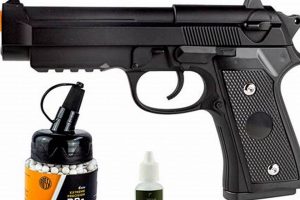
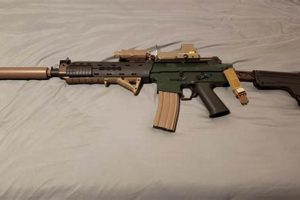
These replicas closely resemble real firearms, often mimicking their appearance, weight, and operation. They launch spherical plastic projectiles, typically 6mm or 8mm in diameter, propelled by compressed gas or a spring mechanism. A common application is in simulated combat scenarios and target practice.
Their significance lies in providing a safe and controlled environment for training, recreation, and historical reenactments. They allow individuals to develop weapon handling skills, practice marksmanship, and engage in tactical simulations without the dangers associated with actual firearms. The rise in popularity reflects a growing interest in realistic simulation and accessible recreational activities.
Further discussion will delve into the construction materials, operating mechanisms, performance characteristics, and relevant safety considerations associated with these recreational devices.
Enhancing Performance with Replicated Handguns
Maximizing the effectiveness of simulated firearm replicas requires diligent attention to maintenance, upgrades, and tactical application. The following guidelines offer insights into optimizing performance and ensuring safe operation.
Tip 1: Maintain Consistent Cleaning Schedules: Regular cleaning of the internal mechanisms is paramount. Disassembly and lubrication, as specified by the manufacturer, prevent malfunctions and maintain consistent firing velocity.
Tip 2: Utilize Appropriate Propellants: Select the propellant type (e.g., green gas, CO2) that is compatible with the model’s design. Incorrect propellants can damage internal components or lead to inconsistent performance.
Tip 3: Employ High-Quality Projectiles: The consistency of projectiles directly impacts accuracy. Utilize precision-molded projectiles of uniform weight and diameter to minimize deviations in trajectory.
Tip 4: Optimize Hop-Up Adjustments: The hop-up system imparts backspin to projectiles, extending their range. Fine-tune the hop-up setting to achieve optimal trajectory and accuracy at various distances.
Tip 5: Invest in Precision Inner Barrels: Upgrading to a tightbore inner barrel can enhance accuracy by reducing projectile wobble during firing. Ensure the barrel length is appropriate for the specific model.
Tip 6: Practice Consistent Grip and Stance: Maintaining a stable grip and stance is critical for accuracy. Practice proper shooting techniques to minimize movement and improve target acquisition.
Tip 7: Prioritize Eye Protection: Always wear ANSI-rated eye protection during operation and maintenance. Accidental discharge or component failure can result in serious eye injury.
Adhering to these guidelines will contribute to improved performance, extended lifespan, and enhanced safety when utilizing these replicated handguns. Consistent maintenance and tactical awareness are key factors in maximizing their potential.
The subsequent sections will address safety protocols, responsible handling practices, and legal considerations related to these simulated firearms.
1. Realism in Replication

The degree of realism achieved in the replication of actual firearms is a critical factor influencing the utility and application of replicated handguns. Fidelity to the original weapon’s form, function, and operational characteristics dictates its suitability for training, simulation, and recreational purposes.
- External Appearance and Dimensions
Replicated handguns strive to mirror the physical attributes of their real counterparts. This includes dimensional accuracy, replicating the contours, size, and weight distribution of the original firearm. Realistic external features enable users to practice proper handling techniques, weapon manipulation, and holster draw drills that closely approximate real-world scenarios. For example, a training exercise that requires drawing a weapon from a concealed carry holster benefits from a replica that matches the dimensions of the actual carry weapon.
- Functional Controls and Operation
A high degree of realism extends to the functionality of controls. Replicated handguns may feature functional slide releases, magazine releases, safety mechanisms, and trigger actions that mimic the operation of the original firearm. This allows users to develop muscle memory and proficiency in performing essential tasks such as loading, unloading, clearing malfunctions, and engaging the safety. Replicated firearm training can then mimic the functional challenges of the real thing.
- Recoil Simulation and Feedback
Advanced models incorporate mechanisms to simulate recoil and tactile feedback during firing. This can be achieved through gas blowback systems or other mechanical means. Recoil simulation enhances the training experience by providing a more realistic representation of the physical forces experienced when firing a real firearm. This allows users to develop recoil management skills and improve accuracy under simulated stress.
- Material Composition and Weight
The materials used in construction contribute significantly to the overall realism. High-quality models utilize materials that closely resemble those found in real firearms, such as metal alloys and durable polymers. Matching the weight of the original firearm is essential for replicating the balance and handling characteristics. This is particularly important for training scenarios where users need to become accustomed to the feel and handling of a specific weapon.
The combination of these elementsappearance, functional controls, recoil, and materialsdetermines the degree to which the replicated handgun accurately reflects the experience of handling and operating a real firearm. This realism, in turn, influences the effectiveness of these tools in training, simulation, and responsible recreational activities, and helps provide a level of safety in environments where using a real firearm would be too dangerous.
2. Propulsion Mechanisms Variance
The diverse range of propulsion mechanisms directly influences the performance characteristics, operational requirements, and maintenance demands of replicated handguns. Understanding the nuances of each system is critical for selecting a model appropriate for the intended application.
- Gas Blowback (GBB) Systems
GBB systems utilize compressed gas, typically green gas or CO2, to propel projectiles and cycle the slide, simulating the recoil action of a real firearm. This mechanism provides a high degree of realism and is commonly found in models intended for training and simulation. However, GBB systems are sensitive to temperature fluctuations and require regular maintenance to prevent gas leaks and ensure consistent performance. For example, a GBB pistol used in a law enforcement training exercise will provide realistic recoil feedback, but requires careful maintenance to function reliably.
- Non-Blowback (NBB) Systems
NBB systems also use compressed gas, but do not cycle the slide. This simplifies the mechanism, resulting in greater gas efficiency and quieter operation. NBB models are often preferred for skirmishes or stealth applications where minimizing noise is essential. The reduced mechanical complexity generally translates to lower maintenance requirements and increased reliability. For example, a sniper might prefer an NBB pistol as a sidearm due to its quiet operation.
- Electric Powered (Automatic Electric Pistol – AEP) Systems
AEP systems utilize an electric motor and gearbox to compress a spring, which then propels the projectile. AEPs offer consistent performance in varying temperature conditions and are generally easier to maintain than gas-powered systems. However, they typically exhibit lower power output and less realistic recoil. They are commonly used in indoor skirmishes where consistent performance is prioritized over realism. As another example, electric-powered airsoft guns are common to use indoor where can’t generate loud sounds.
- Spring-Powered Systems
Spring-powered systems rely on manual compression of a spring to propel the projectile. These models are the simplest and most affordable, but require manual cocking before each shot. Spring pistols are typically less powerful and less accurate than gas or electric-powered models, and are primarily used for recreational target practice. These models are common to find in toy stores.
The selection of a specific propulsion mechanism should be guided by the intended use case. GBB systems offer realism for training, NBB systems prioritize efficiency and stealth, AEP systems provide consistent performance, and spring-powered systems offer affordability for recreational use. Each system presents distinct advantages and disadvantages that must be carefully considered.
3. Projectile Velocity Regulation

Projectile velocity regulation is a fundamental aspect of replicated firearm design and operation. It dictates the potential for injury, influences the effective range, and is a primary factor in determining compliance with legal and safety standards. In the context of replicated handguns, velocity control is achieved through various mechanisms, including gas regulator valves, spring tension adjustment, and gearbox configuration. Failure to adequately regulate projectile velocity can result in excessive force upon impact, leading to potential injury to participants in skirmishes or bystanders. For instance, many organized simulated combat events impose strict velocity limits, often measured in feet per second (FPS) with standardized projectile weights. Violations can result in immediate disqualification due to safety concerns.
The design of gas-powered models incorporates regulator valves that control the flow of gas to the projectile, thereby limiting the maximum velocity. Electric-powered models utilize gearboxes and motor systems that determine the rate at which the spring is compressed and released, which directly impacts projectile speed. In spring-powered models, the spring tension is the primary determinant of velocity. Modifications or alterations that bypass these regulation mechanisms can drastically increase projectile velocity, exceeding safe limits and potentially transforming a recreational device into a dangerous instrument. One example is the intentional modification of a gas pistol’s regulator valve to increase FPS, which could easily violate established safety protocols and increase the risk of injury.
Effective projectile velocity regulation is critical for maintaining safety and ensuring compliance with legal restrictions. It necessitates responsible manufacturing practices, proper maintenance, and adherence to established guidelines. Understanding the principles of velocity regulation and the potential consequences of exceeding safe limits is paramount for users and retailers of replicated handguns. The ongoing development of more sophisticated velocity control mechanisms aims to enhance safety and expand the range of applications for these devices while minimizing the potential for harm. The careful regulation of projectile velocity is a shared responsibility among manufacturers, retailers, and end-users, ensuring safe operations.
4. Material Composition Impact

Material selection significantly influences the durability, performance, and realism of replicated handguns. Polymers, metals, and composite materials are employed in varying combinations, each imparting distinct characteristics to the final product. Polymer frames contribute to reduced weight and cost, while metal slides and barrels enhance structural integrity and aesthetic fidelity to actual firearms. The balance between these materials often dictates the operational lifespan and resistance to wear and tear, for example, a pistol with a metal slide is more likely to withstand frequent use and cycling than one solely constructed from polymer. A deeper understanding of these materials is vital for evaluating the expected longevity and suitability of replicated firearms for specific applications.
The choice of materials directly affects the functionality and perceived quality. High-grade aluminum alloys contribute to increased robustness and resistance to impact damage, vital for skirmishes and training scenarios. Conversely, lower-grade plastics might compromise the firearm’s ability to withstand rigorous use, increasing the likelihood of breakage and malfunction. Consider the difference between a replicated handgun designed for competitive simulated combat, which would benefit from robust metal components, and a lower-cost model intended for casual target practice, where polymer construction might be adequate. These material choices directly impact the performance and longevity of the replica.
In summary, material composition serves as a critical determinant of a replicated handgun’s overall quality, durability, and realism. Discerning the properties of different materials allows for more informed purchasing decisions and responsible use. Recognizing the potential trade-offs between cost, weight, durability, and realism enables consumers to select models that align with their specific needs and expectations. A considered approach to material evaluation enhances user satisfaction and ensures a safer and more enjoyable recreational experience.
5. Safety Protocol Adherence

Strict adherence to safety protocols is paramount when engaging with simulated firearms. These devices, while non-lethal, can cause injury if mishandled or used irresponsibly. Protective eyewear, designed to withstand projectile impact, constitutes the most critical safety measure. Eye injuries, ranging from corneal abrasions to permanent vision impairment, represent the most common consequence of neglecting this precaution. The use of full-face masks is advisable in close-quarters combat scenarios or when operating high-velocity models.
Responsible handling extends beyond personal protection to encompass the surrounding environment. Maintaining a safe muzzle direction, even when the device is unloaded, prevents accidental discharge from posing a risk to others. Storing replicas securely, out of reach of children and unauthorized individuals, mitigates the potential for misuse and accidental injury. Furthermore, awareness of local laws and regulations pertaining to simulated firearms is essential. Some jurisdictions restrict the open carry of these devices or require them to be transported in designated containers. One can consider that neglecting these requirements may result in legal penalties and confiscation of the device.
In summary, safety protocol adherence represents an indispensable component of responsible ownership and operation. Consistent application of protective measures, coupled with awareness of legal and ethical considerations, minimizes the risk of injury and promotes a safe environment. Prioritizing safety not only protects individuals but also safeguards the reputation of the hobby and ensures its continued accessibility. Neglecting safety protocols carries potentially severe consequences, underscoring the critical importance of responsible behavior. With safety at the forefront, the use of replicated firearms is a fun and harmless activity.
Frequently Asked Questions
The following questions address common inquiries regarding these devices, providing clarity on their capabilities, limitations, and responsible use.
Question 1: What constitutes an “airsoft-style pistol” and how does it differ from other types of projectile-launching devices?
An airsoft-style pistol is a replica firearm designed to fire spherical plastic projectiles. These are distinguished from BB guns or pellet guns, which typically use metal projectiles and operate at higher velocities, and from toy guns that lack realistic features and intended applications.
Question 2: What are the typical safety precautions one must undertake while operating an airsoft-style pistol?
Eye protection is mandatory at all times during operation and maintenance. A safe muzzle direction is critical, even when the device is unloaded. Proper storage away from children and unauthorized individuals is essential.
Question 3: What legal restrictions govern the ownership and use of airsoft-style pistols?
Regulations vary by jurisdiction. Some areas require orange tip markings for identification, restrict open carry, or mandate transportation in closed containers. Knowledge of local laws is the responsibility of the owner.
Question 4: What factors influence the accuracy and range of an airsoft-style pistol?
Projectile quality, hop-up adjustment, barrel quality, and propulsion system efficiency all impact accuracy and range. Environmental factors, such as wind, also play a role.
Question 5: How does one maintain an airsoft-style pistol to ensure its proper function and longevity?
Regular cleaning, lubrication of moving parts, and proper storage are essential. Adherence to the manufacturer’s maintenance guidelines is recommended.
Question 6: What are the implications of modifying an airsoft-style pistol, particularly concerning projectile velocity?
Modifications that increase projectile velocity beyond safe limits can result in injury and potential legal ramifications. Tampering with safety mechanisms is strongly discouraged.
These answers offer a concise overview of essential considerations related to these recreational devices. Responsible ownership and operation are paramount.
The subsequent section will explore the potential applications and benefits derived from the use of these simulated firearms.
Conclusion
The preceding discussion has explored various facets of airsoft-style pistols, encompassing their design, operation, safety protocols, and legal considerations. Key points addressed include the importance of realistic replication, the variance in propulsion mechanisms, the necessity of projectile velocity regulation, the impact of material composition, and the absolute requirement for safety protocol adherence. A clear understanding of these elements is crucial for responsible ownership and operation.
Given the potential for both recreational enjoyment and practical training, airsoft-style pistols warrant continued scrutiny and responsible development. A commitment to safety, adherence to legal standards, and a dedication to informed usage are essential for ensuring the sustained viability of this activity. Further research and refinement of safety technologies will contribute to a more secure and enriching experience for all involved.