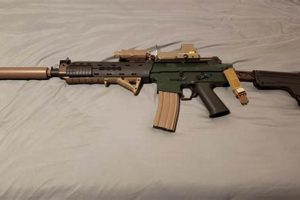
The creation of rifle components for simulated combat weaponry through additive manufacturing, specifically involving the buttstock, represents a growing trend. This method allows for the fabrication of these parts using digital designs and materials like polymers. As an example, a player might require a customized buttstock for their airsoft rifle to improve ergonomics, which they can obtain through this process.
This approach offers advantages such as design flexibility, the ability to produce parts on demand, and potential cost savings compared to traditional manufacturing methods. Historically, obtaining specialized or custom airsoft components required extensive modification of existing parts or relying on limited aftermarket options. Additive manufacturing provides an alternative, enabling individuals and small businesses to rapidly prototype and produce these items.
The following sections will delve into the materials suitable for fabricating these components, the design considerations involved in creating robust and functional parts, and the legal and ethical aspects of producing simulated weapon components.
Key Considerations for Additive Manufacturing of Simulated Firearm Components
The following guidelines address essential factors to consider when producing buttstocks for simulated firearms using additive manufacturing technologies. Attention to these details is crucial for ensuring functionality, durability, and adherence to legal and ethical standards.
Tip 1: Material Selection: Selecting an appropriate material is paramount. Polylactic acid (PLA) is a common choice for prototyping, but Acrylonitrile Butadiene Styrene (ABS) or Nylon-based filaments offer superior impact resistance and durability for functional components. Consider the specific stresses the buttstock will endure during gameplay.
Tip 2: Design for Strength: Implement design features that enhance structural integrity. Incorporate internal reinforcing structures, such as infill patterns with high density, to resist stress concentrations. Avoid sharp corners, which can act as stress risers, and use fillets or radii to distribute loads more evenly.
Tip 3: Layer Orientation: Orient the component during printing to maximize strength in critical directions. The layer lines represent planes of weakness. Align the layers to resist forces applied during use. For example, printing with the long axis of the stock vertical may improve its resistance to bending.
Tip 4: Post-Processing: Consider post-processing techniques to improve the finished part’s properties. Sanding, priming, and painting can enhance the aesthetics and provide additional protection against the elements. Chemical smoothing, if appropriate for the material, can improve surface finish and potentially increase strength.
Tip 5: Tolerances and Fitment: Precisely measure and model the connection points where the buttstock attaches to the simulated firearm. Ensure accurate tolerances in the 3D model to guarantee a secure and stable fit. Test fit the printed component before final finishing.
Tip 6: Legal Compliance: Understand and comply with all applicable laws and regulations regarding the manufacturing and modification of simulated firearms. These regulations may vary depending on location, and it is the responsibility of the producer to ensure adherence.
Tip 7: Ethical Considerations: Recognize the potential for misuse of simulated firearms and act responsibly. Avoid producing components that could be easily modified to accept real firearm parts or that could be used to create realistic replicas for illicit purposes.
Adhering to these guidelines promotes the creation of robust, safe, and legally compliant components. Careful planning, material selection, and execution are essential for achieving successful results.
The subsequent sections will examine the practical applications of these principles in specific design scenarios.
1. Material Strength

Material strength is a critical determinant of the functional lifespan and overall performance of an airsoft buttstock produced via additive manufacturing. The buttstock of an airsoft rifle is subjected to various stresses during gameplay, including impact from falls, pressure from shouldering the weapon, and cyclical loading from recoil. Inadequate material strength can lead to premature failure of the component, rendering the rifle unusable and potentially causing injury to the user. For example, a buttstock printed from a brittle material, such as standard PLA, may crack or shatter upon impact with a hard surface, negating any ergonomic or aesthetic advantages it may have possessed. Therefore, selecting materials with sufficient tensile strength, impact resistance, and flexural modulus is paramount to ensuring the durability and reliability of an airsoft buttstock produced via 3D printing.
The specific material requirements are further influenced by the design of the buttstock. A more complex design with thinner sections and intricate features necessitates a material with higher strength characteristics to compensate for potential weak points. Conversely, a simpler, more robust design may allow for the use of materials with slightly lower strength specifications without compromising functionality. Common materials employed include ABS, known for its impact resistance; nylon, favored for its flexibility and durability; and carbon fiber-reinforced filaments, offering high strength-to-weight ratios. The choice depends on balancing performance requirements, printing ease, and cost considerations. Furthermore, post-processing techniques, such as annealing or chemical treatments, can sometimes be used to enhance the strength characteristics of printed components.
In summary, the selection of a material with adequate strength is not merely a technical detail but a fundamental requirement for creating a functional and safe airsoft buttstock via 3D printing. Compromising on material strength to save cost or simplify the printing process can have significant negative consequences in terms of product durability and user safety. A comprehensive understanding of material properties, design principles, and manufacturing processes is therefore essential for successfully producing high-quality airsoft components using additive manufacturing technologies.
2. Design Integrity

Design integrity, in the context of producing airsoft buttstocks via additive manufacturing, refers to the soundness and robustness of the digital design. It encompasses factors ensuring the final printed component is both functionally effective and structurally reliable, capable of withstanding the stresses inherent in airsoft gameplay. Deficiencies in design integrity can lead to premature failure, user dissatisfaction, and potentially unsafe conditions.
- Structural Analysis and Load Paths
This facet involves simulating the forces and stresses the buttstock will experience during use. Finite element analysis (FEA) software can be employed to identify stress concentrations and optimize the design for maximum strength and minimal material usage. For example, a poorly designed buttstock might exhibit high stress concentrations around the attachment point to the rifle, leading to cracking or breakage under recoil or impact. Proper analysis allows designers to reinforce these critical areas proactively.
- Material Properties and Print Orientation
Design integrity is intrinsically linked to the selected material’s characteristics and how the design is oriented during printing. An inherently strong material, like carbon fiber-reinforced nylon, might compensate for minor design flaws, whereas a weaker material demands a more structurally sound design. Furthermore, layer orientation impacts strength; printing a buttstock with layers oriented perpendicular to the direction of the primary load can significantly weaken the component. This aspect demands careful consideration of material properties and printer settings.
- Geometric Considerations and Feature Integration
The overall geometry and the integration of features like adjustable cheek rests or sling mounts profoundly influence design integrity. Sharp corners and abrupt transitions can create stress risers, weakening the structure. Smooth, flowing lines and gradual transitions are preferable. Properly integrated features, such as sling mounts reinforced with additional material around the attachment points, enhance the overall robustness of the buttstock, preventing premature failure.
- Tolerance and Fitment
Design integrity extends to ensuring precise fitment with the airsoft rifle’s receiver. Inaccurate dimensions or inadequate tolerances can lead to a loose or unstable connection, compromising the buttstock’s functionality and potentially damaging the rifle. Precise measurements and accurate modeling of the interface between the buttstock and the rifle are essential for ensuring a secure and reliable fit.
These interconnected facets of design integrity are crucial for achieving a durable, functional, and safe airsoft buttstock through additive manufacturing. Neglecting any of these elements can result in a compromised component, undermining the benefits of customization and on-demand production that 3D printing offers. Successful implementation requires a comprehensive understanding of materials, manufacturing processes, and the application’s specific demands.
3. Printer Accuracy

Printer accuracy is a paramount determinant in the viability of utilizing additive manufacturing for airsoft buttstocks. This accuracy directly influences dimensional precision, surface finish, and the overall structural integrity of the final product. Inadequate printer accuracy can lead to significant deviations from the intended design, resulting in a component that is either incompatible with the airsoft rifle, structurally unsound, or aesthetically unappealing. For example, if the internal diameter of the buttstock attachment point is printed with insufficient accuracy, it may either fail to fit onto the rifle’s buffer tube or fit loosely, compromising stability and potentially causing damage during use. Similarly, inaccurate printing of threaded features can render them unusable, requiring post-processing or rendering the entire component unusable. Therefore, achieving a high degree of printer accuracy is not merely a cosmetic concern but a fundamental requirement for producing functional and reliable airsoft buttstocks.
The impact of printer accuracy extends beyond simple dimensional deviations. Inaccurate printing can also introduce inconsistencies in layer adhesion, resulting in weakened structural integrity. This is particularly critical in areas subjected to high stress, such as the interface between the buttstock and the rifle’s receiver. Inconsistent layer adhesion can create stress concentrations, leading to premature failure under load. Furthermore, surface finish is directly affected by printer accuracy; inaccurate printing can result in rough or uneven surfaces, diminishing the component’s aesthetic appeal and potentially impacting its ergonomic properties. For instance, a rough surface finish on the cheek rest can cause discomfort during prolonged use. Calibration, material selection, and understanding limitations are keys to mitigating effects on component characteristics.
In summary, printer accuracy is inextricably linked to the success of producing airsoft buttstocks via additive manufacturing. It directly affects the component’s fit, structural integrity, and aesthetic appeal. While design and material selection are crucial considerations, they are ultimately contingent on the printer’s ability to accurately translate the digital design into a physical object. Overcoming the challenges of printer accuracy requires careful calibration, appropriate material selection, and a thorough understanding of the printer’s capabilities and limitations. Ensuring high printer accuracy is therefore essential for realizing the full potential of additive manufacturing in the creation of functional and aesthetically pleasing airsoft components.
4. Ergonomic Customization
Ergonomic customization constitutes a primary driver for employing additive manufacturing in the production of airsoft buttstocks. This capability addresses the inherent variability in user anthropometry and preferences, allowing for tailored components that enhance comfort, weapon handling, and overall performance.
- Adjustable Length of Pull
Length of pull, the distance between the trigger and the buttplate, significantly impacts shooter comfort and accuracy. Additive manufacturing enables the creation of buttstocks with adjustable length of pull, accommodating users with varying arm lengths. For instance, a shorter player might require a reduced length of pull to maintain proper cheek weld and trigger reach, improving aiming stability and reducing strain. This customization is difficult to achieve with traditional manufacturing methods, which often rely on fixed dimensions or limited adjustment ranges.
- Customizable Cheek Rests
Cheek weld, the contact point between the shooter’s cheek and the buttstock, is crucial for consistent sight alignment. Additive manufacturing allows for the creation of cheek rests with adjustable height and lateral positioning, optimizing eye alignment with the optic or iron sights. A player using a raised optic might require a higher cheek rest to achieve a proper sight picture, improving accuracy and reducing neck strain. Traditional buttstocks often lack this degree of adjustability, forcing users to adapt their shooting posture or rely on aftermarket accessories.
- Grip Angle and Texture
The angle and texture of the grip portion of the buttstock influence weapon control and comfort, particularly during rapid firing or maneuvering. Additive manufacturing enables the creation of grips with customized angles and textures, catering to individual preferences and hand sizes. A player might prefer a more vertical grip angle for improved wrist comfort or a more aggressive texture for enhanced grip security. Traditional manufacturing methods often impose limitations on grip design, resulting in compromises between ergonomics and manufacturability.
- Weight Optimization and Balance
The weight and balance of the airsoft rifle significantly impact handling and fatigue. Additive manufacturing allows for the creation of buttstocks with optimized weight distribution, improving overall weapon balance and reducing strain on the user. A player might prefer a lighter buttstock to reduce overall weight or a heavier buttstock to counterbalance a front-heavy rifle. Traditional manufacturing methods often involve compromises between weight, strength, and cost, limiting the ability to fine-tune weapon balance.
These facets of ergonomic customization, facilitated by additive manufacturing, contribute to a more personalized and effective airsoft experience. The ability to tailor buttstocks to individual needs and preferences enhances comfort, weapon handling, and overall performance, providing a significant advantage over traditional manufacturing methods. The integration of adjustable features and customized geometries represents a key benefit of employing additive manufacturing in this application.
5. Legal Compliance
The additive manufacturing of airsoft buttstocks necessitates strict adherence to legal regulations, which vary significantly across jurisdictions. Ignorance or disregard for these regulations can result in legal penalties, including fines and potential criminal charges. Therefore, a thorough understanding of applicable laws is paramount before engaging in the design, production, or distribution of these components.
- Classification of Airsoft Devices
Airsoft devices are classified differently depending on the location. Some jurisdictions treat them as toys, while others categorize them as replica firearms. The classification dictates the regulations governing their manufacture, modification, and sale. For instance, modifying an airsoft device to resemble a real firearm too closely might be illegal in certain areas. A lack of awareness of these local ordinances can result in unintended violations.
- Material Restrictions and Marking Requirements
Specific regulations might dictate the types of materials permissible for manufacturing airsoft components, aiming to prevent the creation of parts that could be easily converted for use in real firearms. Furthermore, some jurisdictions mandate specific markings on airsoft devices to clearly differentiate them from real firearms. Failing to comply with these material and marking requirements can lead to confiscation of the manufactured components and legal action.
- Sales and Distribution Regulations
The sale and distribution of airsoft devices, including individual components, are often subject to licensing and age restrictions. Selling airsoft buttstocks to minors or distributing them without the necessary permits can result in legal penalties. Online sales are particularly complex, as they may be subject to regulations in both the seller’s and the buyer’s location. Comprehensive due diligence is essential to ensure compliance.
- Intellectual Property Rights
Manufacturing and distributing airsoft buttstocks based on proprietary designs or licensed products without authorization constitutes a violation of intellectual property rights. Companies producing airsoft rifles often hold patents and trademarks on their designs. Creating and selling replicas of these designs without permission can lead to legal action from the rights holders. It is crucial to ensure that all designs are original or properly licensed.
The intersection of additive manufacturing and airsoft components introduces unique challenges in maintaining legal compliance. The ease with which designs can be replicated and disseminated necessitates a proactive approach to understanding and adhering to applicable laws. Furthermore, staying informed about evolving regulations is crucial, as legislation regarding airsoft devices and additive manufacturing is subject to change. A commitment to legal compliance is not merely a matter of risk mitigation but a fundamental aspect of responsible manufacturing.
6. Cost Efficiency
The economic viability of producing airsoft buttstocks through additive manufacturing hinges on a nuanced understanding of various cost factors. While initial perceptions might suggest cost savings, a comprehensive analysis reveals a more complex interplay of expenses and potential benefits.
- Material Costs and Waste Reduction
Material expenses represent a significant component of the overall cost. Additive manufacturing allows for precise material usage, minimizing waste compared to subtractive methods. For instance, creating a complex buttstock design via milling would generate substantial material waste, whereas additive manufacturing builds the part layer by layer, using only the necessary material. The cost-effectiveness is material-dependent, with high-performance filaments often carrying a premium. The type of part and print parameters heavily influence cost.
- Tooling and Setup Expenses
Traditional manufacturing methods often require substantial investment in tooling, such as molds or machining fixtures. Additive manufacturing largely eliminates these costs, reducing the barrier to entry for producing custom or low-volume buttstocks. A small airsoft team, for example, could produce specialized buttstocks without the capital expenditure associated with injection molding. However, the 3D printer itself represents an initial investment.
- Labor and Skill Requirements
While additive manufacturing automates much of the production process, skilled labor is still required for design, printer operation, and post-processing. Designing a functional and durable buttstock requires expertise in CAD software and an understanding of material properties. Printer maintenance and troubleshooting also demand technical knowledge. In some cases, post-processing, such as sanding or painting, adds to labor costs, especially when compared to mass-produced products.
- Production Volume and Scalability
Additive manufacturing is generally cost-effective for low-to-medium production volumes. The per-unit cost typically decreases with higher production runs in traditional manufacturing due to economies of scale. A large retailer producing thousands of identical buttstocks might find injection molding more cost-effective than 3D printing. However, additive manufacturing excels at producing customized parts on demand, eliminating the need for large inventories and reducing the risk of obsolescence. For highly tailored pieces or small teams, additive manufacturing is cost-effective.
The cost efficiency of producing airsoft buttstocks using additive manufacturing depends on the specific application, production volume, and design complexity. While it offers significant advantages in terms of customization, waste reduction, and tooling costs, it is crucial to consider material expenses, labor requirements, and scalability. A comprehensive cost analysis is essential to determine whether additive manufacturing is the most economically viable option compared to traditional manufacturing methods.
7. Durability Enhancement

The longevity and operational effectiveness of airsoft buttstocks manufactured via additive processes are directly contingent upon strategies implemented to enhance their durability. The stresses inherent in airsoft gameplay, including impacts, vibrations, and cyclical loading, necessitate design and material choices that maximize the component’s resistance to failure.
- Material Reinforcement Techniques
The incorporation of reinforcement methodologies significantly augments the structural integrity of 3D-printed airsoft buttstocks. This includes the strategic placement of internal ribs or lattices within the component’s design to distribute stress and prevent localized failure. For instance, a buttstock subjected to repeated impacts during gameplay can benefit from an internal honeycomb structure that absorbs and dissipates energy, preventing cracks or fractures. The selection of materials with inherently high tensile strength and impact resistance, such as carbon fiber-reinforced polymers, also contributes to overall durability. Careful consideration must also be given to layer adhesion, as weaknesses along layer lines can compromise the part’s integrity.
- Surface Treatment and Coatings
Applying protective coatings or surface treatments represents another avenue for enhancing the durability of additively manufactured airsoft buttstocks. Coatings can provide resistance to abrasion, chemicals, and ultraviolet (UV) radiation, extending the component’s lifespan and preserving its aesthetic appearance. For example, applying a UV-resistant clear coat can prevent the degradation of the polymer material due to prolonged exposure to sunlight, preventing brittleness and cracking. Similarly, a coating designed to resist abrasion can protect the surface from scratches and scuffs, maintaining its smooth finish and ergonomic properties. Proper preparation and application techniques are crucial for ensuring the coating’s effectiveness.
- Design Optimization for Stress Mitigation
Optimizing the design of the airsoft buttstock to minimize stress concentrations is essential for enhancing durability. This involves employing techniques such as incorporating fillets and radii at sharp corners, which can act as stress risers, and ensuring that the component’s geometry is well-suited to the expected loads. For instance, a buttstock with a poorly designed attachment point to the airsoft rifle receiver may experience high stress concentrations in that area, leading to premature failure. Finite element analysis (FEA) can be employed to identify potential stress concentrations and optimize the design accordingly, ensuring that the component is structurally sound and capable of withstanding the rigors of gameplay.
- Post-Processing Techniques for Strength Enhancement
Certain post-processing techniques can be applied to enhance the strength and durability of 3D-printed airsoft buttstocks. For example, annealing, a heat treatment process, can be used to relieve internal stresses within the polymer material, reducing the likelihood of cracking or warping over time. Chemical vapor smoothing can also improve the surface finish and layer adhesion, creating a more homogenous and durable component. The selection of appropriate post-processing techniques depends on the specific material and printing process used, and careful attention must be paid to process parameters to avoid compromising the component’s dimensional accuracy or material properties.
The integration of these durability enhancement strategies is critical for ensuring the long-term performance and reliability of airsoft buttstocks produced via additive manufacturing. By carefully considering material selection, design optimization, surface treatments, and post-processing techniques, it is possible to create components that withstand the demanding conditions of airsoft gameplay and provide a durable and reliable platform for the user.
Frequently Asked Questions
This section addresses common inquiries regarding the utilization of additive manufacturing for the production of airsoft rifle buttstocks. The information provided aims to offer clarity on key aspects of this practice.
Question 1: What materials are suitable for creating durable airsoft buttstocks using 3D printing?
Durable airsoft buttstocks necessitate materials possessing high impact resistance and tensile strength. Suitable options include ABS, Nylon, and composite filaments like carbon fiber-reinforced polymers. PLA is generally unsuitable due to its brittleness.
Question 2: Are there legal restrictions on manufacturing airsoft buttstocks using 3D printing?
Legal restrictions vary by jurisdiction. It is imperative to research and comply with all applicable local, regional, and national laws regarding the manufacture, modification, and sale of airsoft components. Markings and material restrictions may apply.
Question 3: How does printer accuracy affect the quality of a 3D-printed airsoft buttstock?
Printer accuracy directly influences the dimensional precision, surface finish, and structural integrity of the component. Insufficient accuracy can lead to poor fitment, weakened structural integrity, and compromised aesthetics. Proper printer calibration and maintenance are crucial.
Question 4: What design considerations are important for creating a robust 3D-printed airsoft buttstock?
Key design considerations include material selection, internal reinforcement structures (e.g., ribs, lattices), stress mitigation techniques (e.g., fillets, radii), and optimized layer orientation. Finite element analysis (FEA) can assist in identifying and addressing stress concentrations.
Question 5: Is it cost-effective to produce airsoft buttstocks using 3D printing?
Cost-effectiveness depends on factors such as material costs, production volume, design complexity, and labor requirements. Additive manufacturing is generally more cost-effective for low-to-medium production volumes and customized designs compared to traditional manufacturing methods.
Question 6: What post-processing techniques can enhance the durability of 3D-printed airsoft buttstocks?
Post-processing techniques such as annealing (heat treatment), chemical smoothing, and the application of protective coatings can enhance the durability and aesthetics of 3D-printed airsoft buttstocks. These techniques improve surface finish, reduce internal stresses, and provide resistance to abrasion and UV radiation.
In summary, producing durable and legally compliant airsoft buttstocks via additive manufacturing requires careful attention to material selection, design considerations, printer accuracy, and post-processing techniques. Understanding applicable legal restrictions is crucial for responsible manufacturing.
The subsequent section will explore specific case studies showcasing successful applications of this technology.
Conclusion
The exploration of airsoft stock 3D print reveals a multifaceted landscape where technology, design, and regulation intersect. The preceding analysis emphasizes the critical role of material selection, design integrity, printer accuracy, and legal compliance in realizing the potential of additive manufacturing for airsoft components. Neglecting any of these factors can compromise product quality, safety, and legal standing.
The integration of 3D printing into airsoft manufacturing represents a paradigm shift, enabling unprecedented customization and on-demand production. However, responsible implementation demands adherence to stringent quality control measures and a proactive approach to legal and ethical considerations. Continued innovation in materials and printing technologies, coupled with a commitment to responsible manufacturing practices, will shape the future trajectory of airsoft stock 3D print and its broader impact on the airsoft industry.