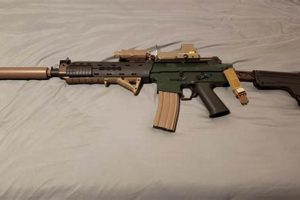
Attire and equipment sets replicating the standard issue gear of the Russian armed forces, or specific Russian units, used in the sport of airsoft are common among players seeking a high degree of realism. These collections typically include camouflage uniforms (such as EMR or Partizan), load-bearing vests or chest rigs, helmets, and replica firearms patterned after Russian designs like the AK platform or various sidearms. The appeal stems from a desire to emulate the aesthetic and tactical loadouts seen in real-world military applications.
The popularity of recreating these military appearances is fueled by several factors. The distinctive camouflage patterns and weapon designs offer a visually unique alternative to more commonly replicated Western military loadouts. Some participants are drawn to the historical significance of Russian military units and operations. Furthermore, using specific loadouts fosters team cohesion and identity within airsoft groups that focus on a particular style of play or impression.
The following will explore specific aspects related to the selection, assembly, and practical application of such gear, along with considerations for authenticity and responsible use within the airsoft community.
Essential Considerations for Airsoft Russian Kit Assembly
The following guidelines provide essential considerations for those seeking to assemble an accurate and functional set of gear replicating that of Russian armed forces or related units.
Tip 1: Conduct Thorough Research: Before acquiring any components, dedicate time to researching the specific unit or time period that the kit is intended to represent. Different branches of the Russian military and various eras employ distinct equipment sets and camouflage patterns. Utilizing online resources, historical photos, and expert advice are essential to ensuring accuracy.
Tip 2: Prioritize Authentic Components: When possible, acquire genuine Russian-manufactured items. While replica gear is available, authentic equipment provides superior durability and more accurately reflects the appearance and construction of the actual gear. Consider sourcing directly from reputable importers or surplus dealers.
Tip 3: Focus on Functional Load Bearing: Prioritize the selection of load-bearing equipment, such as chest rigs or vests, that effectively distributes the weight of magazines, radio, and other essential items. Ensure that the chosen system is comfortable and allows for ease of movement during gameplay. Evaluate the placement and capacity of pouches based on personal preferences and tactical requirements.
Tip 4: Choose Appropriate Camouflage: Select a camouflage pattern appropriate for the intended operating environment. EMR (Digital Flora) is a widely used pattern, but other options, such as Partizan or various solid colors, may be more suitable depending on the specific unit or scenario. Verify that the pattern and color variations align with the established standard.
Tip 5: Ensure Compatibility of Components: Before purchasing individual components, confirm that they are compatible with one another. Ensure that pouches fit securely on the chosen load-bearing equipment, and that the selected helmet is compatible with any desired accessories, such as headsets or night vision mounts.
Tip 6: Account for Seasonal Variations: Consider the impact of seasonal changes on gear selection. During colder months, insulated clothing and appropriate headwear are essential for maintaining comfort and operational effectiveness. Select camouflage patterns that blend effectively with the prevailing environment.
Tip 7: Practice with the Full Kit: Before participating in an airsoft event, thoroughly practice wearing and operating with the complete kit. This allows for identifying any potential issues with fit, mobility, or equipment placement, enabling adjustments to be made prior to gameplay.
Adhering to these guidelines can significantly enhance the authenticity, functionality, and overall effectiveness of the assembled gear. Furthermore, promoting accurate portrayals and responsible gear usage within the community helps preserve the integrity and enjoyment of the hobby.
The following section will explore considerations for ethical representation and responsible engagement within the airsoft community.
1. Authenticity

The pursuit of authenticity represents a central tenet for many participants engaging in airsoft who seek to replicate Russian military loadouts. It extends beyond mere aesthetic replication, encompassing a commitment to historical accuracy and functional fidelity. The level of adherence to genuine specifications can significantly impact the immersive experience and the credibility of the portrayal.
- Uniforms and Camouflage Patterns
The selection of correct uniforms and camouflage patterns is paramount. Different branches of the Russian military and varying time periods utilize distinct patterns such as EMR (Digital Flora), Partizan, and others. The use of incorrect patterns immediately detracts from the authenticity of the kit. Identifying the specific unit and era being represented is crucial for accurate selection.
- Equipment Sourcing and Materials
The origin and materials of the gear components play a significant role. Sourcing genuine Russian-manufactured equipment, when feasible, enhances authenticity due to the accurate construction techniques and materials employed. Replica gear, while more accessible, may lack the durability and detailed accuracy of genuine items.
- Weapon Platform Realism
The use of airsoft replicas patterned after Russian weapon designs, primarily those based on the AK platform, is essential. The degree of realism extends to the accurate reproduction of external features, such as furniture, markings, and overall dimensions. Internally, striving for realistic operation and consistent performance contributes to the overall authentic experience.
- Era-Specific Accuracy
Depending on the unit or time period being represented, the specific configuration and accessories on the rifle should align with historical or contemporary usage. Minor details, such as optic choices, sling types, and the presence or absence of specific attachments, contribute to the overall authenticity of the impression.
In conclusion, the pursuit of authenticity for replicating Russian military loadouts in airsoft involves rigorous research, careful selection of components, and an unwavering commitment to historical accuracy. The level of dedication to these aspects determines the credibility and overall immersive experience of the portrayal, fostering a deeper appreciation for the nuances of Russian military equipment and tactics.
2. Camouflage Patterns

Camouflage patterns are a foundational element in achieving an authentic portrayal of Russian military forces within the context of airsoft. Their selection directly influences the visual accuracy and contextual appropriateness of an “airsoft russian kit.”
- EMR (Digital Flora)
EMR, also known as Digital Flora, represents the current standard-issue camouflage pattern of the Russian Armed Forces. Its digitized, pixelated design aims to provide effective concealment across a range of environments. In the context of an “airsoft russian kit,” utilizing EMR correctly situates the portrayal as representing modern Russian military personnel.
- Partizan/SS Leto
Partizan and SS Leto camouflage patterns are examples of specialized or legacy patterns still sometimes observed, particularly within special forces or reconnaissance units. Including these patterns in an “airsoft russian kit” could suggest a portrayal of such a specialized role, necessitating additional research to ensure accurate application.
- Environmental Considerations
The effectiveness of any camouflage pattern is contingent upon the operating environment. The selection of a pattern ill-suited for the surrounding terrain diminishes the realism and tactical advantage. Therefore, when assembling an “airsoft russian kit,” the intended environment of use should dictate the appropriate camouflage choice. For example, a predominantly green woodland environment would necessitate a pattern optimized for verdant settings.
- Temporal Accuracy
Camouflage patterns evolve over time, with older patterns being phased out in favor of newer designs. An “airsoft russian kit” aiming to represent a specific historical period must utilize camouflage patterns that were contemporaneously accurate. Employing a modern pattern in a historical portrayal compromises the authenticity of the overall impression.
In summary, the selection and application of camouflage patterns within an “airsoft russian kit” transcends mere aesthetics. It constitutes a critical aspect of accurate portrayal, environmental adaptation, and temporal context. Careful consideration of these factors is paramount to achieving a credible and immersive representation.
3. Load-bearing Gear

Load-bearing gear forms a critical component of any credible “airsoft russian kit.” Its selection and configuration directly impact the functionality, realism, and overall effectiveness of the loadout. These systems, typically chest rigs or vests, serve as the foundation for carrying essential equipment, mimicking the real-world demands placed upon soldiers in the field. A poorly chosen or improperly configured system undermines the kit’s practicality, hindering movement and access to necessary items. For instance, a typical loadout requires the carriage of multiple AK-series magazines, a radio for communication, and potentially medical supplies, all of which necessitate a robust and well-organized carrying solution.
The choice of load-bearing gear is intricately linked to the specific unit or role the “airsoft russian kit” aims to represent. Different branches of the Russian military, or distinct special forces units, utilize varying patterns and configurations of chest rigs and vests. For example, a kit attempting to replicate a VDV (Russian Airborne Forces) loadout would necessitate gear distinct from that employed by Spetsnaz (Russian special forces). Furthermore, the type of mission simulated influences gear selection. A reconnaissance role might prioritize a lightweight, low-profile chest rig for enhanced mobility, while an assault role could require a more robust vest with greater carrying capacity. The use of incorrect load-bearing gear detracts significantly from the authenticity of the kit.
In conclusion, the selection and configuration of load-bearing gear are fundamental to the success of an “airsoft russian kit.” It is not merely an aesthetic detail, but a functional requirement for carrying essential equipment and maintaining operational effectiveness. A thorough understanding of the intended unit, role, and mission parameters is essential for choosing load-bearing gear that is both authentic and practical, contributing to a more immersive and realistic experience. Neglecting this aspect compromises the integrity of the entire kit and diminishes its effectiveness on the airsoft field.
4. Weapon Platform

The selection of an appropriate weapon platform constitutes a defining characteristic of any airsoft loadout intended to replicate Russian military or paramilitary forces. The chosen replica firearm serves not only as a visual indicator of the intended impression but also as a functional tool within the airsoft environment. Accuracy in weapon selection, therefore, significantly impacts the overall authenticity and effectiveness of the kit.
- The AK Family of Rifles
The AK family of rifles, particularly the AK-74 and AK-100 series, represents the most prevalent weapon platform within the Russian military. Replicas of these rifles, encompassing airsoft versions of the AK-74M, AK-105, and AK-103, are fundamental to constructing a credible Russian military impression. Variations in furniture, such as handguards, stocks, and muzzle devices, further distinguish specific models and necessitate careful consideration during kit assembly.
- Specialized Weapon Systems
Beyond the standard AK platform, certain specialized units within the Russian military employ alternative weapon systems, including the VSS Vintorez, AS Val, and various sniper rifles. Replicating these specialized loadouts requires the acquisition of corresponding airsoft replicas, which often present challenges in terms of availability and cost. However, the inclusion of such weapons significantly enhances the accuracy of a specific unit portrayal.
- Sidearms and Support Weapons
While rifles dominate the primary weapon selection, sidearms and support weapons also contribute to the overall authenticity of the airsoft loadout. Replicas of Russian-designed pistols, such as the Makarov PM or Yarygin PYa, can complement the primary rifle and provide a secondary weapon option. Support weapons, such as airsoft versions of the PKM machine gun, may be incorporated into specific team loadouts to replicate squad-level firepower.
- Weapon Accessories and Modifications
The addition of appropriate accessories and modifications to the airsoft weapon further enhances its realism. This includes the use of Russian-designed optics, such as red dot sights or magnified scopes, as well as tactical accessories such as foregrips, weapon lights, and slings. Careful attention to detail in the selection and configuration of these accessories contributes significantly to the overall impression.
In conclusion, the weapon platform serves as a central component of an “airsoft russian kit,” directly influencing its visual accuracy and functional capability. The selection of an appropriate rifle, sidearm, and associated accessories requires thorough research and a commitment to replicating the specific equipment used by the intended unit or branch of the Russian military. Prioritizing accuracy in weapon selection significantly enhances the overall authenticity and immersive experience of the loadout.
5. Unit Impression

The concept of “Unit Impression” forms the core of many airsoft loadouts, particularly when constructing an “airsoft russian kit.” It involves meticulously replicating the appearance, equipment, and operational style of a specific military or paramilitary unit, aiming for a high degree of historical or contemporary accuracy. This pursuit extends beyond mere costume, encompassing a commitment to detailed research and accurate representation.
- Historical Accuracy and Time Period
Establishing the correct historical context is paramount for a credible unit impression. This includes identifying the specific time period the impression intends to represent, as equipment, uniforms, and tactics vary significantly across different eras. For instance, a kit depicting a Soviet soldier in the 1980s would differ substantially from one portraying a modern-day Russian Spetsnaz operator. Researching the equipment and uniforms used by the unit during the chosen timeframe is essential.
- Gear and Equipment Authenticity
The authenticity of gear and equipment contributes significantly to the overall impression. This includes replicating the correct camouflage patterns, load-bearing equipment, weapon systems, and associated accessories. While replica gear is often necessary, striving for accurate reproductions of the items used by the unit enhances the visual fidelity and overall credibility of the impression. Sourcing photographs and documentation from the period or unit being represented is crucial.
- Weapon System Configuration
Weapon system configuration extends beyond simply selecting an appropriate airsoft replica. It involves configuring the weapon with the correct accessories, optics, and modifications that were commonly used by the unit being represented. This may include specific types of red dot sights, foregrips, slings, or other attachments. Researching photographic evidence and technical specifications is necessary to ensure accurate weapon configuration.
- Tactical Doctrine and Operational Style
Beyond visual appearance, a comprehensive unit impression also incorporates elements of tactical doctrine and operational style. This involves understanding the tactics, techniques, and procedures employed by the unit, and attempting to replicate them during airsoft gameplay. While strict adherence to real-world tactics is not always feasible or desirable in an airsoft context, incorporating elements of the unit’s operational style can enhance the immersion and authenticity of the impression.
In conclusion, the pursuit of “Unit Impression” when assembling an “airsoft russian kit” represents a commitment to detailed research, accurate representation, and immersive gameplay. By carefully considering historical context, gear authenticity, weapon configuration, and tactical doctrine, participants can create a more credible and engaging portrayal of Russian military or paramilitary forces within the airsoft environment.
6. Tactical Functionality
Tactical functionality represents a critical consideration when assembling an “airsoft russian kit,” extending beyond mere aesthetic replication. The practical application of the kit within an airsoft environment dictates the selection and configuration of individual components. Prioritizing functionality ensures that the loadout enhances performance and survivability, rather than merely hindering movement and access to essential equipment. A kit may appear authentic, but without functional considerations, its effectiveness on the field is significantly diminished. For example, a chest rig with insufficient magazine pouches, regardless of its historical accuracy, directly impairs the operator’s ability to reload and sustain fire during gameplay. Similarly, cumbersome or improperly fitted equipment reduces mobility and situational awareness, negatively impacting tactical effectiveness. Thus, a direct cause-and-effect relationship exists between tactical functionality and operational performance within airsoft.
The selection of load-bearing gear, weapon platforms, and supporting accessories must align with the anticipated tactical scenarios. Considerations include the weight distribution of the equipment, the accessibility of magazines and essential items, and the ease of movement in varied terrains. A minimalist loadout, favoring speed and agility, may be suitable for reconnaissance roles, while a more robust setup with increased carrying capacity is appropriate for engagements requiring sustained firepower. For instance, a kit designed for close-quarters combat necessitates a streamlined weapon platform with a readily accessible sidearm, facilitating rapid transitions between primary and secondary weapons. Conversely, a sniper-oriented loadout demands a stable and accurate rifle platform, along with specialized gear for concealment and long-range observation. Therefore, aligning gear selection with specific roles optimizes tactical effectiveness.
In summary, tactical functionality represents an indispensable element of any effective “airsoft russian kit.” It dictates the practical utility of the loadout within the airsoft environment, directly influencing the operator’s ability to perform assigned tasks. The selection and configuration of gear must prioritize accessibility, mobility, and compatibility, ensuring that the kit enhances, rather than hinders, tactical performance. While historical accuracy contributes to the overall aesthetic and immersive experience, prioritizing functional considerations is paramount for achieving operational success on the airsoft field.
Frequently Asked Questions Regarding Airsoft Russian Kits
The following section addresses common inquiries and concerns pertaining to the assembly, utilization, and ethical considerations surrounding airsoft kits designed to replicate Russian military or paramilitary forces.
Question 1: What constitutes an acceptable level of historical accuracy when assembling such a kit?
The degree of historical accuracy depends on individual preferences and the specific goals of the loadout. Some participants prioritize strict adherence to authentic equipment and configurations, while others focus on achieving a general impression. However, regardless of the chosen approach, a baseline understanding of the equipment used by the intended unit and time period is recommended to avoid egregious inaccuracies.
Question 2: Where can one source authentic Russian-manufactured equipment for airsoft kits?
Sourcing authentic equipment can be challenging due to import restrictions and limited availability. Reputable surplus dealers, online marketplaces specializing in military equipment, and direct importers represent potential sources. Due diligence is essential to verify the authenticity and legality of any purchased items. Consider consulting with experienced members of the airsoft community for recommendations and guidance.
Question 3: What camouflage patterns are considered appropriate for representing modern Russian forces?
The EMR (Digital Flora) camouflage pattern currently serves as the standard issue pattern for the Russian Armed Forces. While other patterns, such as Partizan or older designs, may still be encountered in certain units or contexts, EMR represents the most widely recognized and accurate choice for portraying contemporary Russian military personnel.
Question 4: Are there any ethical considerations related to portraying military forces in airsoft?
Representing military forces in airsoft carries inherent ethical responsibilities. Participants should avoid glorifying or promoting harmful ideologies associated with real-world conflicts. Respectful portrayal and accurate representation are essential to avoid causing offense or perpetuating negative stereotypes. Furthermore, it is imperative to adhere to all applicable laws and regulations regarding the possession and use of replica firearms and military equipment.
Question 5: What are the key differences between airsoft replicas of the AK-74M and AK-105 rifles?
The AK-74M and AK-105 represent distinct variants within the AK family of rifles. The AK-74M serves as the modernized version of the AK-74, featuring a side-folding polymer stock and updated furniture. The AK-105 represents a shortened carbine variant, offering increased maneuverability in confined spaces. Identifying these differences is crucial for accurate weapon selection within an airsoft kit.
Question 6: How should load-bearing gear be configured for optimal tactical functionality?
Load-bearing gear should be configured to facilitate easy access to essential equipment, such as magazines, communication devices, and medical supplies. Prioritize ergonomic placement and secure retention to prevent items from shifting or becoming dislodged during gameplay. Conduct practice drills to familiarize oneself with the placement and operation of all gear components.
In summary, careful planning, diligent research, and a commitment to ethical representation are crucial for assembling and utilizing airsoft kits replicating Russian military or paramilitary forces. By addressing common questions and concerns, participants can contribute to a more informed and responsible airsoft community.
The following section will delve into recommended gear and accessory options for creating authentic and functional airsoft Russian kits.
Airsoft Russian Kit
This exploration has delineated the critical aspects involved in constructing an “airsoft russian kit.” From the selection of appropriate camouflage patterns and load-bearing gear to the intricacies of weapon platform replication and the nuances of unit impression, the pursuit of authenticity and tactical functionality demands meticulous attention to detail. Furthermore, ethical considerations surrounding the portrayal of military forces necessitate responsible and respectful engagement within the airsoft community.
The continuous evolution of equipment and tactical doctrines underscores the importance of ongoing research and adaptation. Continued engagement with historical sources, technical specifications, and community expertise remains essential for maintaining accuracy and promoting responsible participation in this aspect of the airsoft hobby. Further refinement and critical evaluation are encouraged to ensure continued authenticity and responsible representation.