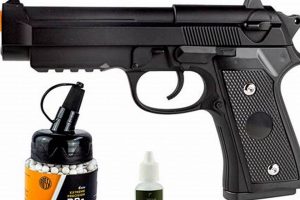
These devices are replicas of real firearms that discharge spherical plastic projectiles using compressed gas or springs. The “semi-automatic” designation indicates a firing mechanism where a single trigger pull results in one projectile being launched. This is in contrast to fully automatic mechanisms, which continuously fire while the trigger is depressed, or manually operated systems requiring separate action to load each projectile. A common example would be a gas-powered sidearm in an airsoft loadout that cycles a new BB into the chamber each time the trigger is activated, ready for the next shot.
The popularity of these simulated weapons stems from their realistic operation and the tactical advantage they provide in simulated combat scenarios. Their use allows players to engage targets rapidly without manual reloading after each shot, enhancing the pace and realism of gameplay. Historically, these mechanisms have evolved from simple spring-powered designs to more sophisticated gas blowback systems that mimic the recoil and feel of real firearms, further adding to their appeal.
The following sections will delve deeper into the specific types of propulsion systems employed in these devices, the materials used in their construction, and the regulations governing their ownership and use. We will also explore the various hop-up systems that affect projectile accuracy and range, and examine some of the most popular models available on the market today.
Essential Considerations for Optimal Performance
The effective utilization of these devices requires careful attention to several key factors. Adherence to these guidelines can enhance performance, extend the lifespan, and ensure safe operation.
Tip 1: Gas Selection. The type of propellant gas significantly impacts performance. Lower-powered gases are suitable for plastic slides, while higher-pressure options may be required for metal slides but can increase wear and tear. Use the manufacturer’s recommended gas to avoid damage.
Tip 2: Maintenance is Critical. Regular cleaning and lubrication are vital. Disassemble and clean the internal components after each use, applying silicone oil to moving parts. Neglecting maintenance reduces accuracy and increases the risk of malfunctions.
Tip 3: Hop-Up Adjustment is Essential. The hop-up unit imparts backspin to the projectile, extending its range and improving accuracy. Adjust the hop-up incrementally until the projectile flies straight. Over-hopping can cause the BB to curve upwards excessively.
Tip 4: Use Quality Ammunition. Utilize high-quality, seamless BBs of the correct weight. Low-quality BBs can be inconsistent in size and shape, leading to jamming and decreased accuracy. Use only BBs designed for Airsoft use.
Tip 5: Slide Lubrication. Ensure the slide moves smoothly by applying silicone oil to the rails. A dry slide increases friction and reduces gas efficiency. Be careful not to over-lubricate, as this can attract dirt and debris.
Tip 6: Proper Storage. Store the device with a small amount of gas in the magazine to maintain the seals. Remove the magazine and store separately when not in use for extended periods.
Tip 7: Know Your Field Limits. Be aware of the FPS (feet per second) limits of your local Airsoft field. Upgrading the gun to fire at a higher FPS than allowed may result in not being able to use it in games.
By incorporating these practices, users can maximize the potential of the these devices, ensuring reliable operation and a competitive edge on the field. Consistent maintenance and informed adjustments are the foundation of long-term performance.
The following sections will address common malfunctions, troubleshooting techniques, and customization options for these devices.
1. Gas Blowback Systems

Gas Blowback (GBB) systems represent a significant advancement in the realism and operational characteristics of airsoft pistols designed with semi-automatic functionality. The GBB system utilizes compressed gas, typically green gas or CO2, not only to propel the BB projectile but also to cycle the pistol’s slide, mimicking the action of a real firearm. This creates a tangible recoil effect with each shot, enhancing the user’s sensory experience. In a semi-automatic configuration, the gas propels the BB, forces the slide rearward to cock the hammer, and then returns the slide forward to load another BB. This process happens each time the trigger is pulled, completing the simulated firing cycle.
The importance of the GBB system lies in its contribution to realism and training value. For instance, law enforcement and military personnel can use GBB airsoft pistols in training exercises to simulate realistic firearm handling, recoil management, and target acquisition without the dangers associated with live ammunition. The blowback action adds complexity to the shooting process, requiring the user to maintain a steady grip and sight picture for accurate follow-up shots. Absent of the GBB system in a semi-automatic airsoft pistol, the realistic operation and training effectiveness are dramatically reduced. These devices rely on simple mechanical or electrical systems, failing to replicate the feel and response of actual firearms.
In summary, the Gas Blowback system is an integral component of the advanced semi-automatic airsoft pistol. It distinguishes the device from simpler designs by providing a more immersive and realistic shooting experience. This connection is essential for users seeking to replicate real-world firearms operations, improve training effectiveness, and enjoy the added engagement that comes from simulated recoil and cycling. The interplay between the GBB system and the semi-automatic firing mode enables a level of realism not attainable through other propulsion methods.
2. Propellant Type Matters

The performance of a semi-automatic airsoft pistol is inextricably linked to the type of propellant employed. Propellant selection directly influences factors such as muzzle velocity, recoil strength (in gas blowback models), and overall operational consistency.
- Green Gas/Propane Performance
Green gas, primarily composed of propane with added silicone oil, is a common propellant. It offers a balance of power and affordability, typically delivering moderate muzzle velocities and a manageable recoil impulse in GBB (Gas Blowback) pistols. However, its performance can be temperature-dependent, with reduced gas pressure in colder environments impacting cycling reliability.
- CO2 Cartridge Consistency
CO2 cartridges provide higher gas pressure, resulting in increased muzzle velocity and a more pronounced recoil effect. This propellant is less susceptible to temperature fluctuations than green gas, offering more consistent performance across a wider range of conditions. However, the higher pressure can accelerate wear on internal components and necessitate stronger materials in the pistol’s construction.
- HPA (High-Pressure Air) Regulation
HPA systems, utilizing compressed air stored in external tanks, offer highly consistent and adjustable performance. A regulator controls the gas pressure delivered to the pistol, allowing for precise tuning of muzzle velocity and recoil. HPA systems require additional equipment (tank, regulator, hose) and are more complex than green gas or CO2, but provide superior consistency and control.
- Black Gas Impact on Durability
Black gas, a higher-pressure variant of green gas, is designed to deliver even greater power. However, its use can significantly reduce the lifespan of the airsoft pistol, particularly in models not designed to withstand the increased stress. The increased pressure can lead to accelerated wear on seals, valves, and other critical components, potentially resulting in malfunctions or premature failure.
In conclusion, the choice of propellant for a semi-automatic airsoft pistol involves a trade-off between power, consistency, and potential impact on the device’s longevity. Each propellant type offers distinct advantages and disadvantages, influencing the pistol’s suitability for different applications and user preferences. Selection of an inappropriate propellant can lead to compromised performance or accelerated wear.
3. Hop-Up Unit Adjustments

The hop-up unit is a critical component within an airsoft pistol semi auto, significantly impacting projectile trajectory and range. Its adjustment governs the backspin imparted onto the BB as it exits the barrel. This backspin creates a Magnus effect, generating lift that counteracts gravity and extends the projectile’s flight path. Without proper hop-up adjustment, the BB will typically exhibit a rapid downward trajectory, severely limiting effective range. Consider, for example, two identical semi-auto pistols: one with a properly adjusted hop-up will achieve significantly greater range and accuracy than the other with an improperly adjusted or non-functional hop-up.
The practical significance of understanding hop-up adjustments lies in maximizing the performance capabilities of the airsoft pistol. Over-hopping, which introduces excessive backspin, causes the BB to rise sharply and unpredictably. Under-hopping results in a rapid descent, as gravity overcomes the insufficient lift. The optimal adjustment achieves a flat trajectory over a useful distance, enabling accurate targeting. Furthermore, different BB weights require different hop-up settings; heavier BBs generally require more hop-up to achieve the desired effect. Experienced players often fine-tune the hop-up unit based on environmental conditions, such as wind, to compensate for external factors affecting projectile flight.
Effective hop-up adjustment represents a fundamental skill for airsoft enthusiasts utilizing semi-auto pistols. While designs vary, the core principle remains consistent: modulating backspin to optimize trajectory. Failure to understand and properly adjust the hop-up unit compromises the accuracy and effective range of the device, irrespective of the pistol’s other features or power output. Mastering this adjustment is a key element in achieving consistent and accurate shots in airsoft gameplay, thereby influencing competitive effectiveness and overall user satisfaction.
4. Magazine Capacity Variance
Magazine capacity variance in semi-automatic airsoft pistols directly impacts gameplay dynamics and strategic considerations. Discrepancies in magazine size influence reload frequency, ammunition management, and overall operational effectiveness on the field. This variance necessitates adaptive tactical approaches and influences a player’s choice of sidearm based on mission requirements.
- Standard Capacity Magazines
Standard capacity magazines for airsoft pistols typically hold between 15 to 30 BBs. Their primary advantage is their realistic size and weight, mirroring the dimensions of real firearm magazines. This contributes to a more authentic handling experience and allows for the use of realistic magazine pouches. However, the limited capacity mandates more frequent reloads, potentially exposing the user during tactical maneuvers.
- Extended Capacity Magazines
Extended capacity magazines can hold upwards of 50 BBs or more. This increased capacity reduces the need for frequent reloads, providing a sustained rate of fire advantage. This can be particularly useful in close-quarters combat scenarios or when engaging multiple opponents. However, these magazines are often larger and heavier, potentially affecting the pistol’s balance and handling. Some fields may also restrict the use of extended magazines to maintain fairness and promote tactical gameplay.
- Real Capacity Magazines
Real capacity magazines are designed to hold the same number of BBs as their real-world firearm counterparts. This emphasis on realism can enhance training scenarios and MilSim (Military Simulation) events. The restricted capacity necessitates careful ammunition management and tactical planning. These magazines encourage players to prioritize shot placement and conserve ammunition, simulating the constraints of real-world combat scenarios.
- Impact on Gameplay Styles
Magazine capacity directly influences gameplay styles. Players using standard or real-capacity magazines tend to adopt a more deliberate and tactical approach, emphasizing accuracy and conservation of ammunition. Conversely, those utilizing extended capacity magazines may favor a more aggressive and suppressive playstyle, relying on volume of fire to overwhelm opponents. The choice of magazine capacity is therefore a crucial factor in defining a player’s role and effectiveness within a team.
Magazine capacity variance introduces a strategic element to the selection of airsoft pistol semi autos. The optimal choice depends on the intended application, field regulations, and individual preferences. Balancing realism, firepower, and tactical considerations is paramount in maximizing the effectiveness of the chosen sidearm.
5. Material Durability Impact

The long-term performance and reliability of a semi-automatic airsoft pistol are fundamentally determined by the materials used in its construction. Material selection dictates the pistol’s resistance to wear, impact, and environmental factors, influencing its operational lifespan and suitability for various gameplay conditions.
- Slide Material and Cycling Stress
The slide, responsible for cycling the action in gas blowback pistols, experiences significant stress with each shot. Metal slides, typically constructed from aluminum alloys or steel, offer greater durability and resistance to wear compared to polymer slides. However, metal slides also increase the pistol’s weight and may require higher gas pressure for reliable cycling. Polymer slides, while lighter and more affordable, are more susceptible to cracking or deformation under prolonged use, particularly with high-pressure gas systems.
- Internal Component Composition and Gas Pressure
Internal components, such as the nozzle, piston, and valves, are subjected to repeated impact and pressure from the propellant gas. Steel or reinforced polymers are often used in these components to withstand the stresses involved. The choice of material directly affects the pistol’s ability to maintain consistent gas seal and reliable firing performance over time. Components constructed from lower-grade materials are more prone to wear, leading to gas leaks, reduced power, and eventual failure.
- Frame Material and Impact Resistance
The frame, serving as the structural foundation of the pistol, must withstand impacts and external forces encountered during gameplay. Polymer frames offer excellent impact resistance and are less prone to cracking or shattering compared to metal frames. Metal frames, while more rigid, can be susceptible to deformation under significant impact. The frame material also influences the pistol’s overall weight and balance, affecting handling characteristics.
- Magazine Material and Gas Retention
The magazine’s construction materials play a vital role in its ability to reliably feed BBs and maintain gas pressure. Metal magazines generally offer better durability and gas retention compared to polymer magazines. However, metal magazines can be more susceptible to corrosion and may require regular maintenance to ensure proper function. The choice of magazine material impacts the pistol’s overall reliability and the consistency of its firing performance.
The selection of materials for a semi-automatic airsoft pistol represents a critical engineering trade-off between durability, weight, cost, and performance. Careful consideration of these factors is essential to ensure that the pistol meets the demands of its intended use and provides a satisfactory operational lifespan. Upgrading key components with more durable materials can significantly extend the pistol’s longevity and improve its overall reliability.
Frequently Asked Questions
The following section addresses common inquiries regarding the functionality, maintenance, and usage of semi-automatic airsoft pistols. Information presented aims to clarify critical aspects of these devices for both novice and experienced users.
Question 1: What distinguishes a semi-automatic airsoft pistol from other types?
A semi-automatic airsoft pistol is characterized by its firing mechanism: one projectile is discharged with each trigger pull, automatically reloading the subsequent projectile. This contrasts with fully automatic pistols, which fire continuously while the trigger is depressed, and single-action pistols requiring manual reloading after each shot.
Question 2: What are the common types of propellants used in semi-automatic airsoft pistols, and how do they differ?
Common propellants include green gas (propane-based), CO2 cartridges, and high-pressure air (HPA). Green gas offers a balance of power and cost-effectiveness, while CO2 provides higher pressure and consistent performance across varying temperatures. HPA systems, requiring external tanks, offer the most adjustable and consistent performance, albeit with increased complexity.
Question 3: How does hop-up adjustment influence the accuracy and range of a semi-automatic airsoft pistol?
The hop-up unit imparts backspin to the projectile, generating lift that counteracts gravity and extends the projectile’s flight path. Proper adjustment achieves a flat trajectory, optimizing range and accuracy. Over-hopping causes the projectile to rise excessively, while under-hopping results in a rapid downward trajectory.
Question 4: What maintenance procedures are essential for ensuring the longevity of a semi-automatic airsoft pistol?
Regular cleaning and lubrication are critical. Disassembling and cleaning internal components after each use, applying silicone oil to moving parts, prevents malfunctions. Proper storage, with a small amount of gas in the magazine, maintains seal integrity. Consistent maintenance is paramount to prevent degradation of the mechanism.
Question 5: How does magazine capacity affect gameplay strategy with a semi-automatic airsoft pistol?
Lower magazine capacity necessitates a more deliberate and tactical approach, emphasizing accuracy and ammunition conservation. Higher capacity magazines allow for a more aggressive and suppressive playstyle, relying on volume of fire. Magazine capacity dictates tactical decisions.
Question 6: What materials are typically used in the construction of semi-automatic airsoft pistols, and how do they impact durability?
Common materials include aluminum alloys, steel, and reinforced polymers. Metal components offer greater durability and resistance to wear compared to polymer counterparts. However, polymer components can reduce weight and improve impact resistance. Material selection directly affects the pistol’s operational lifespan.
Understanding these frequently asked questions is crucial for anyone involved with semi-automatic airsoft pistols. These concepts offer an awareness of usage in gameplay.
The following sections will discuss upgrade options and legal considerations surrounding the use of these devices.
In Conclusion
The preceding analysis has explored the multifaceted nature of the airsoft pistol semi auto, encompassing its functional mechanisms, propellant types, hop-up adjustments, magazine capacity variations, and the impact of material selection on durability. These elements collectively define the device’s performance characteristics and suitability for diverse operational contexts. A comprehensive understanding of these factors is essential for informed decision-making regarding acquisition, maintenance, and tactical application.
Continued diligence in adhering to safety protocols and remaining abreast of evolving regulations governing airsoft devices is paramount. Further research into advanced customization options and emerging technologies within the airsoft industry is encouraged to optimize performance and maintain a competitive edge. The responsible and informed use of airsoft pistol semi auto devices ensures both personal safety and the preservation of the sport’s integrity.