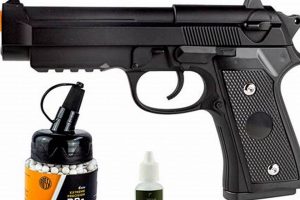
These battery-powered airsoft replicas are designed to fire 6mm plastic BBs using an internal electric motor. This motor drives a piston, which compresses air to propel the projectile. As a common example, consider a compact sidearm replica that utilizes a rechargeable battery to power its firing mechanism, allowing for semi-automatic or fully automatic firing modes.
The value of these devices lies in their ease of use and consistent performance. Electrically powered mechanisms offer a relatively stable rate of fire compared to gas-powered alternatives, often without the need for manual cocking between shots. Historically, these devices gained popularity as a cost-effective and user-friendly entry point into the sport of airsoft, appealing to both novice and experienced players.
The following sections will delve into the specific features, performance characteristics, maintenance requirements, and safety considerations associated with these electrically driven airsoft sidearms. Furthermore, a comparison will be made against other types of airsoft weaponry to provide a holistic understanding of their place within the airsoft landscape.
Enhancing Performance and Longevity
These tips aim to provide practical advice for optimizing the operation and preserving the lifespan of the battery-operated airsoft sidearm. Adherence to these guidelines will promote consistent performance and reduce the risk of malfunction.
Tip 1: Battery Management is Paramount: Utilize only batteries specifically designed for electric airsoft devices. Avoid overcharging or completely depleting the battery, as this significantly shortens its lifespan. Implement a charging schedule that aligns with the manufacturer’s recommendations.
Tip 2: Maintain Cleanliness of the Barrel: Regularly clean the inner barrel to remove accumulated dirt and debris. A clean barrel ensures optimal BB trajectory and reduces friction, contributing to enhanced accuracy and range.
Tip 3: Gearbox Lubrication is Essential: Periodically lubricate the internal gearbox components with a high-quality silicone grease designed for airsoft applications. Proper lubrication minimizes wear and tear, improving the overall efficiency and durability of the mechanism.
Tip 4: Inspect and Tighten Screws: Routinely inspect all screws and fasteners to ensure they are securely tightened. Loose screws can lead to internal component misalignment and potential malfunctions. A visual inspection before and after each use is advisable.
Tip 5: Proper BB Selection is Crucial: Utilize high-quality, seamless BBs with a consistent weight and diameter. Inferior BBs can cause jams, damage internal components, and negatively impact accuracy. Avoid using low-grade or reused ammunition.
Tip 6: Store in a Cool, Dry Place: When not in use, store the device in a cool, dry environment away from direct sunlight and extreme temperatures. This prevents damage to the battery and other sensitive components. Remove the battery for extended storage periods.
Tip 7: Motor Adjustment Considerations: Pay attention to the motor adjustment screw (if equipped). Over-tightening or under-tightening can put undue stress on the motor and gears, potentially leading to premature failure. Consult the user manual for proper adjustment procedures.
Consistent implementation of these measures will yield noticeable improvements in performance and extend the operational life of battery-powered airsoft sidearms. Neglecting these maintenance practices can result in decreased performance, increased repair costs, and a shortened lifespan.
The succeeding sections will address troubleshooting common issues and explore advanced modification options for these particular devices.
1. Power Source (Battery)

The battery serves as the fundamental energy provider for electrically powered airsoft sidearms, dictating operational capabilities and influencing performance characteristics. Its functionality extends beyond simple energy provision, impacting critical aspects of the device’s overall effectiveness.
- Voltage and Capacity
The battery’s voltage and capacity (measured in milliampere-hours or mAh) determine the replica’s firing rate and operational duration. Higher voltage typically translates to a faster rate of fire, while greater capacity allows for extended use before requiring a recharge. For instance, a 7.4V battery might offer a moderate firing rate and reasonable playtime, whereas an 11.1V battery could provide a significantly faster rate of fire but potentially shorten the device’s lifespan due to increased stress on internal components.
- Battery Chemistry
Different battery chemistries, such as Nickel-Metal Hydride (NiMH) and Lithium Polymer (LiPo), exhibit distinct performance profiles. NiMH batteries are known for their durability and lower cost but offer lower energy density compared to LiPo batteries. LiPo batteries, conversely, provide higher energy density and are lighter, enabling faster firing rates and longer runtimes, but they require more careful handling and charging due to their sensitivity to overcharging and discharging. This distinction influences overall user experience and maintenance requirements.
- Discharge Rate (C-Rating)
The discharge rate, denoted by a C-rating, indicates the maximum current a battery can safely deliver. A higher C-rating enables the battery to supply the current demanded by the electric motor during firing, reducing the risk of voltage sag and ensuring consistent performance. Insufficient C-rating can lead to sluggish firing rates and potential damage to the battery or motor. Selecting a battery with an appropriate C-rating is crucial for optimal and reliable operation.
- Connector Type
The battery connector type establishes the physical interface between the battery and the replica’s internal wiring. Common connector types include Mini Tamiya, Standard Tamiya, and Deans/T-Plug. Connector compatibility is essential for ensuring a secure and efficient power transfer. Mismatched or low-quality connectors can lead to poor electrical contact, voltage drop, and even overheating, negatively impacting performance and potentially causing damage.
In summary, the battery is not merely a power source; its characteristics directly influence the firing rate, runtime, reliability, and overall performance of the airsoft pistol. Careful consideration of voltage, capacity, chemistry, discharge rate, and connector type is essential for selecting a battery that aligns with the replica’s specifications and the user’s performance expectations. The choice of battery directly impacts the device’s usability and long-term durability.
2. Firing Mechanism (Gearbox)

The gearbox is the central operational component in an electrically powered airsoft sidearm, dictating its firing capabilities and overall performance. Within this sealed unit, a series of gears driven by an electric motor interacts to compress a spring, which then releases to propel a piston forward. This action forces a volume of air through a nozzle, expelling the BB from the barrel. The gearbox’s efficiency and durability directly correlate with the replica’s rate of fire, shot consistency, and long-term reliability. A substandard gearbox can result in inconsistent shots, reduced firing rate, or complete mechanical failure. For example, a model utilizing reinforced steel gears within its gearbox is demonstrably more resilient under sustained rapid firing compared to one equipped with polymer gears. This directly translates to a longer lifespan and reduced maintenance requirements.
Variations in gearbox design exist to accommodate different firing modes, such as semi-automatic (single shot per trigger pull) and fully automatic (continuous fire while the trigger is depressed). The specific configuration of the gears, piston, and spring determines the power output and rate of fire. Modifications to these components, such as upgrading to a more powerful spring or high-speed motor, can significantly alter the replica’s performance characteristics. However, such modifications require careful consideration to ensure compatibility and avoid placing undue stress on other gearbox components, potentially leading to premature failure. In practical application, a player intending to use the replica primarily for close-quarters combat might opt for a gearbox configuration emphasizing a high rate of fire, whereas a player engaging in longer-range engagements might prioritize a configuration that delivers consistent power output for improved accuracy.
The gearbox constitutes an integral and indispensable element within the architecture of an electrically powered airsoft sidearm. Its design and construction directly govern performance metrics and impact overall reliability. Understanding the intricacies of the gearbox mechanism empowers users to make informed decisions regarding maintenance, modifications, and ultimately, the selection of a device that aligns with their operational requirements. Challenges arise primarily from balancing performance enhancements with maintaining long-term durability, necessitating careful component selection and diligent maintenance practices. The functionality of the gearbox is inextricably linked to the overall effectiveness of the device as a whole within the airsoft environment.
3. Rate of Fire (RPM)

Rate of Fire (RPM), or rounds per minute, represents a crucial performance metric for electrically powered airsoft sidearms. It quantifies the number of projectiles the device can discharge within a minute, directly influencing its effectiveness in various airsoft scenarios. High RPM translates to greater suppressive fire capability, while lower RPM may prioritize accuracy and ammunition conservation.
- Motor Torque and Speed
The electric motor’s torque and rotational speed are primary determinants of RPM. Motors with higher torque can turn gears more forcefully, even under load, contributing to a faster cycle time. Higher-speed motors rotate at increased RPM, directly accelerating the gearbox’s cycling rate. The selection of motor is a trade-off; increased speed can reduce gear lifespan, while increased torque may demand more battery power. The interplay between these factors defines the attainable RPM.
- Gear Ratio
The gear ratio within the gearbox dictates the relationship between the motor’s rotation and the piston’s cycling. Lower gear ratios (e.g., 13:1) emphasize speed, enabling the piston to cycle more rapidly per motor rotation, resulting in a higher RPM. Conversely, higher gear ratios (e.g., 18:1) prioritize torque, increasing the force applied to the piston but potentially reducing RPM. The ideal gear ratio depends on the desired balance between rate of fire and power output.
- Battery Voltage and Current
Battery voltage and current output significantly impact the motor’s performance, thereby influencing RPM. Higher voltage provides the motor with greater electrical potential, enabling it to spin faster and more forcefully. Adequate current delivery ensures the motor receives sufficient power to maintain its speed, especially during sustained firing. Voltage sag, caused by insufficient current, can lead to a noticeable decrease in RPM. Using batteries with appropriate voltage and a high discharge rate (C-rating) is essential for maintaining consistent RPM.
- Internal Friction and Component Quality
Internal friction within the gearbox and the quality of its components play a significant role in RPM. Friction generated by poorly lubricated gears, misaligned components, or substandard materials can impede the motor’s ability to cycle the gearbox efficiently, thereby reducing RPM. High-quality bearings, proper lubrication, and precision-engineered components minimize friction, allowing for smoother and faster cycling, resulting in a higher RPM.
In summary, the rate of fire in an electrically powered airsoft sidearm is a multifaceted characteristic influenced by the interplay of motor specifications, gear ratio, battery performance, and internal component quality. Modifications targeting RPM require careful consideration of these interconnected factors to achieve the desired effect without compromising reliability or efficiency. The selection of components to enhance RPM must also consider the device’s intended application and the user’s performance requirements.
4. Effective Range (Distance)

Effective range, representing the distance at which an electrically powered airsoft sidearm can consistently and accurately engage a target, is a crucial performance metric. It defines the practical limits of engagement and influences tactical deployment decisions. While maximum range indicates the furthest a projectile can travel, effective range considers factors affecting accuracy and hit probability, thereby providing a more realistic assessment of the device’s operational capabilities.
- Hop-Up System Influence
The hop-up system, a mechanism imparting backspin to the BB, significantly extends the effective range. By generating lift, the hop-up counteracts gravity, allowing the projectile to maintain a flatter trajectory over a longer distance. For example, a properly adjusted hop-up can increase the effective range by 20-30% compared to a system without hop-up. The effectiveness of the hop-up is contingent on BB weight and quality, requiring careful calibration for optimal results.
- Inner Barrel Length and Bore
Inner barrel length and bore diameter affect the projectile’s stability and velocity, thereby influencing the effective range. Longer barrels typically allow for greater acceleration of the BB, resulting in higher muzzle velocity and extended range. Bore diameter impacts air seal and consistency of propulsion. However, excessively long barrels can diminish maneuverability, particularly in close-quarters environments. The optimal barrel length and bore diameter are contingent upon the device’s design and intended use.
- Muzzle Velocity Considerations
Muzzle velocity, the speed at which the BB exits the barrel, directly correlates with the effective range. Higher muzzle velocity translates to a flatter trajectory and reduced time-to-target, improving accuracy and hit probability at longer distances. However, muzzle velocity is often regulated by field rules to ensure player safety, necessitating a balance between range and compliance. Achieving optimal muzzle velocity requires careful selection of internal components and precise tuning of the air compression system.
- Environmental Factors Impact
Environmental factors, such as wind and temperature, influence the effective range. Wind can deflect the BB’s trajectory, reducing accuracy and effective range, particularly at longer distances. Temperature affects air density, which can alter the projectile’s flight characteristics. For example, colder temperatures typically result in lower muzzle velocity and reduced range. Understanding and compensating for these environmental factors are crucial for maximizing effective range in real-world scenarios.
The effective range of an electrically powered airsoft sidearm is a composite characteristic determined by the interplay of hop-up system efficiency, inner barrel specifications, muzzle velocity, and environmental conditions. Optimizing these factors requires a comprehensive understanding of the device’s mechanics and the external variables influencing projectile flight. A well-tuned device, coupled with skillful adaptation to environmental conditions, can significantly enhance its effective range and overall operational effectiveness.
5. Accuracy (Consistency)
Accuracy, defined as the ability to repeatedly place projectiles in a predictable location, is paramount for effective utilization of electrically powered airsoft sidearms. Consistency, the degree to which shots group together, forms the foundation of accuracy. The inherent design and functionality of these devices directly impact the level of precision achievable. For instance, a sidearm with a loose inner barrel or an inconsistent hop-up unit will invariably exhibit poor accuracy. Such a deficiency renders the device unreliable for targeted engagement, reducing its practical value in competitive scenarios. The link lies in the mechanics; stable components translate to stable trajectories.
The electric mechanism itself contributes to potential inconsistencies. Variations in battery voltage, even slight fluctuations, can alter the power delivered to the gearbox, leading to shot-to-shot velocity variations. This, in turn, affects the BB’s trajectory and point of impact. Similarly, wear and tear on internal components, such as the piston head or air nozzle, can degrade the air seal, resulting in inconsistent air pressure behind the BB. Regular maintenance and component upgrades focusing on air seal improvement directly enhance consistency. A real-world example is observable when comparing a stock sidearm to one with a precision inner barrel and upgraded hop-up bucking; the latter demonstrably exhibits tighter groupings at extended ranges.
Ultimately, accuracy in these battery-operated sidearms is not a singular attribute but a confluence of factors, with consistency serving as its cornerstone. Internal stability, power regulation, and component quality are all vital elements. Understanding this relationship is crucial for selecting and maintaining a device capable of delivering reliable performance on the airsoft field. Addressing inconsistencies through meticulous maintenance and strategic upgrades is essential to maximize the accuracy potential of these devices, ensuring effective target engagement and overall competitive advantage. The degree of accuracy achievable directly influences a user’s ability to effectively perform in airsoft scenarios, making consistency an indispensable characteristic.
6. Durability (Longevity)

Durability, representing the operational lifespan and resistance to damage, is a critical consideration when evaluating electrically powered airsoft sidearms. The longevity of these devices directly impacts their cost-effectiveness and overall user satisfaction. Multiple factors contribute to the durability of these replicas, influencing their ability to withstand regular use and potential stresses encountered during gameplay.
- Material Composition of Key Components
The materials used in the construction of the gearbox, outer shell, and other critical components significantly influence the device’s durability. Gearboxes constructed from reinforced steel or high-strength alloys are more resistant to wear and tear than those made from polymer or weaker metals. The outer shell’s material composition determines its ability to withstand impacts and resist damage from drops or rough handling. For example, a model with a full metal gearbox and a durable polymer frame will generally exhibit greater longevity compared to one with a plastic gearbox and a brittle plastic frame.
- Stress Points and Reinforcement Strategies
Certain areas of electrically powered airsoft sidearms are subjected to higher stress levels than others. These stress points, such as the area around the trigger mechanism or the mounting points for accessories, are prone to failure if not adequately reinforced. Manufacturers often employ reinforcement strategies, such as metal inserts or thicker material sections, to bolster these vulnerable areas. Devices incorporating such reinforcement measures typically demonstrate greater durability and resistance to breakage.
- Maintenance Regimen and User Habits
The maintenance regimen employed by the user significantly impacts the device’s longevity. Regular cleaning, lubrication, and inspection can prevent premature wear and tear on internal components. Conversely, neglecting maintenance or subjecting the device to excessive abuse, such as dry-firing or using low-quality BBs, can shorten its lifespan. Proper storage practices, such as keeping the device in a cool, dry place, also contribute to its longevity.
- Component Compatibility and System Balance
Component compatibility and the overall system balance greatly affect the durability. Mismatched or low-quality parts can cause undue stress on other components, leading to premature failure. For example, using a high-speed motor with a gearbox designed for a lower rate of fire can overload the gears and result in breakage. Similarly, an imbalanced air compression system can damage the piston or cylinder head. Ensuring compatibility and balance within the system optimizes performance and extends the device’s lifespan.
In conclusion, the durability of electrically powered airsoft sidearms is a multifaceted characteristic determined by material selection, design reinforcement, user maintenance, and component compatibility. Devices constructed from robust materials, incorporating reinforcement strategies, and subjected to diligent maintenance practices will generally exhibit greater longevity. Understanding these factors empowers users to select and maintain devices that offer reliable performance and sustained operational life, maximizing their investment and ensuring a positive airsoft experience.
Frequently Asked Questions
The following questions address common concerns and misconceptions regarding battery-operated airsoft pistols, providing essential information for informed decision-making.
Question 1: What distinguishes an electrically powered airsoft sidearm from a gas-powered or spring-powered variant?
Electrically powered airsoft sidearms utilize a battery-driven motor to cycle the firing mechanism, enabling semi-automatic or fully automatic firing modes. Gas-powered variants rely on compressed gas (CO2 or green gas) to propel the BB, while spring-powered models require manual cocking before each shot.
Question 2: What is the typical effective range of a battery-operated airsoft pistol?
The effective range varies depending on the model, hop-up system, and muzzle velocity, but generally falls within 50-100 feet (15-30 meters). Factors such as wind and BB weight can also influence effective range.
Question 3: How long does a fully charged battery typically last during gameplay?
Battery life depends on the battery’s capacity (mAh), voltage, and the frequency of firing. A higher capacity battery will generally last longer. Continuous full-automatic fire will deplete the battery faster than semi-automatic fire. Expect anywhere from 500 to 2000 shots on a single charge, depending on these variables.
Question 4: What type of maintenance is required for an electrically powered airsoft sidearm?
Regular maintenance includes cleaning the inner barrel, lubricating the gearbox, inspecting and tightening screws, and properly storing the battery. Adherence to the manufacturer’s recommended maintenance schedule is crucial for optimal performance and longevity.
Question 5: Are there any inherent safety concerns associated with battery-powered airsoft pistols?
All airsoft devices, including electrically powered models, should be treated with the same level of caution as real firearms. Always wear appropriate eye protection, avoid aiming at unprotected individuals, and store the device securely when not in use. Improper handling of batteries, particularly Lithium Polymer (LiPo) batteries, can pose a fire hazard.
Question 6: What are the common performance upgrade options for an electrically powered airsoft sidearm?
Common upgrades include replacing the inner barrel with a precision barrel, upgrading the hop-up bucking, installing a more powerful motor, and reinforcing the gearbox components. These upgrades can improve accuracy, range, and rate of fire; however, proper installation is critical to avoid damaging the device.
Understanding these frequently asked questions provides a solid foundation for evaluating and utilizing electrically powered airsoft sidearms effectively and safely. Responsible ownership and adherence to established safety guidelines are paramount.
The subsequent section will delve into comparative analyses of various airsoft weapon systems.
Concluding Observations on Electrically Powered Airsoft Pistols
The preceding exploration has elucidated the multifaceted nature of electrically powered airsoft pistols. Critical facets, ranging from power source dynamics and firing mechanism intricacies to rate of fire, effective range, accuracy determinants, and durability factors, have been thoroughly examined. This comprehensive analysis serves to underscore the intricate interplay of engineering and user practices that dictate the performance and longevity of these devices.
The understanding gained should empower users to make informed decisions regarding selection, maintenance, and modification of these devices. Continued adherence to safety protocols and responsible engagement with the airsoft community remain paramount. Further advancements in battery technology and materials science hold the potential to significantly enhance the capabilities and reliability of electrically powered airsoft sidearms in the future.