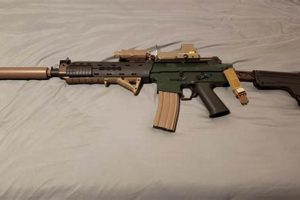
Devices attached to airsoft guns that aid in target acquisition and aiming are critical components of an airsoft player’s gear. These enhancements range from simple iron sights to advanced holographic sights and magnified scopes, allowing users to engage targets at varying distances and under diverse conditions. For example, a red dot sight facilitates rapid target engagement in close-quarters combat, while a magnified scope provides greater precision for longer-range engagements.
The utilization of these sighting devices significantly improves accuracy and speed, leading to a more competitive and enjoyable experience. Historically, airsoft players relied on inherent aiming skills; however, the advent of specialized sighting technologies mirrored advancements in real firearm applications, leading to their widespread adoption within the sport. The advantages include faster target acquisition, improved accuracy under stress, and the ability to engage targets effectively in low-light conditions.
This article will delve into the various types available, examining their functionality, advantages, and disadvantages. Considerations for selecting appropriate sighting devices, including budget, play style, and field conditions, will also be explored. Furthermore, maintenance and proper usage techniques will be addressed to ensure longevity and optimal performance.
Airsoft Optics
Optimizing performance requires understanding and adhering to specific guidelines concerning selection, mounting, and care.
Tip 1: Select Appropriate Magnification. Consider the typical engagement distances at the intended field. Higher magnification is advantageous for outdoor fields with longer ranges, while lower or no magnification is preferable for indoor CQB environments.
Tip 2: Secure Mounting is Critical. Employ high-quality mounts and ensure they are securely attached to the airsoft gun’s rail system. Loose or improperly mounted devices will lead to zeroing issues and inaccurate shots.
Tip 3: Zeroing for Optimal Accuracy. Prior to gameplay, zero the device to the specific airsoft gun and BB weight being used. This involves adjusting the windage and elevation until the point of impact matches the point of aim at a designated distance.
Tip 4: Battery Management is Essential. For electronic devices, ensure batteries are fully charged before each game. Carry spare batteries and familiarize oneself with the device’s battery life indicators.
Tip 5: Lens Protection is Paramount. Utilize lens protectors to shield against BB impacts. Scratched or damaged lenses severely impair visibility and necessitate replacement.
Tip 6: Regular Cleaning Ensures Clarity. Clean lenses regularly with a microfiber cloth and lens cleaning solution designed for optical devices. Avoid using abrasive materials or harsh chemicals.
Tip 7: Storage Practices Impact Longevity. Store the device in a padded case when not in use to prevent damage from impacts or environmental factors.
Adhering to these recommendations will significantly enhance accuracy, prolong the lifespan of the sighting device, and contribute to a more effective and enjoyable airsoft experience.
The subsequent sections will address specific types and their suitability for various play styles, further elaborating on the nuances of implementation.
1. Magnification Capabilities

Magnification capabilities represent a defining characteristic within the realm of airsoft sighting devices. The degree to which an optic magnifies the target image directly impacts the user’s ability to identify and engage opponents at varying distances. Insufficient magnification hinders target identification at longer ranges, potentially leading to missed shots or misidentification of friendly players. Conversely, excessive magnification can narrow the field of view, hindering situational awareness in close-quarters combat. Thus, selection of an airsoft optic with appropriate magnification is directly correlated with effectiveness on the field. For example, a 3-9x variable scope may prove advantageous for outdoor engagements, allowing for precise aiming at distant targets. However, such a scope would be unwieldy and detrimental in a close-quarters indoor arena where a non-magnified red dot sight would offer superior target acquisition speed.
The incorporation of magnification capabilities within sighting devices introduces complexities in zeroing and parallax management. Higher magnification amplifies the effects of slight aiming errors, necessitating meticulous zeroing procedures to ensure accuracy. Furthermore, parallax, the perceived shift in the target image relative to the reticle due to eye position, becomes more pronounced with increased magnification. Addressing parallax requires the user to maintain consistent eye alignment behind the optic, or utilizing optics with adjustable parallax correction mechanisms. The practical significance of understanding magnification lies in the ability to strategically select and utilize optics tailored to specific airsoft scenarios, enhancing accuracy, target identification, and overall gameplay effectiveness.
In summary, magnification capabilities form a critical component of airsoft sighting devices, influencing target engagement range, field of view, and aiming precision. The careful consideration of these factors, alongside appropriate zeroing techniques, enables the airsoft player to optimize their equipment for diverse gameplay conditions. While higher magnification offers potential advantages in long-range engagements, it necessitates greater attention to detail and introduces challenges related to parallax and field of view. Therefore, the optimal choice hinges on a thorough assessment of the intended playing environment and individual preferences, solidifying the understanding of magnification capabilities within airsoft optics.
2. Target acquisition speed
Target acquisition speed, the measure of time required to visually identify and aim at a target, is a critical performance factor in airsoft engagements. The selection and configuration of sighting devices directly influence this metric, impacting a player’s responsiveness and effectiveness during gameplay. The following points elaborate on key facets of this relationship.
- Reticle Type and Visibility
The reticle, the aiming point within the optic, significantly affects acquisition speed. Red dot sights, characterized by a simple illuminated dot, offer rapid target acquisition in close to medium ranges due to their intuitive design and minimal obstruction of the field of view. Conversely, complex reticles with multiple aiming points or elaborate designs can hinder acquisition speed, particularly under pressure or in dynamic scenarios. Brightness and clarity of the reticle further influence visibility in varying lighting conditions; a dim or obscured reticle necessitates additional time for target identification.
- Field of View and Peripheral Vision
Optics with a wider field of view (FOV) allow for greater situational awareness and faster target detection. A constricted FOV, common in magnified scopes, limits peripheral vision and requires more time for the operator to scan the environment for potential threats. Therefore, optics designed for close-quarters battle (CQB) scenarios typically prioritize a wide FOV to facilitate rapid engagement of multiple targets. Conversely, in open field environments, a narrower FOV may be acceptable, trading acquisition speed for increased magnification and precision at longer distances.
- Mounting Height and Eye Relief
The height at which the optic is mounted affects the shooter’s head position and the speed at which they can align their eye with the sight. Lower mounting heights generally promote a more natural shooting stance and reduce the time required to acquire the target. Eye relief, the optimal distance between the eye and the optic, also impacts acquisition speed. Insufficient eye relief forces the shooter to strain their neck or adopt an unnatural position, hindering quick target engagement. Properly adjusting the optic’s position and selecting a mount that provides appropriate eye relief is crucial for maximizing acquisition speed.
- Parallax and Focusing Adjustments
Parallax, the apparent shift in the target’s position relative to the reticle when the eye moves, can negatively impact target acquisition speed. Optics with parallax correction mechanisms allow users to adjust the focus and eliminate this effect, ensuring accurate aiming regardless of eye position. The absence of parallax correction, particularly in magnified scopes, can require additional time for the shooter to align their eye perfectly behind the optic, slowing down target acquisition. Furthermore, focusing adjustments, present in some optics, allow the user to sharpen the image and improve target clarity, further enhancing acquisition speed.
The relationship between target acquisition speed and the selection of airsoft optics is multifaceted. Reticle type, field of view, mounting height, eye relief, and parallax correction all contribute to a player’s ability to rapidly engage targets. Prioritizing these factors based on the intended playing environment and individual preferences can significantly enhance responsiveness and effectiveness in airsoft engagements.
3. Environmental Adaptability
The performance of sighting devices is significantly influenced by prevailing environmental conditions. Fluctuations in temperature, humidity, precipitation, and ambient light can compromise optical clarity, target visibility, and overall aiming accuracy. A sighting device lacking adequate environmental adaptability may become rendered ineffective, hindering the user’s ability to engage targets effectively. For instance, fogging of lenses due to high humidity can obscure the target, while glare from intense sunlight can wash out the reticle, rendering it difficult to see. These factors directly impact the user’s success in dynamic scenarios.
Specific design features and material choices address challenges posed by various environments. Nitrogen-purged optics mitigate internal fogging by displacing moisture-laden air with an inert gas. Hydrophobic lens coatings repel water, preventing rain or condensation from obscuring the field of view. Adjustable reticle brightness settings enable users to adapt to varying ambient light levels, ensuring optimal visibility in both bright daylight and low-light conditions. For example, an airsoft player participating in a nighttime woodland scenario would benefit from an optic featuring night vision compatibility or a very low reticle brightness setting to avoid blinding themselves.
The selection of airsoft optics should, therefore, consider the prevalent environmental conditions of the intended playing environment. Investing in sighting devices with robust environmental adaptability features, such as fog resistance, water resistance, and adjustable reticle brightness, ensures reliable performance and consistent aiming accuracy regardless of external factors. Failure to account for these environmental factors can negate the benefits of even the most technologically advanced optical systems. Prioritizing environmental adaptability contributes directly to enhanced gameplay and improved target engagement success.
4. Mounting compatibility
Mounting compatibility represents a critical aspect in the integration of sighting devices with airsoft weapons. The secure and proper attachment of an optic directly influences its stability, zero retention, and, ultimately, the user’s aiming accuracy. Incompatibility between the optic and the weapon’s mounting platform negates the benefits of even the most advanced sighting technologies.
- Rail System Standards
Airsoft guns utilize various rail systems, with the Picatinny rail (MIL-STD-1913) and Weaver rail being the most prevalent. Compatibility hinges on matching the optic mount to the rail system. Utilizing an optic mount designed for a Weaver rail on a Picatinny rail, or vice versa, may result in an insecure fit, leading to shifting under recoil and inconsistent zero. Adapters exist but can introduce additional points of failure. This system is important when attaching airsoft optics.
- Mount Height and Eye Relief
The height of the optic mount influences the shooter’s head position and alignment with the sight. An improperly chosen mount height can force an unnatural shooting stance, hindering quick target acquisition and causing discomfort. Furthermore, eye relief, the distance between the eye and the optic, must be considered. Insufficient eye relief can result in a limited field of view or even injury from recoil. The combination is necessary when using airsoft optics. For example, using a high mount with a red dot sight may require a cheek riser on the stock to achieve proper eye alignment.
- Mounting Hardware and Torque Specifications
The quality of the mounting hardware, including screws and clamps, is paramount. Weak or improperly tightened hardware can result in the optic shifting under recoil. Torque specifications provided by the manufacturer must be adhered to when tightening mounting screws to prevent damage to the optic or the weapon. Overtightening can strip threads, while undertightening can lead to loosening during use, and is critical for stable airsoft optics.
- Specialized Mounting Solutions
Certain airsoft weapons, particularly replicas of historical firearms, may require specialized mounting solutions due to unconventional receiver designs or the absence of standard rail systems. These solutions can include custom-made mounts, adapters, or modifications to the weapon. The implementation of these specialized solutions requires careful consideration and may necessitate professional installation for dependable airsoft optics performance.
The interplay between rail system standards, mount height, mounting hardware, and specialized solutions defines mounting compatibility for airsoft optics. Addressing these factors ensures a secure and stable platform for sighting devices, enabling accurate aiming and consistent performance. Neglecting any aspect of mounting compatibility compromises the utility of the optic and degrades the overall airsoft experience.
5. Zeroing precision

Zeroing precision, the process of aligning a sighting device such that the point of aim coincides with the point of impact at a predetermined distance, represents a fundamental aspect of airsoft marksmanship. Its meticulous execution is paramount to maximizing the effectiveness of any optic and achieving consistent target engagement.
- Environmental Factors Compensation
Zeroing precision extends beyond simply adjusting elevation and windage. Skilled shooters account for environmental factors such as wind drift, projectile drop, and temperature variations, which can significantly alter the trajectory of an airsoft BB. For example, crosswinds require lateral adjustments to the optic’s windage setting, while longer distances necessitate consideration of projectile drop, demanding upward adjustments to the elevation. Compensation for these variables distinguishes a novice from a proficient marksman, translating into tangible advantages on the field. Precise zeroing must take these external factors into account when using airsoft optics.
- Optic and Weapon Synergy
The inherent characteristics of both the optic and the airsoft weapon influence the zeroing process. Variations in barrel length, hop-up settings, and projectile weight necessitate individualized zeroing procedures. An optic perfectly zeroed on one weapon may exhibit significant deviations on another. For instance, a high-quality scope mounted on an airsoft rifle with an inconsistent hop-up unit will yield unpredictable results, regardless of the zeroing efforts. Achieving optimal zeroing precision necessitates a harmonious interplay between the optic and the weapon’s performance parameters, creating a synergistic system.
- Zeroing Distance Selection
The selection of an appropriate zeroing distance directly impacts the optic’s performance across varying engagement ranges. Zeroing at a shorter distance, such as 25 feet, may provide optimal accuracy at close quarters but introduce significant deviations at longer ranges. Conversely, zeroing at a longer distance, such as 100 feet, may offer superior accuracy at range but compromise performance in close-quarters combat. The optimal zeroing distance depends on the intended playing environment and the typical engagement distances encountered, requiring a strategic compromise to maximize overall effectiveness when using airsoft optics.
- Maintenance of Zero Retention
Zeroing precision is not a one-time event; it requires ongoing maintenance and verification. Physical impacts, temperature fluctuations, and component wear can gradually alter the optic’s zero. Periodic checks and adjustments are essential to maintain optimal accuracy. Neglecting to monitor zero retention can lead to gradual degradation in performance, diminishing the benefits of even the most precise zeroing procedures. Regular maintenance, including cleaning lenses, tightening screws, and re-verifying the zero, ensures consistent performance and prolonged accuracy in the airsoft optics.
In conclusion, zeroing precision is a dynamic and multifaceted process, encompassing environmental compensation, optic and weapon synergy, strategic zeroing distance selection, and vigilant maintenance of zero retention. Mastering these facets elevates a shooter’s proficiency and maximizes the potential of their airsoft optic, translating into enhanced accuracy, consistent target engagement, and a competitive edge on the airsoft field.
Frequently Asked Questions
This section addresses common inquiries regarding the selection, utilization, and maintenance of sighting devices for airsoft applications, providing concise and informative responses.
Question 1: What magnification power is suitable for airsoft?
The optimal magnification depends upon the intended playing environment. Close-quarters battle (CQB) scenarios benefit from non-magnified optics, such as red dot sights. Outdoor fields with longer engagement ranges may warrant low-power magnification (1-4x) for improved target identification.
Question 2: How does one address fogging in sighting devices?
Fogging can be mitigated through several methods. Nitrogen-purged optics prevent internal fogging. Anti-fog sprays or lens coatings can be applied to external lens surfaces. Proper ventilation and the avoidance of rapid temperature changes are also beneficial.
Question 3: What is the importance of eye relief in airsoft optics?
Eye relief, the distance between the eye and the optic’s lens, is crucial for a comfortable and unobstructed field of view. Insufficient eye relief can result in a limited sight picture and potential eye strain. Selecting optics with appropriate eye relief is vital for prolonged use.
Question 4: How often should airsoft optics be zeroed?
Zeroing should be conducted initially upon mounting the optic and repeated periodically, particularly after impacts or significant changes in environmental conditions. Regular verification of zero ensures consistent accuracy.
Question 5: What types of lens protection are recommended?
Dedicated lens protectors, constructed from durable polycarbonate or similar impact-resistant materials, are highly recommended. These shields prevent damage to the optic’s lens from BB impacts, preserving its optical clarity.
Question 6: Are expensive optics always superior to budget-friendly options?
While higher-priced optics often incorporate advanced features, superior materials, and enhanced durability, budget-friendly options can provide adequate performance for many airsoft applications. Evaluating specific needs and conducting thorough research is recommended prior to purchase.
Selecting and maintaining appropriate sighting devices significantly enhances an airsoft player’s effectiveness on the field. Careful consideration of factors such as magnification, fog mitigation, and zeroing procedures is essential for optimal performance.
The subsequent section will provide insights on troubleshooting common issues and problems of airsoft optics.
Airsoft Optics
This article has explored various facets of aiming devices utilized within the sport, encompassing selection criteria, maintenance practices, and performance optimization strategies. The importance of magnification capabilities, target acquisition speed, environmental adaptability, mounting compatibility, and zeroing precision has been thoroughly examined. Ultimately, the proper selection and implementation of suitable sighting devices directly correlate with enhanced accuracy and improved gameplay effectiveness.
Continued advancements in airsoft technology necessitate a comprehensive understanding of associated equipment. Prioritizing informed decision-making and consistent maintenance procedures remains paramount for those seeking to maximize their potential and contribute to the evolution of airsoft. Future developments in optical technology will likely further refine performance parameters, solidifying the role of these devices as essential components for players aiming to achieve the highest levels of competitive performance.