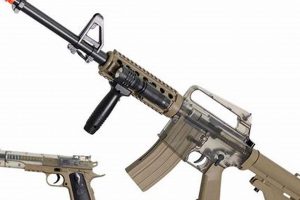
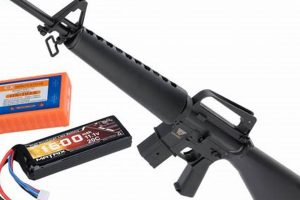
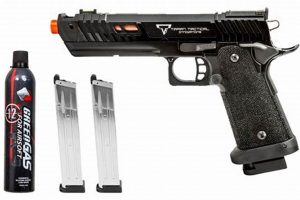
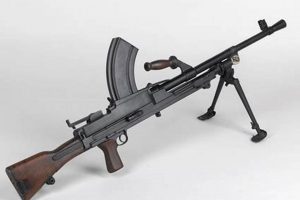
This category of airsoft weaponry utilizes an Automatic Electric Gun system, commonly referred to as an AEG. These devices employ an electric motor to power a gearbox, which in turn compresses a spring and releases it to propel a projectile. A typical example would involve a replica rifle used in simulated military or law enforcement training exercises, firing plastic BBs via battery-powered mechanism.
The significance of this technology lies in its capacity for sustained, rapid firing. This characteristic provides a distinct advantage in competitive scenarios, offering enhanced realism and strategic possibilities during gameplay. Historically, these systems represented a considerable advancement over spring-powered or gas-powered alternatives, improving reliability and ease of use.
Subsequent sections will delve into the internal mechanics, performance characteristics, modification options, and selection criteria pertinent to these widely-used airsoft devices. Detailed analysis will cover aspects such as battery selection, gearbox components, hop-up systems, and considerations for optimal performance and maintenance.
Essential Guidelines for Automatic Electric Airsoft Rifles
This section offers crucial guidelines to ensure optimal functionality, longevity, and user safety when operating electrically powered airsoft replicas.
Tip 1: Battery Selection: Employ batteries with appropriate voltage and discharge rates. Using batteries exceeding the recommended specifications can damage the internal gearbox components. Consult manufacturer documentation for compatibility.
Tip 2: Gearbox Maintenance: Regularly lubricate the internal gears within the gearbox. Proper lubrication reduces friction, minimizes wear, and enhances operational efficiency. Silicone-based grease is generally recommended.
Tip 3: Hop-Up Adjustment: Calibrate the hop-up unit to achieve optimal projectile trajectory. Improper adjustment can result in reduced range and accuracy. Experiment with incremental adjustments to achieve the desired effect.
Tip 4: Motor Care: Monitor motor temperature during prolonged usage. Excessive heat can indicate increased friction or component strain. Allow the motor to cool down between extended firing sessions.
Tip 5: Cleaning Protocol: Routinely clean the barrel to remove debris and residue. A clean barrel promotes consistent projectile velocity and accuracy. Use a cleaning rod and appropriate cleaning solution.
Tip 6: Storage Procedures: Store the replica with the battery disconnected to prevent unintended discharge and potential damage. This also reduces the risk of accidental firing when not in use.
Tip 7: Trigger Discipline: Maintain strict trigger discipline when handling the device. Treat it as a real firearm and keep the finger off the trigger until ready to engage a target. This helps prevent accidental discharges.
Adherence to these guidelines maximizes performance, extends the operational lifespan, and promotes safe handling practices with electric-powered airsoft platforms.
The subsequent sections will cover advanced modifications, troubleshooting common malfunctions, and considerations for competitive play.
1. Gearbox Mechanics

The gearbox constitutes the central operational component within electrically powered airsoft replicas. Its design and functionality directly dictate the performance characteristics, reliability, and modification potential of the overall system. A thorough understanding of the gearbox is essential for informed maintenance, upgrades, and troubleshooting.
- Gear Set Configuration
The configuration of gears within the gearbox determines the torque and rate of fire. Standard gear sets balance these factors, while high-torque sets prioritize projectile velocity and high-speed sets favor rapid firing. For instance, a 13:1 gear set emphasizes rate of fire, suitable for close-quarters engagement, whereas a 32:1 gear set offers increased durability and power for longer-range applications. Misalignment or wear on the gears leads to decreased performance and potential mechanical failure.
- Piston Assembly
The piston assembly compresses the air required to propel the projectile. The piston’s material composition and seal integrity affect the air volume and pressure generated. A reinforced piston with a tight seal improves consistency and power output. Failure of the piston due to stress or material fatigue is a common point of failure requiring replacement.
- Spring Guide and Spring
The spring and spring guide work in conjunction to store and release the energy that drives the piston. The spring’s stiffness dictates the projectile’s muzzle velocity, while the spring guide ensures proper alignment and prevents spring deformation. An upgraded spring increases power but may place greater stress on other internal components, necessitating corresponding upgrades. A broken or weakened spring diminishes firing power.
- Tappet Plate and Nozzle
The tappet plate and nozzle control the feeding of projectiles into the hop-up chamber. The tappet plate retracts the nozzle, allowing a BB to enter, and then releases it to seal against the hop-up bucking. Proper timing and alignment of these components are crucial for consistent feeding and preventing misfeeds. A worn or broken tappet plate leads to feeding issues and reduced performance.
These interconnected components within the gearbox collectively determine the functionality of electrically powered airsoft devices. Modifications or upgrades to any single component necessitates careful consideration of its impact on the other components to ensure optimal performance and prevent premature wear or failure. A well-maintained and appropriately configured gearbox is essential for reliable and effective operation.
2. Battery Power

Battery power is integral to the functionality of electrically powered airsoft replicas, directly influencing operational performance and reliability. The selection and management of battery systems demand careful consideration to optimize sustained firing capability and safeguard internal components.
- Voltage and Compatibility
The voltage rating of a battery must correspond to the specifications of the electric-powered airsoft device’s motor and internal circuitry. Utilizing a battery with excessive voltage risks damaging or destroying sensitive electronic components. Conversely, insufficient voltage results in diminished motor performance and reduced firing rate. For example, a 9.6V battery may be suitable for a standard configuration, while a modified replica might necessitate an 11.1V LiPo battery to achieve optimal performance. Incompatibility invariably results in suboptimal operation and potential equipment failure.
- Battery Chemistry (NiMH vs. LiPo)
Nickel-Metal Hydride (NiMH) and Lithium Polymer (LiPo) represent the two primary battery chemistries employed in electrically powered airsoft applications. NiMH batteries offer a balance of cost-effectiveness and safety, exhibiting a lower risk of thermal runaway. LiPo batteries, conversely, provide superior energy density and discharge rates, enabling higher rates of fire and improved trigger response. However, LiPo batteries demand meticulous handling and charging procedures to mitigate the risk of fire or explosion. The selection of battery chemistry involves weighing performance benefits against safety considerations and user expertise.
- Discharge Rate (C-Rating)
The discharge rate, denoted by the C-rating, specifies the maximum continuous current a battery can safely deliver. A higher C-rating indicates the battery’s capacity to sustain high-drain applications, such as rapid firing and high-torque motors. Insufficient discharge rate can lead to battery overheating, voltage sag, and diminished performance. For example, a battery with a 20C rating can safely discharge 20 times its capacity (in Ampere-hours). Selecting a battery with an adequate C-rating is crucial for maintaining consistent performance and preventing battery damage.
- Battery Capacity (mAh)
Battery capacity, measured in milliampere-hours (mAh), indicates the total amount of electrical charge the battery can store. Higher mAh ratings translate to extended operational time between charges. The battery capacity must be balanced against the physical space available within the airsoft replica’s battery compartment. Exceeding the physical limitations necessitates external battery pouches or alternative storage solutions. A higher mAh rating allows for more sustained gameplay before requiring a recharge.
In summary, the appropriate selection and management of battery power is critical for the reliable and effective operation of electrically powered airsoft replicas. Considerations encompassing voltage compatibility, battery chemistry, discharge rate, and capacity must be carefully evaluated to maximize performance, ensure user safety, and prolong the lifespan of both the battery and the replica itself. A properly matched battery system provides the foundation for consistent and effective operation.
3. Hop-Up System

The Hop-Up system represents a critical component in electrically powered airsoft devices, influencing projectile range and accuracy. This system imparts backspin to the BB as it exits the barrel, generating an aerodynamic lift force that counteracts gravity, extending the effective range. The absence of a functional Hop-Up system in an electric-powered airsoft replica results in a significantly reduced effective range and a pronounced downward trajectory of the projectile. For example, a standard electric-powered airsoft rifle without Hop-Up might have an effective range of only 50 feet, while the same rifle with a properly adjusted Hop-Up system can achieve effective ranges exceeding 150 feet. Understanding the mechanical principles and adjustment methods associated with the Hop-Up directly translates to improved field performance.
Practical applications of Hop-Up adjustments are evident in various gameplay scenarios. In outdoor engagements, precise calibration of the Hop-Up is essential to engage targets at longer distances. Conversely, in close-quarters environments, a reduced Hop-Up setting prevents overshooting targets at close range. The ability to fine-tune the Hop-Up setting allows users to adapt to varying environmental conditions, such as wind, and to optimize the trajectory for specific target distances. An incorrectly adjusted Hop-Up system can lead to unpredictable projectile behavior, making it difficult to consistently engage targets, which is a serious disadvantage on field.
In summary, the Hop-Up system is an indispensable element of electrically powered airsoft replicas, fundamentally influencing their range and accuracy. Effective utilization of this system requires a thorough understanding of its underlying mechanics and a practical application of adjustment techniques. While Hop-Up systems significantly enhance performance, challenges remain in achieving consistent results due to variations in BB weight and quality. Further advancements in Hop-Up technology aim to address these challenges and provide even greater precision in airsoft gameplay.
4. Rate of Fire

Rate of Fire (ROF) in electrically powered airsoft devices signifies the number of projectiles discharged per unit of time, typically measured in rounds per minute (RPM). This characteristic is intrinsically linked to the internal mechanics and power source of the system. Higher rates of fire are generally achieved through modifications to the gearbox, including upgraded motors, gear sets, and battery systems. Increased ROF results in a greater volume of projectiles directed towards the target, theoretically enhancing the probability of a successful engagement. For example, a standard electrically powered airsoft rifle may exhibit a ROF of 700 RPM, whereas a modified version could achieve rates exceeding 1200 RPM.
The practical application of increased ROF manifests in various gameplay scenarios. In close-quarters combat (CQB), a higher ROF provides a distinct advantage, allowing for suppressive fire and rapid target engagement. Conversely, in open-field engagements, where accuracy and range are paramount, the benefits of increased ROF may be diminished, as projectile dispersion becomes more pronounced. Furthermore, the sustained firing associated with high ROF can lead to accelerated battery depletion and increased wear on internal components. Therefore, the selection of an appropriate ROF requires careful consideration of the intended operational environment and maintenance implications. For example, sustained use of a high ROF setup without proper gearbox maintenance can lead to premature gear stripping or motor failure.
Ultimately, the Rate of Fire is a crucial performance metric for electrically powered airsoft platforms, directly impacting their effectiveness in various tactical scenarios. While a higher ROF can offer certain advantages, its implementation must be carefully balanced against considerations of accuracy, battery consumption, and component durability. Understanding the interplay between ROF and these factors is essential for informed decision-making and optimal performance.
5. Upgrade Potential

The capacity for modification represents a significant characteristic of electrically powered airsoft devices, enhancing performance and tailoring the replica to specific operational requirements. The inherent design of these systems facilitates the replacement and upgrading of numerous internal components, providing a high degree of customization.
- Gearbox Components
The gearbox, as the central operating mechanism, offers extensive upgrade possibilities. Gears, pistons, springs, and motors can be replaced to alter rate of fire, muzzle velocity, and overall durability. For instance, reinforced gears made from high-strength steel offer increased resistance to wear under high-stress conditions, while a high-torque motor improves trigger response and pulling heavier springs. The modular design enables incremental enhancements to achieve desired performance parameters.
- Motor Enhancements
The electric motor directly impacts the replica’s rate of fire and trigger response. Upgrading to a high-performance motor can significantly improve these characteristics. Brushless motors, for example, offer increased efficiency, reduced heat generation, and extended lifespan compared to traditional brushed motors. The selection of an appropriate motor is crucial for optimizing performance and preventing premature wear on other internal components. Motor upgrades enable a noticeable boost in the device’s responsiveness and firing speed.
- Hop-Up Unit Modifications
Modifications to the Hop-Up unit can enhance range and accuracy. Replacing the Hop-Up bucking with a higher-quality variant improves the seal around the BB, resulting in more consistent backspin and a flatter trajectory. Precision inner barrels, with tighter bore diameters, further contribute to improved accuracy by reducing projectile wobble during firing. Enhanced Hop-Up systems are crucial for achieving consistent long-range engagements.
- Electrical System Upgrades
The electrical system, including wiring, MOSFETs (Metal-Oxide-Semiconductor Field-Effect Transistors), and batteries, is amenable to upgrades. Replacing stock wiring with low-resistance alternatives improves electrical conductivity, reducing energy loss and enhancing trigger response. MOSFETs protect the trigger contacts from damage caused by high-current draw, extending their lifespan and allowing for the use of higher-voltage batteries. Upgrading the battery to a higher-capacity LiPo provides sustained power and improved performance. These modifications ensure efficient power delivery and improve system reliability.
These upgrade options provide users with the ability to fine-tune the performance characteristics of electrically powered airsoft replicas to meet specific needs. Component selection and installation require careful consideration to ensure compatibility and prevent unintended consequences. A well-planned upgrade strategy can significantly enhance the overall effectiveness and enjoyment of the device.
Frequently Asked Questions
This section addresses common inquiries regarding Automatic Electric Guns, providing concise and factual answers to clarify misconceptions and enhance understanding.
Question 1: What is the typical operational lifespan of an AEG gearbox before requiring maintenance or component replacement?
The operational lifespan of an AEG gearbox varies significantly based on usage intensity, component quality, and maintenance practices. Under moderate usage with regular maintenance, a gearbox may function reliably for several years. However, high-stress scenarios or neglecting maintenance can substantially reduce its lifespan. Inspection and lubrication are crucial for longevity.
Question 2: What factors determine the accuracy of an AEG?
Accuracy in an AEG is influenced by several interrelated factors. These include the quality of the inner barrel, the consistency of the Hop-Up system, the quality and weight consistency of the BBs used, and the stability of the platform itself. Even minor inconsistencies in any of these areas can negatively impact accuracy.
Question 3: Are all AEG components universally compatible across different brands and models?
No, component compatibility is not guaranteed across different brands and models. While some components adhere to standardized dimensions, variations in design and manufacturing tolerances can result in incompatibility. Cross-referencing compatibility charts and seeking expert advice is recommended before attempting component swaps.
Question 4: What are the potential risks associated with over-volting an AEG battery?
Over-volting an AEG battery, exceeding the voltage specified for the system, poses significant risks. These risks include damage to the motor, overheating of electrical components, potential fire hazards, and catastrophic failure of the gearbox. Adherence to manufacturer-recommended voltage specifications is paramount.
Question 5: How does ambient temperature affect the performance of an AEG?
Ambient temperature can influence the performance of an AEG, particularly in extreme conditions. Low temperatures can reduce battery capacity and stiffen Hop-Up buckings, decreasing performance. High temperatures can lead to overheating and decreased motor efficiency. Adjustments to Hop-Up and battery management may be necessary to compensate.
Question 6: What constitutes a responsible approach to AEG ownership and usage?
Responsible AEG ownership includes adhering to all applicable safety regulations, using appropriate protective gear, maintaining the device in proper working order, storing it securely, and treating it with the same respect and caution as a real firearm. Negligence in any of these areas can lead to accidents and injuries.
These answers provide a baseline understanding of key considerations regarding AEG operation and maintenance. Continued learning and diligent adherence to safety protocols are crucial for responsible participation in airsoft activities.
The subsequent section will cover advanced topics such as AEG modification techniques and competitive gameplay strategies.
Concluding Remarks on airsoft guns aeg
This exploration has illuminated the multifaceted nature of airsoft guns aeg, encompassing their internal mechanisms, performance characteristics, operational guidelines, and modification potential. The comprehensive analysis has underscored the significance of gearbox mechanics, battery power, Hop-Up systems, and Rate of Fire in determining the overall effectiveness and reliability of these devices. Further, the necessity of responsible ownership, maintenance, and adherence to safety protocols has been consistently emphasized.
Continued advancements in materials science, electrical engineering, and precision manufacturing promise to further refine airsoft guns aeg, enhancing their performance and realism. As the technology evolves, a commitment to ongoing learning and responsible application remains paramount for both enthusiasts and professionals alike. The informed and ethical utilization of these platforms is essential for promoting safety, preserving the integrity of the sport, and fostering a culture of respect and responsibility within the airsoft community.