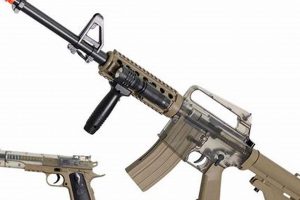
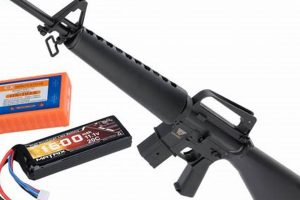
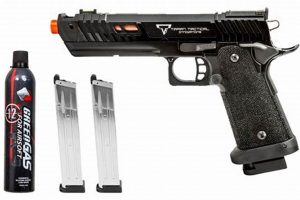
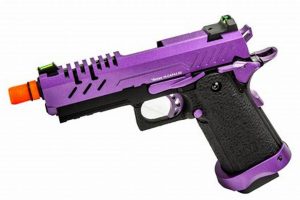
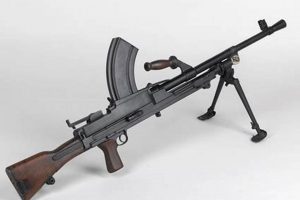
The auditory signature produced by an airsoft weapon when discharged is a complex acoustic event. These sounds, typically less intense than those generated by firearms, are characterized by a combination of mechanical noises resulting from the internal mechanisms and the discharge of compressed gas propelling a projectile. For example, a distinct “thwack” or “pop” can be heard depending on the gun’s model, the power source (gas or spring), and the surrounding environment.
The role of these sounds is multifaceted. They contribute significantly to the realism and immersion of airsoft activities, enhancing the simulation experience for participants. Historically, the pursuit of authentic sound reproduction has driven technological advancements in airsoft gun design and the development of associated sound effects for digital media. Furthermore, these sounds can serve a functional purpose in gameplay, providing auditory cues for teammates and opponents alike.
The remainder of this exploration will focus on various aspects of airsoft weapon audio, including its acoustic characteristics, recording and manipulation techniques, and its application in fields such as game design and film production. Furthermore, factors affecting the perceived realism and effectiveness of these auditory elements will be examined in detail.
Airsoft Weapon Auditory Cues
Effective utilization of sounds originating from airsoft weapons necessitates careful consideration. The following guidelines offer strategies for maximizing their impact and realism in various contexts.
Tip 1: Prioritize Authentic Recording Environments: When capturing sounds, select spaces that minimize extraneous noise. Controlled studio environments or outdoor locations with minimal ambient interference are preferable. For instance, record firing events in a quiet field rather than a bustling urban area.
Tip 2: Employ High-Quality Recording Equipment: Utilize professional-grade microphones and recording devices. A wide dynamic range and low self-noise are crucial for capturing the nuances of firing mechanisms. Field recorders equipped with directional microphones offer precise capture in various environments.
Tip 3: Differentiate Sound Based on Weapon Type: Airsoft weapons vary in their firing mechanisms (e.g., spring-powered, gas blowback, electric). Record distinct samples for each type to reflect their unique auditory characteristics. For instance, a gas blowback pistol will produce a sharper, louder sound compared to a spring-powered rifle.
Tip 4: Capture Multiple Perspectives: Record sounds from different distances and angles to provide versatility during post-production. Close-range recordings capture mechanical details, while distant recordings provide environmental context. Multiple perspectives allow for greater manipulation in sound design.
Tip 5: Implement Layering Techniques: Combine multiple sound elements to create a richer, more complex auditory experience. Layer mechanical sounds (e.g., trigger pull, magazine release) with the primary discharge report. This adds depth and realism.
Tip 6: Utilize Post-Processing for Enhancement: Apply equalization, compression, and reverb effects to refine the sound and tailor it to specific applications. Careful use of these tools can enhance the clarity and impact of the sound event.
Tip 7: Account for Environmental Factors: Consider how the surrounding environment affects sound propagation. Reverb and echo will vary depending on the location (indoor vs. outdoor). Simulate these effects during post-processing to create a realistic soundscape.
Adherence to these principles elevates the realism and effectiveness of auditory elements, resulting in a more immersive and engaging experience.
The subsequent sections will explore specific applications of these techniques, providing further context and examples.
1. Authenticity

Authenticity, in the context of an auditory signature, denotes the degree to which the sound replicates the auditory characteristics of its real-world source. In the domain of simulated weapons, specifically those used in airsoft, authentic sound generation is paramount for immersion and realism. This stems from the fact that an accurate auditory replication enhances the participant’s belief in the simulated environment, thereby increasing the perceived fidelity of the experience. For example, a high-quality gas blowback airsoft pistol should generate a sound profile distinct from that of a spring-powered rifle, mirroring the auditory differences between real firearms.
The importance of authentic sound profiles extends beyond mere aesthetic value. In competitive airsoft scenarios, auditory cues provide critical information about an opponent’s weapon, their location, and their actions. An accurate portrayal of sound can inform tactical decision-making. In contrast, a poor sound, or one that misrepresents the sound, could lead to errors in judgment. Such issues can affect a player’s situational awareness and impact their effectiveness within the game. Digital recreations of war zones in film and video game scenarios need similar authentic audio quality to generate believable immersion.
Attaining authenticity presents inherent challenges. Real-world firearms and their airsoft counterparts operate through complex physical principles, generating nuanced sound profiles that are difficult to replicate accurately. Furthermore, environmental factors and recording limitations can introduce inaccuracies. To address these challenges, sophisticated recording techniques, coupled with advanced digital signal processing, are often employed to capture and reproduce auditory characteristics with high fidelity. This persistent pursuit of authenticity is crucial for achieving a truly immersive and realistic sound experience within the world of airsoft and its related applications.
2. Realism
The perceived realism of airsoft activities is intrinsically linked to the accuracy of its generated auditory experience. Sound is a key sensory input that shapes a participant’s immersion and belief in the simulated environment. The congruence between the auditory cues emitted by an airsoft gun and the expectation based on real firearm sounds directly influences the realism of the event. Therefore, the fidelity of sound plays a central role in creating a believable and engaging experience. For instance, if an airsoft rifle emits a weak, unrealistic sound, the participant’s sense of immersion will be diminished, reducing the perceived realism of the scenario. Conversely, a well-recorded and accurately reproduced sound event can substantially enhance the sense of being in a realistic combat situation.
The impact of realistic sound extends beyond simple enjoyment; it has practical implications. In training simulations utilizing airsoft, auditory cues can assist in reinforcing learned behavior and improving situational awareness. Military and law enforcement organizations have adopted airsoft as a training tool, relying on the realistic auditory feedback to simulate the stress and sensory overload of a real-world encounter. A lack of realistic sound, in these contexts, can hinder the training effectiveness by failing to elicit the appropriate physiological and psychological responses. Moreover, in the entertainment industry, films and video games strive for authentic sound design to enhance realism. Accurately portraying the auditory signature contributes significantly to the user’s immersion and overall quality of experience.
In summary, the pursuit of realism in airsoft activities is fundamentally intertwined with the accurate replication of firing sounds. This impacts user enjoyment, training effectiveness, and the overall believability of the simulated environment. The challenge lies in capturing and reproducing these sounds with a level of fidelity that convinces the human ear. Success in achieving this goal significantly elevates the airsoft experience, blurring the line between simulation and reality.
3. Weapon variety
The diversity of weapon models within the airsoft ecosystem directly influences the characteristics of the associated sound events. Each type of airsoft gun, replicating various real-world firearms, possesses unique mechanical and pneumatic properties that result in a distinct auditory signature. This variance necessitates a comprehensive understanding of weapon-specific sound profiles to achieve a high level of auditory realism in simulation and media applications.
- Gas Blowback Pistols (GBB)
Gas blowback pistols simulate the recoil action of real firearms, employing compressed gas to cycle the slide and produce a distinctive, sharp “crack” sound. The auditory profile includes the gas release, the slide movement, and the impact of the slide reaching the end of its travel. GBB pistols offer the most realistic sound events in airsoft due to the simulated recoil mechanism.
- Electric Rifles (AEG)
Automatic electric guns rely on electric motors and gearboxes to propel projectiles. The resultant sound is characterized by a rapid, high-pitched whirring noise coupled with the impact of the piston. While less distinct than GBB pistols, AEGs exhibit variation based on motor type, gearbox design, and rate of fire. High-speed AEGs produce more sustained whirring sounds, while upgraded gearboxes generate more pronounced mechanical clatter.
- Spring-Powered Weapons
Spring-powered airsoft guns rely on the release of a compressed spring to launch projectiles. The sound profile is typically dominated by a “thwack” or “snap” generated by the spring’s release and the piston’s movement within the cylinder. The sound is relatively quiet compared to gas-powered and electric-powered counterparts, reflecting the simpler mechanical process. Sniper rifles often use spring mechanisms, which can alter the sound considerably.
- High-Pressure Air (HPA) Systems
HPA systems utilize compressed air tanks connected to the airsoft gun. The firing sound is highly dependent on the regulator and nozzle designs. Typical sound signatures range from a quiet “poof” to a more pronounced “hiss” as the air is released. The sound can vary from a subtle whoosh to a distinct sharp crack depending on the pressure and valve control. They often generate more complex sounds that are a blend of hisses and impacts
The preceding examples underscore the crucial relationship between weapon variety and the sound effect produced. Accurately capturing and reproducing these distinct auditory signatures is essential for enhancing the realism of airsoft simulations and effectively conveying weapon-specific characteristics in related media.
4. Acoustic environment
The acoustic environment plays a pivotal role in shaping the perception and interpretation of sound produced by airsoft guns. The characteristics of the surrounding space significantly alter the propagation, reflection, and absorption of sound waves, thereby influencing the auditory experience of individuals within that environment. These alterations impact the perceived realism, directionality, and overall impact of firing sound events.
- Reverberation
Reverberation, the persistence of sound within a space after the initial sound source has ceased, is determined by the size, shape, and surface materials of the environment. In enclosed spaces such as indoor arenas, sound waves reflect off walls, ceilings, and other surfaces, creating a prolonged and complex sound field. This reverberation can enhance the perceived loudness and fullness of airsoft gun sounds. Conversely, in open outdoor environments, reverberation is minimal, leading to a cleaner, more direct sound perception. This effect influences the perceived distance and direction of the sound source.
- Absorption
Sound absorption refers to the ability of materials within an environment to convert sound energy into heat, reducing the intensity of sound waves. Soft surfaces, such as carpets, curtains, and acoustic panels, exhibit high sound absorption coefficients. In environments with high sound absorption, airsoft gun noises are dampened, resulting in a quieter and less resonant auditory experience. Conversely, hard surfaces, such as concrete and metal, reflect sound waves, leading to higher sound levels and increased reverberation. Therefore, the choice of materials in a playing area substantially influences the auditory experience during airsoft activities.
- Obstruction and Diffraction
The presence of obstacles, such as walls, trees, or buildings, alters the path of sound waves. Sound waves can be reflected, absorbed, or diffracted around these obstacles, creating sound shadows and altering the perceived directionality of sound sources. Diffraction, the bending of sound waves around obstacles, allows sound to be heard even when the direct line of sight to the source is blocked. This phenomenon can complicate the identification of airsoft gun sound sources in complex environments. For example, a player positioned behind cover may still be able to hear the sound of an opponent’s airsoft gun, albeit with altered characteristics.
- Ambient Noise
The presence of ambient noise, such as wind, traffic, or background chatter, significantly impacts the audibility and clarity of airsoft gun sounds. High levels of ambient noise can mask or obscure the subtle nuances of firing sounds, making it difficult to discern the direction or type of airsoft gun being used. In environments with low ambient noise, even faint sounds become easily detectable, enhancing the realism of the auditory experience. Therefore, the level of ambient noise directly affects the ability of players to effectively utilize auditory cues during gameplay.
The interplay of reverberation, absorption, obstruction, and ambient noise collectively shapes the acoustic environment and its impact on the perception of sound. Recognizing these influences is crucial for both players and sound designers in airsoft-related media to create realistic and immersive auditory experiences. Manipulating the acoustic environment, either through physical modifications or digital audio processing, can significantly enhance the perceived realism and tactical value of the auditory dimension within these simulated environments.
5. Gameplay cues

Auditory signals from airsoft weapons serve as critical gameplay cues, providing players with vital information about the actions and positions of their opponents and teammates. These cues contribute significantly to situational awareness, tactical decision-making, and overall gameplay effectiveness. The accurate interpretation of these sounds is essential for success in airsoft engagements.
- Weapon Identification
The distinct auditory profiles of different airsoft weapon types (e.g., gas blowback pistol, automatic electric gun) allow players to identify the weaponry used by opposing or allied forces. Recognizing a weapon’s sound signature enables players to anticipate its rate of fire, range, and potential impact, informing tactical choices such as positioning, cover selection, and engagement strategies. For example, the high-pitched whir of an AEG signals a sustained rate of fire, while the sharp “crack” of a GBB pistol indicates a shorter-range, semi-automatic weapon.
- Direction and Distance Estimation
The perceived loudness, clarity, and reverberation of sounds emanating from airsoft weapons allow players to estimate the direction and distance of their source. This auditory localization provides crucial information about the positions of other players, even when visual contact is obstructed. Players can use subtle variations in sound to differentiate between nearby and distant threats, enabling them to prioritize targets and navigate the playing field effectively. For instance, a faint “thwack” suggests a distant spring-powered rifle, while a loud, clear “pop” indicates a nearby gas-powered pistol.
- Suppression and Cover Status
The sound of airsoft gunfire can indicate whether a player is actively engaged in firing upon another player, providing valuable information about suppression and cover status. The sustained firing of an AEG may signal that a player is pinned down behind cover, creating an opportunity for flanking maneuvers or aggressive pushes. Conversely, the absence of gunfire may indicate that a player is reloading, repositioning, or attempting to remain concealed. Experienced players use the rhythm and intensity of gunfire to infer the tactical situation and make informed decisions.
- Reloading and Malfunction Indicators
Distinct auditory cues are associated with reloading and weapon malfunctions in airsoft guns. The sound of a magazine being inserted, the click of a charging handle, or the distinctive sound of a misfire all provide valuable information about an opponent’s status. These cues can signal vulnerabilities, such as a reloading player being momentarily defenseless, or a malfunctioning weapon leaving a player at a disadvantage. Players who are attentive to these sounds can exploit these opportunities to gain a tactical advantage.
In conclusion, auditory cues generated by airsoft weapons are integral to gameplay dynamics, providing players with critical information that influences their tactical decisions and overall effectiveness. The ability to accurately interpret and respond to these auditory signals is a key skill for success in airsoft engagements, highlighting the importance of realistic and detailed sound effects in enhancing the immersive experience.
6. Recording fidelity

Recording fidelity represents a critical determinant in the quality and realism of auditory simulations of airsoft weapons. The faithfulness with which sound events are captured and reproduced directly impacts the listener’s perception of authenticity and immersion. Inadequate fidelity compromises the ability to accurately convey the unique characteristics of these sounds, hindering the overall realism of simulated scenarios.
- Dynamic Range Capture
Capturing the full dynamic range of an airsoft gun’s sound is essential. The dynamic range refers to the difference between the quietest and loudest sounds produced during a firing event. High-fidelity recording equipment is capable of capturing the subtle mechanical noises alongside the sharp discharge sound, preserving the nuances of the sound event. Failing to capture the full dynamic range results in a compressed or distorted sound, diminishing its realism. For instance, a low-quality recording might clip the peak of the discharge, losing the impact and clarity of the report.
- Frequency Response Accuracy
Accurate reproduction of the frequency spectrum is crucial for conveying the tonal qualities of the sound. Airsoft gun sounds contain a range of frequencies, from low-frequency mechanical vibrations to high-frequency air expulsion noises. Recording equipment with a flat frequency response ensures that all frequencies are captured and reproduced accurately, without unwanted emphasis or attenuation. An inaccurate frequency response can result in a muffled or tinny sound, distorting the original characteristics of the weapon. For example, if the low frequencies are not captured adequately, the sound will lack the “body” and impact, reducing its perceived power.
- Signal-to-Noise Ratio (SNR)
A high signal-to-noise ratio is essential for minimizing unwanted background noise and preserving the clarity of the sound event. The SNR represents the ratio of the desired sound (the airsoft gun firing) to the background noise present in the recording. A low SNR results in a noisy recording where the airsoft gun sound is obscured by ambient sounds, such as wind, traffic, or equipment hum. This degrades the quality of the recording and makes it difficult to isolate and manipulate the desired sounds. Professional recording environments minimize ambient noise to achieve a high SNR, ensuring a clean and clear recording.
- Bit Depth and Sample Rate
The bit depth and sample rate of the recording determine the resolution and detail of the captured sound. A higher bit depth provides a greater number of discrete levels for representing the amplitude of the sound wave, resulting in a more accurate and detailed recording. A higher sample rate captures more samples per second, allowing for the reproduction of higher frequencies. Insufficient bit depth and sample rate can result in a loss of detail and the introduction of artifacts, such as quantization noise. Professional-grade audio recordings typically utilize high bit depths (e.g., 24-bit) and high sample rates (e.g., 48 kHz or higher) to ensure maximum fidelity.
These facets of recording fidelity collectively determine the realism and effectiveness of simulated airsoft gun sound events. Achieving high fidelity requires careful attention to equipment selection, recording environment, and audio processing techniques. The resulting auditory experience significantly enhances the immersion and enjoyment of airsoft simulations and contributes to the realism of related media applications.
7. Digital enhancement
Digital enhancement constitutes a critical stage in the creation of realistic auditory experiences related to airsoft simulations. Post-recording manipulation of raw audio data enables sound designers to refine, modify, and optimize the sound of airsoft weapon emissions, thereby improving overall realism and immersion.
- Noise Reduction and Isolation
Digital audio workstations provide tools for removing unwanted background noise from recordings. Techniques such as spectral editing and noise gating are employed to isolate the sound of the airsoft gun firing. This process eliminates distractions, improving the clarity of the desired sound. For example, hum from electrical equipment or distant traffic can be significantly reduced, allowing the weapon’s report to be more prominent.
- Equalization (EQ)
Equalization involves adjusting the frequency content of the sound. It corrects imbalances in the recording or shape the tone to better match the sound characteristics of real firearms. An airsoft gun sound may have too much low-end rumble or be overly harsh in the high frequencies; EQ can fix these issues. For instance, adding a slight boost in the upper-midrange can enhance the “snap” of the report, making it more impactful.
- Compression and Limiting
Compression reduces the dynamic range, making quiet parts louder and loud parts quieter. Limiting prevents the signal from exceeding a certain level, preventing clipping and distortion. These processes increase the perceived loudness and impact of the airsoft gun sound, ensuring it remains audible in a mixed soundscape. An expertly compressed sound will “cut through” other noises more effectively.
- Reverb and Spatial Effects
Adding reverb simulates the acoustic properties of different environments. By manipulating the decay time and early reflections, sound designers can place sounds within virtual spaces, like an indoor shooting range or an outdoor field. Spatial effects, such as panning and stereo widening, can further enhance the sense of realism, placing the sound in a three-dimensional auditory landscape. This makes the sound more believable within a particular digital setting.
The implementation of these digital enhancement techniques ultimately aims to transform raw recordings into polished, impactful sound events that accurately represent the auditory characteristics of airsoft weapons. Skillful application of these techniques can substantially increase the sense of realism and immersion in simulated environments, thereby improving the overall auditory experience.
Frequently Asked Questions
The following addresses frequently encountered inquiries pertaining to the generation, manipulation, and application of auditory elements originating from airsoft weapons. These responses aim to provide clear, concise, and informative insights into various aspects of audio design related to the keyword.
Question 1: What constitutes the primary difference between a real firearm auditory event and an airsoft gun sound effect?
The fundamental distinction lies in the energy release and projectile propulsion mechanism. Real firearms involve rapid combustion of gunpowder, generating a high-pressure explosion and supersonic projectile speeds. Airsoft guns, conversely, utilize compressed gas or spring mechanisms to propel projectiles at subsonic velocities. Consequently, the auditory signature of a real firearm is significantly louder, more percussive, and includes the distinct crack of a sonic boom, which is absent in typical airsoft weapon emissions.
Question 2: What types of microphones are optimally suited for recording high-fidelity airsoft gun sound effects?
Small-diaphragm condenser microphones with a wide frequency response and low self-noise are generally recommended. These microphones are capable of capturing subtle nuances and transient details of airsoft gun sounds. Shotgun microphones can be employed to isolate the sound source in noisy environments, while binaural microphones can capture immersive spatial audio information.
Question 3: What digital audio workstation (DAW) tools are commonly used for enhancing and manipulating airsoft gun auditory elements?
Industry-standard DAWs, such as Pro Tools, Logic Pro X, and Ableton Live, offer a comprehensive suite of tools for audio processing. Equalization (EQ), compression, reverb, and spatialization plugins are frequently utilized to refine the sonic characteristics of airsoft gun sounds. Noise reduction algorithms and spectral editing tools can be employed to remove unwanted background noise and artifacts.
Question 4: How can realism and authenticity of airsoft gun auditory effects be maximized?
Achieving high levels of realism necessitates meticulous attention to detail throughout the recording and post-production process. Recording in controlled environments with minimal ambient noise, utilizing high-quality recording equipment, and accurately replicating the acoustic characteristics of different airsoft weapon types are critical. Furthermore, employing authentic sound layering techniques and simulating realistic environmental effects can enhance the perceived realism of auditory elements.
Question 5: What considerations are paramount when integrating airsoft gun auditory cues into video games and film?
Maintaining consistency and accuracy are of utmost importance. The airsoft gun sound effect must align with the visual representation of the weapon and the in-game or on-screen action. Realistic sound propagation, spatialization, and occlusion effects should be implemented to create an immersive auditory environment. Adaptive audio techniques, which dynamically adjust the sound based on the player’s or viewer’s location and perspective, can further enhance the realism of the experience.
Question 6: Are there ethical considerations associated with the use of realistic airsoft gun sound effects?
Ethical considerations warrant careful attention, particularly in contexts where the sounds might be misinterpreted or cause undue alarm. Responsible use involves avoiding the reproduction of airsoft gun noises in public spaces or in a manner that could be perceived as threatening. Transparency and context are crucial when utilizing such effects in entertainment or educational settings.
In summary, the successful creation and implementation hinges upon adherence to principles of accurate recording, thoughtful manipulation, and responsible application. The above FAQs address several pivotal elements involved in the production of realistic and effective audio.
The succeeding segment will explore the future trends of airsoft sound technology and its effect on the digital sound industry.
Airsoft Gun Sound Effect
This exploration has illuminated the multifaceted nature of the sounds created by airsoft weapons. From meticulous recording techniques to advanced digital enhancement, the generation of authentic auditory experiences is a crucial aspect of both immersive simulation and engaging media production. A comprehensive understanding of weapon-specific characteristics, environmental acoustics, and effective gameplay cues is paramount for achieving high levels of realism and tactical fidelity.
The continued refinement of audio technology and its application within the field offers significant potential for future innovation. Further research and development are warranted to explore advanced spatial audio techniques, adaptive sound design methodologies, and the integration of artificial intelligence to create even more believable and impactful auditory simulations. The strategic and ethical considerations surrounding these sounds should also remain at the forefront of any future developments.