This recreational activity combines the realism of simulated combat with the large-scale, elimination-style gameplay popularized by video games. Participants, armed with realistic airsoft replicas, engage in simulated firefights within expansive, often outdoor environments. The objective is typically to be the last player or team remaining, achieved through strategic maneuvering, tactical coordination, and skillful marksmanship.
This form of organized recreation offers numerous advantages. It promotes physical fitness through rigorous activity and endurance. It fosters teamwork, communication, and strategic thinking. Furthermore, it provides a controlled and safe environment for individuals to experience the challenges and exhilaration of simulated combat scenarios. The format builds upon the popularity of virtual entertainment while encouraging real-world interaction and physical engagement, distinguishing itself from purely digital pastimes. Early instances were largely community-driven, evolving organically from established airsoft groups seeking more complex and engaging game modes.
The following sections will explore the specific equipment, strategic considerations, safety protocols, and organizational aspects that define this dynamic and engaging activity. Discussion will also include the different variations and adaptations of the core concept, as well as considerations for prospective participants.
Strategic Insights for Domination
Success within the parameters of this organized recreation demands careful planning and execution. Adopting a strategic approach significantly increases a participant’s likelihood of achieving a favorable outcome.
Tip 1: Reconnaissance is Paramount: Prioritize gathering information about the operational environment. Mapping the terrain, identifying potential ambush points, and understanding the flow of likely engagement zones are crucial elements.
Tip 2: Prioritize Concealment and Cover: Movement should be deliberate and cautious. Utilize natural and artificial obstacles to minimize exposure to opposing forces. Avoid open areas and maintain a low profile whenever possible.
Tip 3: Ammunition Management is Essential: Closely monitor ammunition levels and replenish them opportunistically. Conserving ammunition during periods of inactivity is critical to ensure readiness during intense engagements. Consider carrying speed loaders or extra magazines to facilitate rapid reloading.
Tip 4: Communication and Coordination are Key: If operating as part of a team, maintain clear and concise communication. Coordinate movements and tactics to maximize effectiveness and minimize friendly fire incidents. Employ hand signals or pre-arranged verbal cues to relay critical information silently.
Tip 5: Weapon Maintenance is Non-Negotiable: Ensure the functionality of the primary airsoft replica through consistent maintenance. Clean the barrel regularly, check for any mechanical issues, and lubricate moving parts as needed. Malfunctioning equipment at a critical moment can lead to elimination.
Tip 6: Adaptability is Crucial: The dynamics of simulated combat are inherently unpredictable. Be prepared to adjust strategies and tactics based on evolving circumstances. Rigidity can be a fatal flaw.
Tip 7: Utilize Terrain to Advantage: Recognize that the environment is a strategic asset. Employ high ground for observation and fire superiority, use bottlenecks to funnel enemy movements, and exploit natural barriers for defense.
Mastery of these strategic elements provides a significant advantage in simulated combat scenarios. Diligence in planning and execution is key to achieving lasting success.
The following sections will delve into the specific equipment recommendations and safety protocols that are integral to participation.
1. Objective

The objective in this simulated combat activity serves as the foundational element that dictates participant behavior, strategic decision-making, and overall engagement within the operational environment. It is the driving force behind all actions, shaping individual and team tactics from initial deployment to final confrontation.
- Elimination and Survival
The primary objective is typically the elimination of all opposing forces while ensuring individual or team survival. This necessitates a dual focus on offensive and defensive strategies. Participants must actively seek out and engage adversaries while simultaneously mitigating personal or team vulnerability to enemy fire. Success hinges on a balance of aggression and calculated risk assessment.
- Area Control and Resource Acquisition
In certain variations, the objective expands beyond simple elimination to encompass area control and resource acquisition. Designated zones may need to be secured and held for a specified duration, or specific items may need to be located and extracted from the operational environment. This introduces additional layers of complexity, requiring coordinated team efforts and the prioritization of multiple objectives simultaneously.
- Time Constraints and Zone Dynamics
The imposition of time constraints and dynamic zone restrictions further alters the objective landscape. The shrinking of the operational area forces engagements, eliminating passive playstyles and demanding proactive participation. Time limits on objective completion require efficient resource allocation and rapid decision-making under pressure. This dynamic element simulates the escalating tension often present in real-world scenarios.
- Scenario-Specific Variations
The underlying objective can be significantly modified to reflect scenario-specific conditions. For example, a VIP escort mission might prioritize the safe extraction of a designated individual, while a bomb defusal scenario focuses on disabling a simulated explosive device within a limited timeframe. These variations introduce asymmetric objectives, requiring distinct tactical approaches and specialized skill sets.
In essence, the objective acts as the keystone around which all other aspects of the activity are constructed. It defines the parameters of success, shaping participant behavior and driving the strategic narrative of each engagement. Different objective formats can profoundly alter the dynamics of the game, creating diverse and engaging experiences for all involved.
2. Environment
The operational environment in simulated combat scenarios is not merely a backdrop; it is an active participant influencing tactical decisions, movement patterns, and engagement outcomes. Its characteristics significantly shape the experience and demand adaptability from all participants.
- Terrain Complexity and Navigation
Varied terrain, including undulating landscapes, dense vegetation, and man-made structures, presents both opportunities and challenges. Navigating complex environments demands proficiency in route planning, obstacle negotiation, and covert movement. Understanding terrain features is crucial for identifying advantageous firing positions, concealment opportunities, and potential ambush points. In wooded areas, knowledge of foliage density and visibility ranges is essential, while urban environments necessitate familiarity with building layouts and entry points.
- Weather Conditions and Visibility
Prevailing weather conditions exert a considerable influence on visibility, weapon performance, and participant comfort. Rain, fog, or snow can significantly reduce visibility, impacting engagement distances and accuracy. Temperature extremes can affect battery performance in airsoft replicas and necessitate appropriate protective gear. Wind can also influence projectile trajectory, requiring adjustments to aiming techniques. Participants must adapt their strategies and equipment choices to account for environmental factors.
- Acoustic Landscape and Sound Discipline
The acoustic environment plays a critical role in situational awareness and potential detection. The presence of ambient noise, such as wind or wildlife, can mask movement and reduce the audibility of approaching adversaries. Conversely, excessive noise generated by participants, including loud footsteps or verbal communication, can reveal their location and compromise stealth. Maintaining sound discipline and utilizing acoustic cues for target identification are essential skills.
- Urban vs. Rural Settings and Strategic Implications
The distinction between urban and rural operational environments presents fundamentally different strategic considerations. Urban settings offer numerous opportunities for close-quarters combat, room clearing, and building-to-building engagements. Rural environments, characterized by open spaces and natural cover, favor longer-range engagements and emphasis on camouflage and concealment. Adapting tactical approaches to suit the specific environment is crucial for maximizing effectiveness.
The environment within simulated combat extends beyond mere physical surroundings. It encompasses a complex interplay of terrain, weather, acoustics, and strategic considerations. Participants who can effectively analyze and adapt to environmental factors gain a significant advantage, enhancing both their survivability and their overall performance. Mastery of environmental awareness is an integral component of successful engagement.
3. Equipment
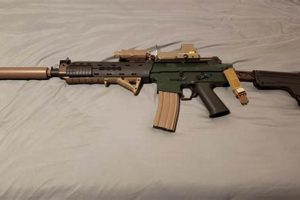
The selection and maintenance of equipment are critical determinants of success and safety within the competitive environment of airsoft battle royale. Effective participation hinges on a participant’s capacity to utilize tools optimized for simulated combat. The airsoft replica, the primary instrument of engagement, dictates effective range, accuracy, and rate of fire, directly influencing a players ability to eliminate opponents. Protective gear, including eye protection and tactical vests, mitigates the risk of injury, enabling participants to engage more confidently and aggressively. Communication devices facilitate team coordination and strategic planning, enhancing group effectiveness. A poorly maintained or inadequately selected loadout directly increases vulnerability and reduces combat effectiveness. A replica with insufficient range may leave a participant unable to engage effectively. The omission of vital protective gear leads to a heightened risk of injury. Lack of communication hamstrings team-based tactics. Equipment considerations therefore form an integral component to the overall experience.
Practical application of equipment knowledge extends beyond mere selection. Proficiency in weapon maintenance, including cleaning, lubrication, and basic repairs, ensures consistent performance under varied environmental conditions. Understanding ballistics and range estimation is crucial for accurate target engagement. Tactical gear must be organized for rapid access, facilitating quick reloading and equipment deployment in dynamic combat situations. Load distribution affects mobility and endurance, requiring careful consideration. Skilled participants demonstrate a comprehensive understanding of their equipment’s capabilities and limitations, adapting their strategies and tactics accordingly.
In summation, the nexus between equipment and successful participation cannot be overstated. Equipment deficiencies translate directly into tactical disadvantages and increased safety risks. A comprehensive understanding of equipment selection, maintenance, and effective deployment constitutes a foundational pillar of proficiency within the framework of airsoft battle royale. Continued refinement of equipment choices and usage techniques remains essential for maximizing performance and minimizing potential hazards.
4. Strategy
The interplay between strategy and airsoft battle royale constitutes a fundamental determinant of success within this simulated combat environment. Strategic planning, encompassing terrain analysis, resource management, and coordinated team maneuvers, directly impacts a participant’s survivability and effectiveness. For instance, teams that pre-plan patrol routes, establish communication protocols, and designate roles typically outperform those relying solely on individual skill. A real-world example includes the practice of designating specific team members as scouts, tasked with reconnaissance, enabling the team to anticipate enemy movements and establish advantageous positions. Ignoring strategic considerations invariably leads to suboptimal performance and increased vulnerability to elimination.
Strategic depth extends beyond pre-game planning to encompass in-situ adaptation and decision-making. The dynamic nature of the battle royale format necessitates the ability to adjust tactics based on evolving circumstances. For example, if a team’s initial plan is compromised by unforeseen enemy presence, adapting to a defensive posture, establishing a fallback position, and reassessing the situation becomes paramount. Furthermore, effective resource management, including ammunition conservation and the strategic allocation of limited supplies, is critical for sustaining operations throughout the duration of the engagement. Teams observed effectively utilizing smoke grenades for cover and concealment to advance across open ground demonstrate an acute understanding of tactical adaptation.
In conclusion, strategic proficiency represents a non-negotiable element for achieving sustained success in airsoft battle royale. From initial reconnaissance to in-engagement adaptation, strategic thinking dictates both survivability and the capacity to achieve the ultimate objective. Addressing challenges associated with effective communication and team coordination remains crucial for maximizing the benefits of a well-defined strategy, reinforcing the intrinsic link between strategic planning and optimal performance within this simulated combat environment.
5. Safety

Safety protocols are paramount within airsoft battle royale. Given the inherent risks associated with simulated combat involving projectile weapons, rigorous adherence to safety guidelines is non-negotiable. These protocols are designed to minimize the potential for injury and ensure a secure environment for all participants.
- Mandatory Eye Protection
The use of full-seal, ANSI-rated eye protection is universally required. Airsoft projectiles can cause severe eye damage, rendering proper eye protection indispensable. Before gameplay commencement, thorough inspection of all eye protection is mandatory. Any compromised or non-compliant eye protection must be replaced before the individual is permitted to participate. This protocol directly mitigates the risk of potentially blinding injuries.
- Velocity Limits and MED Enforcement
Airsoft replicas are subject to strict velocity limits, typically measured in feet per second (FPS) with 0.20g BBs. These limits are designed to minimize the impact force of projectiles. Minimum Engagement Distances (MEDs) are implemented based on replica velocity. Higher velocity replicas necessitate greater minimum engagement distances to reduce the potential for close-range injury. Chronograph testing to verify replica velocity is a common pre-game procedure.
- Safe Zones and Weapon Handling
Designated safe zones, where eye protection may be removed and replicas must be unloaded and safetied, are essential for preventing accidental discharges and maintaining a secure environment during non-gameplay periods. Strict weapon handling protocols, including muzzle awareness and trigger discipline, are enforced at all times. Under no circumstances are replicas to be fired within safe zones or at individuals who are not actively participating in gameplay.
- Physical Contact and Blind Firing Prohibition
Physical contact between participants is strictly prohibited. Airsoft is a non-contact sport, and any form of physical aggression is grounds for immediate disqualification. Blind firing, defined as discharging a replica without a clear line of sight to the target, is similarly prohibited. Both of these rules mitigate the risk of accidental injury and promote responsible engagement.
The collective enforcement of these safety measures fosters a responsible and secure environment for airsoft battle royale participants. Neglecting any aspect of these guidelines presents unacceptable risks. Maintaining a strong safety culture necessitates ongoing education, rigorous rule enforcement, and a commitment from all participants to prioritize safety above all else.
Frequently Asked Questions
This section addresses common inquiries pertaining to the operational parameters, participation requirements, and safety considerations associated with organized simulated combat events.
Question 1: What distinguishes simulated combat events from standard skirmishes?
Organized simulated combat events typically involve larger playing areas, more participants, and longer engagement durations than standard airsoft skirmishes. Objectives extend beyond simple elimination, often incorporating area control, resource acquisition, and scenario-specific tasks. The format prioritizes strategic depth and prolonged engagement, demanding increased physical endurance and tactical proficiency.
Question 2: What are the minimum age requirements for participation?
Age requirements are governed by local regulations and the specific event organizer’s policies. Typically, participants under the age of 18 require parental consent, and individuals below a certain age may be restricted from utilizing higher-velocity airsoft replicas. Prospective participants should verify age restrictions prior to registration.
Question 3: Is prior experience required to engage in simulated combat?
Prior experience in airsoft or related activities is beneficial but not always mandatory. While experienced participants possess a tactical advantage, many events welcome newcomers, providing introductory briefings and guidance on basic safety protocols and gameplay mechanics. However, a fundamental understanding of safe weapon handling practices is essential for all participants.
Question 4: What type of airsoft replica is appropriate for this activity?
The optimal airsoft replica depends on individual playstyle, environmental conditions, and event-specific regulations. Assault rifles and carbines are generally well-suited for versatile engagements. Snipers and designated marksman rifles are effective for long-range engagements in open environments. Adherence to velocity limits and MED requirements is paramount, irrespective of replica type.
Question 5: Are there specific dress code requirements?
Dress code requirements vary depending on the event organizer and the operational environment. Camouflage clothing is frequently recommended to enhance concealment. Sturdy footwear is essential for navigating varied terrain. Protective gear, including full-seal eye protection and potentially tactical vests, is always mandatory. Brightly colored clothing or armbands may be required to differentiate teams or designate specific roles.
Question 6: What recourse is available in the event of a safety violation?
Event organizers typically establish a system for reporting and addressing safety violations. This may involve designated referees or marshals who monitor gameplay and enforce rules. Violations may result in warnings, temporary suspensions, or permanent ejection from the event. Prioritizing safety necessitates prompt reporting of any observed infractions.
In summary, participation requires adherence to defined regulations, appropriate equipment selection, and a commitment to safe and responsible engagement. Prospective participants should familiarize themselves with event-specific guidelines prior to registration.
The following sections delve into the future trends and potential evolution of simulated combat.
Conclusion
This exploration of airsoft battle royale has underscored its multifaceted nature, encompassing strategic planning, equipment selection, environmental awareness, and rigorous safety protocols. The activity’s inherent complexity demands both physical and mental acuity, requiring participants to adapt continuously to evolving circumstances. Mastery of these elements contributes directly to both survivability and overall enjoyment.
As simulated combat continues to evolve, prospective participants are encouraged to approach it with a commitment to safety, responsible gameplay, and ongoing skill development. Whether engaging as a team or as an individual, the potential for tactical challenge and immersive experience remains significant. Continued adherence to best practices will ensure the longevity and integrity of airsoft battle royale for enthusiasts and newcomers alike.