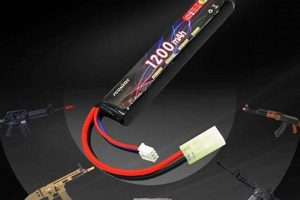
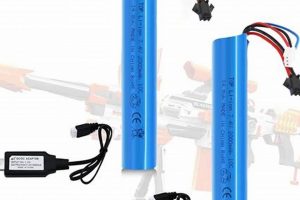
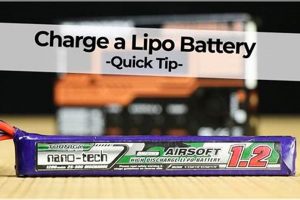
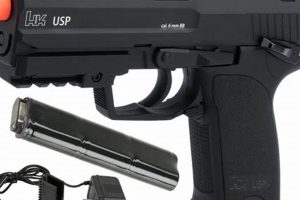
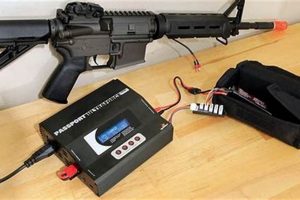
The power source for airsoft replicas of the Steyr AUG rifle typically consists of rechargeable cells housed in a distinct unit. These units are designed to fit within the stock or other designated compartments of the replica, providing the necessary electrical energy to operate the internal mechanism that propels projectiles. Configuration options often include NiMH (Nickel Metal Hydride) or LiPo (Lithium Polymer) chemistries, each offering varying voltage, capacity, and discharge rate characteristics, impacting the replica’s rate of fire and overall performance.
A reliable and appropriate power source is critical for the operational effectiveness of the airsoft AUG replica. Selecting the correct voltage and capacity ensures optimal cycling of the gearbox, promoting consistent performance and minimizing the risk of damage to internal components. Historically, NiMH units were prevalent; however, LiPo options have gained popularity due to their higher energy density and discharge rates, offering improved trigger response and sustained performance. Understanding the specifications and limitations of each chemistry is essential for responsible use and longevity of both the power source and the airsoft replica itself.
The following sections will detail the different types of units available, factors to consider when choosing a suitable unit, proper charging and maintenance procedures, and troubleshooting common issues. Understanding these aspects will help ensure the safe and efficient operation of the airsoft AUG replica.
Airsoft AUG Battery
The following guidelines offer critical information for maximizing performance and ensuring the safe operation of airsoft AUG replicas utilizing a dedicated power source. Proper handling and maintenance are vital for longevity and reliability.
Tip 1: Select the Correct Voltage: Adherence to the voltage specifications outlined by the airsoft replica manufacturer is paramount. Over-volting can lead to premature motor failure or damage to the electronic control unit, if equipped. Under-volting may result in reduced rate of fire and inconsistent cycling.
Tip 2: Match Capacity to Play Style: Consider the duration and intensity of gameplay when selecting a unit’s capacity (mAh). Higher capacity provides longer runtime, but also increases physical size and weight. Balance capacity with the practical limitations of the AUG replica’s battery compartment.
Tip 3: Monitor Temperature During Use: Excessive heat during operation is an indicator of potential problems, such as over-stressing the motor or internal wiring. Discontinue use immediately if the unit becomes unusually hot to the touch and investigate the cause.
Tip 4: Use a Smart Charger: Employ a dedicated smart charger designed for the specific battery chemistry (NiMH or LiPo). Smart chargers prevent overcharging, which can damage the unit and reduce its lifespan. They also often offer balancing and storage modes for optimal maintenance.
Tip 5: Store Properly When Not in Use: Store the unit in a cool, dry place away from direct sunlight and extreme temperatures. For LiPo units, utilize the storage charge function of the smart charger to bring the voltage to approximately 3.8V per cell for long-term storage, preventing degradation.
Tip 6: Inspect Connections Regularly: Routinely check the wiring and connectors for signs of damage, such as fraying, corrosion, or loose connections. Damaged wiring can cause performance issues or pose a safety hazard. Replace damaged components promptly.
Tip 7: Be Aware of Discharge Rate: The discharge rate (C-rating) indicates how quickly the unit can safely deliver current. Ensure the discharge rate is sufficient to meet the demands of the AUG replica’s motor. A lower-than-required discharge rate can cause voltage sag and reduced performance.
Following these tips will contribute to the reliable operation, extended lifespan, and enhanced safety of the power source used in an airsoft AUG replica. Consistent adherence to these guidelines is crucial for optimal performance and avoiding potential hazards.
The next section will delve into troubleshooting common issues encountered with airsoft AUG replica power units, providing practical solutions for resolving performance-related problems.
1. Voltage Compatibility

Voltage compatibility represents a crucial intersection between electrical safety, optimal performance, and equipment longevity in the context of powering airsoft replicas of the Steyr AUG rifle. Mismatched voltage levels can lead to significant damage or sub-optimal functionality.
- Potential for Component Damage
Employing a power unit with a voltage exceeding the AUG replica’s specified range introduces a high risk of irreversible damage to sensitive internal components. These components, including the motor, electronic control unit (ECU) if present and wiring, are designed to operate within defined voltage parameters. Over-volting can result in overheating, insulation breakdown, and catastrophic failure of electronic circuits, rendering the replica inoperable. This also poses a potential fire hazard due to thermal runaway.
- Suboptimal Performance and Reduced Rate of Fire
Conversely, utilizing a power unit with a voltage below the recommended level will typically manifest as reduced performance. The motor will receive insufficient power, resulting in a decreased rate of fire and sluggish trigger response. The replica may struggle to cycle the gearbox consistently, leading to misfeeds and overall unreliable operation. While not as immediately damaging as over-volting, prolonged use at an insufficient voltage can still place undue stress on the motor and other components.
- Manufacturer Specifications and Safety Compliance
Adhering strictly to the voltage specifications provided by the airsoft AUG replica manufacturer is paramount. These specifications are the result of rigorous testing and design considerations aimed at ensuring both optimal performance and safe operation. Furthermore, using a power unit with an incompatible voltage can void any warranties and potentially violate safety regulations pertaining to modified electrical devices.
- Impact on Electronic Control Units (ECUs)
Many modern airsoft AUG replicas are equipped with electronic control units (ECUs) that regulate motor performance, provide burst-fire capabilities, and offer other advanced features. These ECUs are particularly sensitive to voltage fluctuations and are highly susceptible to damage from over-volting. Even slight deviations from the specified voltage range can disrupt the ECU’s operation, leading to malfunctions or complete failure. Replacing an ECU is often a costly repair.
In conclusion, voltage compatibility serves as a non-negotiable requirement when selecting a power source for an airsoft AUG replica. Careful attention to manufacturer specifications, combined with the use of appropriate voltage meters and compatible smart chargers, is essential for preserving the replica’s operational integrity, ensuring safe usage, and maximizing its lifespan. Neglecting voltage compatibility can have severe consequences, ranging from diminished performance to catastrophic component failure.
2. Capacity Requirements

The capacity requirements of an airsoft AUG power source dictate the duration of operational use attainable before requiring recharge. This characteristic is a critical consideration for users, as it directly impacts the practicality and enjoyment of extended gameplay scenarios.
- Gameplay Duration and Intensity
The desired length of gameplay sessions significantly influences the required capacity. A short skirmish requires less capacity than a prolonged MilSim (Military Simulation) event. Furthermore, the intensity of gameplay, characterized by the frequency of firing, increases power consumption. Players engaging in sustained rapid-fire scenarios deplete the power source at a faster rate than those utilizing a more conservative firing style. Selecting a capacity that adequately accommodates both the anticipated duration and intensity of gameplay is therefore essential.
- Physical Constraints of the Airsoft AUG Replica
The physical dimensions of the power source compartment within the airsoft AUG replica impose limitations on the maximum permissible size. Higher capacity units generally exhibit larger physical dimensions. Users must carefully consider the available space to ensure compatibility. Overly large units may not fit properly, while units that are too small may offer inadequate capacity. Balancing the need for sufficient capacity with the physical constraints of the replica is a critical aspect of the selection process.
- Power Source Chemistry and Energy Density
Different power source chemistries, such as NiMH (Nickel Metal Hydride) and LiPo (Lithium Polymer), exhibit varying energy densities. LiPo units, for instance, typically offer a higher energy density than NiMH counterparts, allowing for a greater capacity within a smaller physical volume. The choice of chemistry, therefore, influences the capacity attainable within the limitations imposed by the replica’s physical dimensions. Users should consider the trade-offs between chemistry, energy density, capacity, and safety when making their selection.
- Operational Temperature and Performance Degradation
Capacity ratings are typically specified under ideal laboratory conditions. In real-world scenarios, operational temperature can affect the unit’s actual usable capacity. Extreme temperatures, whether hot or cold, can reduce the available capacity and impact performance. Prolonged exposure to high temperatures, particularly during charging or discharging, can also accelerate degradation of the power source, leading to a permanent reduction in capacity over time. Proper storage and handling are therefore critical for maintaining optimal capacity throughout the unit’s lifespan.
The aforementioned factors highlight the multifaceted nature of capacity requirements in relation to powering airsoft AUG replicas. A comprehensive understanding of gameplay dynamics, physical constraints, chemistry characteristics, and operational conditions is paramount for selecting a power source that delivers satisfactory performance, reliability, and longevity. Ignoring these considerations can lead to frustration, diminished performance, and potentially, premature failure of the power source.
3. Chemistry Selection and Airsoft AUG Power

The chemistry employed within an airsoft AUG power unit directly dictates performance characteristics, safety considerations, and overall longevity. Selection of the appropriate chemistry is not arbitrary; it represents a fundamental decision impacting the replica’s usability and reliability. Two primary chemistries dominate the market: Nickel Metal Hydride (NiMH) and Lithium Polymer (LiPo), each possessing inherent strengths and weaknesses pertinent to airsoft applications.
NiMH units offer a relatively stable and forgiving profile. These exhibit lower risk of thermal runaway or combustion compared to LiPo alternatives. However, NiMH often presents with lower energy density, resulting in reduced runtime for a given size and weight. Furthermore, NiMH can exhibit “voltage sag” under heavy load, diminishing rate of fire. Conversely, LiPo provides higher energy density and superior discharge rates, translating to improved trigger response and sustained performance. This advantage comes at the cost of increased sensitivity to overcharging, over-discharging, and physical damage. Improper handling of LiPo can lead to catastrophic failure involving fire or explosion. The selection, therefore, involves a trade-off between convenience and safety (NiMH) versus performance and potential risk (LiPo). For example, a novice user may opt for NiMH due to its forgiving nature, while an experienced player prioritizing competitive performance might choose LiPo with diligent adherence to safety protocols.
The selection of power unit chemistry is not merely a matter of personal preference; it is a foundational element impacting an airsoft AUG replica’s operational parameters and safety profile. Understanding the inherent characteristics and limitations of each chemistry, along with adopting appropriate handling and maintenance practices, is crucial for ensuring reliable performance and mitigating potential hazards. Improper chemistry selection, combined with negligent handling, can lead to diminished performance, equipment damage, or, in extreme cases, pose a significant safety risk to the user and surrounding environment.
4. Discharge rate (C-rating)
Discharge rate, commonly expressed as a C-rating, represents a critical parameter defining the performance capabilities of a power source used in airsoft AUG replicas. This value indicates the maximum continuous current a power source can deliver without experiencing damage or significant voltage drop, thus directly influencing the replica’s operational characteristics.
- C-Rating Definition
The C-rating is a numerical value representing a multiple of the power source’s capacity. For example, a 1600mAh power source with a 20C rating can theoretically deliver 1600mAh * 20 = 32000mA or 32 Amps continuously. Exceeding this current draw can lead to overheating, reduced performance, or premature failure of the power source. It is a benchmark for comparing different power sources for current delivery capability.
- Impact on Rate of Fire (ROF)
The airsoft AUG replica’s motor requires a specific amount of current to operate effectively. A higher C-rating allows the power source to supply the necessary current more readily, sustaining a higher rate of fire. Insufficient C-rating results in “voltage sag,” where the voltage drops under load, causing a noticeable decrease in ROF and potentially leading to gearbox lock-ups. Internal components are impacted if the ROF isn’t stable.
- Motor Stress and Heat Generation
A properly matched C-rating ensures the motor receives adequate current without over-stressing the power source. An undersized C-rating forces the power source to work harder, generating excessive heat and potentially shortening its lifespan. A drastically oversized C-rating, while not inherently harmful, provides no added benefit if the motor’s current draw is significantly lower. Finding the right C-rating maintains stable motor function for the internal AEG.
- Compatibility with Internal Components
The selected C-rating needs to be congruent with the specifications of the airsoft AUG replica’s internal components. Motors, wiring, and electronic control units (ECUs), if present, are designed to handle a specific current range. Exceeding these limits, even with a high C-rated power source, can damage these components, negating any potential performance gains and compromising the replica’s reliability. Having an appropriate power balance keeps the system functioning properly.
In conclusion, the C-rating represents a critical factor in the selection of a power source for an airsoft AUG replica. Matching the C-rating to the motor’s current requirements, considering the replica’s internal components, and understanding the trade-offs between performance, heat generation, and longevity are essential for ensuring reliable operation and preventing damage. Disregard for this specification can lead to suboptimal performance, reduced lifespan of the power source, or even catastrophic failure of the replica’s internal components.
5. Charging protocols

The charging protocols governing the use of an airsoft AUG power unit are inextricably linked to its operational lifespan, safety, and performance consistency. The relationship between charging protocols and these units is cause-and-effect: adherence to specified charging procedures directly results in optimized performance and extended lifespan, while deviations lead to degradation, diminished capacity, or catastrophic failure. Understanding charging protocols is not merely a suggestion; it is a fundamental component of responsible airsoft AUG power unit ownership. For instance, attempting to charge a Lithium Polymer (LiPo) unit with a charger designed for Nickel Metal Hydride (NiMH) chemistries will invariably result in damage, potentially causing thermal runaway and combustion. Real-world examples abound in online forums and communities, detailing instances of damaged equipment and safety hazards resulting from improper charging practices.
The practical significance of understanding these charging protocols extends beyond mere cost savings through preventing equipment damage. Correct charging ensures the unit consistently delivers its rated voltage and capacity, directly impacting the airsoft AUG replica’s rate of fire and trigger response. Specific protocols often dictate the use of balance charging, particularly crucial for LiPo units. Balance charging ensures each cell within the unit receives an equal charge, preventing individual cells from being overstressed and thus prolonging overall lifespan. Smart chargers, designed to automatically regulate charging parameters based on the detected chemistry and cell voltage, are essential tools in maintaining proper charging practices. These chargers often incorporate safety features such as overcharge protection and thermal monitoring, further mitigating risks associated with improper charging. The lack of understanding charging protocols leads to damage of the battery and internal components such as the motor and ECU which would lead to inconsistent functionality of the AEG.
In summary, the charging protocols are not optional guidelines but essential procedures for the safe and effective utilization of an airsoft AUG power unit. Neglecting these protocols can lead to diminished performance, reduced lifespan, and potentially hazardous situations. Challenges surrounding charging protocols often stem from a lack of user education and the complexity of modern unit chemistries. However, diligent adherence to manufacturer specifications and the utilization of appropriate charging equipment are crucial for maximizing the performance and longevity of the airsoft AUG power unit, ultimately contributing to a safer and more enjoyable airsoft experience.
6. Physical dimensions
The physical dimensions of a power unit are paramount when considering its compatibility with an airsoft AUG replica. The AUG’s internal compartment, typically within the stock, dictates the maximum allowable size. Deviations from these dimensional constraints render the unit unusable, irrespective of its electrical characteristics.
- Compartment Geometry
The AUG’s power source compartment features a specific geometry, often accommodating long, slender units. This design necessitates precise dimensional matching. Length, width, and thickness are all critical. For instance, a unit exceeding the compartment’s length will prevent closure of the stock, while excessive width or thickness may obstruct internal mechanisms or wiring. Real-world examples include users modifying stock compartments, which are not recommended, to force oversized units to fit. The structural integrity can be comprised doing so.
- Unit Shape and Configuration
The shape and configuration also exert influence. Units may be cylindrical, rectangular, or custom-shaped to optimize space utilization. The presence of wiring, connectors, and protective casings further impacts the overall dimensions. Airsoft AUG replicas that feature tight internal spacing require units with minimal protrusions or unconventional shapes to ensure proper fitment and functionality. The power unit must align with the intended orientation inside the replica.
- Impact on Capacity and Performance
Physical dimensions impose a direct constraint on the achievable capacity of the power unit. Within a given volume, there exists a maximum energy storage potential determined by the chemistry employed. For example, a smaller unit, while fitting comfortably within the AUG’s compartment, may necessarily sacrifice capacity compared to a larger unit, impacting the replica’s operational runtime. Striking a balance between physical dimensions and capacity represents a critical design consideration. Many airsoft players find themselves making this tradeoff.
- Aftermarket Compatibility
The aftermarket power unit market offers units designed to fit a variety of airsoft AUG models and their battery compartments, offering options for size, capacity, and construction. The compatibility may vary from model to model due to battery compartment configurations and sizing. Dimensions should be considered when finding a suitable unit.
The interplay between physical dimensions and the airsoft AUG power unit underscores the importance of precise specifications and dimensional awareness. The dimensions affect the performance, capacity, and functionality. A unit deemed electrically suitable may prove useless if its physical dimensions preclude installation, rendering all other characteristics moot. Therefore, careful attention to dimensional constraints is paramount when selecting a power source for an airsoft AUG replica.
Frequently Asked Questions
This section addresses common inquiries and misconceptions regarding power sources for airsoft AUG replicas. The information provided aims to offer clarity and promote informed decision-making.
Question 1: What voltage power source is suitable for a stock airsoft AUG replica?
The appropriate voltage varies depending on the specific model and manufacturer. Consult the replica’s user manual or the manufacturer’s website for definitive specifications. Operating outside the recommended voltage range can result in damage or diminished performance.
Question 2: Is it permissible to use Lithium Polymer (LiPo) units in older airsoft AUG replicas originally designed for Nickel Metal Hydride (NiMH) units?
The compatibility hinges on the replica’s internal wiring and motor capabilities. Older replicas may lack the robust wiring and motor components required to handle the higher discharge rates of LiPo units. Modification or professional assessment is recommended before attempting to use LiPo units in older replicas.
Question 3: What does the “C-rating” signify in relation to airsoft AUG power sources?
The C-rating indicates the maximum continuous discharge rate, expressed as a multiple of the unit’s capacity. A higher C-rating generally corresponds to improved trigger response and sustained rate of fire, provided the replica’s motor and wiring can handle the increased current draw.
Question 4: How can the lifespan of an airsoft AUG power unit be maximized?
Lifespan maximization involves adherence to proper charging protocols, avoidance of over-discharge, storage in a cool, dry environment, and regular inspection of wiring and connectors for damage. Utilizing a smart charger designed for the specific power unit chemistry is also critical.
Question 5: Is it safe to leave an airsoft AUG power unit connected to a charger indefinitely?
Prolonged overcharging can damage the unit and reduce its lifespan. It is advisable to disconnect the unit from the charger once charging is complete. Smart chargers typically incorporate automatic shut-off features to prevent overcharging.
Question 6: What are the risks associated with using damaged or swollen power units in an airsoft AUG replica?
Damaged or swollen units pose a significant safety hazard. These units may be prone to thermal runaway, potentially resulting in fire or explosion. Damaged or swollen units should be disposed of responsibly in accordance with local regulations.
The information presented above is intended to serve as a general guide. Specific circumstances may warrant consultation with qualified technicians or experienced airsoft users.
The subsequent section will delve into advanced troubleshooting techniques for common power-related issues encountered with airsoft AUG replicas.
Airsoft AUG Battery
The preceding analysis has thoroughly examined the various facets of the power source essential for the proper functioning of airsoft AUG replicas. Key points include voltage compatibility, capacity considerations, chemistry selection (NiMH vs. LiPo), discharge rate implications, and physical dimension constraints. Proper charging protocols and adherence to safety guidelines are not merely suggestions, but prerequisites for longevity and safe operation. This unit, when selected and maintained appropriately, is a fundamental component impacting the replica’s rate of fire, trigger response, and overall reliability on the field. The longevity and performance hinges on proper utilization and understanding of its characteristics.
Effective management of the airsoft AUG battery is, therefore, not just a matter of convenience, but a critical element of responsible airsoft participation. Continued advancements in chemistry and power management technologies will likely yield further improvements in performance and safety. Vigilance and informed decision-making remain paramount for ensuring the airsoft experience is both enjoyable and devoid of unnecessary risks. The user should use safe practices when charging, storing, and operating the replica. This contributes to a more positive and responsible user and community for the sport of airsoft.