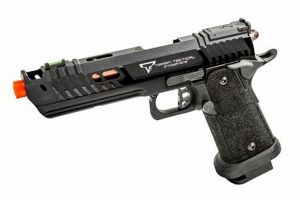
Compact, scaled-down replicas of firearms designed to fire spherical plastic projectiles are commonly used in recreational target shooting and simulated tactical scenarios. These devices typically utilize compressed gas or spring mechanisms to propel the projectiles. A common example is a miniature version of a Glock or Beretta, engineered for close-quarters engagement.
The appeal of these scaled-down models lies in their ease of handling, portability, and suitability for indoor environments or restricted spaces. Historically, their development served as an entry point into the broader airsoft hobby, offering a more accessible and less intimidating option for newcomers. Furthermore, these replicas can be instrumental in developing fundamental marksmanship skills and tactical awareness, providing a safe and controlled training platform.
The following sections will delve into the specific types available, power sources used, safety considerations, and maintenance procedures associated with these popular airsoft platforms.
Optimizing the Use of Compact Airsoft Handguns
This section offers guidance on maximizing performance and ensuring longevity when utilizing scaled-down airsoft replicas. Proper maintenance and informed handling are crucial for both safety and optimal functionality.
Tip 1: Ammunition Selection: Employing high-quality, seamless BBs is critical. Irregularly shaped or low-grade ammunition can cause internal damage and reduced accuracy. Opt for polished, precision-grade BBs to maintain performance integrity.
Tip 2: Gas Reservoir Management: For gas-powered models, maintain consistent gas pressure. Inconsistent pressure leads to erratic shot velocity and reduced effective range. Regular lubrication of gas seals also prevents leakage and ensures optimal operation.
Tip 3: Spring System Maintenance: For spring-powered devices, periodic lubrication of the internal piston and spring mechanism is vital. This reduces friction and maintains consistent compression, resulting in improved power output.
Tip 4: Cleaning Protocols: After each use, thoroughly clean the internal barrel. Accumulation of debris impairs accuracy and can damage internal components. Utilize a cleaning rod and appropriate solvent to remove any residue.
Tip 5: Storage Practices: Store the devices in a cool, dry environment, away from direct sunlight and extreme temperatures. This prevents degradation of plastic and rubber components, prolonging their lifespan.
Tip 6: Safe Handling Procedures: Always treat the devices as if they are loaded. Never point them at anything or anyone you do not intend to shoot. Adherence to fundamental firearm safety principles is paramount.
Tip 7: Upgrade Considerations: Evaluate potential upgrades carefully. Ill-advised modifications can negatively impact performance or compromise the structural integrity of the device. Research compatibility and consult with experienced technicians before implementing any alterations.
By adhering to these guidelines, users can significantly enhance the performance and longevity of their compact airsoft handguns while ensuring safe and responsible operation.
The subsequent section will address common malfunctions and troubleshooting techniques, offering practical solutions for resolving operational issues.
1. Size and Portability

The inherent dimensions and weight of these airsoft replicas fundamentally dictate their operational scenarios and user accessibility. The reduced scale directly contributes to enhanced maneuverability and ease of concealment, impacting tactical applications and storage considerations.
- Concealed Carry Potential
The diminutive size allows for discreet carry, a feature valued in scenarios emphasizing covert operations or personal defense simulations (where permissible). This characteristic is often explored in MilSim events and training exercises that mimic real-world tactical situations. However, any carry, concealed or otherwise, must comply with local laws regarding imitation firearms.
- Ease of Storage and Transport
Their compact nature simplifies storage and transport. These airsoft devices can be readily accommodated in smaller containers or equipment bags, reducing logistical challenges associated with larger airsoft rifles or support weapons. This facilitates accessibility for spontaneous skirmishes or training sessions.
- Maneuverability in Confined Spaces
The reduced length and weight enhance handling within confined spaces, such as indoor arenas or densely forested environments. This advantage allows for quicker target acquisition and engagement in close-quarters combat scenarios, improving operator effectiveness in dynamic tactical situations. For example, room clearing exercises in CQB (Close Quarters Battle) training benefit significantly from the use of these airsoft devices.
- Reduced Physical Strain
The lighter weight minimizes physical fatigue during prolonged usage. This is particularly relevant in extended MilSim events or training exercises, where operators may be required to carry their equipment for extended periods. This reduction in strain allows for increased focus and performance over time.
In conclusion, the size and portability of these replicas provide significant advantages in specific scenarios, influencing tactical deployment, storage solutions, and user endurance. These features are often prioritized when selecting airsoft equipment for particular operational requirements.
2. Power Source Variance

The performance characteristics of compact airsoft handguns are critically dependent on the power source employed. Variations in power sourcesnamely, spring-powered, electric-powered (AEPs), and gas-powered (CO2, green gas, or propane)directly influence factors such as projectile velocity, effective range, rate of fire, and operational consistency. For instance, spring-powered versions, typically single-shot, offer a low-cost entry point, but their manually operated mechanism limits the rate of fire and potential power output. Conversely, gas-powered models, while capable of higher velocities and simulated recoil, are susceptible to temperature-dependent performance fluctuations and require a continuous supply of propellant. AEPs offer a middle ground, providing semi-automatic or fully automatic capabilities with relatively consistent performance, though often at the expense of power output compared to gas-powered alternatives. The choice of power source, therefore, becomes a primary determinant in selecting a compact airsoft handgun aligned with specific operational needs and budgetary constraints.
The impact of power source extends beyond immediate performance metrics. For example, gas-powered models necessitate routine maintenance of seals and valves to prevent leaks and ensure optimal pressure regulation. The selection of propellantCO2 versus green gasfurther influences operating pressure and compatibility with specific models. AEPs, reliant on rechargeable batteries, demand consideration of battery capacity, charging cycles, and potential for battery degradation over time. Spring-powered versions, while requiring minimal maintenance, are inherently limited in terms of upgrade potential and overall performance ceiling. Consequently, the power source significantly affects long-term operational costs, maintenance requirements, and the overall lifespan of the compact airsoft handgun.
In summary, the “Power Source Variance” in compact airsoft handguns constitutes a fundamental design consideration, dictating performance capabilities, maintenance demands, and operational suitability. Selecting the appropriate power source requires a comprehensive evaluation of the intended application, budgetary limitations, and tolerance for maintenance requirements. A misaligned power source can lead to suboptimal performance, increased operational costs, or premature equipment failure. Ultimately, understanding the nuances of each power source is crucial for informed decision-making and achieving the desired operational outcomes.
3. Accuracy Limitations

The accuracy of scaled-down airsoft handguns is inherently constrained by several factors attributable to their compact design and operational mechanics. These limitations affect effective range, target acquisition, and overall performance in simulated combat scenarios.
- Reduced Barrel Length
The shortened barrel length of these devices directly impacts projectile stability and velocity. A shorter barrel provides less time for the projectile to stabilize, leading to increased trajectory deviation and reduced accuracy at extended ranges. For instance, a standard airsoft pistol barrel may measure between 80mm and 120mm, significantly less than a rifle barrel, resulting in a noticeable drop in precision beyond 20 meters.
- Lower Muzzle Velocity
Compact airsoft pistols often exhibit lower muzzle velocities compared to their larger counterparts due to space constraints for gas reservoirs or spring mechanisms. Reduced velocity translates to a shorter effective range and increased susceptibility to wind drift, further limiting accuracy, especially in outdoor environments. Velocities can range from 200 to 300 feet per second, a value often insufficient for engaging targets at distances exceeding 30 meters with any degree of reliability.
- Compromised Hop-Up Systems
The hop-up system, responsible for imparting backspin to the projectile and extending its range, is often less refined in compact models. A less effective hop-up unit results in inconsistent backspin and erratic trajectory, negatively impacting accuracy and effective range. While some models feature adjustable hop-up units, their performance is often inferior to those found in larger airsoft guns.
- Ergonomic Constraints
The smaller grip size and reduced weight of compact airsoft pistols can compromise handling and stability. This can lead to increased hand wobble and difficulty maintaining a consistent sight picture, particularly during rapid firing. These ergonomic challenges contribute to diminished accuracy, especially for users with larger hands or limited experience handling smaller firearms.
The combined effect of these factors creates inherent accuracy limitations in small airsoft pistols. While these devices can be effective in close-quarters scenarios, their performance is significantly compromised at longer ranges, necessitating careful consideration of engagement distances and environmental factors. Therefore, users should be aware of these limitations and adjust their tactics accordingly when employing these compact replicas.
4. Material Composition

The materials used in the construction of compact airsoft handguns significantly influence their durability, weight, performance, and overall cost. Material selection represents a critical engineering trade-off, balancing realism, operational lifespan, and compliance with regulatory requirements.
- Polymer Frame Construction
The utilization of high-impact polymer materials for the frame is prevalent due to their lightweight properties, cost-effectiveness, and resistance to environmental degradation. Examples include ABS (Acrylonitrile Butadiene Styrene) and reinforced nylon polymers. The widespread adoption of polymer frames in real firearms has influenced airsoft design, offering a balance of durability and affordability. However, polymer frames may exhibit reduced resistance to extreme temperatures or impacts compared to metal counterparts, potentially limiting their operational lifespan under harsh conditions.
- Metal Alloy Components
Critical internal components, such as the barrel, trigger mechanism, and gas system (in gas-powered models), often incorporate metal alloys, including zinc alloys, aluminum, and steel. These materials enhance the structural integrity of the handgun, improving resistance to wear and tear under repeated use. For example, a steel inner barrel contributes to improved accuracy and longevity compared to a plastic alternative. The use of metal alloys increases manufacturing costs and overall weight but enhances the realism and durability of the replica.
- Gas Reservoir Materials
In gas-powered variants, the gas reservoir is typically constructed from high-strength metal alloys, such as steel or aluminum, to withstand the pressure of the compressed gas. The material selection is critical for safety, preventing catastrophic failure due to overpressure. The gas reservoir must also be resistant to corrosion from the propellant used, whether CO2, green gas, or propane. The quality of the gas reservoir materials directly impacts the reliability and safety of the airsoft handgun.
- Internal Component Materials
Internal components, such as gears, pistons, and springs, are often constructed from a combination of metal and polymer materials. Metal gears provide increased durability and resistance to wear in electric-powered models, while polymer pistons offer lightweight and cost-effective solutions. The interplay between these materials influences the overall performance and lifespan of the airsoft handgun. For instance, a metal-toothed piston may be paired with polymer gears to balance durability and weight reduction.
The material composition of these compact airsoft handguns reflects a careful consideration of factors such as cost, weight, durability, and performance. The specific materials employed dictate the operational characteristics and longevity of the replica, influencing its suitability for various airsoft scenarios. A comprehensive understanding of these material properties is essential for making informed purchasing decisions and ensuring the safe and effective utilization of these devices.
5. Regulation Compliance

Adherence to legal statutes and regulatory frameworks is paramount in the ownership, usage, and distribution of compact airsoft handguns. The specifics of these regulations vary significantly across jurisdictions, encompassing aspects such as age restrictions, permissible usage locations, and requirements for distinguishing features to differentiate them from real firearms. Non-compliance can result in legal penalties, including fines and confiscation of equipment.
- Age Restrictions
Many jurisdictions impose age restrictions on the purchase and use of airsoft devices, including compact handguns. These restrictions are intended to prevent misuse by minors and ensure responsible handling. For instance, some regions may require individuals to be 18 years or older to purchase an airsoft gun, while others may permit supervised use by younger individuals at designated airsoft fields. Violation of age restrictions can lead to legal repercussions for both the minor and the adult providing access to the device.
- Distinguishing Features
Regulations often mandate the inclusion of specific markings or features to clearly differentiate airsoft devices from real firearms. These may include blaze orange barrel tips, transparent construction, or specific color schemes. The purpose of these features is to prevent misidentification by law enforcement and to minimize the risk of accidental shootings or criminal misuse. Failure to comply with these requirements can result in confiscation of the airsoft gun and potential criminal charges.
- Permissible Usage Locations
The permissible locations for using airsoft devices are frequently restricted to designated airsoft fields, private property with owner consent, or other approved areas. Public display or discharge in unauthorized locations is often prohibited to prevent public alarm and ensure public safety. Violations of these restrictions can lead to fines, arrest, and confiscation of the airsoft gun. Local ordinances should be consulted to determine approved usage locations.
- Transportation Regulations
Transportation regulations govern how airsoft devices must be transported to prevent accidental discharge or misuse. Typically, these regulations require that the airsoft gun be unloaded, stored in a case or container, and kept out of plain sight. These measures are intended to minimize the risk of theft or accidental discharge during transport. Failure to comply with transportation regulations can result in fines and confiscation of the airsoft gun.
The interplay of these regulatory facets directly impacts the responsible use and legality surrounding compact airsoft handguns. It is incumbent upon owners and users to familiarize themselves with and adhere to all applicable regulations in their specific jurisdiction. Ignorance of the law is not an excuse, and non-compliance can have serious legal consequences.
Frequently Asked Questions
The following section addresses common inquiries regarding small airsoft pistols, clarifying key aspects of their operation, safety, and regulatory compliance.
Question 1: What is the typical effective range of small airsoft pistols?
Effective range is typically limited to 20-30 meters due to reduced barrel length and lower muzzle velocity compared to larger airsoft rifles. Accuracy diminishes significantly beyond this range.
Question 2: What are the primary power source options for these devices?
The primary power sources include spring mechanisms, electric motors (AEPs), and compressed gas (CO2, green gas, or propane). Each option influences performance characteristics, maintenance requirements, and operational costs.
Question 3: What safety precautions should be observed when handling small airsoft pistols?
Fundamental firearm safety principles must be observed. These include treating the device as if it were loaded, never pointing it at anything or anyone not intended as a target, and always wearing appropriate eye protection.
Question 4: Are there specific regulations governing the ownership and use of small airsoft pistols?
Regulations vary by jurisdiction. Common regulations pertain to age restrictions, permissible usage locations, and requirements for distinguishing features to differentiate them from real firearms. Local ordinances should be consulted for specific requirements.
Question 5: What maintenance procedures are necessary to ensure optimal performance?
Regular maintenance includes cleaning the barrel, lubricating moving parts, and maintaining gas seals (for gas-powered models). Proper maintenance extends the lifespan and ensures consistent performance.
Question 6: What are the common causes of malfunctions in small airsoft pistols?
Common malfunctions include BB jams, gas leaks (in gas-powered models), and battery failures (in AEPs). Proper maintenance and the use of high-quality ammunition can mitigate these issues.
In conclusion, understanding the operational characteristics, safety protocols, and regulatory requirements associated with compact airsoft handguns is essential for responsible ownership and use.
The subsequent section will provide a comparative analysis of different brands and models available in the market.
Small Airsoft Pistols
This examination of small airsoft pistols has explored various facets of these devices, encompassing design considerations, operational characteristics, safety protocols, and regulatory compliance. The discussion has highlighted the trade-offs inherent in their compact design, including limitations in accuracy and power output, as well as the advantages they offer in terms of portability and maneuverability. Understanding these factors is crucial for making informed decisions regarding their acquisition and responsible utilization.
The responsible use of small airsoft pistols requires a commitment to safety, adherence to legal regulations, and a clear understanding of their capabilities and limitations. Continued engagement with reliable information sources and adherence to best practices are essential for promoting safe and responsible airsoft activities within the community.