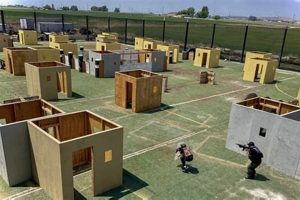
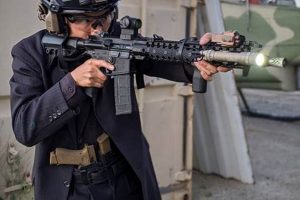
This activity combines the strategy and teamwork of simulated military combat with replica firearms that discharge plastic pellets. Participants engage in objective-based scenarios, utilizing tactics and communication to achieve victory. A common example involves two teams attempting to capture a designated area or eliminate opposing players.
The appeal lies in its blend of physical exertion, mental agility, and social interaction. It provides an outlet for individuals seeking adrenaline-pumping experiences while fostering camaraderie among teammates. Historically, such activities have grown from informal wargaming to organized events with established rules and safety regulations, becoming a popular recreational pursuit worldwide.
The following sections will delve into equipment considerations, gameplay strategies, safety protocols, and the community aspects associated with this engaging pastime.
Strategic Guidance
The following guidance aims to enhance performance and survivability in tactical scenarios. Adherence to these principles contributes to a more effective and enjoyable experience.
Tip 1: Situational Awareness: Maintain constant awareness of surroundings. Observation of enemy positions, team movements, and potential flanking routes is critical for informed decision-making.
Tip 2: Cover and Concealment: Utilize available cover effectively. Employ hard cover (walls, bunkers) to minimize exposure to enemy fire. Concealment (bushes, shadows) can obscure presence and facilitate ambushes.
Tip 3: Communication: Clear and concise communication is paramount. Relay enemy sightings, planned movements, and requests for support using established channels.
Tip 4: Movement Techniques: Vary movement patterns to avoid predictability. Utilize bounding overwatch techniques, where one team member covers while another advances.
Tip 5: Weapon Manipulation: Practice proficient weapon handling. Ensure magazines are readily accessible and practice reloading under simulated stress.
Tip 6: Teamwork and Coordination: Coordinate actions with teammates. Assign roles and responsibilities to maximize effectiveness and minimize redundancy.
Tip 7: Objective Focus: Maintain focus on the mission objective. Avoid unnecessary engagements and prioritize actions that contribute to achieving the stated goal.
Incorporating these principles into operational procedures leads to improved tactical proficiency, enhanced teamwork, and increased mission success.
The subsequent section will address crucial aspects of equipment maintenance and safety considerations.
1. Equipment Maintenance
The operational effectiveness and safety of any participant hinges significantly on meticulous equipment maintenance. Neglecting routine upkeep can lead to performance degradation, malfunctions during critical moments, and, potentially, hazardous situations. The integrity of the gear directly impacts the experience and the overall safety of all involved.
- Replica Firearm Maintenance
This encompasses cleaning, lubrication, and inspection of internal mechanisms. Residue buildup can impede functionality, while damaged components can cause misfires or inconsistencies in pellet trajectory. Regular cleaning prevents these issues, ensuring reliable performance. For example, disassembling and cleaning the hop-up unit improves range and accuracy.
- Protective Gear Integrity
Eye protection, face masks, and body armor are crucial safety components. Cracks, wear, or compromised materials diminish their protective capabilities. Thorough inspection before each engagement is essential to identify and address potential weaknesses. A cracked lens in eye protection, for instance, renders it ineffective against high-velocity impacts.
- Battery and Power System Management
For electrically powered replicas, battery health is paramount. Proper charging procedures, storage practices, and regular testing prolong battery life and prevent unexpected power failures. Overcharging or improper storage can damage batteries, leading to reduced capacity or potential hazards. A fully charged, well-maintained battery ensures consistent power output during gameplay.
- Magazine and Ammunition Handling
Magazines must be kept clean and free from debris to ensure smooth feeding of pellets. Damaged or malfunctioning magazines can cause jams and disrupt gameplay. Ammunition storage also affects performance; moisture or contamination can deform pellets, affecting accuracy and range. Storing magazines and ammunition properly minimizes these risks.
The collective impact of diligent upkeep across all equipment categories results in a safer, more reliable, and ultimately more enjoyable activity. Attention to detail in maintenance directly translates to enhanced performance and mitigated risks, reinforcing the importance of this aspect within the activity.
2. Safety Protocols

The incorporation of comprehensive safety protocols is paramount in this activity, mitigating potential risks and ensuring participant well-being. Strict adherence to established guidelines fosters a secure environment, allowing individuals to engage in the activity without undue hazard.
- Mandatory Eye Protection
Eye protection, typically in the form of full-seal goggles or masks certified to meet specific impact resistance standards (e.g., ANSI Z87.1), is non-negotiable. The high-velocity projectiles utilized necessitate robust shielding to prevent ocular injuries. Failure to wear appropriate eye protection can result in severe, irreversible damage. Every field should enforce the rule for all members to wear them at any time.
- Velocity Limits and Enforcement
Replica firearms must adhere to prescribed velocity limits, typically measured in feet per second (FPS) with a standardized weight pellet. Chronographs are used to verify compliance, and replicas exceeding the limit are prohibited from use. Maintaining velocity limits prevents excessive force, reducing the risk of injury upon impact. Example, most fields have a limit of 400 FPS with 0.20g BBs.
- Minimum Engagement Distances
Minimum engagement distances are established to prevent close-range, high-velocity impacts. Replicas with higher FPS ratings often necessitate greater minimum engagement distances. When players accidentally violate these distances, safety is violated with a high chance of severe hurt.
- Safe Zones and Barrel Covers
Designated safe zones, where eye protection may be removed, are strictly no-fire zones. Replica firearms must have barrel covers or magazine removed and fired to prevent accidental discharges within these areas. These measures prevent unintended injuries and maintain a secure environment when not actively engaged in gameplay.
These core safety protocols represent a foundational framework for responsible participation. Consistent enforcement, coupled with participant education, ensures a safer and more enjoyable experience for all. The absence of these protocols dramatically increases the potential for serious injury, underscoring their critical importance.
3. Tactical Maneuvers

Tactical maneuvers form the core of strategic engagement within this activity. Effective employment of these techniques differentiates recreational play from coordinated, objective-oriented gameplay. The success in accomplishing mission relies on applying tactical movements.
- Flanking Maneuvers
Flanking involves maneuvering a team or a portion thereof to the side or rear of an enemy position, thereby gaining a tactical advantage. This disrupts enemy lines of sight and creates opportunities for concentrated fire. Real-world military applications include encircling enemy strongholds to cut off supply lines and disorient defending forces. In this activity, flanking can break stalemates and overcome entrenched positions.
- Suppression Fire
Suppression fire is the use of sustained fire to pin down or discourage enemy movement. This allows friendly forces to advance, maneuver, or perform other tactical actions without being directly targeted. Military examples include providing cover for advancing troops or suppressing enemy fire during an extraction. In this activity, suppression fire facilitates movement and objective capture.
- Cover and Concealment Utilization
The effective use of available cover and concealment is fundamental to survivability and tactical success. Cover provides protection from direct fire, while concealment obscures a player’s presence. Real-world combat emphasizes minimizing exposure through the strategic use of natural and man-made obstacles. Similarly, in this activity, proficient use of cover and concealment enhances survivability and facilitates ambushes.
- Communication and Coordination
Tactical maneuvers are contingent upon clear and concise communication. Accurate reporting of enemy positions, planned movements, and requests for support are essential for coordinated action. Military units rely on standardized communication protocols to ensure clarity and efficiency. In this activity, effective communication translates to improved teamwork and enhanced tactical execution.
The implementation of these tactical maneuvers, while simplified from real-world military applications, underscores the strategic depth of this activity. These example highlight the need to be proficient. Through the application of these maneuvers, participants experience a heightened sense of realism and strategic engagement, elevating the overall experience.
4. Field Awareness

In this activity, field awareness encompasses the continuous and comprehensive assessment of the surrounding environment. It is a critical element contributing to both individual survivability and overall team effectiveness. A lack of such awareness increases vulnerability to attack and hinders strategic decision-making.
- Terrain Assessment
Terrain assessment involves analyzing the topography for potential cover, concealment, and avenues of approach. Understanding elevation changes, natural obstacles, and man-made structures allows participants to anticipate enemy movements and plan tactical maneuvers. For example, identifying a ridgeline as a potential sniper nest or a cluster of trees as a concealed ambush point is crucial. Accurate terrain assessment directly influences route selection and engagement strategies.
- Opponent Positioning
Monitoring the location and movement patterns of opposing players is essential for anticipating threats and coordinating responses. This requires observation skills, communication with teammates, and the ability to interpret visual cues. Detecting an enemy flanking maneuver or identifying a concentration of forces in a specific area allows for proactive countermeasures. Accurate opponent tracking is paramount for both defensive and offensive operations.
- Objective Status
Maintaining awareness of the status of mission objectives is critical for achieving success. This includes knowing the location of objectives, the number of friendly or enemy players contesting them, and the remaining time to complete the mission. Neglecting objective status can lead to missed opportunities or strategic setbacks. Constant monitoring ensures that efforts are focused on achieving mission goals.
- Environmental Factors
Environmental factors, such as weather conditions, visibility, and ambient noise, can significantly impact gameplay. Rain, fog, or darkness can reduce visibility, while wind can affect projectile trajectory. Being aware of these factors allows participants to adjust their tactics and equipment accordingly. Adapting to changing environmental conditions is crucial for maintaining effectiveness.
These facets of field awareness are intrinsically linked, forming a holistic understanding of the battlespace. A participant adept at assessing terrain, tracking opponents, monitoring objectives, and adapting to environmental factors possesses a significant advantage. Cultivating field awareness enhances both individual performance and overall team success, transforming recreational play into a more strategic and immersive experience.
5. Team Communication

In organized tactical simulations, effective team communication serves as a critical determinant of success. The rapid exchange of information concerning enemy positions, movement patterns, and objective status directly influences tactical decision-making and maneuver execution. The absence of clear and concise communication frequently results in tactical errors, increased vulnerability, and mission failure. For example, a team that neglects to communicate an enemy flanking maneuver may find itself outmaneuvered and eliminated, demonstrating the cause-and-effect relationship between communication and outcome. The importance of this component cannot be overstated; it is the backbone of coordinated action.
Real-world military tactics provide a relevant analog. Special forces teams, operating in high-stakes environments, rely heavily on pre-established communication protocols and constant information sharing to maintain situational awareness and coordinate their actions. Similarly, structured scenarios benefit from established communication channels and designated roles. In a capture-the-flag scenario, for example, a team might assign specific individuals to relay enemy positions, coordinate flanking maneuvers, and track objective status, ensuring a synchronized effort. The practical application involves using tools such as hand signals, short commands, and organized communication channels to relay crucial information.
Ultimately, the ability to communicate effectively is not merely a supplementary skill but an essential component for any participant seeking to excel. Challenges, such as noisy environments or limited communication channels, must be addressed through clear communication planning and adaptability. Effective team communication can overcome these short comings. The value cannot be overstated when working as a team.
6. Objective Completion
Objective completion in organized tactical simulations serves as the ultimate measure of success, reflecting a team’s proficiency in strategy, coordination, and execution. Scenarios are structured around specific objectives, such as capturing a designated area, eliminating opposing players, or retrieving an item. The ability to effectively plan and execute actions that lead to objective completion underscores the tactical capabilities of the participants. Scenarios failing to achieve an objective despite tactical advantages or superior resources suggest shortcomings in planning or coordination. Objective completion serves as a practical benchmark for evaluating team performance and identifying areas for improvement.
The emphasis on completing objectives differentiates this activity from simple skirmishes. Real-world military operations similarly prioritize achieving specific objectives, whether securing a strategic location, neutralizing a threat, or extracting personnel. Likewise, in organized games, teams must focus on achieving the assigned objective, avoiding the temptation to engage in irrelevant confrontations that detract from the overall mission. A team may dominate in terms of individual eliminations but still fail to secure the objective, highlighting the importance of prioritizing strategic goals over individual performance. A well-executed plan focused on objective completion will often outweigh superior firepower or individual skill.
Objective completion represents the culmination of tactical proficiency, effective communication, and strategic planning. Participants seeking to excel should prioritize objective-oriented gameplay, fostering teamwork and coordination. This focus transforms the activity from a simple recreational pursuit into a dynamic and engaging strategic experience, emphasizing the practical application of tactical principles and the importance of collaboration.
Frequently Asked Questions
The following questions address common inquiries and misconceptions regarding this activity. The information provided aims to clarify key aspects and promote a better understanding.
Question 1: What are the minimum age requirements for participation?
Minimum age requirements vary depending on the field or event organizer. Generally, participants must be at least 12 years of age, with parental consent often required for minors. Some fields may impose higher age restrictions based on the intensity of gameplay or the type of equipment used. Age verification is typically required before participation is permitted.
Question 2: Is specialized training required before engaging in gameplay?
While not always mandatory, specialized training is highly recommended, particularly for beginners. Basic training courses cover equipment operation, safety protocols, and fundamental tactical maneuvers. This ensures participants possess the knowledge and skills necessary to engage in gameplay safely and effectively. Furthermore, familiarity with standard operating procedures enhances both individual performance and team coordination.
Question 3: What types of protective gear are essential for participation?
Mandatory protective gear includes full-seal eye protection meeting ANSI Z87.1 standards, face masks, and appropriate clothing covering exposed skin. Additional protective gear, such as vests, gloves, and knee pads, is recommended to minimize potential injuries. The purpose of such gear is to provide a layer of protection between the skin and the incoming projectile.
Question 4: What are the typical velocity limits for replica firearms?
Velocity limits vary depending on the field and the type of replica firearm. Common limits include 400 FPS (feet per second) with 0.20g BBs for assault rifles and 500 FPS with 0.20g BBs for sniper rifles, measured using a chronograph. Exceeding velocity limits is strictly prohibited and can result in expulsion from the field. Fields enforce a velocity limit to preserve safety.
Question 5: Are there specific rules governing engagement distances?
Minimum engagement distances are established to prevent close-range, high-velocity impacts. These distances vary depending on the FPS rating of the replica firearm. Replicas with higher FPS ratings necessitate greater minimum engagement distances. Failing to adhere to these rules causes safety violations that can result in injuries.
Question 6: What types of scenarios are commonly encountered in organized gameplay?
Common scenarios include capture the flag, team deathmatch, king of the hill, and bomb defusal. These scenarios provide varied objectives and tactical challenges, requiring participants to adapt their strategies and teamwork accordingly. Each scenario has its own set of objectives, rules, and victory conditions, contributing to diverse gameplay experiences.
Adherence to established rules and safety protocols promotes a secure and enjoyable experience for all participants. This section emphasizes the importance of these elements.
The subsequent segment will provide closing thoughts on the activity, summarizing key aspects and highlighting the benefits of participation.
Conclusion
This exploration has detailed the multifaceted nature, emphasizing strategic gameplay, safety protocols, and equipment maintenance. The activity’s dependence on teamwork, communication, and adherence to established rules is paramount for both individual enjoyment and collective well-being. Consideration of these factors fosters a safer and more engaging environment.
Ultimately, responsible participation contributes to the continued growth and positive perception of this engaging recreation. Further individual exploration of advanced tactical methodologies, equipment optimization, and field-specific nuances will serve to enhance the participant’s experience and contribute to the collective understanding of the activity. The potential for strategic depth, coupled with the emphasis on teamwork, positions it as a compelling pursuit for those seeking both physical and mental engagement. The future hinges on a commitment to safety, ethical conduct, and the continued refinement of tactical approaches.
![Top-Rated: Best Airsoft Brand Guide [Year] & Beyond | Ultimate Airsoft Guide for Beginners, Tactics & Gear Reviews](https://airsoftica.com/wp-content/uploads/2026/05/th-80-300x200.jpg "Top-Rated: Best Airsoft Brand Guide [Year] & Beyond Ultimate Airsoft Guide for Beginners, Tactics & Gear Reviews")