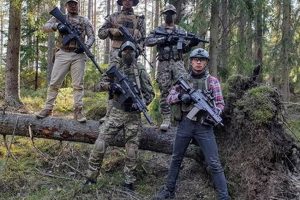
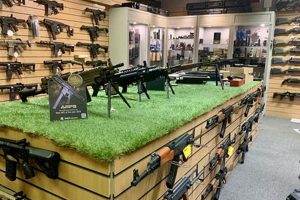
A compact, often two-barreled, replica firearm designed to fire 6mm plastic BBs. These small-scale models replicate the iconic shape and functionality of the original derringer pistols, but are intended for recreational target shooting or use in simulated combat scenarios rather than lethal force. They typically utilize spring-powered mechanisms or, less commonly, gas-powered systems to propel the projectiles. An example would be a player choosing one as a backup weapon in a close-quarters skirmish.
The appeal of these replicas lies in their concealability, aesthetic resemblance to historical firearms, and affordability. The compact size allows for easy storage and discreet carry in certain scenarios. Furthermore, they can serve as a training tool for firearm handling and safety, provided they are used responsibly and under proper supervision. Their historical connection adds a collector’s value and intrigue, appealing to enthusiasts of both the sport and firearm history.
The following sections will detail specific models, power sources, maintenance procedures, and safety considerations related to these replica firearms, providing a comprehensive overview for both newcomers and experienced users.
Operational and Maintenance Tips
The following guidelines offer practical advice for maximizing performance and ensuring the longevity of the product.
Tip 1: Barrel Maintenance: Regularly clean the barrel with a specialized cleaning rod to remove any debris or residue. Obstructions can severely impact accuracy and range.
Tip 2: Lubrication: Apply silicone oil to the internal mechanisms periodically. This reduces friction and ensures smooth operation, especially for gas-powered variants.
Tip 3: BB Quality: Utilize high-quality, seamless 6mm BBs. Avoid using warped or damaged projectiles, as they can cause jams and damage internal components.
Tip 4: Storage Considerations: Store in a cool, dry place away from direct sunlight and extreme temperatures. Exposure to heat can warp plastic components and degrade seals.
Tip 5: Spring Tension: For spring-powered models, avoid over-compressing the spring during loading. Excessive force can lead to premature spring fatigue and reduced power.
Tip 6: Gas Pressure Monitoring: For gas-powered variants, ensure the correct gas pressure is used. Over-pressurizing can damage seals and internal mechanisms. Using the correct type of gas as recommended by the manufacturer is crucial.
Tip 7: Disassembly Precautions: If disassembly is necessary for maintenance or repair, consult the manufacturer’s instructions. Improper disassembly can void warranties and damage internal components.
Adhering to these practices will contribute to consistent performance, extended lifespan, and enhanced user experience.
The concluding section will address common troubleshooting scenarios and safety precautions to ensure responsible use.
1. Compact Size
The defining characteristic directly influences its functionality and application. The deliberate reduction in scale presents both advantages and limitations, dictating its role within the broader spectrum.
- Concealment Advantages
The diminished profile allows for discrete carry and ease of concealment. This is advantageous in scenarios where a primary weapon might be impractical or disallowed. For example, a player might carry one as a backup in close-quarters environments where maneuverability is paramount. The ease of concealment is a direct consequence of the reduced dimensions.
- Operational Limitations
The reduced size invariably restricts magazine capacity and overall power output. Fewer rounds can be accommodated, and smaller gas reservoirs or weaker springs result in diminished range and velocity. These limitations necessitate a different tactical approach, favoring close-range engagements and supplementary roles. For example, a user cannot expect the same performance as a larger airsoft pistol, the design trades off for smaller size and easier carry, but with reduced magazine capacity.
- Ergonomic Considerations
The reduced grip size presents challenges to users with larger hands. Manipulation, particularly reloading and cocking, can be cumbersome. Ergonomic compromises are often made to maintain the intended form factor, impacting user comfort and dexterity. The design may make the product harder to manage. A balance is often necessary to allow for concealability.
- Material Constraints
Miniaturization necessitates the use of lighter, and often less durable, materials. Stress tolerances are lowered, and susceptibility to damage increases. Maintenance and careful handling become crucial to prolong operational lifespan. The tradeoff of lighter materials allow for easier carry, however, there are some durability constraints that need to be considered.
The interplay between these facets illuminates the core tradeoff inherent in the design. The focus on compactness necessitates sacrifices in firepower, ergonomics, and material robustness. Understanding these tradeoffs is crucial for effective utilization and informed purchasing decisions.
2. Concealability

Concealability is a defining characteristic that significantly influences the applications and tactical considerations surrounding these compact replica firearms. This feature dictates potential usage scenarios and necessitates specific considerations regarding safety and responsible handling.
- Physical Dimensions and Profile
The small overall size directly contributes to its ease of concealment. Reduced length, height, and thickness allow for discreet storage in pockets, holsters, or bags. The diminished profile minimizes the likelihood of detection, facilitating use in scenarios where maintaining a low profile is paramount. The product design allows it to be hidden easily.
- Carrying Methods and Accessories
Concealability necessitates the use of specialized carrying methods and accessories. Ankle holsters, inside-the-waistband holsters, and small pouches are commonly employed to ensure secure and discreet carry. The availability and effectiveness of these accessories directly impact the practicality of concealed carry. Using accessories for safer carry.
- Tactical Applications and Role-Playing Scenarios
Concealability lends itself to specific tactical applications and role-playing scenarios. It allows users to carry a secondary or backup weapon without attracting undue attention. This is particularly relevant in scenarios that simulate covert operations or where adherence to specific rules regarding visible weaponry is required. They are a backup weapon for covert situations.
- Legal and Ethical Considerations
The ease of concealment raises specific legal and ethical considerations. Users must be aware of and adhere to all applicable laws and regulations regarding the ownership, transportation, and use of replica firearms. Responsible handling and storage are crucial to prevent accidental discharge or misuse. The user must be aware of all laws when carrying.
The attributes relating to this are not only physical but also deeply intertwined with responsible and ethical usage. Understanding and respecting legal boundaries, as well as practicing safe handling techniques, are paramount when leveraging the inherent attributes. These replica guns need to be used responsibility.
3. BB Velocity

BB velocity serves as a critical performance indicator for replica firearms, directly impacting range, accuracy, and potential safety considerations. In the context of compact models, velocity is often a trade-off, balanced against size and mechanism limitations. Understanding this relationship is essential for responsible use.
- Power Source Influence
Spring-powered models typically exhibit lower velocities due to the limitations of spring compression within a small frame. Gas-powered variants can achieve higher velocities but are subject to gas pressure regulation and temperature sensitivity. The selected power source profoundly impacts projectile speed. Example: A spring pistol may shoot at 200 FPS, while a CO2-powered version may reach 300 FPS.
- Range and Accuracy Implications
Lower velocities translate to shorter effective ranges and increased projectile drop. Accuracy is also negatively affected, as the lighter BB is more susceptible to wind resistance and external factors. Compensation for these factors is necessary for accurate targeting. Example: A target at 50 feet may require significant upward aiming to compensate for drop.
- Safety Considerations
While these replica firearms are non-lethal, higher velocities can increase the risk of injury, particularly to sensitive areas like the eyes. Proper eye protection is mandatory, and responsible target selection is crucial. Velocity is directly proportional to potential impact force. Example: A shot to bare skin at close range from a high-velocity model can cause welts or minor abrasions.
- Regulatory Compliance
Many jurisdictions impose velocity limits on replica firearms for safety reasons. Models exceeding these limits may be subject to legal restrictions or outright prohibition. Compliance with local regulations is essential for responsible ownership and use. Example: Some areas may limit velocity to under 350 FPS for backyard target practice.
These factors underscore the importance of understanding velocity characteristics. The interplay between power source, range, safety, and regulatory compliance defines the operational parameters of these replica firearms and guides responsible use. Consumers should always check the velocity limits.
4. Spring/Gas Power
The operational mechanism of a derringer airsoft replica is intrinsically linked to its power source, primarily either a spring-powered or gas-powered system. The choice of power source dictates performance characteristics, influencing factors such as projectile velocity, effective range, and operational consistency. Spring-powered models utilize a compressed spring to propel the projectile, typically resulting in lower velocities compared to gas-powered counterparts. Conversely, gas-powered systems, employing compressed gases like CO2 or green gas, offer the potential for higher velocities and more consistent performance, albeit at the cost of requiring a pressurized gas source. For example, a spring pistol may require manual cocking before each shot, limiting its rate of fire, while a gas-powered variant can offer semi-automatic or fully automatic firing capabilities.
The practical significance of understanding the differences between spring and gas power lies in its influence on intended use and maintenance requirements. Spring-powered models are generally simpler to maintain, requiring minimal external components, while gas-powered models necessitate regular maintenance of seals and valves to prevent leaks. Furthermore, environmental factors, such as temperature, can significantly impact the performance of gas-powered systems, affecting gas pressure and, consequently, projectile velocity. Consider a scenario where a gas-powered model experiences a decrease in velocity due to colder temperatures, potentially affecting its effective range and accuracy.
In summary, the selection of spring or gas power represents a fundamental design choice that directly impacts the operational characteristics and user experience of a derringer airsoft replica. While spring-powered systems offer simplicity and affordability, gas-powered systems provide increased performance potential at the expense of complexity and maintenance requirements. Understanding these trade-offs is essential for selecting the appropriate model for a given application and ensuring responsible operation. The power source choice also impacts legal compliance, given that different jurisdictions have laws in place. Each user needs to be mindful of such power requirements.
5. Aesthetics

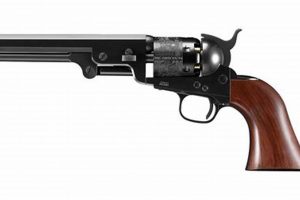
The aesthetic design significantly influences the perceived value and market appeal. The visual representation, mirroring historical models, often drives consumer interest. Replicas are crafted to emulate the appearance of specific eras, with attention paid to details such as grip texture, metal finish, and engraving patterns. This emphasis on visual fidelity directly impacts consumer perception and purchase decisions. For example, a model accurately replicating a Remington 1866 derringer is likely to attract collectors and history enthusiasts. The attention to design can be a major selling point.
Manufacturers employ various techniques to enhance the aesthetic realism. These include the use of realistic materials, such as metal alloys and faux wood, to replicate the weight and feel of the original firearms. Surface treatments, such as bluing or parkerizing, are applied to mimic the authentic finish. Furthermore, some manufacturers offer custom engraving options, allowing consumers to personalize their replicas. This customization further enhances the perceived value and collectability. The end result is an authentic look and feel.
The design serves as more than mere ornamentation; it contributes to the overall experience. A well-crafted replica enhances the sense of immersion in simulated combat scenarios or historical reenactments. It also provides a tangible connection to firearm history, appealing to collectors and enthusiasts. However, the focus on aesthetics should not overshadow safety considerations. Responsible handling and adherence to safety guidelines remain paramount, regardless of the replica’s appearance. Therefore, despite the appeal to design, safety remains the top priority.
6. Limited Capacity
The inherent design of these products dictates a restriction in ammunition capacity, typically limited to one or two rounds. This limitation stems directly from the compact size and specific operational mechanism mirroring the historical firearms they emulate. The minimal carrying capacity significantly impacts their practical application, necessitating a tactical approach that prioritizes accuracy and resource management. For example, a player utilizing this type of replica in a skirmish must carefully consider each shot, as opportunities for rapid follow-up shots are severely restricted.
The limited capacity influences several aspects of their use. It reduces their effectiveness in sustained engagements. This often relegates them to a secondary weapon role, utilized only in situations where a primary weapon is unavailable or ineffective. Users may employ them as a last resort. It also necessitates careful shot placement, since one must make every shot count. This requirement for precision enhances the realism of simulated combat scenarios, forcing participants to act strategically.
The limited capacity presents a key consideration for responsible use. Users must understand and respect the limitations, adjusting their expectations and tactics accordingly. The compact size makes this replica suitable for some skirmish needs. The knowledge gained may enhance safety awareness. While other airsoft weapons may carry more rounds, this weapons realistic portrayal of limited capacity helps enhance safety.
7. Short Range

Short range is a defining characteristic impacting functionality and tactical applications. Its inherent design limitations dictate its intended use and necessitate specific considerations regarding engagement strategies.
- Velocity and Projectile Trajectory
Lower muzzle velocities, characteristic of many derringer airsoft models, directly contribute to a shorter effective range. The reduced energy imparted to the projectile results in a more pronounced trajectory arc and diminished resistance to external factors such as wind. Consequently, accuracy and target effectiveness are compromised beyond a limited distance. For example, a model with a muzzle velocity of 200 feet per second will exhibit a significantly shorter range than one firing at 300 feet per second.
- Barrel Length and Projectile Stability
The inherently short barrel length in this model contributes to projectile instability and dispersion. The limited barrel length provides insufficient guidance to the BB, resulting in increased yaw and deviation from the intended trajectory. This effect is exacerbated at longer distances, leading to diminished accuracy. As barrel length decreases, stability drops.
- Target Engagement Scenarios
The reduced range dictates specific target engagement scenarios. These guns are most effective in close-quarters environments where targets are within a limited proximity. Attempting to engage targets beyond this range results in a decreased probability of a successful hit. Close quarters battles are best for this gun.
- Tactical Implications and Limitations
The limitations imposed by the short range necessitate specific tactical considerations. These models are best suited for a secondary weapon role or as a surprise weapon in close-quarters ambushes. Users must be aware of the limited range and avoid engaging targets beyond its effective reach. Short range impacts tactics.
Short range is a defining characteristic. Tactical deployment considerations can be determined through its design.
Frequently Asked Questions
The following addresses common inquiries regarding these replica firearms, providing clarity on their operation, safety, and maintenance.
Question 1: What is the typical effective range?
The effective range varies depending on the power source and model, but it generally falls between 20 and 50 feet. Factors such as wind and BB weight can influence this range.
Question 2: What type of BBs should be used?
Only high-quality, seamless 6mm plastic BBs are recommended. Using lower-quality or damaged BBs can cause jams and damage the internal mechanism.
Question 3: Are eye protection mandatory?
Yes, proper eye protection is mandatory whenever handling or using it. Projectiles can cause serious eye injuries, even at low velocities.
Question 4: How should it be stored?
It should be stored in a cool, dry place, away from direct sunlight and extreme temperatures. This helps to prevent warping of plastic components and degradation of seals.
Question 5: Can it be modified?
Modifications are generally discouraged, as they can compromise safety and void any existing warranties. Unauthorized modifications can also impact performance and reliability.
Question 6: What are the legal restrictions surrounding ownership?
Legal restrictions vary by jurisdiction. It is the user’s responsibility to be aware of and comply with all applicable laws and regulations regarding the ownership, transportation, and use of these replica firearms.
Adherence to these guidelines ensures responsible use and maintenance. Remember, safety and awareness are paramount.
The subsequent section will offer a comparative analysis of available models.
Conclusion
This exploration has delineated critical attributes, functionalities, and potential limitations. Factors such as compact size, concealability, power source, velocity, and limited ammunition capacity collectively define its tactical niche. Responsible employment necessitates a comprehensive understanding of these characteristics, alongside unwavering adherence to safety protocols and legal regulations.
Therefore, while the replica guns offer a unique blend of historical appeal and recreational functionality, their responsible utilization demands a commitment to safety, legal compliance, and informed decision-making. Continued education and awareness will ensure that the user can make the best informed choices on responsible use.
![Best Airsoft Chest Protector: [Brand] & [Type] | Ultimate Airsoft Guide for Beginners, Tactics & Gear Reviews](https://airsoftica.com/wp-content/uploads/2026/05/th-33-300x200.jpg "Best Airsoft Chest Protector: [Brand] & [Type] Ultimate Airsoft Guide for Beginners, Tactics & Gear Reviews")