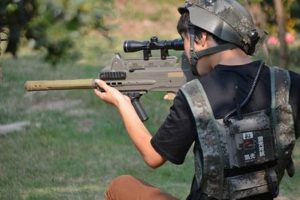
A shortened, compact version of an airsoft rifle designed for close-quarters battle (CQB) scenarios, these replicas offer maneuverability in tight spaces. Often modeled after real-world personal defense weapons, they typically feature shorter barrels and collapsible or folding stocks, facilitating easier handling in confined environments. An example is a replica based on the SIG MPX or the FN P90.
The reduced size is of significant importance, especially for players who prioritize agility and speed. This format allows for quicker target acquisition and easier navigation through enclosed structures. Historically, the development of these compact variants mirrored the real-steel firearm industry’s efforts to provide effective firepower in a smaller package, catering to military and law enforcement personnel operating in urban environments. This adaptability translates well to the airsoft field, enhancing the player’s tactical options.
The subsequent sections will delve into the different types available, the considerations for selecting the appropriate model, and the performance characteristics to expect, as well as recommended accessories and maintenance procedures.
Airsoft PDW
Optimal performance and user satisfaction with compact airsoft replicas hinge on informed decision-making and appropriate handling. This section offers critical guidelines for selecting, maintaining, and utilizing this type of equipment.
Tip 1: Research Real-World Counterparts: Familiarizing oneself with the specifications and intended use of the real-world firearm that the airsoft replica is based on informs tactical application and potential modifications. For example, understanding the intended role of the MP7 will aid in selecting appropriate accessories and loadouts.
Tip 2: Prioritize Internal Component Quality: A robust gearbox and reliable hop-up unit are paramount for consistent performance. Evaluate internal components and consider immediate upgrades if the stock configuration is lacking. Inspecting reviews and manufacturer specifications is recommended.
Tip 3: Match BB Weight to Barrel Length: Shorter barrels typically benefit from lighter BB weights to maintain accuracy and range. Experimentation is crucial, but as a general rule, lighter BBs (e.g., 0.20g – 0.25g) are often more suitable for shorter inner barrels. Chronograph results should be monitored.
Tip 4: Optimize Battery Selection: Compact airsoft replicas often have limited battery compartments. Select a battery with appropriate dimensions and sufficient discharge rate (C-rating) to power the motor effectively. LiPo batteries are often favored for their energy density but require careful handling.
Tip 5: Secure Optics Appropriately: Given the confined spaces where these airsoft guns are typically employed, a red dot sight or holographic sight is often preferable over magnified optics. Ensure the optic is securely mounted and properly zeroed for optimal accuracy.
Tip 6: Practice Weapon Manipulation: Familiarize yourself with reloading, clearing malfunctions, and transitioning between firing modes in a swift and efficient manner. Regular practice drills are essential for effective utilization in dynamic scenarios.
Tip 7: Regular Maintenance is Crucial: Cleaning the barrel, lubricating moving parts, and inspecting for wear and tear are essential for maintaining performance and prolonging the lifespan. A consistent maintenance schedule will mitigate potential issues.
These considerations, when properly addressed, significantly enhance the effectiveness and longevity of airsoft compact replicas in various tactical situations. Selecting the right model and optimizing its performance through careful maintenance ensures a competitive edge.
The following sections will expand on the specifics of accessories, upgrade paths, and common troubleshooting procedures.
1. Compact maneuverability

Compact maneuverability is a defining characteristic and primary advantage afforded by the airsoft PDW (Personal Defense Weapon) platform. Its diminished size, relative to standard airsoft rifles, directly translates to enhanced agility and ease of handling within constricted environments. This section will detail the facets contributing to this maneuverability and its implications for airsoft gameplay.
- Reduced Overall Length
The shortened barrel and often collapsible or folding stock configurations of a PDW minimize its length. This allows for quicker weapon transitions and easier navigation through doorways, hallways, and other tight spaces commonly encountered in CQB (Close Quarters Battle) scenarios. For example, a player armed with a standard-length M4-style airsoft rifle may struggle to clear corners effectively compared to one utilizing a compact MP5 variant.
- Lightweight Construction
PDWs are typically constructed from lighter materials or have a reduced parts count to further decrease their weight. This reduced weight contributes significantly to maneuverability, enabling faster target acquisition and more rapid changes in position. Carrying a lighter weapon also reduces fatigue during extended gameplay sessions, maintaining a player’s responsiveness.
- Ergonomic Design
The design of a PDW often incorporates features such as textured grips, ambidextrous controls, and optimized weight distribution. These ergonomic enhancements improve handling and control, allowing the operator to maintain a stable firing platform even while moving or under stress. The ability to quickly manipulate the weapon’s controls without shifting grip is paramount in dynamic engagements.
- Enhanced CQC Performance
Due to its compact size, the PDW facilitates faster reaction times and tighter weapon handling. It is also ideal for room clearing and building-to-building urban combat where space is limited. It minimizes the risk of snagging on obstacles when moving from position to position or engaging targets around corners. This enables a faster pace of advance.
The combined effect of reduced length, weight, ergonomic design, and optimized performance in close-quarters battle underscores the core advantage of a airsoft PDW: superior compact maneuverability. This attribute makes it a preferred choice for players specializing in CQB tactics and scenarios where agility and rapid response are paramount.
2. Close-quarters optimization

Close-quarters optimization is a central design principle inherent in airsoft PDW (Personal Defense Weapon) platforms. Their configuration prioritizes effectiveness in confined spaces, aligning with the requirements of close-quarters battle (CQB) scenarios. This optimization is achieved through various design and functional aspects.
- Reduced Barrel Length for Enhanced Mobility
The shortened barrel length is a defining feature, significantly reducing the overall length of the replica. This facilitates improved maneuverability within tight spaces such as hallways, doorways, and small rooms, typical of CQB environments. The shorter length reduces the risk of barrel impingement on obstacles, enabling faster target engagement. A real-world parallel exists in law enforcement and military units employing short-barreled rifles for similar operational advantages.
- Collapsible or Folding Stocks for Adaptability
Many airsoft PDW variants feature collapsible or folding stocks. This design allows the operator to further reduce the weapon’s profile when maneuvering in extremely confined spaces or during vehicle operations. When required, the stock can be rapidly extended to provide a stable shooting platform for increased accuracy at longer ranges. This adaptability enhances the weapon’s suitability for a broader range of tactical situations.
- High Rate of Fire for Suppressive Fire
Airsoft PDWs are often configured to deliver a high rate of fire. This characteristic enables the operator to provide effective suppressive fire, hindering the movement and accuracy of opposing forces. The ability to saturate an area with BBs creates opportunities for team members to advance or flank. However, maintaining responsible trigger discipline is crucial to conserve ammunition and avoid excessive overshooting.
- Ergonomic Design for Rapid Target Acquisition
Ergonomic considerations, such as textured grips, ambidextrous controls, and optimized weight distribution, contribute to rapid target acquisition. A well-designed airsoft PDW allows the operator to quickly and comfortably transition between targets, even under stress. These ergonomic features enhance the overall handling and control of the replica, resulting in improved accuracy and responsiveness.
Collectively, these design elementsreduced barrel length, adaptable stocks, high rate of fire, and ergonomic designdirectly contribute to the close-quarters optimization of airsoft PDWs. The convergence of these features renders these replicas particularly effective in CQB scenarios, providing a tactical advantage in environments where mobility and rapid target engagement are paramount.
3. Rate of fire versatility
Rate of fire versatility is a critical performance aspect influencing the tactical deployment and effectiveness of airsoft PDW platforms. The capacity to modulate the firing rate directly affects ammunition consumption, target engagement strategies, and overall adaptability in diverse combat scenarios.
- Variable Select Fire Modes
Many airsoft PDW models incorporate multiple firing modes, including single-shot (semi-automatic), fully automatic, and burst fire. The presence of these options allows the operator to select the appropriate firing rate based on the engagement distance, target density, and the need for ammunition conservation. For instance, single-shot mode promotes accuracy and reduces ammunition expenditure at longer ranges, while fully automatic fire provides suppressive capabilities in close quarters. The ability to switch between these modes rapidly is essential for adapting to dynamic battlefield conditions.
- Electronic Trigger Control Systems
Advanced airsoft PDW variants may feature electronic trigger control systems (ETUs). These ETUs offer programmable firing modes and adjustable rates of fire, enhancing the weapon’s adaptability. An ETU can be configured to limit the rate of fire in fully automatic mode, preventing excessive ammunition consumption while still providing suppressive fire. Furthermore, burst fire modes can be customized to deliver specific numbers of rounds per trigger pull, optimizing performance in controlled engagements.
- Gear Ratio and Motor Selection
The internal gear ratio and motor selection significantly influence the achievable rate of fire in an airsoft PDW. High-speed motors and gearsets are designed to increase the rate of fire, potentially sacrificing torque and trigger response. Conversely, torque-oriented motors and gearsets prioritize trigger response and power, potentially limiting the achievable rate of fire. Careful consideration of these factors is necessary to achieve the desired balance between firing rate and overall performance.
- Battery Voltage and Discharge Rate
The battery voltage and discharge rate directly impact the motor’s performance and, consequently, the rate of fire. Higher voltage batteries generally provide increased motor speed, resulting in a higher rate of fire. However, the battery’s discharge rate must be sufficient to meet the motor’s power demands; otherwise, performance may be compromised. Selecting a battery with appropriate voltage and discharge characteristics is crucial for achieving optimal rate of fire performance and preventing damage to the electrical system.
The strategic implementation of rate of fire versatility within airsoft PDW designs allows players to modify their tactical approach. Options for selecting gear ratio, adjusting motor, or battery allow for a customization to match their unique play style and enhance field effectiveness.
4. Accessory adaptability

The inherent design of the airsoft PDW platform facilitates the attachment and utilization of a wide array of tactical accessories. This adaptability enhances the replica’s functionality and allows for customization to suit specific mission requirements or player preferences, significantly expanding its operational capabilities.
- Rail Integration Systems
The prevalence of Picatinny or M-LOK rail systems on airsoft PDW receivers and handguards provides a standardized interface for mounting various accessories. These rails allow for the secure attachment of optics, tactical lights, lasers, vertical grips, and other mission-essential equipment. For example, a red dot sight enhances target acquisition speed in close quarters, while a tactical light improves visibility in low-light environments. The modularity offered by these rail systems allows for rapid reconfiguration of the weapon to adapt to changing tactical situations.
- Optics Compatibility
Airsoft PDWs typically accommodate a range of optical sights, including red dot sights, holographic sights, and magnified scopes. The selection of an appropriate optic depends on the intended use and engagement distance. Red dot and holographic sights are well-suited for close-quarters combat, providing rapid target acquisition and a wide field of view. Magnified scopes offer increased accuracy at longer ranges, but may be less effective in confined spaces. The ability to easily mount and adjust these optics enhances the weapon’s versatility and accuracy.
- Magazine Compatibility and Adaptability
While many airsoft PDWs utilize proprietary magazine designs, some models offer compatibility with more common magazine types. The ability to utilize readily available and affordable magazines simplifies logistics and reduces the cost of operation. Furthermore, some airsoft PDWs can be adapted to accept different magazine types through the use of magazine adapters, further expanding their versatility and compatibility with existing equipment.
- Suppressor and Tracer Unit Integration
Many airsoft PDWs feature threaded barrels, allowing for the attachment of suppressors or tracer units. Suppressors, while not silencing the replica completely, can alter the sound signature and reduce the muzzle flash, providing a tactical advantage in certain scenarios. Tracer units illuminate tracer BBs as they are fired, enhancing visibility in low-light conditions and allowing for easier tracking of shots. The ability to integrate these devices enhances the weapon’s stealth capabilities and provides improved feedback on shot placement.
The accessory adaptability inherent to airsoft PDWs significantly enhances their tactical utility. By leveraging the modularity afforded by rail systems, optics compatibility, magazine options, and suppressor/tracer unit integration, operators can tailor their equipment to meet the demands of diverse operational environments.
5. Internal component durability

The operational lifespan and performance consistency of any airsoft gun, including the compact airsoft PDW, are directly contingent upon the durability of its internal components. The compressed dimensions of the PDW necessitate that these components withstand significant stress within a smaller volume. The reciprocating forces generated by the gearbox, piston assembly, and motor demand robust construction to prevent premature failure. For example, a standard airsoft rifle might tolerate a lower-quality piston head due to its more spacious internal configuration, while a PDW experiencing equivalent usage levels may exhibit rapid piston head degradation due to the increased stress per unit area.
The materials used in construction, along with the precision of manufacturing, are key determinants of durability. A gearbox constructed from reinforced steel will exhibit greater resistance to cracking under stress than one made from weaker alloys. Similarly, a piston assembly employing a durable polymer and a full metal rack will resist stripping and deformation, leading to prolonged reliable operation. Consider the frequent manipulation and higher firing rates often associated with PDW usage; this exacerbates the wear and tear on internal components, underscoring the need for superior quality. The practical implication of this is that investing in a PDW with upgraded or demonstrably durable internal parts translates directly to reduced maintenance frequency and a lower likelihood of mid-game failures.
In conclusion, the interplay between internal component durability and the airsoft PDW design is critical. The compact form factor and often intensive usage patterns place heightened demands on internal parts. Prioritizing models with demonstrably robust components, or proactively upgrading vulnerable elements, is essential for ensuring sustained performance and maximizing the long-term value of the replica. This understanding is paramount for informed purchasing decisions and responsible equipment maintenance.
Frequently Asked Questions
This section addresses common inquiries regarding the selection, operation, and maintenance of airsoft PDW (Personal Defense Weapon) platforms. Information presented aims to clarify misconceptions and provide guidance for optimal performance.
Question 1: What distinguishes an airsoft PDW from a standard airsoft rifle?
An airsoft PDW is characterized by its significantly reduced overall length and compact design. This configuration prioritizes maneuverability in confined spaces, making it particularly well-suited for close-quarters battle (CQB) scenarios. Standard airsoft rifles typically feature longer barrels and fixed stocks, optimized for longer-range engagements.
Question 2: Are airsoft PDWs less accurate than standard airsoft rifles?
While barrel length can influence accuracy, modern airsoft PDWs often employ high-quality hop-up units and precision inner barrels to mitigate potential accuracy losses. The effective range may be shorter than that of a full-sized rifle, but accuracy within CQB engagement distances remains competitive. Factors such as BB weight and wind conditions will also affect accuracy.
Question 3: What battery types are recommended for airsoft PDWs?
Due to the often-limited battery compartment space within airsoft PDWs, LiPo (Lithium Polymer) batteries are frequently recommended. These batteries offer high energy density and discharge rates, providing sufficient power in a compact form factor. NiMH (Nickel-Metal Hydride) batteries can also be used, but may be less energy-dense. Adherence to manufacturer voltage and current specifications is crucial to prevent damage.
Question 4: What internal upgrades are advisable for enhancing airsoft PDW performance?
Common internal upgrades for airsoft PDWs include reinforced gearboxes, high-torque motors, precision inner barrels, and improved hop-up units. These upgrades enhance durability, accuracy, and rate of fire. Selecting components that are compatible with the specific model and gearbox type is imperative.
Question 5: What is the optimal BB weight for airsoft PDWs?
The optimal BB weight for an airsoft PDW depends on the inner barrel length and hop-up unit configuration. Lighter BBs (0.20g – 0.25g) are typically preferred for shorter inner barrels, while heavier BBs (0.28g – 0.32g) may offer improved accuracy and range in models with longer barrels or upgraded hop-up units. Experimentation is recommended to determine the optimal BB weight for a given setup.
Question 6: How should an airsoft PDW be properly maintained?
Regular maintenance for an airsoft PDW includes cleaning the inner barrel, lubricating moving parts, inspecting for wear and tear, and storing the replica in a clean and dry environment. Periodic disassembly for a more thorough cleaning and inspection is also recommended. Following the manufacturer’s maintenance guidelines will prolong the lifespan and maintain the performance of the PDW.
The above FAQs provide fundamental insights into the world of airsoft PDWs, clarifying design features, performance considerations, and essential maintenance practices.
Subsequent discussions will explore the tactical applications and competitive advantages of these versatile airsoft replicas.
airsoft pdw
The preceding exploration of airsoft PDW platforms reveals their distinct advantages within the landscape of airsoft weaponry. Their compact dimensions afford superior maneuverability in confined spaces, making them particularly effective in close-quarters battle (CQB) scenarios. The adaptability offered by accessory rail systems and variable rate of fire capabilities further enhances their tactical utility. However, realization of these advantages hinges on informed selection, proper maintenance, and strategic deployment. The durability of internal components remains a crucial factor, directly impacting the reliability and longevity of these specialized replicas.
The ongoing evolution of airsoft technology and design will likely continue to refine the airsoft PDW concept. Further improvements in internal component strength, hop-up precision, and battery technology will undoubtedly enhance their performance and widen their application in various airsoft game formats. Operators should remain cognizant of these developments to leverage the most advanced equipment and tactics. The strategic implications of airsoft PDWs extend beyond mere equipment selection, requiring a comprehensive understanding of their strengths, limitations, and optimal employment to achieve decisive outcomes on the field.