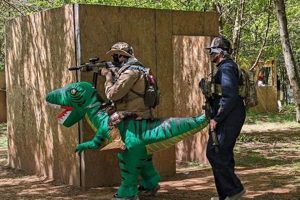
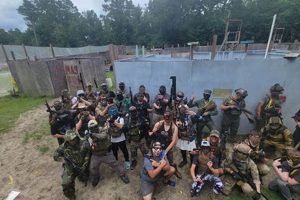
The concept involves organizing a celebratory event centered around the recreational sport of airsoft, coinciding with an individual’s birth anniversary. This entails gathering participants to engage in simulated combat scenarios using airsoft replicas within a designated play area. For instance, a group of adolescents might convene at an outdoor field equipped with obstacles to partake in organized airsoft games as part of a birthday celebration.
Such gatherings offer a structured environment for physical activity, promoting teamwork and strategic thinking amongst participants. Moreover, these events provide an alternative entertainment option, fostering social interaction and creating memorable experiences. Historically, similar recreational activities involving simulated combat have been used as team-building exercises and outlets for competitive energy.
The subsequent sections will delve into the practical considerations for planning and executing these celebratory events, encompassing aspects such as safety protocols, venue selection, equipment requirements, and game format options. This information aims to provide a comprehensive guide for individuals considering organizing such an occasion.
Essential Planning Considerations
Effective execution requires meticulous planning, prioritizing safety, participant experience, and legal compliance.
Tip 1: Venue Selection: Secure a location that accommodates the number of participants and offers varied terrain suitable for diverse gameplay scenarios. Ensure the selected venue possesses adequate safety barriers and adheres to local regulations pertaining to airsoft activities. Example: A designated airsoft field, a large private property with permission, or an indoor airsoft arena.
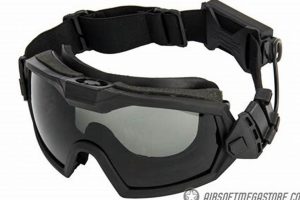
Tip 2: Safety Briefing and Gear: Conduct a mandatory safety briefing prior to commencement. All attendees must be equipped with approved protective eyewear, and full-face masks are strongly recommended, particularly for younger participants. Enforce strict adherence to muzzle velocity limits for all airsoft replicas. Example: Distribute safety pamphlets, demonstrate proper gear usage, and visually inspect all equipment.
Tip 3: Age-Appropriate Scenarios: Design gameplay scenarios that are suitable for the age and skill level of the participants. Complex, objective-based games are better suited for older participants, while simpler capture-the-flag variations are ideal for younger attendees. Example: For children, consider target practice or simplified team games.
Tip 4: Trained Supervision: Ensure adequate supervision by experienced airsoft players or trained staff. Maintain a ratio of supervisors to participants that allows for effective monitoring and intervention if necessary. Example: Appoint designated referees to enforce rules and resolve disputes.
Tip 5: Parental Consent: Obtain written consent from parents or legal guardians for all participants under the age of eighteen. This consent should include a waiver of liability and confirmation of understanding regarding the inherent risks associated with airsoft activities. Example: Prepare a comprehensive consent form outlining all relevant information.
Tip 6: Equipment Rental and Maintenance: If providing rental equipment, ensure it is well-maintained and functioning correctly. Regularly inspect airsoft replicas for any damage that could compromise safety. Example: Have spare batteries, BBs, and tools readily available.
Tip 7: Contingency Planning: Develop a plan to address potential incidents, such as injuries or equipment malfunctions. Have a first-aid kit readily available and know the location of the nearest medical facility. Example: Designate a specific individual as the first-aid responder.
Successful implementation hinges on meticulous planning and proactive safety measures. By adhering to these guidelines, organizers can maximize the entertainment value while minimizing potential risks.
The ensuing sections will provide further details on specific aspects, including potential game formats and equipment considerations, offering a complete resource for organizing a safe and enjoyable event.
1. Safety Protocols Enforcement

Stringent enforcement of established safety protocols is not merely recommended but is an absolute necessity when organizing an airsoft event, particularly one centered around a birthday celebration. The inherent nature of airsoft, involving projectile weaponry, necessitates unwavering adherence to rules designed to mitigate potential risks and ensure participant well-being.
- Mandatory Protective Gear Verification
The cornerstone of airsoft safety is the consistent and rigorous verification of mandatory protective gear. This includes, at a minimum, ANSI-rated eye protection designed to withstand the impact of airsoft projectiles. Failure to wear or properly utilize such protection can result in severe ocular injuries. Organizers must implement a system to visually inspect all participants’ gear before allowing entry to the playing field. Real-world examples demonstrate the devastating consequences of neglecting this protocol, often leading to irreversible vision loss. The implications for an event are significant, potentially resulting in liability lawsuits and irreparable damage to the event organizer’s reputation.
- Velocity Limit Adherence Monitoring
Airsoft replicas, while not lethal, can cause injury if the projectiles are fired at excessive velocities. Most fields and events establish strict muzzle velocity limits to minimize this risk. Enforcement necessitates the use of a chronograph to measure the velocity of each participant’s airsoft replica. Replicas exceeding the stated limit must be prohibited from use. Failure to enforce this protocol increases the risk of skin lacerations, bruising, and, in rare instances, more serious injuries. Real-world scenarios highlight instances where individuals have sustained significant trauma due to unregulated velocity limits. This aspect of enforcement has significant implications in reducing the chances of injury and creating a safer game atmosphere.
- Gameplay Rule Adherence and Supervision
Enforcement extends beyond equipment checks to include vigilant monitoring of gameplay behavior. Strict adherence to established rules, such as no blind firing and minimum engagement distances, must be ensured. This necessitates the presence of trained referees or supervisors who actively monitor gameplay and intervene when necessary. Real-world examples show that unregulated gameplay, particularly among inexperienced players, can lead to accidental injuries and rule violations that compromise safety. The implications highlight the importance of maintaining order and control on the field.
- Safe Zone Protocol Management
A designated safe zone, where airsoft replicas are prohibited from firing and magazines must be removed, is critical. This area provides a sanctuary for participants to adjust gear, communicate, and rest without the risk of accidental discharges. Effective management of the safe zone requires clear demarcation, prominent signage, and consistent monitoring to prevent rule violations. Real-world situations illustrate the potential for accidental injuries resulting from negligence in safe zone management. The repercussions reinforce that strict safety protocols in these areas help prevent injuries.
The direct correlation between stringent “Safety Protocols Enforcement” and the successful execution of an airsoft birthday party cannot be overstated. By prioritizing and rigorously implementing these measures, event organizers demonstrate a commitment to participant safety, fostering a positive and enjoyable environment. Neglecting these protocols introduces unacceptable risks, potentially transforming a celebratory event into a situation with lasting negative consequences.
2. Venue Suitability Assessment
Venue suitability assessment is an indispensable process in the planning and execution of any airsoft-centric event, particularly an “airsoft birthday party.” This assessment transcends mere logistical considerations, encompassing safety, legal compliance, and overall participant experience. The selection of an appropriate venue directly impacts the feasibility, safety, and enjoyment of the planned activities.
- Spatial Adequacy for Gameplay
Spatial adequacy refers to the size and configuration of the venue relative to the number of anticipated participants. Insufficient space can lead to overcrowding, increasing the risk of accidental collisions and restricting tactical maneuverability. Conversely, an overly large venue may dilute the engagement and require disproportionate staffing for effective supervision. Real-world examples of poorly chosen venues demonstrate the consequences of inadequate space, including compromised safety and reduced participant satisfaction. Within the context of an “airsoft birthday party,” the venue must offer sufficient open areas for gameplay, as well as designated safe zones for equipment management and rest. The implications of misjudging spatial requirements can range from minor inconveniences to serious safety hazards.
- Terrain Variety and Obstacle Placement
Terrain variety enhances the gameplay experience by providing diverse tactical opportunities and promoting strategic thinking. A venue with varied terrain, including natural or artificial obstacles such as trees, bunkers, or buildings, allows for more engaging and realistic scenarios. Conversely, a flat, featureless field may limit tactical options and reduce participant interest. Real-world examples highlight the advantages of venues that offer a balance of open areas and cover, fostering dynamic and unpredictable gameplay. For an “airsoft birthday party,” careful consideration should be given to the age and skill level of the participants when selecting a venue with specific terrain features. The chosen layout needs to provide engaging experiences.
- Safety Barrier and Perimeter Security
The presence of robust safety barriers and secure perimeter fencing is paramount for preventing unauthorized access and mitigating the risk of projectiles leaving the designated play area. Perimeter security is essential to protect bystanders and prevent accidental injuries. Safety netting or solid barriers should be strategically placed to contain projectiles and prevent them from entering spectator areas or neighboring properties. Real-world incidents involving inadequate perimeter security underscore the importance of this facet of venue assessment. In the context of an “airsoft birthday party,” organizers have a heightened responsibility to ensure the safety of all attendees and the surrounding community, making perimeter security a non-negotiable requirement.
- Accessibility and Amenities
Accessibility and amenities, including parking, restrooms, and first-aid facilities, contribute significantly to the overall participant experience. A venue that is easily accessible and provides adequate amenities demonstrates a commitment to participant comfort and convenience. Limited parking, inadequate restroom facilities, or the absence of first-aid support can detract from the event and create logistical challenges. Real-world examples demonstrate the importance of considering these factors when selecting a venue, particularly for events involving children or large groups. When planning an “airsoft birthday party,” organizers should prioritize venues that offer convenient access and essential amenities to ensure a positive and hassle-free experience for all attendees.
In summary, a thorough venue suitability assessment is not merely a formality but a critical determinant of success. Addressing spatial adequacy, terrain features, safety barriers, and accessibility considerations directly contributes to a safer, more engaging, and ultimately more memorable “airsoft birthday party.” Neglecting these factors can result in a compromised event, jeopardizing participant safety and diminishing the overall experience.
3. Equipment quality standards

Equipment quality standards represent a cornerstone in the successful and safe execution of an airsoft-themed birthday celebration. The direct correlation between the quality of airsoft replicas, protective gear, and associated accessories, and the well-being of participants is undeniable. Substandard equipment introduces a higher probability of malfunctions, which, in turn, can lead to accidental injuries, ranging from minor abrasions to more severe ocular trauma. The selection of high-quality, properly maintained equipment serves as a proactive measure, mitigating potential risks and fostering a safer recreational environment. For example, the use of inexpensive, low-quality airsoft replicas constructed from brittle plastics significantly increases the risk of fragmentation upon impact, potentially causing injuries to participants. Similarly, inadequate or improperly fitted protective eyewear offers insufficient protection against high-velocity projectiles, elevating the risk of serious eye injuries. These scenarios underscore the critical need for adherence to stringent equipment standards.
Furthermore, equipment quality extends beyond safety considerations to encompass performance and reliability. High-quality airsoft replicas are typically more accurate, consistent, and durable, enhancing the overall gameplay experience. Conversely, substandard equipment can suffer from frequent malfunctions, inconsistent firing rates, and a shorter lifespan, detracting from the enjoyment of the event. Real-world instances illustrate the impact of equipment quality on event outcomes. Events utilizing well-maintained, high-quality airsoft replicas experience fewer interruptions due to equipment failures and achieve a higher level of participant satisfaction. Conversely, events relying on low-quality, poorly maintained equipment often face disruptions, frustration, and a diminished sense of value. The impact of equipment performance has wide range from enjoyable game to a terrible experiences.
In conclusion, upholding stringent equipment quality standards is not merely a desirable practice but a fundamental requirement for organizing a safe and enjoyable airsoft-themed birthday celebration. Prioritizing the selection of high-quality airsoft replicas, protective gear, and accessories demonstrates a commitment to participant well-being, minimizes the risk of accidental injuries, and enhances the overall gameplay experience. While the initial investment in quality equipment may be higher, the long-term benefits, in terms of safety, reliability, and participant satisfaction, far outweigh the cost. This emphasis on quality should be an integral component of any comprehensive event planning strategy. Furthermore the safety for the participant and players in general must be the main objective to the organizer.
4. Age-appropriate gameplay

The principle of tailoring activities to the developmental stage of participants is paramount when organizing a recreational event. For an airsoft birthday party, the selection of game scenarios, equipment, and rules must align with the cognitive and physical capabilities of the attendees. This alignment is crucial for safety, engagement, and the overall success of the event.
- Cognitive Maturity and Strategic Complexity
Cognitive maturity dictates the level of strategic complexity that participants can comprehend and effectively execute. Younger participants may struggle with intricate, objective-based games requiring complex planning and communication. In contrast, simpler game modes, such as team deathmatch or capture the flag, are more readily understood and enjoyed. Real-world examples demonstrate that introducing overly complex rules or objectives to younger players often results in confusion, disengagement, and a diminished sense of accomplishment. The implications for an airsoft birthday party are clear: game scenarios must be designed with the cognitive abilities of the target age group in mind.
- Physical Capabilities and Equipment Weight
Physical capabilities directly influence the type of equipment that participants can safely and comfortably handle. Younger participants may lack the strength and stamina to wield heavier airsoft replicas or navigate challenging terrain. Utilizing lighter, more ergonomic equipment, and modifying game scenarios to minimize strenuous activity are essential considerations. Real-world observations show that forcing younger players to use inappropriately sized or weighted equipment increases the risk of fatigue, muscle strain, and potential injuries. At an airsoft birthday party, providing age-appropriate equipment and adjusting gameplay to accommodate physical limitations is crucial for ensuring a safe and enjoyable experience.
- Rule Comprehension and Enforcement
Rule comprehension is closely linked to cognitive development. Younger participants may have difficulty grasping and adhering to complex rules or nuanced safety protocols. Simplifying rules, providing clear and concise instructions, and ensuring vigilant supervision are critical for maintaining a safe playing environment. Real-world incidents highlight the potential consequences of inadequate rule comprehension, including accidental injuries and rule violations that compromise the safety of others. When organizing an airsoft birthday party for younger participants, prioritizing rule simplification and consistent enforcement is essential for mitigating risks and fostering a positive playing environment.
- Supervision Ratio and Intervention Capacity
The ratio of supervisors to participants must be adjusted to reflect the age and experience level of the attendees. Younger participants require a higher level of supervision to ensure adherence to safety rules, mediate disputes, and provide assistance when needed. An inadequate supervision ratio increases the risk of accidents, rule violations, and a diminished sense of security. Real-world analyses demonstrate that events with a higher supervision ratio experience fewer incidents and a more positive overall atmosphere. For an airsoft birthday party, allocating sufficient supervisory personnel is crucial for maintaining order, ensuring safety, and providing appropriate support to younger participants.
These facets are not independent but rather interconnected elements that contribute to the overall success of an airsoft birthday party. By carefully considering the cognitive maturity, physical capabilities, rule comprehension, and supervision needs of the participants, organizers can create an event that is not only safe and enjoyable but also developmentally appropriate. Examples of successful implementation include modifying gameplay rules for younger age groups, providing specialized equipment, and strategically deploying supervisory personnel to ensure participant well-being. These tailored approaches optimize the value of these occasions.
5. Supervision effectiveness ratio

The supervision effectiveness ratio, defined as the number of qualified supervisors relative to the number of participants, directly impacts the safety and overall success of an airsoft birthday party. A deficient ratio increases the likelihood of rule infractions, accidental injuries, and inadequate response to emergent situations. Consequently, the event’s inherent risks are amplified, potentially jeopardizing the well-being of attendees and exposing organizers to liability. A high supervision effectiveness ratio, conversely, facilitates proactive monitoring, timely intervention, and adherence to established safety protocols. Example: A party of 20 adolescents necessitates a minimum of two qualified supervisors with demonstrable experience in airsoft safety regulations and first-aid procedures. These supervisors can then effectively enforce rules regarding eye protection, muzzle velocity, and safe zone conduct.
The practical significance of an appropriate supervision effectiveness ratio extends beyond immediate safety concerns. Effective supervision contributes to a more structured and controlled environment, promoting fair play, resolving disputes impartially, and fostering a positive social dynamic. For instance, trained supervisors can mediate disagreements regarding hit confirmation, ensuring that gameplay remains respectful and enjoyable for all participants. Furthermore, a higher ratio allows for individualized attention, enabling supervisors to address specific concerns or provide guidance to less experienced players. This personalized support enhances participant engagement and contributes to a more inclusive and welcoming atmosphere. Real-world analyses of organized youth airsoft events consistently demonstrate a strong correlation between increased supervision and reduced incident rates.
Challenges associated with maintaining an optimal supervision effectiveness ratio often revolve around resource constraints and volunteer availability. Recruiting and training qualified supervisors can be a significant undertaking, particularly for smaller events. Despite these challenges, prioritizing supervision is paramount. Event organizers must either limit the number of participants to align with available supervisory resources or actively seek additional support from experienced airsoft players or qualified personnel. In conclusion, the supervision effectiveness ratio serves as a critical indicator of an airsoft birthday party’s safety and overall quality. Adhering to established guidelines and investing in adequate supervision represent fundamental steps toward mitigating risks and creating a memorable experience for all attendees.
6. Parental consent acquisition

Parental consent acquisition constitutes a foundational requirement for the responsible organization of an airsoft birthday party involving minors. The activity carries inherent risks associated with projectile weaponry and simulated combat scenarios. Consequently, securing informed consent from parents or legal guardians is not merely a procedural formality but a legal and ethical imperative. The absence of valid parental consent exposes event organizers to potential liability in the event of injury or incident. Furthermore, it disregards the fundamental rights of parents to make informed decisions regarding their children’s participation in potentially hazardous activities. Real-world examples underscore the legal repercussions faced by organizations that fail to obtain proper consent, often resulting in lawsuits and reputational damage. The core element of organization lies in the ability to secure the child welfare in terms of accidents and incidents. The parental consent should allow the event to be proceed without any potential legal actions to arise.
The process of acquiring parental consent must involve the provision of comprehensive information regarding the nature of the activity, including potential risks, safety precautions, and emergency procedures. A standardized consent form should be utilized, detailing the specific activities planned, the level of supervision provided, and the contact information for event organizers. The consent form should also include a waiver of liability, acknowledging the inherent risks associated with airsoft and releasing the organizers from responsibility for injuries sustained as a result of participation, excluding instances of gross negligence or willful misconduct. Upon completion, the consent form should be retained by the organizers for future reference and potential legal defense. Example of parental negligence towards their child’s accidents during the game is also a huge factor.
Effective acquisition of parental consent is crucial for mitigating legal risks, upholding ethical responsibilities, and ensuring the safety and well-being of all participants in an airsoft birthday party. Compliance with these requirements demonstrates a commitment to responsible event management and fosters trust between organizers, parents, and participants. Failure to prioritize parental consent undermines the integrity of the event and exposes all parties to unnecessary risk. Thus, obtaining informed and documented parental consent should be a non-negotiable aspect of event planning and execution.
7. Contingency planning readiness

Contingency planning readiness is a critical component of organizing any event, particularly an airsoft birthday party, where inherent risks are elevated due to the nature of the activity. A well-defined contingency plan anticipates potential incidents, such as injuries, equipment malfunctions, or adverse weather conditions, and outlines specific procedures for mitigation and response. The absence of such planning can lead to disorganization, delayed response times, and amplified consequences in the event of an emergency. For example, a sudden rainstorm could render an outdoor venue unsafe, necessitating immediate evacuation and relocation to an alternative indoor facility. A comprehensive contingency plan would pre-identify suitable backup locations and establish communication protocols for informing participants and parents of the change in venue. Furthermore, the plan would delineate procedures for ensuring the continued safety of all individuals during the relocation process. Cause and effect relationship can occur when planning is neglected or not.
Real-life examples demonstrate the importance of contingency planning readiness in mitigating the impact of unforeseen events. At one airsoft event, a participant sustained a minor eye injury due to a malfunctioning airsoft replica. However, due to the event organizers having a well-stocked first-aid kit and personnel trained in basic medical response, the individual was promptly treated and further medical attention was sought within a very short amount of time. Conversely, at another event lacking adequate contingency planning, a similar incident resulted in significant delays in treatment and a prolonged period of uncertainty, exacerbating the situation and causing unnecessary distress to the injured party and their family. The plan also must consider that the participants in the game is the child.
In conclusion, contingency planning readiness is not merely a recommended practice but a fundamental responsibility for organizers of airsoft birthday parties. By proactively anticipating potential incidents, developing comprehensive response protocols, and ensuring that all personnel are adequately trained, organizers can significantly mitigate risks and safeguard the well-being of participants. The challenges associated with contingency planning, such as the time and resources required for development and implementation, are outweighed by the potential consequences of failing to prepare. The safety consideration must be plan out to lessen or prevent the potential risk. A well-executed contingency plan demonstrates a commitment to responsible event management and fosters confidence among parents and participants alike.
Frequently Asked Questions
This section addresses common inquiries and misconceptions pertaining to the organization and execution of a birthday celebration centered around the recreational activity of airsoft.
Question 1: What age range is generally considered appropriate for participation in an airsoft-themed birthday event?
The suitability of participation varies based on individual maturity, physical capabilities, and adherence to safety guidelines. However, a generally accepted minimum age is 10 years old, with parental discretion and event organizer approval being essential factors in determining eligibility. Certain venues or events may impose stricter age restrictions. Prior experience with airsoft or similar activities is advantageous.
Question 2: What are the fundamental safety precautions that must be implemented at an airsoft birthday party?
Essential safety precautions include mandatory use of ANSI-rated eye protection, adherence to established muzzle velocity limits for airsoft replicas, designated safe zones where replicas are prohibited from firing, and constant supervision by trained personnel. Comprehensive safety briefings must be conducted prior to commencement, and all participants must acknowledge and adhere to stated safety protocols.
Question 3: Is parental consent required for minors participating in an airsoft birthday party?
Yes, parental consent is an absolute requirement for all participants under the age of 18. Consent forms must include detailed information regarding the activity, potential risks, safety precautions, and emergency procedures. Furthermore, the consent form must incorporate a waiver of liability, acknowledging the inherent risks associated with airsoft and releasing event organizers from responsibility for injuries sustained as a result of participation, excluding instances of gross negligence or willful misconduct.
Question 4: What type of venue is best suited for hosting an airsoft birthday party?
The optimal venue is a designated airsoft field or a large, enclosed area with sufficient space for gameplay and clearly defined boundaries. The venue should possess adequate safety barriers, appropriate terrain features for diverse gameplay scenarios, and necessary amenities such as restrooms and first-aid facilities. Outdoor venues may require contingency plans for inclement weather.
Question 5: What types of airsoft replicas are typically permitted at an airsoft birthday party?
The permissibility of specific airsoft replicas is generally governed by established muzzle velocity limits and venue regulations. Replicas exceeding the stated velocity limit are strictly prohibited. Full-automatic replicas may be restricted or require modifications to comply with local regulations and safety guidelines. All replicas must be inspected and approved by event organizers prior to use.
Question 6: What are the potential legal liabilities associated with organizing an airsoft birthday party?
Potential legal liabilities include negligence claims arising from injuries sustained by participants due to inadequate safety measures or supervision, property damage claims resulting from projectile impact, and regulatory violations pertaining to airsoft replica ownership and usage. Event organizers should secure adequate liability insurance and diligently adhere to all applicable local, state, and federal laws to mitigate potential legal risks.
The preceding responses provide clarification on key aspects of organizing a safe and legally compliant celebratory event. Prioritizing safety and meticulous planning remains paramount.
The next section will delve into a detailed checklist designed to guide organizers through each step of the planning process, ensuring comprehensive coverage of all essential considerations.
Airsoft Birthday Party
The preceding exploration has comprehensively addressed the key considerations surrounding the organization of an airsoft birthday party. It has underscored the paramount importance of safety protocols, meticulous venue assessment, adherence to equipment quality standards, the implementation of age-appropriate gameplay scenarios, the maintenance of a sufficient supervision effectiveness ratio, the diligent acquisition of parental consent, and the proactive development of robust contingency plans. Neglecting these essential elements increases the potential for incidents, compromises the well-being of participants, and exposes organizers to significant legal risks.
The information presented serves as a critical resource for individuals contemplating such an event. Its application promotes responsible planning and execution, safeguarding the interests of all involved. The future success and continued viability of airsoft as a recreational activity, particularly among younger demographics, hinges upon a steadfast commitment to safety, ethical conduct, and the unwavering prioritization of participant well-being.