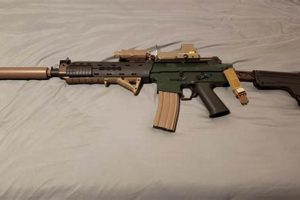
The creation of shortened buttstocks for airsoft rifles through additive manufacturing processes has become a popular modification technique. These components, designed for enhanced maneuverability in close-quarters combat scenarios, are digitally modeled and then produced using 3D printers. Materials commonly used include durable polymers like ABS or PLA, chosen for their strength and impact resistance in simulated combat. For example, a player might opt for this kind of modification on a standard M4 airsoft rifle to make it more compact for navigating tight indoor environments.
This approach offers several advantages. It provides a cost-effective alternative to purchasing specialized, commercially manufactured short stocks. Moreover, it allows for a high degree of customization, enabling users to tailor the design to their specific ergonomic preferences or aesthetic requirements. Historically, modifications of this type required extensive machining or fabrication, but the advent of accessible 3D printing technology has democratized the process, putting design and manufacturing capabilities into the hands of individual users.
The following sections will delve into specific design considerations for these components, examine the range of available materials and their respective properties, discuss the necessary printing parameters for optimal results, and explore potential legal and safety considerations surrounding the modification of airsoft equipment.
Tips for Successful Airsoft Stubby Stock 3D Printing
Achieving optimal results in the additive manufacturing of compact airsoft rifle stocks requires careful attention to several critical factors. These tips address key areas to enhance the structural integrity, fit, and overall performance of the printed component.
Tip 1: Material Selection: Employ high-impact polymers, such as ABS or Nylon, to ensure adequate durability. PLA, while easier to print, may exhibit insufficient strength for withstanding the stresses of regular use. Consider the environmental conditions in which the airsoft rifle will be used, as some materials degrade under UV exposure.
Tip 2: Design Optimization: Incorporate internal support structures, such as infill patterns exceeding 20%, to bolster the part’s resistance to fracture. Strategically placed ribs or gussets can reinforce areas prone to high stress, such as the attachment points to the receiver.
Tip 3: Print Orientation: Orient the model on the print bed to minimize the need for support structures in critical areas. Align the long axis of the stock parallel to the print bed to maximize layer adhesion along the primary stress lines.
Tip 4: Layer Height Adjustment: Utilize lower layer heights (e.g., 0.1mm – 0.15mm) to improve surface finish and dimensional accuracy. This enhances the fit and aesthetics of the final product. It also improves the resolution of intricate design details.
Tip 5: Temperature Control: Maintain consistent print bed and nozzle temperatures within the material manufacturer’s recommended ranges. Adherence to these parameters reduces warping and promotes optimal layer adhesion, improving the overall structural integrity.
Tip 6: Post-Processing: Employ post-processing techniques such as sanding, filling, and painting to improve the surface finish and aesthetics of the printed stock. Application of a sealant can further enhance its resistance to moisture and wear.
Tip 7: Hardware Integration: Design the stock to accommodate standard airsoft rifle buffer tubes and attachment hardware. Ensure precise dimensions for mounting points to guarantee a secure and reliable connection.
By adhering to these guidelines, individuals can significantly enhance the quality and performance of short airsoft rifle stocks produced using additive manufacturing techniques. These measures contribute to a component that is durable, functional, and aesthetically pleasing.
The subsequent sections will delve into case studies of successful “airsoft stubby stock 3d print” projects and address common challenges encountered during the printing process.
1. Design Optimization

Design optimization is paramount in the creation of short airsoft rifle stocks via additive manufacturing. The inherent constraints of 3D printing, coupled with the functional requirements of a buttstock, necessitate a strategic approach to design to ensure structural integrity, ergonomic suitability, and reliable attachment.
- Internal Lattice Structures
The incorporation of internal lattice structures significantly influences the overall strength-to-weight ratio of the printed stock. By strategically arranging lattice patterns within the stock’s interior, material usage is minimized while maximizing resistance to compressive and tensile forces. For instance, a gyroid infill pattern can provide omnidirectional support, mitigating stress concentrations and enhancing the stock’s ability to withstand impacts encountered during gameplay.
- Stress Concentration Mitigation
Sharp corners and abrupt transitions in geometry can create stress concentrations, leading to premature failure under load. Design optimization involves incorporating fillets and radii at these critical points to distribute stress more evenly throughout the structure. This is particularly crucial around the buffer tube interface and attachment points, where significant forces are applied during operation.
- Material-Specific Considerations
Different 3D printing materials exhibit varying mechanical properties, requiring tailored design approaches. For example, if using PLA, which is known for its lower tensile strength, the stock design should incorporate thicker walls and more robust internal supports compared to a design intended for ABS or nylon. Material selection directly informs the optimal design parameters.
- Attachment Point Reinforcement
The interface between the 3D printed stock and the airsoft rifle’s receiver must be robust to withstand repeated use and potential impacts. Design optimization includes incorporating reinforced mounting points, such as embedded metal inserts or thickened polymer sections, to prevent cracking or shearing at these critical connections. Precise tolerances are also essential to ensure a secure and wobble-free fit.
These design considerations are not merely aesthetic enhancements; they are integral to the functionality and longevity of a 3D printed short airsoft rifle stock. A well-optimized design maximizes the component’s performance within the simulated combat environment, providing users with a reliable and durable modification for their airsoft rifle.
2. Material Strength

Material strength constitutes a critical determinant in the viability and performance of any airsoft stubby stock produced through additive manufacturing. The forces exerted on a buttstock during airsoft gameplay including impacts, stresses from shouldering the rifle, and potential twisting forces necessitate a material with sufficient tensile strength, impact resistance, and flexural modulus. The selection of a material lacking adequate strength will result in premature failure, rendering the component unusable and potentially hazardous. For instance, utilizing a brittle material like standard polylactic acid (PLA) without reinforcement in a high-stress area, such as the buffer tube attachment point, is likely to cause cracking or complete breakage after minimal use.
The choice of material directly influences the design considerations for these printed stocks. Stronger materials, such as acrylonitrile butadiene styrene (ABS), nylon, or carbon fiber-reinforced composites, permit the creation of more lightweight designs with thinner walls, thereby reducing overall weight and enhancing maneuverability. Conversely, weaker materials require thicker walls and more substantial internal supports to achieve the requisite level of durability, potentially increasing the weight and bulk of the stock. A practical example is the use of carbon fiber-reinforced nylon in creating streamlined and highly resilient stocks capable of withstanding significant impacts and stresses without deformation. A carefully selected, high-strength material ensures the stock can reliably fulfill its intended purpose throughout sustained use.
In summary, the successful implementation of 3D printing for short airsoft rifle stocks hinges on prioritizing material strength. This consideration dictates design parameters, influences the stock’s overall weight and dimensions, and ultimately determines its durability and suitability for the demands of airsoft gameplay. Overlooking material strength introduces the risk of component failure, reduced performance, and potential safety hazards. A thorough understanding of material properties and their interaction with design features is therefore essential for effective and reliable additive manufacturing of these components.
3. Print Accuracy
Print accuracy is a fundamental factor governing the functionality and integration of additively manufactured short airsoft rifle stocks. Dimensional deviations, surface imperfections, and feature misalignments introduced during the printing process directly impact the component’s ability to interface with the airsoft rifle, affecting stability, user ergonomics, and overall performance.
- Dimensional Fidelity in Mating Surfaces
The precision with which the 3D printer reproduces the intended dimensions of the stock’s mating surfaces is critical. Inaccurate dimensions at the buffer tube interface, for example, can result in a loose or excessively tight fit, compromising the stock’s stability and potentially damaging the buffer tube or receiver threads. Dimensional deviations exceeding acceptable tolerances (typically within 0.1mm for critical interfaces) necessitate post-processing or, in severe cases, render the part unusable.
- Feature Resolution and Small Detail Reproduction
Successful reproduction of small features, such as screw holes, alignment pins, and textured surfaces, hinges on the printer’s resolution capabilities. Poor feature resolution leads to improperly sized or shaped screw holes, hindering secure attachment of the stock to the rifle. Similarly, inadequate reproduction of textured surfaces compromises grip and handling comfort.
- Warpage and Distortion Control
Warpage and distortion, common artifacts in 3D printing, can significantly impact the overall geometry of the stock. Warped mating surfaces prevent flush contact with the receiver, leading to instability and potential stress concentrations. Proper temperature control, print bed adhesion techniques, and support structure optimization are essential for minimizing these distortions and ensuring dimensional accuracy.
- Tolerance Stacking Effects
Tolerance stacking refers to the cumulative effect of small dimensional variations across multiple features. Even if individual features are within acceptable tolerances, their combined deviation can lead to significant misalignment or fitment issues. Designers and manufacturers must account for tolerance stacking by specifying tighter tolerances for critical interfaces and incorporating design features that allow for minor adjustments during assembly.
In conclusion, print accuracy exerts a decisive influence on the performance and usability of additively manufactured short airsoft rifle stocks. Attention to dimensional fidelity, feature resolution, warpage control, and tolerance stacking is paramount for producing components that meet the stringent demands of airsoft applications. Neglecting these aspects introduces the risk of compromised stability, reduced user comfort, and potential equipment damage.
4. Ergonomic Fit

The ergonomic fit of a compact airsoft rifle stock, particularly when produced using 3D printing methodologies, directly affects a user’s performance, comfort, and overall experience. An ill-fitting stock can lead to discomfort, fatigue, and reduced accuracy due to an unnatural or unstable shooting posture. Conversely, a well-designed ergonomic fit promotes a stable and comfortable shooting platform, enabling users to maintain accuracy over extended periods. The capability to customize dimensions, angles, and contact points through 3D printing allows for a tailored ergonomic solution unavailable with mass-produced alternatives. A user with shorter arms, for example, can benefit from a stock with a reduced length of pull, enhancing their ability to comfortably shoulder the rifle and maintain a proper cheek weld. This customization becomes particularly important in dynamic airsoft scenarios, where rapid target acquisition and movement are critical.
The practical significance of ergonomic fit extends beyond mere comfort. A properly fitted stock facilitates consistent weapon manipulation, reduces muscle strain, and minimizes the risk of injury. Consider the impact of an improper cheek weld; it can lead to inconsistent sight alignment, resulting in decreased accuracy. The ability to adjust the cheek rest height or angle through 3D printing enables users to achieve a repeatable and stable sight picture. Furthermore, texturing and contouring on the stock’s surface can enhance grip and prevent slippage, particularly in adverse weather conditions or when wearing gloves. In the context of airsoft, where realism and tactical effectiveness are valued, ergonomic fit contributes directly to a user’s competitive edge and overall enjoyment of the sport. 3D Printing allows these ergonomic needs to be addressed with a high degree of specificity
In summary, the ergonomic fit of an airsoft stubby stock significantly influences user performance and comfort. Additive manufacturing offers the potential for highly customized ergonomic solutions, addressing individual user needs and enhancing overall effectiveness in airsoft scenarios. Challenges remain in accurately measuring and translating ergonomic preferences into digital designs, but the benefits of a properly fitted stock, in terms of accuracy, comfort, and weapon manipulation, underscore the importance of prioritizing ergonomic considerations in the design and fabrication process. The increasing accessibility of 3D printing technologies continues to democratize the production of personalized airsoft equipment, empowering users to optimize their gear for enhanced performance and enjoyment.
5. Attachment Security
Attachment security is paramount when considering the implementation of shortened airsoft rifle stocks fabricated via additive manufacturing. The connection between the stock and the receiver must withstand forces encountered during simulated combat, preventing detachment or failure that could compromise user safety and weapon functionality.
- Material Yield Strength at Attachment Points
The yield strength of the 3D-printed material at the critical attachment points (e.g., buffer tube threads, receiver interface) dictates the stock’s resistance to deformation under load. If the material’s yield strength is insufficient, repeated stress cycles can lead to thread stripping or cracking, jeopardizing the security of the connection. For example, using PLA without reinforcement in these areas is generally inadvisable due to its relatively low yield strength. Implementing reinforcement using metal inserts or high infill densities can mitigate this risk.
- Thread Engagement and Tolerance Control
Adequate thread engagement between the buffer tube and the 3D-printed stock is essential for distributing stress and preventing thread stripping. Insufficient thread engagement concentrates stress on the first few threads, increasing the likelihood of failure. Precise tolerance control during printing ensures proper thread fit, minimizing play and maximizing the surface area of contact. A tight, secure thread fit is crucial for maintaining the stock’s stability during rapid firing and maneuvers.
- Mechanical Fastener Integration and Load Distribution
In designs incorporating mechanical fasteners (e.g., screws, bolts), the fastener’s size, material, and placement must be carefully considered. The fastener’s clamping force must be sufficient to secure the stock to the receiver without overstressing the 3D-printed material. Load distribution is crucial; washers and backing plates can help distribute clamping forces across a wider area, preventing localized stress concentrations that could lead to cracking or deformation. Poorly integrated fasteners can cause premature failure of the stock.
- Impact Resistance of the Receiver Interface
The interface between the 3D-printed stock and the airsoft rifle receiver is vulnerable to impact damage, particularly during falls or collisions. The design should incorporate features that enhance the impact resistance of this interface, such as rounded edges, thickened sections, or energy-absorbing materials. Sharp corners and thin walls at the receiver interface are prone to cracking under impact, compromising the attachment security and potentially causing injury.
These aspects of attachment security are paramount to the safe and effective implementation of shortened airsoft rifle stocks manufactured via additive techniques. Neglecting any of these areas can lead to component failure, potentially jeopardizing user safety and diminishing the overall functionality of the airsoft rifle. Thorough design analysis, material selection, and manufacturing precision are necessary to ensure a robust and reliable connection between the stock and the rifle.
6. Aesthetic Customization
Aesthetic customization plays a significant role in the additive manufacturing of short airsoft rifle stocks, extending beyond mere visual appeal to encompass aspects of personalization, brand expression, and functional identification within the airsoft community. The capacity to modify designs and incorporate unique features directly translates to increased user satisfaction and a stronger sense of ownership over their equipment.
- Coloration and Surface Finishing
Coloration options are virtually limitless with 3D printing, allowing users to select specific hues, patterns, or camouflage schemes to match their existing gear or personal preferences. Surface finishing techniques, such as sanding, polishing, or coating, further enhance the aesthetic appeal and can provide a more tactile or durable exterior. For instance, a user might opt for a desert camouflage pattern applied to their stock, followed by a matte clear coat for added protection and a non-reflective surface.
- Textural Elements and Grip Enhancement
Additive manufacturing enables the incorporation of intricate textural elements directly into the stock design. This can range from simple stippling patterns to complex geometric textures that enhance grip and improve handling. Textural customization not only contributes to the visual aesthetic but also provides a functional benefit, particularly in adverse weather conditions where a secure grip is essential. An example includes a diamond-patterned texture applied to the grip area, improving hand purchase and preventing slippage during rapid movements.
- Logo Integration and Personalized Markings
The integration of logos, initials, or personalized markings allows users to express their individuality or affiliation with a particular team or organization. These markings can be incorporated into the design through embossing, engraving, or inlaying techniques. A user might choose to embed their team logo into the side of the stock or add their initials for identification purposes. This level of personalization fosters a sense of connection with the equipment and enhances team cohesion.
- Shape and Form Variations
While maintaining functional integrity, 3D printing permits alterations to the shape and form of the stock, allowing for unique and visually striking designs. Subtle curves, aggressive angles, or unconventional silhouettes can be incorporated to create a distinct aesthetic. For instance, a user might opt for a stock with a more angular and futuristic design, deviating from the traditional M4-style stock. However, it is crucial to note that any modifications to the stock’s shape must not compromise its structural integrity or ergonomic function.
In conclusion, aesthetic customization plays a vital role in the 3D printing of short airsoft rifle stocks, allowing users to personalize their equipment to reflect their individual preferences and enhance their overall experience. The ability to modify coloration, texture, markings, and form provides a level of customization unavailable with traditional manufacturing methods. Careful consideration must be given to ensure that aesthetic modifications do not compromise the stock’s functionality or structural integrity.
Frequently Asked Questions About Airsoft Stubby Stock 3D Printing
The following addresses common inquiries regarding the design, manufacturing, and utilization of shortened airsoft rifle stocks produced using additive manufacturing techniques. These answers aim to provide clarity and guidance on best practices.
Question 1: What are the primary advantages of utilizing a 3D-printed short airsoft rifle stock compared to commercially manufactured alternatives?
Additive manufacturing provides unparalleled customization options, enabling users to tailor dimensions, ergonomics, and aesthetics to specific requirements. Furthermore, it offers a potentially lower cost alternative, particularly for niche designs or limited production runs. The ability to rapidly prototype and iterate on designs is another significant advantage.
Question 2: Which materials are best suited for 3D printing a durable and reliable short airsoft rifle stock?
High-impact polymers, such as ABS, nylon, or carbon fiber-reinforced composites, are generally recommended due to their superior tensile strength, impact resistance, and flexural modulus. PLA, while easier to print, may exhibit insufficient strength for demanding airsoft applications. Material selection should be guided by the intended use and stress levels.
Question 3: How can one ensure proper attachment security when integrating a 3D-printed stock with an airsoft rifle receiver?
Precise dimensional control during printing is crucial to ensure a tight and secure fit. Incorporating metal inserts or reinforcing the attachment points with high-density infill can enhance the stock’s resistance to stress and prevent thread stripping. Employing mechanical fasteners with appropriate clamping force and load distribution is also recommended.
Question 4: What design considerations are most important for maximizing the ergonomic comfort of a 3D-printed short stock?
Length of pull, cheek weld height, and grip texture are critical ergonomic factors. These parameters should be adjusted to suit the individual user’s body type and shooting style. The ability to customize these features through 3D printing enables a more personalized and comfortable shooting experience.
Question 5: What are the common challenges encountered during the 3D printing of airsoft stubby stocks, and how can they be mitigated?
Warpage, dimensional inaccuracies, and weak layer adhesion are common challenges. These issues can be mitigated by optimizing print parameters (e.g., temperature, layer height, print speed), employing appropriate support structures, and utilizing post-processing techniques such as sanding and coating.
Question 6: Are there any legal or ethical considerations associated with 3D printing airsoft rifle stocks?
While 3D printing of airsoft components is generally permissible, it is essential to ensure that the modifications comply with local laws and regulations regarding replica firearms. Avoid designs that could be construed as converting an airsoft rifle into a real firearm. Responsible and ethical use of the technology is paramount.
These answers serve as a starting point for understanding the intricacies of 3D printing short airsoft rifle stocks. Further research and experimentation are encouraged to optimize design and manufacturing processes.
The subsequent section will provide case studies of successful “airsoft stubby stock 3d print” projects.
Conclusion
The preceding exploration of “airsoft stubby stock 3d print” has elucidated key considerations for successful design, manufacturing, and application. Material selection, design optimization, print accuracy, ergonomic fit, attachment security, and aesthetic customization each contribute to the overall performance and reliability of these components. A comprehensive understanding of these elements is essential for achieving desired outcomes in the additive manufacturing of airsoft rifle stocks.
Continued advancements in materials science, printing technologies, and design methodologies promise to further refine the capabilities of 3D-printed airsoft components. It is incumbent upon practitioners to adhere to responsible design principles, prioritize user safety, and comply with all applicable regulations. This approach will ensure the continued growth and positive impact of 3D printing within the airsoft community.