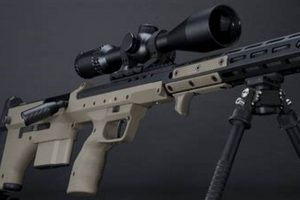
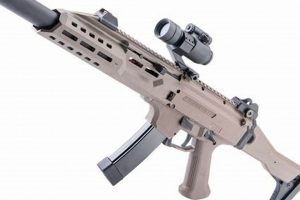
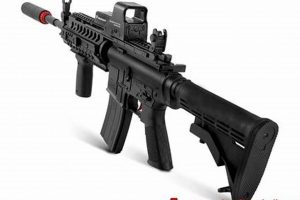
A replica firearm, specifically modeled after the M1 Garand rifle, designed for use in recreational simulation combat. These are typically constructed from metal and polymer, utilizing compressed gas or electric power to propel plastic projectiles. These devices are utilized in a variety of simulated military and law enforcement training scenarios.
These simulated firearms offer a safe and relatively inexpensive avenue for individuals to engage in tactical simulations. The historically significant design provides users with an immersive experience, evoking a sense of connection to a pivotal period in military history. Replicating the weight and feel of the original platform, these models enhance the realism of scenario exercises.
The following sections will explore specific variations, performance characteristics, and maintenance considerations relevant to this class of simulated weapon. Further topics will cover aspects of operation, safety protocols, and upgrades.
Essential Usage and Maintenance Recommendations
The following guidelines provide critical information for maximizing performance and extending the lifespan of the simulated M1 platform. Proper adherence to these recommendations will ensure reliable operation and user safety.
Tip 1: Ammunition Selection: Use only high-quality, seamless plastic projectiles of the recommended weight, typically 0.20g to 0.25g. Projectiles of inconsistent size or weight may damage internal components or degrade accuracy. Inferior ammunition can cause jamming and potential damage to the barrel assembly.
Tip 2: Gas System Maintenance (Gas-Powered Models): Regularly inspect and lubricate the gas valve and O-rings with silicone oil specifically designed for pneumatic systems. Ensure the pressure regulator is functioning correctly to prevent over-pressurization and potential component failure.
Tip 3: Battery Care (Electric-Powered Models): Utilize batteries of the correct voltage and amperage. Avoid overcharging or deep discharging lithium-polymer (LiPo) batteries to prevent damage and potential fire hazards. Store batteries in a cool, dry environment when not in use.
Tip 4: Cleaning and Lubrication: Clean the internal barrel regularly with a cleaning rod and silicone oil to remove debris and maintain accuracy. Lubricate gears and other moving parts with appropriate grease to reduce friction and wear. Disassemble and clean after each use or if performance degraded.
Tip 5: Storage Considerations: Store the simulated rifle in a case or bag to protect it from dust, moisture, and physical damage. Remove the magazine and battery during storage to prevent accidental discharge or battery drain. Keep in a secure and climate-controlled environment.
Tip 6: Safety Precautions: Always wear appropriate eye protection during operation. Never point the simulated firearm at individuals who are not participating in the simulation. Treat it as if it were a real firearm, emphasizing respect and responsible handling.
Tip 7: Hop-Up Adjustment: Fine-tune the hop-up unit to optimize projectile range and accuracy. Proper adjustment compensates for gravity and wind resistance, extending the effective range. Consult the manufacturer’s instructions for specific adjustment procedures.
Adhering to these best practices will significantly enhance the performance, reliability, and longevity of the equipment. Neglecting these steps may lead to decreased accuracy, potential malfunctions, or even irreparable damage.
The concluding section of this article will present additional resource recommendations, as well as offer troubleshooting for common issue encountered.
1. Historical Replica

The characteristic of being a historical replica informs the design, appeal, and application of the simulated M1 Garand. It provides a foundation for understanding its significance beyond mere recreational use.
- Authenticity of Design
The degree to which the simulated rifle accurately mirrors the external appearance and dimensions of the original M1 Garand is a primary factor. Elements such as stock material, receiver markings, and sight design contribute to the overall impression of authenticity. A higher degree of design accuracy increases the value for collectors and reenactors.
- Operating Mechanism Simulation
While the internal firing mechanism differs from the original, some models attempt to replicate aspects of the M1 Garand’s operation. This can include the sound and feel of the charging handle, the magazine ejection, and the simulated recoil. Accurate simulation of these features contributes to a more immersive user experience. Failure to properly replicate these crucial operating components could detract users who seeks an authentic experience
- Historical Context and Markings
Specific markings, such as manufacturer stamps, serial numbers, and unit designations, may be included to reflect particular historical periods or production runs of the M1 Garand. These details add depth and educational value, allowing users to connect the simulation to actual historical events and military units.
- Material Fidelity
The materials employed in construction play a significant role in replicating the feel and weight of the original rifle. Wood stocks, metal receivers, and barrel assemblies contribute to a more realistic heft and balance. The use of lower-quality materials diminishes the sense of historical accuracy and may affect durability.
The fidelity to historical detail directly impacts the perceived value and utility of the equipment. Enhanced design authenticity elevates the model beyond a simple simulated weapon and establishes a connection to a tangible element of military history.
2. Simulated Firearm
The designation “simulated firearm” is fundamental to understanding the essence and purpose of the “airsoft m1.” This classification dictates the design, construction, and legal considerations surrounding the device. The “airsoft m1” is not a toy; it is a device intended to replicate the appearance and, to a degree, the operation of a real firearm for training, recreational, and historical reenactment purposes. As such, it is subject to specific regulations and expectations regarding safe handling and responsible ownership. The core distinction lies in its inability to discharge lethal projectiles, yet the potential for misuse necessitates a degree of caution similar to that exercised with actual firearms. For example, pointing the device at individuals not participating in simulated combat is a violation of safety protocols and responsible behavior.
The quality of simulation directly affects the training and recreational value of the “airsoft m1.” A well-designed simulated firearm replicates the weight, balance, and handling characteristics of the original M1 Garand, enabling users to develop muscle memory and practice weapon manipulation skills in a safe environment. This is particularly relevant for historical reenactors who seek to authentically portray soldiers of past eras. Furthermore, the visual realism of the simulated firearm contributes to the immersive experience of simulated combat scenarios. However, an inaccurate or poorly constructed simulation can detract from the experience and potentially lead to the development of incorrect handling habits.
The classification as a “simulated firearm” also raises important legal and ethical considerations. Regulations regarding the sale, ownership, and use of these devices vary widely depending on jurisdiction. Responsible users must be aware of and comply with all applicable laws to avoid legal repercussions. Furthermore, ethical considerations dictate that these devices should never be used to intimidate, threaten, or cause harm to others. The “airsoft m1,” as a simulated firearm, should be treated with the same respect and caution one would afford a real firearm, regardless of its non-lethal nature.
3. Tactical Training

The utilization of the simulated M1 platform in tactical training scenarios offers a cost-effective and relatively safe method for developing essential skills. These devices allow individuals to practice weapon handling, movement techniques, and team coordination in a controlled environment without the inherent risks associated with live firearms. The weight and form factor of the simulated rifle closely mimic the original M1 Garand, enabling users to build muscle memory and familiarity with the platform’s ergonomics. This is particularly relevant for military and law enforcement personnel seeking to refine their skills in a realistic setting.
The benefits of this approach extend beyond basic weapon handling. Tactical exercises employing these replicas can simulate a wide range of combat situations, from urban warfare to open-terrain engagements. Scenarios can be tailored to address specific training objectives, such as room clearing, hostage rescue, or perimeter defense. The use of non-lethal projectiles allows for force-on-force training, where participants can engage in realistic combat simulations with minimal risk of injury. This type of training fosters quick decision-making, communication, and teamwork, all of which are crucial for success in real-world operational environments. For example, law enforcement agencies often utilize simulated firearms for scenario-based training to prepare officers for encounters with armed suspects.
However, the effectiveness of simulated tactical training hinges on proper implementation and adherence to safety protocols. Participants must receive adequate instruction on weapon handling, safety rules, and scenario objectives. The training environment should be carefully designed to minimize hazards and ensure a safe learning experience. Furthermore, the realism of the simulation should be balanced with the need to avoid the development of unsafe habits or unrealistic expectations. Despite these challenges, the use of the simulated M1 platform in tactical training represents a valuable tool for enhancing the skills and preparedness of military, law enforcement, and security personnel. Such training also enables those interested in the hobby, such as re-enactors, to experience and understand the realities of such a tool used in such a combat simulation environment.
4. Recreational Use

The recreational application of simulated M1 rifles centers on providing engaging and immersive experiences for enthusiasts of military history, marksmanship, and tactical simulations. This facet encompasses various activities where the replica firearm serves as a central tool for leisure and entertainment, distinct from professional training or historical reenactment with strict authenticity standards.
- Backyard Target Shooting
Informal target practice in a controlled environment allows individuals to hone marksmanship skills and familiarize themselves with the simulated rifle’s handling characteristics. This activity typically involves setting up targets at varying distances and practicing aiming, trigger control, and reloading techniques. Participants often modify their simulated firearms to improve accuracy and performance. This low-impact usage allows users to familiarise themselves with more realistic elements of firing such a tool.
- Skirmishes and Simulated Combat Games
Organized or impromptu skirmishes, often held in designated fields or indoor arenas, involve participants engaging in simulated combat scenarios using these simulated firearms. These games incorporate tactical elements, such as flanking maneuvers, cover usage, and team coordination. Various game types exists, ranging from capture-the-flag to team deathmatches. This allows users to learn new skills relating to field combat and tactics.
- Collecting and Display
Many individuals collect simulated firearms as a hobby, appreciating the craftsmanship and historical significance of the replicas. These collectors may display their simulated M1 rifles in showcases or use them as props in themed displays. The value of these collections often depends on the realism, rarity, and condition of the simulated firearms. Collecting simulated tools such as these offers a physical representation of interests related to such tools.
- Film and Photography Props
Simulated M1 rifles find application as props in film, television, and photography productions, providing a safe and visually authentic substitute for real firearms. These props enhance the realism of historical dramas, war movies, and other productions where firearms are featured. Film production companies will utilize such props in order to safely recreate action with firearms, without posing the risk of real steel.
These recreational applications underscore the versatility of the simulated M1 rifle, illustrating its role as a tool for entertainment, skill development, and creative expression. While safety remains a paramount consideration, the recreational use of the device offers a diverse range of engaging activities for enthusiasts and hobbyists.
5. Construction Materials
The choice of materials in simulated M1 platforms significantly influences their durability, realism, performance, and cost. These materials determine the device’s overall weight, balance, and resistance to wear and tear, affecting the user’s experience and the lifespan of the product.
- Metal Alloys (Receiver, Barrel, Internal Components)
Metal alloys, such as aluminum, steel, and zinc, are commonly used in the construction of receivers, barrels, and internal mechanisms. Steel provides high strength and durability, while aluminum offers a lighter weight option. Zinc alloys, often used in less critical components, provide a balance between cost and strength. The specific alloy used impacts the device’s ability to withstand impacts, resist corrosion, and maintain dimensional stability under stress. For example, a steel receiver is more resistant to cracking under high pressure compared to a zinc alloy receiver. This consideration is crucial for gas-powered models where internal pressures can be significant.
- Polymers (Stock, Handguard, External Components)
Various polymers, including ABS plastic, nylon-reinforced polymers, and glass-filled polymers, are utilized for the stock, handguard, and other external components. Polymers offer advantages in terms of weight reduction, impact resistance, and cost-effectiveness. Nylon-reinforced polymers provide increased strength and rigidity compared to standard ABS plastic. Glass-filled polymers offer enhanced dimensional stability and heat resistance. The selection of a specific polymer impacts the device’s overall durability, aesthetic appeal, and resistance to environmental factors. For example, a glass-filled polymer stock is less prone to warping or cracking under extreme temperatures compared to a standard ABS plastic stock.
- Wood (Stock – Historical Replicas)
In historically accurate replicas, wood is sometimes employed for the stock to replicate the look and feel of the original M1 Garand. Different types of wood, such as beech, walnut, and birch, may be used, each offering varying degrees of strength, aesthetic appeal, and cost. Wood stocks provide a more authentic feel and appearance but require more maintenance to prevent warping, cracking, or damage from moisture. A walnut stock, for example, offers a richer color and grain pattern compared to a beech stock but may be more expensive and require more careful treatment.
- Internal Component Materials (Gears, Pistons, Nozzles)
The materials used for internal components, such as gears, pistons, and nozzles, are critical for performance and reliability. Steel gears offer high strength and durability, while brass gears provide good wear resistance. Polycarbonate pistons offer a balance of weight and strength. The choice of materials directly affects the device’s firing rate, accuracy, and lifespan. For example, steel gears are more resistant to wear under high stress compared to plastic gears, resulting in a longer lifespan and more consistent performance.
The interplay between these construction materials determines the overall quality and performance characteristics of the simulated M1 platform. A well-designed device utilizes a combination of materials to optimize strength, durability, weight, realism, and cost. Understanding the properties and trade-offs associated with different materials is essential for making informed purchasing decisions and maintaining the device in optimal condition. Some simulated platforms use a mix of materials to balance cost and longetivity, while others sacrifice one for the other, based on user market.
Frequently Asked Questions
The following addresses common inquiries regarding the airsoft M1 platform, focusing on functionality, maintenance, and safe usage. Accurate information ensures responsible ownership and optimal performance.
Question 1: What is the typical effective range of an airsoft M1?
The effective range varies based on the model, hop-up configuration, and projectile weight. Typically, an airsoft M1 achieves an effective range of 150-200 feet with properly adjusted hop-up and 0.20g or 0.25g projectiles. Variables such as wind conditions may impact range as well.
Question 2: How frequently should an airsoft M1 be cleaned?
Cleaning frequency depends on usage. After each skirmish or extended use, cleaning the barrel and lubricating moving parts is recommended. Regular maintenance prevents debris buildup and ensures consistent performance. Internal components may need cleaning less frequently depending on manufacturer recommendations.
Question 3: What type of power source does an airsoft M1 utilize?
Airsoft M1 platforms employ either electric or gas power sources. Electric models use rechargeable batteries to power an internal motor, while gas models use compressed gas, such as CO2 or green gas, to propel projectiles.
Question 4: Are there specific safety precautions to observe when operating an airsoft M1?
Eye protection is mandatory for all participants. Airsoft M1 platforms should never be pointed at individuals not participating in a simulation. Treat the device as a real firearm, emphasizing responsible handling and storage. Local regulations regarding ownership and usage must be adhered to.
Question 5: Can an airsoft M1 be modified or upgraded?
Numerous modifications and upgrades are available, including improved barrels, hop-up units, and internal components. Modifications should be performed by experienced individuals to ensure proper installation and compatibility. Improper modifications may void warranties or damage the device.
Question 6: What is the approximate weight of an airsoft M1?
Weight varies depending on the construction materials. Typically, an airsoft M1 weighs between 6 and 8 pounds, replicating the weight of the original M1 Garand. Polymer construction reduces weight compared to models with metal components.
These frequently asked questions provide a foundational understanding of the airsoft M1 platform. Addressing these topics promotes safe operation and informed decision-making.
The subsequent section will delve into specific models and manufacturers of the airsoft M1, providing comparative analyses.
Conclusion
This exploration has illuminated the multifaceted nature of the “airsoft m1,” encompassing its historical significance as a replica, its utility in tactical training scenarios, its application in recreational activities, and the considerations surrounding its construction materials. The device serves various purposes, from offering immersive historical experiences to providing a safe platform for practicing weapon handling skills. Understanding these aspects is crucial for responsible ownership and effective utilization.
As the airsoft industry continues to evolve, further advancements in realism, performance, and safety are anticipated. The responsible use and continued refinement of the “airsoft m1” ensures its sustained role in recreation, training, and historical appreciation. Individuals engaging with this equipment should prioritize safety, ethical conduct, and adherence to all applicable regulations, thereby contributing to the ongoing responsible integration of these devices within various sectors.