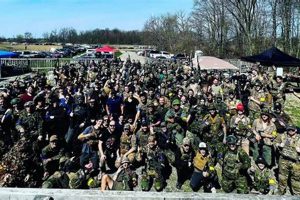
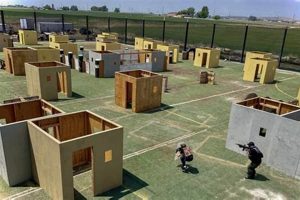
Extensive recreational areas designed for airsoft gameplay provide participants with diverse and immersive tactical environments. These expansive venues often feature varied terrains, including wooded sections, constructed buildings, and open fields, allowing for a range of strategic approaches. For example, a site encompassing several acres may include a mock urban environment complete with multi-story structures and barricades, contrasted by a natural landscape offering concealment and flanking opportunities.
The scale of these areas enhances the overall airsoft experience by fostering more realistic scenarios and larger team engagements. Participants benefit from increased opportunities for strategic planning, teamwork, and physical activity. Historically, smaller, confined spaces limited the scope of airsoft battles; however, the development of larger areas has led to a more dynamic and engaging sport, attracting a broader range of players and facilitating more complex game modes.
This article will delve into the various types of available layouts, common features incorporated into their designs, considerations for selecting a suitable location, and the impact of area size on gameplay mechanics and tactical decision-making. Furthermore, it will discuss safety protocols specific to larger environments and explore the future trends shaping the development of these expansive airsoft destinations.
Tips for Utilizing Extensive Airsoft Venues
The following guidelines provide practical advice for participants and organizers engaging with large-scale airsoft arenas, ensuring optimal gameplay and enhanced safety.
Tip 1: Conduct Thorough Site Reconnaissance: Before engaging, participants should familiarize themselves with the entire area. This includes noting key landmarks, identifying potential ambush points, and understanding the terrains impact on movement. A pre-game walkthrough, if available, is highly recommended.
Tip 2: Emphasize Team Communication: Due to the dispersed nature of larger venues, effective communication is paramount. Implement a clear and concise communication protocol using radios or designated hand signals. Regular updates on enemy positions and team movements are crucial.
Tip 3: Optimize Loadout for Range and Endurance: The increased distances necessitate prioritizing airsoft replicas with effective range and accuracy. Furthermore, carrying sufficient ammunition, water, and essential gear is vital for sustained engagements.
Tip 4: Implement Defined Objectives and Routes: Teams should establish clear objectives and designated routes to minimize aimless wandering and maximize tactical efficiency. A well-defined plan allows for coordinated movements and focused engagement with opposing forces.
Tip 5: Prioritize Hydration and Stamina Management: Extended gameplay in vast environments can lead to dehydration and fatigue. Regular water breaks and pacing oneself are essential to maintain optimal performance throughout the day. Consider carrying energy supplements or snacks for sustained energy levels.
Tip 6: Enforce Strict Adherence to Safety Regulations: Larger settings can increase the risk of accidental injuries. Strict enforcement of eye protection rules, velocity limits, and minimum engagement distances is crucial to maintaining a safe playing environment for all participants.
Tip 7: Utilize Map and Compass Skills: Knowledge of basic orienteering skills, including map reading and compass navigation, can be highly advantageous for traversing the environment efficiently and avoiding getting lost, especially in densely wooded sections.
These tips provide a foundation for navigating and succeeding within expansive airsoft environments. Implementing these strategies enhances both individual and team performance, while also promoting a safer and more enjoyable experience for all participants.
The subsequent sections will explore specific tactical considerations for maximizing the advantages offered by extensive areas.
1. Strategic Maneuverability

Strategic maneuverability, the capacity to effectively reposition forces and exploit advantageous terrain, is intrinsically linked to extensive airsoft venues. The increased spatial dimensions of these locations directly enable a broader range of tactical options, moving beyond the constraints of confined spaces. Specifically, flanking maneuvers, envelopment tactics, and diversions become viable strategies, allowing teams to outmaneuver opponents and gain positional advantages. The cause-and-effect relationship is clear: larger areas afford greater freedom of movement, leading to increased strategic possibilities. In smaller, constricted areas, direct engagements are often unavoidable. However, in expansive settings, players can leverage terrain features and distance to dictate the terms of engagement, creating opportunities for surprise attacks or defensive positioning. A practical example is a field incorporating a wooded area flanking an open field; this permits a team to use the woods for concealed movement, launching an attack on an enemy positioned in the open, who would otherwise be difficult to approach directly.
The importance of strategic maneuverability within airsoft is underscored by its impact on gameplay dynamics. Teams adept at utilizing the terrain for strategic positioning are more likely to achieve objectives and control key areas of the field. This emphasis on tactical thinking elevates the overall experience, encouraging players to develop skills beyond simple marksmanship. For example, a team could use a feigned advance to draw enemy forces away from a critical objective, creating an opening for another team to capture the point with minimal resistance. Or, a team could spread out to cover a wider area, forcing the enemy to divide its attention.
Understanding and applying the principles of strategic maneuverability is of significant practical value. Players who grasp how to use terrain and movement to their advantage can significantly improve their effectiveness on these fields. The success in “big airsoft fields” is not solely about firepower; it is about strategic thinking, positioning, and coordinated action. A field with more open spaces and with different type of buildings and terrain allows players to explore different tactics. Therefore, the capacity to effectively utilize strategic maneuverability serves as a key differentiator between average players and teams and those who consistently excel in large-scale airsoft simulations. By thinking strategically, airsofters can gain an advantage over their opponents and capture more objective.
2. Tactical Diversity

Extensive airsoft arenas directly foster tactical diversity, expanding the range of possible engagement scenarios and strategic approaches. The physical attributes of these large areas, including varied terrain, structures, and open spaces, are the direct cause of this diversification. Smaller, more constricted fields often limit players to straightforward, head-on confrontations. In contrast, expansive environments enable teams to employ a wider range of tactics, such as ambushes, reconnaissance, suppression, and coordinated assaults. The availability of diverse cover and concealment options allows for fluid shifts between offensive and defensive maneuvers. For instance, a team positioned within a multi-story building can provide covering fire for teammates advancing across an open field, demonstrating a coordinated use of different terrain features to achieve a specific objective.
The importance of tactical diversity within airsoft cannot be overstated. It necessitates a greater degree of adaptability and critical thinking on the part of participants. Players must be able to assess the terrain, anticipate enemy movements, and adjust their strategies accordingly. A team’s ability to execute a variety of tactics effectivelyfrom urban combat to woodland warfarebecomes a significant determinant of success. A practical example involves a team encountering an entrenched enemy position; instead of resorting to a frontal assault, they could utilize a flanking maneuver through dense vegetation to gain a more advantageous angle of attack. Similarly, a team facing a larger, more heavily armed force might employ hit-and-run tactics, utilizing speed and mobility to harass the enemy and disrupt their formations.
Ultimately, understanding and embracing tactical diversity is of significant practical value for airsoft participants. Those who are adept at adapting their strategies to the specific challenges presented by an area will possess a distinct advantage. However, challenges remain. The implementation of diverse tactics requires clear communication, well-defined roles, and consistent training. Teams must invest time in developing standardized procedures and practicing different engagement scenarios. By doing so, they can unlock the full potential of these areas and elevate their gameplay to a higher level. The integration of diverse tactical approach ensures that playing “big airsoft fields” become challenging and more fun.
3. Team Coordination
Team coordination is fundamentally critical for effective operation within extensive airsoft venues. The expansive nature of these fields necessitates structured communication and synchronized actions to achieve objectives. The distances involved inherently limit individual effectiveness and amplify the consequences of disorganization. Therefore, clearly defined roles, established communication protocols, and a unified understanding of strategic goals are essential elements of a successful team operating in such environments. For example, a team attempting to secure multiple objectives across a vast area requires coordinated movements, constant communication regarding enemy positions, and the ability to adapt quickly to unforeseen circumstances. Without a centralized command structure and clear lines of communication, fragmentation and ultimately failure are highly probable.
Practical examples of the importance of team coordination abound. Consider a scenario where one squad is tasked with flanking an enemy position while another engages in a frontal assault. Successful execution of this tactic relies on precise timing, effective communication of enemy movements, and the ability of each squad to adapt to changing conditions. Similarly, a team attempting to defend a large perimeter needs a system for monitoring multiple sectors, relaying information about potential breaches, and coordinating reinforcement efforts. The absence of such coordination inevitably leads to vulnerabilities and strategic disadvantages. In fact, an efficient team coordination can increase chance of winning.
In summary, the effectiveness of any team operating within an extensive airsoft field is directly proportional to its level of coordination. The ability to communicate effectively, synchronize actions, and adapt to changing conditions is paramount for achieving objectives and maximizing strategic advantage. While individual skill remains a factor, its impact is significantly diminished without the framework of a well-coordinated team. Challenges such as maintaining communication integrity across large distances and ensuring all team members adhere to established protocols must be addressed proactively to realize the full benefits of team coordination within these dynamic and complex environments. By training team coordination skills in “big airsoft fields”, players can improve strategic planning and enhance success rates.
4. Spatial Awareness
Spatial awareness, the comprehension of one’s position and orientation in relation to surrounding objects and environments, is a critical component of successful participation in large-scale airsoft engagements. Within expansive areas, effective spatial awareness becomes not merely advantageous, but often essential for strategic positioning, tactical execution, and overall safety.
- Navigation Efficiency
The ability to efficiently navigate complex terrains is paramount. Within vast areas, players must utilize landmarks, terrain features, and potentially map-reading skills to traverse the site effectively. A lack of spatial awareness can lead to disorientation, wasted time, and increased vulnerability. For instance, attempting to flank an enemy position requires accurately assessing the distance, identifying potential routes, and maintaining a sense of direction throughout the maneuver.
- Threat Assessment and Positioning
Accurate spatial understanding directly informs threat assessment and optimal positioning. Players must be able to identify potential ambush points, estimate engagement ranges, and anticipate enemy movements based on the layout of the area. This requires a constant evaluation of sightlines, cover availability, and the relative positions of both friendly and hostile forces. For example, recognizing that a particular building provides an elevated vantage point allows a player to anticipate enemy movements and establish a defensive position accordingly.
- Team Coordination and Communication
Effective spatial awareness is integral to team coordination and clear communication. Players must be able to accurately describe enemy positions, relay movement plans, and orient teammates within the environment. Using descriptive language and consistent terminology to reference specific locations enables effective teamwork and reduces the risk of miscommunication. An example would be relaying, “Enemy spotted near the large water tower, heading east towards the supply depot,” allowing teammates to quickly assess the situation and react accordingly.
- Minimizing Risk and Maintaining Safety
A strong sense of spatial awareness contributes directly to player safety in expansive airsoft venues. By understanding the boundaries of the playing area, identifying potential hazards (e.g., uneven terrain, obstacles), and maintaining awareness of surrounding players, the risk of accidental injuries or boundary violations can be significantly reduced. This is particularly important in densely wooded areas or at night, where visibility is limited.
In summation, spatial awareness is a foundational skill for participants in environments. The ability to navigate effectively, assess threats accurately, coordinate with teammates efficiently, and maintain situational awareness directly impacts individual and team performance. As playing areas continue to expand and incorporate more complex layouts, the importance of spatial awareness will only continue to grow.
5. Enhanced Realism

The correlation between expansive airsoft venues and enhanced realism is a demonstrable aspect of the airsoft experience. These larger areas provide a canvas for recreating more authentic combat scenarios, enabling gameplay that more closely mimics real-world tactical situations, thereby increasing participant immersion and strategic depth.
- Scale of Engagement
Larger operational areas facilitate engagements involving a greater number of participants, more accurately simulating the scale of real military operations. The increased number of players necessitates more complex command structures and logistical considerations, mirroring the challenges faced by military units in field conditions. For example, a scenario involving the capture of a strategically important location might require coordinated movements of multiple squads across a wide area, with each squad responsible for specific tasks such as reconnaissance, flank security, or direct assault.
- Environmental Immersion
Expansive fields often incorporate diverse terrain features, such as wooded areas, urban environments, and open fields. These varying environments demand adaptability from participants, forcing them to adjust their tactics and equipment to suit the specific challenges of each terrain type. For instance, maneuvering through a densely wooded area requires utilizing camouflage, stealth, and close-quarters combat skills, while engaging in an urban environment necessitates proficiency in room clearing, building penetration, and long-range fire support.
- Tactical Authenticity
The increased space and varied terrain inherent in these fields enable the implementation of more authentic tactical maneuvers. Teams can utilize flanking maneuvers, ambushes, and reconnaissance operations more effectively, replicating real-world military tactics. This promotes strategic thinking and decision-making, encouraging players to develop a deeper understanding of tactical principles. A practical example is a team utilizing a reconnaissance element to identify enemy positions and weaknesses, followed by a coordinated flanking maneuver to exploit those vulnerabilities.
- Equipment and Loadout Considerations
The demands of larger play areas often necessitate more realistic equipment choices. Players are encouraged to consider factors such as ammunition capacity, weight management, and communication systems more carefully. Carrying sufficient ammunition and water becomes crucial for extended engagements, forcing players to prioritize essential gear. The use of realistic communication systems, such as tactical radios, further enhances immersion and promotes effective team coordination.
In conclusion, the enhanced realism afforded by spacious airsoft areas stems from the ability to simulate the scale of engagement, environmental diversity, tactical authenticity, and equipment considerations present in real-world military operations. This heightened sense of realism contributes to a more immersive and engaging experience, fostering a deeper appreciation for tactical planning and strategic decision-making. The utilization of these “big airsoft fields” allow for a more in-depth and thorough experience.
6. Resource Management
Resource management within extensive airsoft venues is directly correlated to operational effectiveness and mission success. The increased scale of these fields necessitates careful planning and efficient allocation of essential resources, including ammunition, hydration, communication equipment, and medical supplies. The distances involved and the potential for prolonged engagements mean that inadequate resource management can quickly lead to compromised performance and increased risk. For example, a team that fails to properly ration ammunition may find itself unable to effectively engage the enemy during a crucial phase of the operation. Similarly, insufficient water supplies can lead to dehydration, negatively impacting stamina and cognitive function. Therefore, effective resource management is not merely a logistical consideration but a fundamental element of tactical proficiency in these environments.
Practical examples of effective resource management are evident in successful airsoft teams operating in expansive areas. These teams often employ strategies such as designating specific individuals as resupply personnel, establishing designated resupply points throughout the field, and utilizing lightweight and efficient load-bearing equipment. Pre-mission planning includes calculating ammunition requirements based on anticipated engagement intensity and allocating water supplies based on environmental conditions and anticipated activity levels. Furthermore, real-world military tactics related to logistics, such as establishing lines of communication for requesting resupply and prioritizing essential resources, can be adapted to enhance resource management within airsoft scenarios. By implementing such strategies, teams can sustain operational effectiveness over extended periods and overcome logistical challenges inherent in large-scale engagements.
In summation, resource management is an indispensable component of successful operations within expansive airsoft venues. The ability to effectively plan, allocate, and manage essential resources directly impacts a team’s capacity to achieve objectives, maintain operational effectiveness, and mitigate risk. While individual skill and tactical proficiency remain important, their impact is significantly diminished without the foundation of sound resource management practices. Challenges such as accurately predicting resource requirements, maintaining resupply lines, and enforcing resource conservation must be addressed proactively to maximize operational effectiveness. By prioritizing resource management, airsoft teams can significantly enhance their ability to thrive in the demanding environment of large-scale airsoft engagements.
7. Safety Protocols

In the context of expansive airsoft venues, rigorous safety protocols are not merely recommended; they are essential for mitigating the inherent risks associated with large-scale, dynamic gameplay. The increased playing area, combined with a potentially higher number of participants, amplifies the potential for accidents and necessitates a comprehensive approach to risk management.
- Mandatory Eye Protection
Eye protection is non-negotiable in airsoft, and its enforcement is even more critical in extensive playing areas. The vastness of the field increases the potential for impacts from unexpected angles or long distances. Regulations must mandate full-seal goggles or masks meeting ANSI Z87.1 standards, ensuring comprehensive protection against BB projectiles. For instance, marshals should conduct thorough inspections prior to gameplay, denying access to any participant with inadequate eye protection. This is not simply a suggestion but a rigorous requirement for participation.
- Velocity Limits and Chronographing
Maintaining strict velocity limits for airsoft replicas is paramount to prevent injuries. Larger playing areas do not negate the need for adherence to established velocity limits. All replicas must be chronographed before gameplay to ensure compliance with site-specific regulations. For example, a site might impose a maximum velocity of 400 feet per second with 0.20g BBs. Replicas exceeding this limit must be adjusted or prohibited from use. This process safeguards participants from excessive force projectiles. Sites should consider random chronograph checks throughout the day to prevent unauthorized modifications.
- Minimum Engagement Distances (MED)
Minimum Engagement Distances are crucial in preventing close-range injuries. These distances dictate the minimum safe distance at which a player can discharge their airsoft replica directly at another participant. The specific MED varies depending on the replica’s velocity and the type of weapon. For example, a replica firing above a certain velocity might necessitate a 20-foot MED. Enforcing MEDs requires player awareness and marshal oversight to ensure compliance, preventing close-range impacts that can cause discomfort or injury. Designated MED zones, as well as a vocal MED call from the player helps increase safety of all players.
- Clear Communication and Field Awareness
Effective communication is crucial for safety in large-scale airsoft engagements. Participants must clearly communicate their intentions and maintain situational awareness to avoid accidental engagements or collisions. This includes verbally calling out “hit” when struck by a BB, announcing movements through wooded areas, and utilizing visual signals to indicate surrender or non-engagement. Marshals should actively monitor communication channels and intervene to address any safety concerns. For instance, in “big airsoft fields” using tactical radios increases the amount of communication on the field.
These facets of safety protocols are interdependent and collectively contribute to a safer playing environment within expansive venues. Adherence to these protocols is not merely a matter of compliance but a reflection of participant responsibility and a commitment to maintaining a secure and enjoyable airsoft experience. Without the appropriate protocols airsoft may become unsafe and decrease enjoyment for all parties involved. Safety is a key component to increasing the enjoyability for everyone involved in airsoft.
Frequently Asked Questions
This section addresses common inquiries regarding large-scale airsoft areas, providing clear and concise answers to ensure a comprehensive understanding of their features, benefits, and considerations.
Question 1: What defines an airsoft field as considered “big”?
An airsoft area is generally considered expansive when it encompasses multiple acres of playing space, incorporating varied terrains such as wooded sections, constructed buildings, and open fields. This allows for diverse tactical scenarios and larger team engagements than smaller, confined fields.
Question 2: What are the primary advantages of playing in a large-scale airsoft area?
The advantages include enhanced strategic maneuverability, a wider range of tactical options, a more immersive and realistic gameplay experience, and opportunities for larger team engagements. Participants benefit from increased physical activity and improved teamwork skills.
Question 3: Are there specific safety considerations unique to expansive airsoft locations?
Yes. Extended distances necessitate stricter adherence to safety protocols, including mandatory eye protection, velocity limits, minimum engagement distances, and clear communication protocols. The increased playing area also requires greater awareness of surroundings to prevent accidental injuries.
Question 4: What type of equipment is recommended for playing in a vast airsoft environment?
Recommended equipment includes airsoft replicas with effective range and accuracy, sufficient ammunition and water supplies, reliable communication devices (e.g., tactical radios), and appropriate load-bearing gear for carrying essential items. Durable footwear and protective clothing are also advisable.
Question 5: How does team coordination differ in a larger airsoft setting compared to a smaller one?
Team coordination becomes paramount in areas. Effective communication, clear roles, and a unified understanding of strategic goals are essential for success. The distances involved require more structured communication protocols and synchronized actions to achieve objectives.
Question 6: What skills are particularly valuable for excelling in expansive airsoft areas?
Valuable skills include strategic thinking, tactical planning, spatial awareness, effective communication, resource management, and proficiency in using various types of terrain to one’s advantage. Adaptability and the ability to quickly assess and respond to changing situations are also critical.
Understanding these key aspects enhances the airsoft experience. Large-scale venues offer benefits such as better gameplay, but players have the responsibility to be well-informed and properly prepared for the challenges they present.
The final section will explore the future of airsoft as a sport.
Conclusion
This exploration of expansive airsoft arenas has highlighted their defining characteristics, strategic implications, and essential considerations for both participants and organizers. Key aspects include the enhancement of strategic maneuverability, the promotion of tactical diversity, the critical importance of team coordination, the necessity of heightened spatial awareness, the opportunity for enhanced realism, the significance of effective resource management, and the paramount importance of rigorous safety protocols. “Big airsoft fields” represent a significant evolution in the sport, offering immersive and challenging gameplay experiences that extend beyond the limitations of confined spaces.
The continued development and responsible utilization of these large-scale venues are vital to the ongoing growth and maturation of airsoft. As the sport evolves, a continued emphasis on safety, strategic depth, and immersive gameplay will ensure that these expansive environments remain a cornerstone of the airsoft experience. Future advancements in technology and field design will likely further enhance the realism and tactical complexity of these environments, solidifying their position as premier destinations for airsoft enthusiasts seeking a challenging and rewarding recreational activity.

![Your Guide: Best Airsoft Fields in Portland, Oregon [2024] | Ultimate Airsoft Guide for Beginners, Tactics & Gear Reviews](https://airsoftica.com/wp-content/uploads/2026/03/th-561-300x200.jpg "Your Guide: Best Airsoft Fields in Portland, Oregon [2024] Ultimate Airsoft Guide for Beginners, Tactics & Gear Reviews")