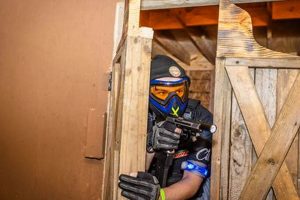
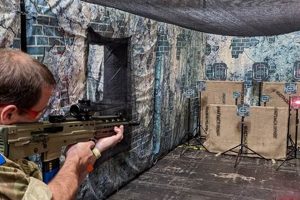
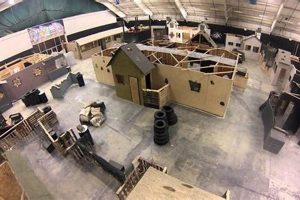
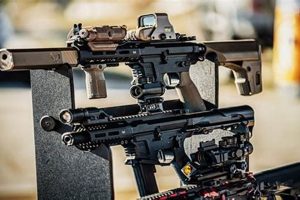
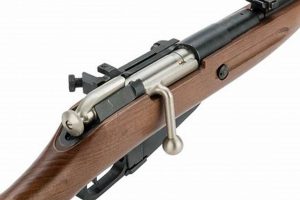
This specialized form of recreational combat simulation transpires within densely vegetated environments. Participants utilize realistic imitation firearms that discharge non-lethal projectiles. This setting introduces unique tactical and physical challenges compared to more conventional playing fields.
The activity fosters teamwork, strategic thinking, and physical endurance. Historically, these types of engagements have evolved from simple backyard games to organized events with intricate scenarios and rule sets. The appeal stems from the immersive experience and the necessity for adaptable strategies dictated by the complex terrain.
Subsequent sections will delve into specific equipment considerations, common tactical approaches employed, and safety protocols essential for engaging in simulated combat within this environment.
Essential Tactical Considerations
Successfully navigating simulated combat in heavily vegetated terrain requires specific knowledge and preparation. The following guidance is designed to enhance performance and minimize risk.
Tip 1: Terrain Familiarization: Prior to engagement, conduct thorough reconnaissance. Study maps, identify key landmarks, and anticipate potential ambush points. Understanding the terrain is paramount to strategic movement.
Tip 2: Camouflage and Concealment: Employ camouflage patterns appropriate for the environment. Utilize natural foliage for concealment, minimizing exposure to opposing forces. Movement discipline is crucial to avoid detection.
Tip 3: Communication Protocols: Establish clear and concise communication methods with team members. Utilize hand signals or encrypted radio transmissions to relay information discreetly. Effective communication is vital for coordinated maneuvers.
Tip 4: Ammunition Management: Closely monitor ammunition levels and resupply as necessary. Conserve ammunition during periods of low activity. Efficient resource management can be the deciding factor in prolonged engagements.
Tip 5: Tactical Movement: Avoid predictable routes. Utilize bounding overwatch techniques and maintain awareness of flanking opportunities. Adapt movement strategies to the evolving battlefield situation.
Tip 6: Hydration and Endurance: Maintaining physical endurance is essential. Stay adequately hydrated to sustain performance throughout extended periods of activity. Fatigue impairs judgment and reaction time.
Adhering to these tactical recommendations can significantly improve operational effectiveness and survivability within this demanding recreational activity.
The subsequent concluding section will reinforce crucial safety measures and ethical considerations for participants.
1. Dense Vegetation
Dense vegetation is an intrinsic characteristic defining gameplay. The environment significantly influences tactical decisions, equipment selection, and overall engagement strategies. Its presence fundamentally alters the dynamics compared to open or urban settings.
- Limited Visibility
Dense foliage restricts sightlines, creating opportunities for ambushes and close-quarters engagements. Traditional long-range weaponry becomes less effective, favoring shorter barrel lengths and rapid-firing platforms. Situational awareness and proactive reconnaissance are paramount.
- Difficult Traversal
Thick undergrowth and uneven terrain impede movement, requiring participants to navigate challenging obstacles. Physical conditioning becomes a critical factor. The selection of lightweight and durable gear is essential for sustained mobility.
- Natural Concealment
The environment provides ample natural camouflage, reducing reliance on artificial concealment methods. Participants must adapt their tactics to exploit natural features, blending into the surroundings to avoid detection. Effective camouflage patterns and movement discipline are crucial.
- Altered Engagement Ranges
Reduced visibility confines engagement ranges, emphasizing close-quarters combat proficiency. Reaction time and weapon handling skills are vital for success. Players must anticipate encounters at close range and be prepared to react swiftly.
These factors highlight that dense vegetation is not merely a backdrop, but an active participant in the gameplay. Understanding its influence is critical for devising effective strategies and achieving success within this simulation environment. Adaptability and a keen awareness of the surroundings are essential attributes for those engaging within this specialized recreational activity.
2. Tactical Movement

Tactical movement forms a cornerstone of effective engagement within dense foliage. The restrictive visibility and complex terrain necessitate specialized techniques distinct from those employed in open or urban environments. Unlike straightforward advances across open fields, movement must prioritize concealment and the exploitation of natural cover.
Consider the “bounding overwatch” technique as an example. In standard military doctrine, this involves alternating movement between fire teams, one providing covering fire while the other advances. In this environment, this technique is modified to account for limited visibility. Teams may only move short distances between available cover, ensuring constant situational awareness. A real-world example can be seen in specialized military training exercises that replicate this type of environment, where the focus shifts from speed to careful, methodical advancement.
Effective tactical movement contributes directly to mission success and individual survivability. Failure to adapt movement patterns to the environment increases the risk of detection and ambush. Emphasizing deliberate and calculated maneuvers, rather than relying on speed or aggression, is essential. The principles of stealth and camouflage are intrinsically linked to the success of movement, forming an integrated approach to the challenges of maneuvering within a dense environment.
3. Camouflage Effectiveness

In densely vegetated environments, camouflage effectiveness directly determines a participant’s capacity to remain undetected. The dense foliage inherently restricts visibility, making visual detection the primary method of observation. Consequently, the appropriate selection and application of camouflage patterns, combined with mindful movement techniques, become paramount. A player’s success depends largely on their ability to blend seamlessly into the surrounding environment, minimizing contrast with the natural backdrop. This directly translates to increased opportunities for strategic positioning and tactical advantage. Conversely, inadequate camouflage significantly increases the risk of detection, negating any tactical advantage.
The selection of appropriate camouflage patterns demands careful consideration of the local vegetation and lighting conditions. Patterns utilizing earth tones, greens, and browns are generally effective in temperate and tropical zones. However, the specific hues and density of vegetation can vary significantly. In regions with dense undergrowth, a disruptive pattern incorporating small, irregular shapes is often superior to a more uniform or large-scale design. Moreover, the effectiveness of camouflage is not solely determined by the pattern itself. The application of mud, foliage, or other natural materials to further disrupt the silhouette enhances its effectiveness. Examples can be found in military applications where camouflage has been successfully employed in various jungle combat operations.
Ultimately, effective camouflage serves as a force multiplier. It enhances survivability, improves tactical flexibility, and amplifies overall mission effectiveness. Participants should prioritize understanding the principles of camouflage and adapting their techniques to the specific environment. The ability to remain unseen is a critical skill, directly influencing the outcome of engagements. Continued refinement of camouflage techniques, based on observation and practical experience, remains an essential aspect of this activity.
4. Team Communication

Effective team communication represents a critical determinant of success. The density of vegetation and inherent limitations on visibility necessitate clear, concise, and reliable communication protocols. The inability to maintain contact and share information amongst team members can lead to disorientation, compromised tactical positioning, and increased vulnerability to opposing forces. A direct correlation exists between the quality of team communication and operational effectiveness. For example, a team that promptly relays the location of enemy combatants or identifies potential ambush points demonstrates superior performance compared to a team that struggles to share this information effectively. The component highlights communication as an inseparable component.
Practical application demands the establishment of standardized communication procedures. This includes pre-arranged hand signals, designated radio frequencies, and a shared understanding of tactical terminology. In situations where verbal communication may be compromised due to distance or environmental noise, hand signals provide a discreet and reliable alternative. Similarly, encrypted radio transmissions minimize the risk of interception by opposing forces. Clear communication is equally important during pre-engagement planning. Teams must coordinate movement patterns, designate responsibilities, and establish contingency plans. Any failure to adequately address these aspects can result in confusion and inefficiency during actual gameplay. Teams need to create rules to have a safe communication.
In summary, team communication is vital for any successful operation. The inherent challenges of a dense environment amplify the importance of clear, concise, and reliable communication protocols. By establishing standardized communication procedures and fostering a culture of open communication, teams can significantly enhance their effectiveness and achieve superior results. Teams must adapt techniques in unique environments.
5. Scenario Immersion
Scenario immersion forms a critical component of the overall “jungle airsoft” experience. Immersion is achieved by creating realistic and engaging scenarios that simulate real-world military or survival situations. This is crucial because it elevates the activity beyond simple target practice, transforming it into a tactical simulation that demands strategic thinking, teamwork, and adaptability. Without a compelling scenario, the exercise lacks context and the inherent challenges of the environment are not fully utilized.
The creation of an immersive scenario often involves detailed background stories, specific objectives, and realistic environmental elements. For instance, a scenario might task players with locating a downed pilot within the dense foliage, requiring them to navigate difficult terrain, evade enemy patrols, and utilize communication skills to coordinate their search. The addition of props, such as simulated wreckage or hidden caches, further enhances the experience. Historical examples also support the importance of immersive scenarios in military training. The U.S. Army’s Jungle Operations Training Course relies heavily on simulated combat situations to prepare soldiers for real-world deployments in similar environments. The principles and techniques are applied in airsoft recreations with similar outcomes.
Effective scenario immersion challenges participants to think critically, adapt to unforeseen circumstances, and rely on their training and teamwork. This fosters a sense of camaraderie and shared accomplishment, providing a more rewarding and engaging experience. The practical significance of understanding the link between scenario immersion and “jungle airsoft” lies in the ability to design more compelling and effective simulations that promote skill development and enhance overall enjoyment. Creating a well-executed environment for the scenario is an important facet of proper preparation.
Frequently Asked Questions
The following section addresses common inquiries regarding this specialized recreational activity conducted within densely vegetated environments.
Question 1: What are the fundamental differences between airsoft in a jungle environment versus a standard field?
Gameplay within dense foliage necessitates adjustments to tactics, equipment, and movement. Reduced visibility, uneven terrain, and limited engagement ranges distinguish it from conventional play.
Question 2: What specific camouflage patterns are most effective?
Patterns incorporating earth tones, greens, and browns are generally suitable. Consideration must be given to the specific vegetation and lighting conditions of the locale. Disruptive patterns with irregular shapes often perform well.
Question 3: What safety precautions are paramount?
Eye protection is mandatory. Full-face protection is strongly recommended. Adherence to established rules of engagement and awareness of surrounding personnel are essential. Participants need to bring a safety mindset.
Question 4: How does communication differ in this environment?
Due to limited visibility, pre-arranged hand signals and reliable radio communication are crucial. The use of encrypted frequencies is advisable to prevent interception.
Question 5: What physical conditioning is recommended?
A reasonable degree of physical fitness is beneficial. Stamina for prolonged periods of walking, crouching, and navigating uneven terrain is advantageous. Hydration and proper nutrition are crucial.
Question 6: Are there specific ethical considerations beyond standard airsoft etiquette?
Respect for the environment is paramount. Minimizing impact on vegetation and wildlife is essential. Adherence to leave-no-trace principles is expected. There are no exceptions.
The provided answers are intended to offer a baseline understanding. Participants are encouraged to seek further information and guidance from experienced players and event organizers.
The subsequent section will provide insights into the equipment requirements for this activity.
Conclusion
The preceding examination highlights core aspects of jungle airsoft, emphasizing the unique challenges and opportunities inherent in simulated combat within densely vegetated environments. Strategic adaptation, specialized equipment considerations, and disciplined teamwork are crucial for success. Effective utilization of camouflage, adherence to stringent safety protocols, and respectful engagement with the natural environment are critical to sustain the long-term viability of this recreational activity.
Jungle airsoft requires a serious commitment to preparedness, ethical conduct, and a thorough understanding of its inherent complexities. Its continued growth and responsible practice necessitate ongoing education, adaptation of established methodologies, and active participation in maintaining a safe and sustainable environment for all participants.