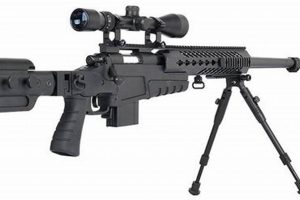
The financial outlay for a quality airsoft sniper rifle varies significantly based on several factors. These factors include the rifle’s brand, internal components, construction materials, and overall performance capabilities. A realistic expectation should be set based on the desired level of precision and durability.
Investing in a well-made airsoft sniper rifle offers advantages in terms of range, accuracy, and longevity. Historically, higher-priced models have incorporated superior materials and advanced engineering, leading to increased consistency and a more reliable platform for upgrading. This investment can result in a competitive edge in airsoft gameplay and reduced maintenance requirements over time.
Understanding the price tiers associated with airsoft sniper rifles is crucial for prospective buyers. The following sections will delve into budget-friendly options, mid-range alternatives, and high-end models, outlining the features and performance characteristics associated with each price point. The objective is to provide a clear understanding of the investment required to obtain a sniper rifle suited to individual needs and expectations.
Tips on Airsoft Sniper Rifle Budgeting
The following guidelines assist in making informed decisions regarding airsoft sniper rifle expenditures. Considerations are given to performance expectations, upgrade potential, and long-term value.
Tip 1: Establish a Realistic Budget: Determine the maximum amount available for the rifle and any necessary accessories (scope, bipod, ammunition). This prevents overspending and allows for comparison within a specific price range.
Tip 2: Research Brands and Models: Investigate different manufacturers and rifle models, noting their reputation for reliability, accuracy, and upgrade compatibility. User reviews and performance tests provide valuable insights.
Tip 3: Prioritize Internal Components: Focus on the quality of internal parts, such as the trigger mechanism, piston, and hop-up unit. These components directly influence performance and longevity.
Tip 4: Consider Upgrade Potential: Assess the rifle’s compatibility with aftermarket parts. A rifle with readily available upgrades allows for performance enhancement over time.
Tip 5: Factor in Accessory Costs: Allocate a portion of the budget for essential accessories, including a suitable scope, bipod, and high-quality airsoft BBs. These accessories are vital for optimal performance.
Tip 6: Evaluate Material Quality: Examine the construction materials used in the rifle’s body and components. Durable materials enhance the rifle’s lifespan and resistance to wear and tear.
Tip 7: Seek Expert Advice: Consult experienced airsoft players or technicians for recommendations and guidance. Their expertise can help avoid common pitfalls and ensure a sound investment.
These tips enable informed decision-making during the selection process, resulting in a rifle that aligns with budgetary constraints and performance expectations. Balancing cost with quality remains paramount to achieving a satisfactory airsoft sniping experience.
The subsequent section will provide a concluding summary and address frequently asked questions regarding airsoft sniper rifle investments.
1. Entry-level rifle price.
Entry-level airsoft sniper rifle prices represent the initial financial investment for individuals entering the sport or seeking a basic platform for recreational use. These prices significantly influence the overall cost consideration when assessing the acquisition of an airsoft sniper rifle and its potential performance capabilities.
- Initial Investment Threshold
Entry-level prices establish a lower bound for acquisition. They determine whether a potential user can even enter the market. This threshold can greatly affect the type of rifle that is selected, since it will limit the brand, and overall quality of the rifle.
- Component Quality Compromises
Lower prices often necessitate compromises in component quality. Materials used may be less durable, and internal mechanisms may lack precision. This results in lowered initial costs, but often an increase in long-term maintenance and potential upgrades.
- Performance Expectations
The price range associated with entry-level rifles sets realistic expectations regarding performance. Accuracy and range may be limited compared to higher-priced models, requiring adjustments in gameplay strategy.
- Upgrade Potential Limitations
While some entry-level rifles offer upgrade paths, limitations may exist. Compatibility with aftermarket parts might be restricted, impacting the rifle’s ability to achieve higher performance levels.
In conclusion, entry-level rifle prices are a crucial factor. They define the initial outlay, influence component quality, and shape performance expectations, all contributing significantly to the overall financial assessment of obtaining a functioning airsoft sniper rifle.
2. Mid-range performance increase.

The performance increase observed in mid-range airsoft sniper rifles represents a pivotal factor in determining the overall investment required for a functional and competitive platform. This performance tier offers a discernible advantage over entry-level models and influences the cost-benefit analysis for serious players.
- Enhanced Accuracy and Range
Mid-range rifles typically feature improved barrel quality, hop-up units, and air seal components. This translates to enhanced accuracy at longer distances, providing a significant tactical advantage over lower-priced alternatives. The cost reflects this improved performance profile, making them a more effective option than their lower-priced counterparts.
- Improved Internal Components and Durability
The internal components of mid-range rifles are constructed from higher-quality materials, resulting in improved durability and reliability. This includes stronger trigger mechanisms, pistons, and cylinders. These improvements reduce the likelihood of component failure and the need for frequent repairs or replacements, justifying the increased upfront investment.
- Greater Upgrade Potential
Mid-range rifles often possess greater compatibility with aftermarket upgrade parts compared to entry-level models. This allows players to further enhance their performance over time, fine-tuning accuracy, power, and consistency. The availability of upgrade options adds to the overall value proposition, allowing for customization to individual play styles and field conditions.
- Better Stock Performance
Mid-range rifles often offer a noticeably better performance “out-of-the-box” (OOTB) than entry-level counterparts. While upgrades are always possible, some individuals prefer stock performance and it would be beneficial to select a mid-range rifle. This is especially important in situations where immediate field readiness is a priority, or when the player lacks the technical expertise to perform internal modifications. This superior stock performance contributes to the overall justification for the higher cost.
In summary, the performance gains realized with mid-range airsoft sniper rifles directly correlate to their associated cost. The enhanced accuracy, improved durability, greater upgrade potential, and good stock performance provide a tangible return on investment for players seeking a competitive edge and a reliable, long-lasting platform. The increase in the cost is justified because of the increased usability and long-term benefits.
3. High-end build quality.

High-end build quality exerts a direct and significant influence on the price point of airsoft sniper rifles. Superior materials, precision engineering, and rigorous quality control processes contribute substantially to the overall manufacturing cost. The resulting durability, reliability, and performance characteristics justify a higher investment for discerning players.
Rifles with high-end construction often incorporate materials such as aircraft-grade aluminum, reinforced polymers, and high-strength steel alloys in critical components. These materials withstand the stresses of repeated use and environmental factors, extending the rifle’s lifespan and minimizing the need for repairs. Precision machining ensures tight tolerances and consistent performance, translating to improved accuracy and range. For example, a rifle utilizing a CNC-machined receiver and a tightly lapped inner barrel demands a higher price due to the intensive manufacturing processes involved, but provides demonstrably superior performance compared to cast or molded alternatives.
The correlation between build quality and cost extends beyond material selection. High-end manufacturers implement stringent quality assurance procedures, including thorough testing and inspection at various stages of production. This dedication to quality control minimizes defects and ensures that each rifle meets exacting performance standards. Ultimately, the investment in a rifle with high-end build quality represents a commitment to long-term reliability, enhanced performance, and reduced maintenance costs, justifying the initial price premium for players seeking a top-tier airsoft sniping experience.
4. Internal component upgrades.

Internal component upgrades represent a substantial factor influencing the total expenditure associated with acquiring a high-performing airsoft sniper rifle. The decision to modify or replace stock components directly impacts the overall cost and determines the rifle’s potential effectiveness on the field.
- Enhanced Accuracy Through Precision Barrels and Hop-Up Units
Replacing the stock inner barrel with a precision-grade stainless steel or brass barrel enhances accuracy and consistency. Similarly, upgrading the hop-up unit with a more adjustable and consistent system allows for finer control over BB trajectory. These upgrades, while adding to the overall cost, are often considered essential for achieving sniper-level accuracy.
- Improved Power and Range Via Spring and Cylinder Upgrades
Increasing the rifle’s power and range often involves replacing the spring and cylinder with stronger, more efficient components. However, these upgrades may also necessitate reinforcing other internal parts, such as the piston and trigger mechanism, to withstand the increased stress. This cascading effect can significantly increase the total cost.
- Durability and Reliability through Reinforced Internals
Upgrading internal components with reinforced materials, such as steel sears, aluminum pistons, and reinforced trigger boxes, improves the rifle’s overall durability and reliability. These upgrades are particularly important for rifles subjected to frequent use or higher-power springs. While adding to the initial cost, they can prevent costly repairs in the long run.
- Consistency and Air Seal Optimization
Achieving consistent performance requires optimizing the air seal between various internal components. Upgrading the piston head, cylinder head, and air nozzle with higher-quality replacements minimizes air leaks and improves consistency in shot power and accuracy. This fine-tuning, while potentially expensive, is critical for maximizing the rifle’s long-range effectiveness.
In essence, the pursuit of improved performance through internal component upgrades directly influences the total amount invested in an airsoft sniper rifle. These upgrades, ranging from precision barrels and hop-up units to reinforced internals and air seal optimization, represent a significant portion of the overall cost and determine the rifle’s ultimate potential on the field.
5. Accessory budget allocation.

Accessory budget allocation forms an integral part of determining the total financial outlay for a functional airsoft sniper rifle setup. A sniper rifle, irrespective of its base cost, requires essential accessories to achieve optimal performance. The allocation of funds towards these accessories has a direct bearing on the sniper’s effectiveness in gameplay. Scopes, bipods, specialized ammunition, and appropriate carrying cases are not merely supplementary items; they are fundamental components that enable precise targeting, stable firing platforms, and secure transportation. Neglecting accessory allocation can negate the benefits of a high-quality rifle, rendering it less effective than a more moderately priced rifle with adequate supporting equipment. A practical example illustrates this: a $500 rifle paired with a $200 scope will likely outperform a $700 rifle using a substandard optic, given the improved accuracy and target acquisition provided by the superior scope. Therefore, understanding and planning for accessory costs is a crucial step in gauging the actual cost of acquiring a usable and effective airsoft sniper system.
The distribution of the accessory budget warrants careful consideration. Prioritization should be based on functionality and impact on performance. Optic quality significantly influences target acquisition and accuracy, making it a primary focus. A stable bipod is crucial for maintaining a consistent firing platform, particularly at longer ranges. Investing in high-quality ammunition is essential for consistent trajectory and accuracy. Additionally, protective gear, such as eye protection and camouflage clothing, should be included within the overall budget. The specific allocation percentage varies according to individual preferences and playing styles. However, typically, 25-50% of the rifle’s cost might be set aside for accessories to secure a balanced and practical setup. For instance, purchasing a less expensive rifle allows allocation of more funds towards higher-quality optics, immediately enhancing battlefield effectiveness.
Proper accessory budget planning presents challenges. Accessory costs often escalate rapidly, and it can be tempting to economize on lower-priority items. However, insufficient funds allocated towards these items can compromise overall system performance. The initial sticker price of the rifle itself often overshadows the true cost when neglecting to factor in accessories, creating a misunderstanding of the financial commitment involved. Successful allocation requires meticulous planning, realistic expectations, and ongoing assessments of accessory needs based on playing conditions and performance goals. Effective planning transforms the initial purchase from a simple transaction to a comprehensive system optimization, ensuring optimal performance and long-term satisfaction. This budgetary approach is therefore an indispensable element when determining the actual expense associated with owning a quality airsoft sniper rifle.
6. Long-term maintenance costs.
Long-term maintenance represents a critical, yet often underestimated, component of the total cost associated with owning an airsoft sniper rifle. While the initial purchase price may appear definitive, recurring maintenance expenses significantly contribute to the overall financial investment over the rifle’s lifespan. The quality of the rifle, playing conditions, and frequency of use directly influence these maintenance demands.
- Component Wear and Replacement
Internal components, such as springs, pistons, and hop-up buckings, are subject to wear and tear with regular use. Springs lose tension, pistons develop cracks, and hop-up buckings degrade, impacting accuracy and power. Replacement of these parts constitutes a recurring expense, particularly for frequently used rifles or those operating at higher power levels. For example, a high-stress spring might require replacement every 6-12 months, incurring costs ranging from $10 to $30 per spring.
- Lubrication and Cleaning
Proper lubrication and cleaning are essential for maintaining optimal performance and preventing component damage. Silicone oil and grease are required to lubricate moving parts, reducing friction and preventing corrosion. Cleaning the inner barrel regularly removes dirt and debris that can impair accuracy. While the cost of these consumables is relatively low (typically under $20 per year), neglecting these tasks can lead to accelerated wear and more costly repairs.
- Air Seal Maintenance
Maintaining a consistent air seal is crucial for accuracy and power consistency. O-rings, air nozzles, and cylinder heads can develop leaks over time, reducing performance. Replacing these components requires technical expertise and incurs both parts and labor costs. A comprehensive air seal maintenance package can cost between $20 and $50, depending on the complexity of the rifle and the extent of the repairs required.
- Unexpected Repairs and Breakdowns
Despite preventative maintenance, unexpected repairs and breakdowns can occur. Trigger mechanisms can fail, sears can wear down, and internal components can break due to stress or impact. These repairs can be costly, especially if specialized parts or professional gunsmithing services are required. A trigger replacement, for instance, can cost anywhere from $30 to $100, depending on the quality and complexity of the trigger unit.
In conclusion, long-term maintenance should be factored into the overall cost assessment when considering the purchase of an airsoft sniper rifle. The expense of component wear, lubrication, air seal maintenance, and potential repairs collectively contributes significantly to the total financial commitment. A higher initial investment in a quality rifle with durable components may reduce long-term maintenance costs compared to a cheaper alternative requiring frequent repairs and replacements. Understanding these long-term expenses allows for a more informed purchasing decision and a more realistic assessment of the true cost of owning an airsoft sniper rifle.
7. Brand reputation influence.
Brand reputation exerts a demonstrable influence on the pricing structure within the airsoft sniper rifle market. Established manufacturers with a proven track record for quality, performance, and customer service often command a premium over lesser-known or unproven brands. This price differential reflects consumer confidence in the brand’s ability to deliver a reliable and effective product.
- Premium Pricing and Perceived Value
Brands renowned for consistent quality, such as Tokyo Marui or Action Army, often command higher prices. This is due to the perceived value associated with their proven performance and reliability. Consumers are frequently willing to pay more for the assurance of a well-engineered product and the expectation of superior long-term performance. This perceived value, cultivated through years of positive reviews and field performance, directly inflates the retail cost of their offerings.
- Aftermarket Support and Upgrade Availability
Manufacturers with strong reputations often have robust aftermarket support, including readily available spare parts and upgrade components. This increased support network translates to a higher overall value proposition, as consumers are assured of the rifle’s longevity and potential for customization. The ease of finding replacement parts and upgrades contributes to a willingness to pay a higher initial price, knowing that the rifle can be maintained and improved over time.
- Resale Value and Brand Recognition
Airsoft sniper rifles from reputable brands tend to retain higher resale value compared to lesser-known alternatives. Brand recognition and perceived quality contribute to a stronger demand in the secondary market, allowing owners to recoup a larger portion of their initial investment. This enhanced resale value functions as an indirect cost offset, further justifying the higher upfront price.
- Warranty and Customer Service
Established brands typically offer comprehensive warranties and responsive customer service. This provides peace of mind to consumers, knowing that they are protected against manufacturing defects and performance issues. The assurance of reliable customer support and warranty coverage can influence purchasing decisions, leading consumers to prioritize reputable brands despite the higher price point.
In summation, the influence of brand reputation significantly impacts the financial investment required to acquire a good airsoft sniper rifle. Reputable brands command higher prices due to perceived value, aftermarket support, resale value, and customer service provisions. These factors collectively contribute to the overall cost equation, influencing consumer choices and shaping the pricing landscape within the airsoft market.
Frequently Asked Questions Regarding Airsoft Sniper Rifle Costs
The following section addresses common inquiries related to the financial aspects of acquiring and maintaining an airsoft sniper rifle. The information presented aims to provide clarity and guidance for prospective buyers.
Question 1: What is the minimum amount needed to purchase a functional airsoft sniper rifle?
A functional airsoft sniper rifle, capable of basic performance, typically requires a minimum investment of approximately $150-$200. This price range generally reflects entry-level models with limitations in accuracy, durability, and upgrade potential. However, this may not include essential accessories such as optics.
Question 2: How much should be budgeted for essential accessories?
An appropriate budget for essential accessories, including a scope, bipod, and quality ammunition, should range from 25% to 50% of the rifle’s initial cost. Higher-quality optics and stable bipods are critical for maximizing accuracy and stability.
Question 3: Are higher-priced airsoft sniper rifles significantly better than cheaper alternatives?
Higher-priced airsoft sniper rifles generally offer significant advantages in terms of build quality, internal component reliability, and overall performance. These advantages translate to improved accuracy, greater durability, and enhanced upgrade potential.
Question 4: What are the potential long-term maintenance costs associated with airsoft sniper rifles?
Long-term maintenance costs can vary depending on the rifle’s quality and usage frequency. Regular maintenance, including lubrication, cleaning, and component replacement, can range from $50 to $100 annually. Unexpected repairs can significantly increase these costs.
Question 5: Does the brand of an airsoft sniper rifle affect its overall cost?
Brand reputation significantly influences the pricing structure. Established brands with a proven track record often command a premium due to perceived quality, aftermarket support, and resale value.
Question 6: Is it more cost-effective to upgrade an entry-level rifle or purchase a mid-range model?
The cost-effectiveness of upgrading an entry-level rifle versus purchasing a mid-range model depends on the desired performance level and the cost of individual upgrades. In many cases, purchasing a mid-range model offers a better value proposition due to the inherent improvements in components and overall design.
In summary, understanding the various factors influencing the cost of airsoft sniper rifles is crucial for making an informed purchasing decision. Considering both the initial investment and the potential long-term expenses ensures a realistic assessment of the overall financial commitment.
The following section will provide a concluding summary and final thoughts regarding the investment in an airsoft sniper rifle.
Concluding Summary
The total expenditure associated with acquiring a functional and effective airsoft sniper rifle is a multifaceted consideration extending beyond the initial purchase price. The quality of internal components, essential accessories, long-term maintenance requirements, and brand reputation all contribute significantly to the overall financial investment. Entry-level models represent a lower initial outlay but often necessitate subsequent upgrades to achieve acceptable performance. Mid-range options strike a balance between cost and performance, while high-end rifles prioritize premium build quality and enhanced features.
Careful evaluation of individual needs, performance expectations, and budgetary constraints is essential for making an informed purchasing decision. Prudent allocation of resources towards essential accessories, coupled with consideration of potential long-term maintenance costs, ensures a realistic assessment of the overall financial commitment. Ultimately, the decision of how much to allocate towards an airsoft sniper rifle should reflect a balance between affordability, performance requirements, and long-term ownership considerations.