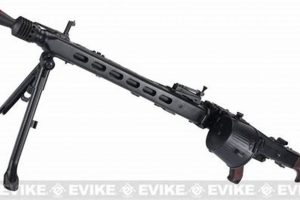
The attribute of maximizing projectile velocity in airsoft weaponry represents a critical performance characteristic. A higher rate of fire, measured in rounds per minute (RPM), signifies a weapon system’s capability to rapidly discharge projectiles, potentially impacting competitive scenarios and gameplay dynamics. The pursuit of increased velocity and firing rate is a continuous objective within the airsoft community, driven by the desire for enhanced accuracy, effective range, and tactical advantage. For example, some advanced gas blowback rifles can achieve impressive rates of fire exceeding 30 rounds per second, offering users a significant advantage in close-quarters engagements.
The significance of high projectile speeds lies in its potential to enhance the accuracy and range of shots, giving players an edge in simulated combat scenarios. Historically, achieving maximum velocity has been a key focus for airsoft manufacturers, driving innovation in motor technology, gear ratios, and gas delivery systems. Increased firing rates can provide a tactical benefit, allowing players to suppress opponents and quickly eliminate threats. However, the advantages must be weighed against factors like ammunition consumption, weapon maintenance, and adherence to field safety regulations which often limit maximum projectile velocities.
The subsequent sections will delve into the technical aspects of maximizing projectile speed and rate of fire in airsoft guns, exploring various types of airsoft guns that prioritize rapid projectile delivery, modifications that can enhance performance, and crucial considerations for safety and responsible gameplay.
Optimizing Airsoft Performance
The following guidance outlines strategies for maximizing performance in airsoft engagements, focusing on achieving a high rate of projectile discharge and addressing considerations related to optimizing “fastest airsoft gun” performance.
Tip 1: Upgrade the Motor: A high-torque motor can significantly increase the cyclic rate of an AEG (Automatic Electric Gun). Selecting a motor specifically designed for high-speed operation is crucial for achieving rapid projectile discharge.
Tip 2: Optimize Gear Ratio: Adjusting the gear ratio within the gearbox can influence both the rate of fire and the trigger response. Lower gear ratios typically result in faster cycling, contributing to a higher rounds-per-minute output.
Tip 3: Utilize a High-Discharge Battery: Employing a lithium polymer (LiPo) or lithium iron phosphate (LiFePO4) battery with a high discharge rate (C-rating) ensures a consistent and powerful energy supply to the motor. This reduces cycle times and enhances overall rate of fire.
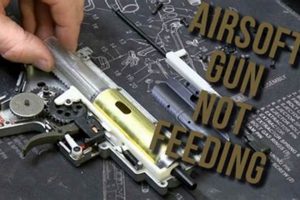
Tip 4: Modify the Piston Assembly: Implementing a lightweight piston head and piston body can reduce the inertial load on the gearbox, allowing for faster cycling. It is essential to ensure compatibility and durability when modifying internal components.
Tip 5: Enhance Air Seal: Optimizing the air seal within the cylinder assembly is critical for maximizing efficiency and consistency. A well-sealed system ensures that the maximum amount of air is compressed and delivered to propel the projectile.
Tip 6: Inspect and Maintain Bushings/Bearings: Worn or damaged bushings or bearings can introduce friction and reduce the efficiency of the gearbox. Regular inspection and maintenance, including lubrication, are essential for optimal performance.
Tip 7: Adjust the Hop-Up Unit: A properly adjusted hop-up unit will improve the range and accuracy of projectiles, allowing for more effective engagement at a distance. Incorrect adjustment can lead to decreased performance and inconsistencies.
These strategies, when implemented correctly, can contribute to a significant increase in the rate of projectile discharge and overall performance, potentially approaching the characteristics associated with achieving the highest possible firing rates in airsoft.
The subsequent conclusion will summarize the key elements and offer a final perspective on balancing performance optimization with safety and responsible airsoft gameplay.
1. Projectile Velocity

Projectile velocity is a defining characteristic influencing the classification and performance of airsoft weapons, particularly those categorized as prioritizing a rapid discharge rate. It represents the speed at which a projectile exits the barrel, directly correlating with range, impact force, and accuracy. Examining projectile velocity provides critical insight into the capabilities of airsoft weaponry.
- Kinetic Energy Transfer
Projectile velocity dictates the kinetic energy delivered upon impact. Higher velocities result in greater energy transfer, potentially influencing target reactions and overall gameplay dynamics. Field regulations often impose limits on projectile velocity to ensure player safety. An airsoft weapon capable of exceedingly high projectile velocity might be deemed unsafe or illegal for competitive play.
- Trajectory and Range
Increased projectile velocity generally translates to a flatter trajectory and extended effective range. This allows players to engage targets at greater distances with improved accuracy. Factors like air resistance and projectile weight also contribute to trajectory. A high projectile velocity, when combined with appropriate hop-up adjustment, can significantly enhance an airsoft weapon’s long-range performance.
- Rate of Fire Limitations
While projectile velocity is a key performance indicator, achieving excessively high velocities may impose limitations on the achievable rate of fire. The internal mechanisms of the airsoft gun may be subjected to increased stress, potentially reducing the weapon’s reliability or requiring specialized components to withstand the forces involved. Balancing projectile velocity with rate of fire is crucial for optimizing overall performance.
- Regulation Compliance
Most airsoft fields and organizations impose strict regulations regarding maximum projectile velocity. These regulations are designed to ensure player safety and prevent injuries. Airsoft guns exceeding specified velocity limits are typically prohibited from use. Understanding and adhering to these regulations is essential for responsible airsoft participation.
These facets demonstrate how projectile velocity is a central element in evaluating the overall effectiveness and safety of an airsoft weapon system and a critical element to fastest airsoft gun. Focusing solely on achieving maximum projectile velocity without considering factors such as rate of fire, accuracy, and compliance with safety regulations can lead to suboptimal outcomes. A balanced approach, prioritizing both performance and responsible gameplay, is paramount.
2. Motor Performance

Motor performance constitutes a critical factor in determining the rate of projectile discharge for airsoft weaponry, particularly in the pursuit of achieving maximum firing rates. The motor’s ability to generate torque and maintain rotational speed directly influences the cyclic rate of the gearbox and, consequently, the rounds-per-minute (RPM) output of the system. The selection of an appropriate motor is paramount in optimizing an airsoft gun for high-speed operation.
- Torque Generation
The torque generated by the motor dictates its ability to overcome the inertial resistance of the gearbox components and compress the air within the cylinder. Motors with higher torque ratings are capable of cycling heavier springs and gear ratios more efficiently, resulting in a faster and more consistent rate of fire. Insufficient torque can lead to sluggish cycling and reduced RPM. High Torque motor is very important to Fastest Airsoft Gun
- Rotational Speed (RPM)
The rotational speed of the motor, measured in revolutions per minute (RPM), directly influences the cycling speed of the gearbox. Higher RPM motors can cycle the gearbox more rapidly, increasing the overall rate of fire. However, excessively high RPM can strain internal components and potentially reduce reliability. RPM, like torque is important to Fastest Airsoft Gun, yet should be balanced.
- Motor Efficiency
Motor efficiency refers to the percentage of electrical energy converted into mechanical energy. More efficient motors generate less heat and consume less power, resulting in improved battery life and reduced stress on the electrical system. Highly efficient motors also tend to maintain their performance levels more consistently under sustained operation, contributing to a more reliable rate of fire. Therefore, efficiency is a crucial element for Fastest Airsoft Gun.
- Motor Type and Design
Different motor types, such as ferrite, neodymium, and brushless motors, exhibit varying performance characteristics. Neodymium motors typically offer higher torque and RPM compared to ferrite motors, while brushless motors provide enhanced efficiency, durability, and control. The selection of an appropriate motor type depends on the desired balance between performance, cost, and reliability. The right Motor type is the core of Fastest Airsoft Gun build.
These elements of motor performance underscore its central role in achieving high rates of projectile discharge in airsoft guns. The interrelation between torque, rotational speed, efficiency, and motor type dictates the overall performance and reliability of the system. Optimizing motor selection and configuration is essential for maximizing the rate of fire while maintaining component longevity and overall system effectiveness which will affect to the ultimate question – fastest airsoft gun.
3. Gear Ratio

Gear ratio is a fundamental aspect of airsoft gun mechanics directly influencing projectile discharge rate. This ratio defines the relationship between the motor’s rotation and the movement of the piston within the gearbox. A lower gear ratio (e.g., 13:1) typically results in faster cycling of the piston, which, in turn, contributes to a higher rate of fire. Conversely, a higher gear ratio (e.g., 18:1 or 32:1) generally prioritizes torque and durability but may reduce the rounds-per-minute (RPM) output. For instance, a competitive speedsoft player seeking maximum rate of fire often opts for lower gear ratios to gain an edge in close-quarters engagements, sacrificing some durability for increased projectile velocity.
The selection of an appropriate gear ratio requires careful consideration of other internal components, such as the motor and battery. Using a low gear ratio with a weak motor can lead to excessive strain and potential motor failure. Similarly, a high-discharge battery is often necessary to provide the sustained power required for a low gear ratio setup to function effectively. Moreover, field regulations regarding maximum projectile velocity must be adhered to, as increasing the rate of fire may inadvertently increase the muzzle velocity beyond permissible limits. A practical example includes carefully balancing the gear ratio with the spring strength to maintain a legal and safe projectile velocity while maximizing the rate of fire.
In summary, gear ratio plays a critical role in determining the projectile discharge rate of an airsoft gun. While lower gear ratios can contribute to a higher rate of fire, this benefit must be carefully balanced against factors such as motor performance, battery capacity, component durability, and field regulations. Achieving the “fastest airsoft gun,” thus requires a holistic approach that considers the interplay of gear ratio with other internal components to optimize both performance and reliability, as well as ensure compliance and safety.
4. Battery Discharge Rate
Battery discharge rate, often expressed as a C-rating, directly dictates the electrical current available to power an airsoft gun’s motor. A higher C-rating signifies a greater capacity to deliver sustained current, which is essential for achieving a high rate of fire. Insufficient current delivery can result in decreased motor performance, sluggish trigger response, and a lower overall rounds-per-minute (RPM) output, thus hindering the attainment of maximum projectile discharge rates. For example, a battery with a low C-rating may struggle to provide the necessary current to cycle a high-torque motor equipped with low-ratio gears, resulting in significant performance degradation. The discharge rate must match the amperage requirements of the motor and other electrical components to ensure consistent and reliable operation.
The influence of battery discharge rate extends beyond simply powering the motor. A consistent and stable current flow contributes to improved trigger response, allowing for faster and more precise shots. This is particularly crucial in competitive airsoft scenarios where split-second reactions can determine the outcome. Furthermore, a battery with an adequate discharge rate reduces the likelihood of voltage sag, which can negatively impact motor performance and potentially damage electronic components. An instance of this would be using a 7.4V LiPo battery with a high C-rating rather than a 9.6V NiMH battery to achieve a comparable or better trigger response and rate of fire in an AEG system.
In conclusion, battery discharge rate is a fundamental component in achieving the “fastest airsoft gun” configuration. It directly influences motor performance, trigger response, and overall system reliability. Selecting a battery with an appropriate C-rating is essential for maximizing projectile discharge rate and ensuring consistent performance. However, this must be balanced with considerations for battery voltage, capacity, and safety regulations to achieve the optimal balance of performance, safety, and longevity.
5. Internal Component Weight

The mass of internal components within an airsoft guns gearbox assembly directly influences its cyclic rate and, therefore, the projectile discharge rate. Lighter components require less energy to accelerate and decelerate, resulting in a faster overall cycling time. This reduced inertia allows the motor to achieve a higher rotational speed and contributes to an increased rate of fire, moving closer to the attainment of what could be described as the “fastest airsoft gun”. A heavier piston assembly, for example, necessitates more force to initiate and halt its movement within the cylinder, thereby reducing the number of cycles that can occur per unit of time. Conversely, a lightweight piston assembly, combined with appropriate motor and gear selections, will enable a significantly faster cyclic rate.
The practical significance of optimizing internal component weight manifests in several ways. In competitive airsoft scenarios, a faster rate of fire can provide a decisive advantage, allowing players to suppress opponents more effectively and achieve quicker target elimination. Upgrading to lightweight piston heads, piston bodies, and tappet plates is a common modification employed by airsoft enthusiasts seeking to enhance their weapon’s performance. For instance, replacing a steel-toothed piston with a lighter polymer or aluminum alternative can noticeably increase the rate of fire without significantly compromising durability, provided the replacement components are of sufficient quality. However, it’s crucial to consider the overall balance of the system. A component weight reduction without addressing other factors, such as motor torque and battery discharge rate, may not yield the desired results.
In summary, internal component weight is a critical parameter affecting the rate of fire of airsoft weaponry and is a significant aspect of determining the “fastest airsoft gun”. Lighter components enable faster cycling speeds, contributing to a higher projectile discharge rate. However, modifications targeting component weight should be carefully considered in conjunction with other performance-enhancing adjustments to maintain system balance and optimize overall effectiveness. Achieving the “fastest airsoft gun” requires a holistic approach, encompassing careful component selection and a thorough understanding of the interplay between various internal factors.
6. Air Seal Efficiency
Air seal efficiency represents a critical performance parameter directly influencing the projectile velocity and, consequently, the potential for achieving a high rate of fire in airsoft weapons, contributing significantly to the qualities of the “fastest airsoft gun”. An optimized air seal ensures maximum transfer of compressed air to propel the projectile, minimizing energy loss and maximizing performance. Conversely, an inefficient air seal diminishes projectile velocity and consistency, thereby reducing the achievable rate of fire. A compromised seal, even minimally, can substantially degrade performance, regardless of other upgrades.
- Cylinder Head to Cylinder Seal
The interface between the cylinder head and cylinder is a primary source of air leakage. A poorly fitted or damaged cylinder head can allow air to escape during compression, reducing the force exerted on the projectile. O-rings of appropriate size and material are crucial for maintaining a tight seal. For instance, using a double O-ring cylinder head, or applying Teflon tape to enhance the seal, can measurably improve air compression efficiency. This improvement translates directly into increased muzzle velocity and potential for a higher rate of fire, contributing to the “fastest airsoft gun” objective.
- Piston Head to Cylinder Seal
The piston head’s O-ring is responsible for maintaining a seal against the cylinder wall as the piston moves forward. A worn, cracked, or improperly sized O-ring will allow air to bypass the piston, decreasing the force applied to the projectile. Regular inspection and replacement of the piston head O-ring are essential maintenance procedures. Upgrading to a piston head with a ported design can also improve the seal under pressure. An effective piston head seal ensures that nearly all the compressed air is utilized to propel the projectile, maximizing velocity and supporting a higher rate of fire, a critical element of any “fastest airsoft gun”.
- Nozzle to Hop-Up Bucking Seal
The nozzle’s seal against the hop-up bucking is crucial for directing the compressed air into the barrel behind the projectile. If this seal is inadequate, air can leak around the bucking, resulting in inconsistent projectile velocity and reduced range. A properly aligned and lubricated nozzle, in conjunction with a compatible hop-up bucking, is essential. Aftermarket nozzles with enhanced sealing features are often employed to minimize air leakage in this area. An optimized nozzle-to-bucking seal ensures consistent air delivery, leading to enhanced accuracy and contributing to the overall effectiveness of the weapon and its viability as a potential “fastest airsoft gun”.
- Tappet Plate Timing
While not directly a seal, the tappet plate’s timing critically influences the nozzle’s ability to properly seal with the hop-up bucking before firing. Incorrect tappet plate timing can result in the nozzle retracting too early or not fully seating against the bucking, leading to air leaks and inconsistent performance. Adjustable tappet plates or modifications to the tappet plate spring can be used to optimize timing. Proper tappet plate timing ensures the nozzle consistently forms a reliable seal, maximizing air efficiency and contributing to a consistent and high rate of fire, aligning with the requirements of a “fastest airsoft gun”.
These interconnected elements collectively determine the efficiency of the air seal within an airsoft gun. Maximizing air seal efficiency through meticulous component selection, careful assembly, and diligent maintenance is essential for achieving optimal projectile velocity and a high rate of fire. These factors are crucial in building a weapon that prioritizes performance and reliability and could potentially be considered among the “fastest airsoft gun” options available. Conversely, neglecting air seal efficiency will invariably result in diminished performance, regardless of other enhancements implemented in the system.
Frequently Asked Questions
The following questions address common inquiries and misconceptions regarding achieving the highest possible projectile discharge rates in airsoft weapons.
Question 1: What factors are most crucial in achieving a high rate of fire?
The rate of fire is influenced by a combination of factors. Motor torque and RPM, gear ratio, battery discharge rate, internal component weight, and air seal efficiency all contribute significantly. Optimizing each aspect is essential for maximizing rounds-per-minute (RPM).
Question 2: Does a higher voltage battery automatically increase the rate of fire?
Increased battery voltage can contribute to a higher rate of fire, but it is not the sole determinant. Battery discharge rate (C-rating) is equally important. A higher voltage battery with a low C-rating may not deliver sufficient current to sustain a high RPM.
Question 3: Are lower gear ratios always better for achieving a high rate of fire?
Lower gear ratios generally facilitate faster cycling, leading to a higher rate of fire. However, they may also increase stress on the motor and require a higher-discharge battery. A balanced approach is necessary, considering the compatibility of all internal components.
Question 4: How does internal component weight affect the rate of fire?
Lighter internal components, such as pistons and tappet plates, reduce inertial resistance, allowing for faster cycling speeds and increased RPM. This contributes directly to achieving a higher rate of fire, but the materials must also withstand the mechanical stresses.
Question 5: What role does air seal efficiency play in maximizing the rate of fire?
An efficient air seal ensures that the maximum amount of compressed air is utilized to propel the projectile, maximizing its velocity and consistency. Air leaks reduce performance and can negatively impact the rate of fire. Air seal optimization is crucial for efficient performance.
Question 6: Are modifications to achieve a higher rate of fire always safe and legal?
Modifications should always be performed with careful consideration of safety and field regulations. Exceeding maximum projectile velocity limits is both dangerous and illegal in most jurisdictions. Responsible modifications prioritize both performance and adherence to established safety standards.
Achieving an elevated rate of fire in airsoft weaponry necessitates a comprehensive understanding of component interactions and a commitment to responsible modification practices.
The subsequent section will address the importance of safety measures and responsible gameplay practices when pursuing modifications aimed at increasing projectile discharge rates.
Fastest Airsoft Gun
The quest for the weapon exhibiting the “fastest airsoft gun” characteristics represents a significant endeavor within the airsoft community, driving innovation in component design and performance optimization. Through this exploration, the criticality of factors such as motor performance, gear ratios, battery discharge rates, internal component weight, and air seal efficiency has become evident. Achieving elevated projectile discharge rates requires a meticulous approach, balancing component selection and technical expertise to maximize performance.
However, the pursuit of extreme performance must always be tempered with a steadfast commitment to safety and responsible gameplay. Adherence to field regulations, responsible modification practices, and a focus on player safety are paramount. The “fastest airsoft gun” should not come at the expense of ethical conduct or the well-being of participants. The ultimate goal remains fostering a safe and enjoyable airsoft experience for all, prioritizing responsible innovation above all else.