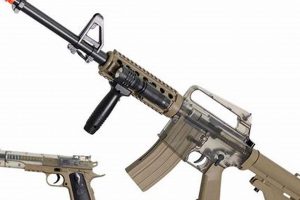
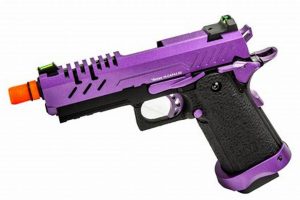
Airsoft guns propel spherical projectiles, typically 6mm or 8mm in diameter. These projectiles, often referred to as BBs, are made of plastic. The propulsion mechanism varies, utilizing compressed gas, spring power, or electric power to discharge the plastic BB from the gun’s barrel.
The use of plastic projectiles is central to the safety and intended applications of these devices. The lower mass and velocity of the plastic BBs compared to metal projectiles significantly reduces the risk of serious injury, allowing for recreational and training applications where realistic simulation is desired. Their historical development reflects a conscious effort to provide a safer alternative to firearms for training and wargaming.
Understanding the nature of these projectiles and the mechanisms by which they are propelled is crucial to appreciating the operational characteristics and safe handling practices associated with these devices. The following sections will delve into the different types of propulsion systems and their impact on performance, as well as address safety considerations and responsible usage.
Operating Airsoft Devices Responsibly
The following guidelines aim to promote safe and responsible handling, emphasizing proper techniques and risk mitigation.
Tip 1: Prioritize Eye Protection: Always wear approved eye protection during operation. The impact of a projectile, even at low velocity, can cause serious eye injury.
Tip 2: Understand Velocity Limits: Be aware of velocity limits in your region or at the specific playing field. Exceeding these limits can increase the risk of injury and may violate regulations.
Tip 3: Utilize Designated Areas: Confine operation to designated fields or areas. Avoid operating in public spaces where unintended engagement with individuals or property may occur.
Tip 4: Maintain Device Condition: Regularly inspect the device for any signs of damage or malfunction. Addressing issues promptly helps prevent unexpected failures during use.
Tip 5: Secure Storage Practices: When not in use, store the device in a secure location, inaccessible to unauthorized individuals, especially children.
Tip 6: Respect Local Regulations: Familiarize yourself with and adhere to local laws and ordinances regarding the ownership and use of these devices. Regulations can vary significantly.
Tip 7: Conduct Pre-Operation Checks: Before each use, perform a functional test to ensure proper operation of the firing mechanism and safety features.
Adhering to these guidelines ensures safer operation and minimizes the potential for accidents or misunderstandings. Responsible use contributes to the positive perception of the activity within the community.
This concludes the guidance on responsible operation. The next section will explore specific scenarios and address common misconceptions.
1. Spherical Shape

The spherical shape of projectiles discharged from airsoft devices is a fundamental design element directly influencing safety, accuracy, and operational characteristics. This geometry is a deliberate choice, balancing the need for projectile flight with the requirement for minimal risk of serious injury.
- Aerodynamic Stability
The spherical shape provides a degree of aerodynamic stability, albeit limited. Unlike projectiles with fins or other stabilizing features, spherical BBs are subject to greater influence from environmental factors such as wind. However, the consistent shape ensures a predictable, if not perfectly stable, trajectory. This predictability allows users to estimate shot placement, particularly at close ranges.
- Impact Distribution
A sphere distributes impact force evenly across its surface. This is a critical safety consideration. A sharp-edged projectile would concentrate force in a small area, increasing the potential for penetration and tissue damage. The spherical shape, by contrast, spreads the force, reducing the likelihood of significant injury upon impact with skin or protective gear.
- Manufacturing Feasibility and Cost
The production of spherical plastic projectiles is a relatively simple and cost-effective process. This is essential for maintaining affordability in a hobby or training environment where large quantities of ammunition are typically expended. The ease of manufacturing allows for widespread availability and reduces the barrier to entry for participants.
- Interaction with Hop-Up Systems
The spherical shape is crucial for the function of “hop-up” systems commonly found in airsoft guns. Hop-up applies a backspin to the projectile as it exits the barrel, creating a Magnus effect. This effect counteracts gravity, extending the projectile’s range. A non-spherical projectile would not interact effectively with the hop-up mechanism, significantly reducing range and accuracy.
In summary, the spherical shape of airsoft projectiles is not merely a matter of convenience; it is a carefully considered design choice that balances safety, functionality, and cost-effectiveness. The shape directly influences the projectile’s flight characteristics, impact dynamics, manufacturability, and compatibility with key performance-enhancing features of the device. This consideration highlights the multifaceted engineering inherent in these devices and their intended purpose.
2. Plastic Composition
The selection of plastic as the primary material for airsoft projectiles is directly linked to safety and functionality. The relatively low density of plastic, compared to metals, results in a projectile with reduced mass. This reduced mass, in turn, dictates a lower kinetic energy at a given velocity, diminishing the potential for injury upon impact. The plastic composition also allows for controlled fragmentation or deformation upon impact, further mitigating the risk of penetration or serious harm. For example, the common use of ABS plastic provides a balance between durability for propulsion through the airsoft gun and breakability upon striking a target.
The specific type of plastic utilized impacts the projectile’s performance characteristics. Variations in plastic density, hardness, and surface finish influence the projectile’s flight trajectory, air resistance, and interaction with the airsoft gun’s hop-up system. For example, higher-grade, more precisely manufactured plastics can yield more consistent and accurate shot groupings. Furthermore, biodegradable plastics are increasingly employed in airsoft projectiles to minimize environmental impact, particularly at outdoor game sites.
The plastic composition of airsoft projectiles is a critical factor determining their safety profile and performance characteristics. The properties of the selected plastic directly influence the potential for injury, the projectile’s flight behavior, and environmental considerations. Understanding the role of plastic composition is essential for responsible use and informed decision-making when selecting airsoft projectiles for specific applications.
3. 6mm or 8mm
The specification of 6mm or 8mm refers to the diameter of projectiles typically utilized in airsoft devices. This dimension is a crucial factor in determining the compatibility, performance, and safety parameters of these devices.
- Standardization and Compatibility
The 6mm BB is the dominant standard, offering widespread availability and compatibility across various airsoft gun models. The 8mm BB, while less common, is often associated with higher-powered devices, potentially offering improved range and accuracy, but may have limitations in terms of availability and compatibility. Selecting the correct BB size is crucial for proper functioning and preventing damage to the airsoft gun’s internal mechanisms.
- Kinetic Energy and Safety
The projectile diameter directly influences the kinetic energy imparted on the target. For a given velocity, an 8mm BB, having greater mass than a 6mm BB (assuming both are made of similar material), will possess higher kinetic energy. This increased energy can result in a greater impact force, necessitating stricter adherence to safety protocols and protective gear requirements. Field regulations often stipulate maximum energy levels, which vary depending on the BB diameter.
- Accuracy and Range
While the 8mm BB is sometimes considered to offer improved accuracy and range due to its increased mass and potentially more stable flight characteristics, this advantage is not always definitive. Factors such as the airsoft gun’s internal components, hop-up system, and projectile quality play significant roles. The 6mm BB, with its wider availability and developmental history, benefits from a greater selection of high-precision projectiles designed for optimal accuracy.
- Operational Considerations
The choice between 6mm and 8mm BBs may depend on the intended use case. For close-quarters combat (CQB) scenarios, where maneuverability and rate of fire are paramount, the 6mm BB, with its wider availability and compatibility with high-capacity magazines, may be preferred. For outdoor skirmishes or simulated military operations requiring longer-range engagements, the 8mm BB might be considered, assuming adherence to safety regulations and availability of appropriate ammunition.
In conclusion, the 6mm or 8mm specification represents a fundamental parameter of airsoft projectiles, influencing compatibility, safety, performance, and operational considerations. Careful consideration of these factors is essential for responsible use and informed decision-making when selecting airsoft devices and ammunition.
4. Lightweight design

The lightweight design of projectiles is a critical factor influencing the performance characteristics, safety profile, and operational capabilities of airsoft devices. The mass of the projectile directly affects the kinetic energy it possesses at a given velocity, thus influencing both its range and the potential for injury upon impact.
- Material Selection
The use of plastic as the primary material for airsoft projectiles directly contributes to their lightweight nature. Compared to metallic alternatives, plastic offers a significant reduction in mass, lowering the kinetic energy transfer upon impact. This is a primary consideration in minimizing the risk of injury during airsoft activities. Different plastic polymers offer varying densities, influencing the ultimate mass of the projectile within the 6mm or 8mm diameter standards.
- Velocity Considerations
Lightweight projectiles allow for higher muzzle velocities within established safety limits. Airsoft devices are often regulated by maximum energy outputs measured in joules. By using a lighter projectile, higher velocities can be achieved while remaining within the mandated energy thresholds. This enhances the range and trajectory of the projectile without exceeding safe impact levels.
- Impact Force Mitigation
The reduced mass of the projectile directly translates to a lower impact force upon contact. This is a fundamental aspect of airsoft safety. While eye protection and other safety gear are essential, the lightweight design of the projectile serves as a primary defense against serious injury. The limited mass minimizes the potential for penetration or significant tissue damage.
- Trajectory and Range
Although lightweight projectiles are more susceptible to environmental factors like wind, their initial velocity contributes to maintaining a reasonable trajectory and range. The balance between mass, velocity, and aerodynamic properties is carefully considered in projectile design to optimize performance within the constraints of safety regulations. Hop-up systems are used to impart backspin, further extending the range of these lightweight projectiles.
The intentional design of lightweight projectiles in airsoft devices is a key element in balancing realistic simulation with acceptable safety standards. This approach allows for recreational and training activities with a reduced risk of injury, compared to alternatives that utilize heavier, higher-impact projectiles. The characteristics of the projectiles directly align with the overall safety profile and purpose of airsoft as a recreational activity.
5. Kinetic Energy

Kinetic energy, the energy of motion, is a fundamental concept in understanding the operation and safety considerations of airsoft devices and projectiles. The amount of kinetic energy possessed by a projectile directly influences its potential to cause injury upon impact, and is, therefore, a crucial parameter in regulating the use of these devices.
- Relationship to Projectile Mass and Velocity
Kinetic energy is mathematically defined as one-half the mass of an object multiplied by the square of its velocity (KE = 1/2 m v^2). In the context of airsoft guns, this relationship underscores that both the mass of the projectile and its velocity contribute significantly to the energy it carries. A small increase in velocity, due to the squared relationship, can result in a disproportionately larger increase in kinetic energy. This necessitates careful control over these parameters to maintain safe operational limits.
- Impact on Safety Regulations
Recognizing the direct correlation between kinetic energy and the potential for injury, regulatory bodies and airsoft organizations often impose limits on the maximum allowable kinetic energy of projectiles. These limits are typically expressed in joules (J) and dictate the maximum permissible combination of projectile mass and velocity. Chronographs are commonly employed to measure projectile velocity, ensuring compliance with these safety standards at airsoft fields and events. Devices exceeding these limits are deemed unsafe and are prohibited from use.
- Influence of Projectile Type
Different projectile types, such as those with varying masses or materials, will exhibit different kinetic energy levels at the same velocity. Heavier projectiles, while potentially offering improved trajectory or wind resistance, also carry a greater kinetic energy. This necessitates careful consideration of projectile weight when selecting ammunition for an airsoft gun, ensuring that the resulting kinetic energy remains within acceptable safety margins. Biodegradable projectiles, for instance, may have slightly different densities than standard plastic BBs, affecting their kinetic energy profile.
- Role of Energy Delivery System
The energy delivery system of an airsoft gun, whether spring-powered, gas-powered, or electric-powered, directly determines the projectile’s velocity and, consequently, its kinetic energy. Adjustments to these systems, such as upgrading springs or increasing gas pressure, can significantly alter the projectile’s kinetic energy output. Tampering with or modifying these systems without a thorough understanding of the underlying principles can lead to unsafe operating conditions and potentially violate safety regulations.
The interplay between kinetic energy, projectile characteristics, and airsoft gun mechanisms underscores the need for responsible use and adherence to safety guidelines. By understanding and respecting the fundamental principles governing kinetic energy, users can ensure the safe and enjoyable operation of airsoft devices, minimizing the potential for injury and promoting the responsible use of these recreational tools.
6. Trajectory

Trajectory, the curved path of a projectile in flight, is a critical element in understanding the practical application of airsoft devices. Several factors influence this path, directly affecting the accuracy and range of these devices.
- Initial Velocity and Angle
The velocity and angle at which a projectile exits the airsoft device’s barrel are primary determinants of trajectory. Higher initial velocities generally result in flatter trajectories and extended range. The angle of launch must be carefully calibrated to achieve the desired range, accounting for the effects of gravity and air resistance. Incorrect initial velocity or angle can significantly reduce the effective range and accuracy.
- Gravity and Air Resistance
Throughout its flight, the projectile is subject to the forces of gravity and air resistance. Gravity constantly pulls the projectile downward, causing it to deviate from its initial straight path. Air resistance, or drag, opposes the projectile’s motion, slowing it down and further altering its trajectory. The shape and surface texture of the projectile influence the magnitude of air resistance. These factors must be considered to predict and compensate for trajectory deviations.
- Hop-Up Systems
Airsoft devices often incorporate “hop-up” systems, which impart backspin on the projectile as it exits the barrel. This backspin generates lift, counteracting the effects of gravity and extending the projectile’s range. The effectiveness of the hop-up system depends on the projectile’s characteristics, the system’s adjustment settings, and environmental conditions. Proper adjustment of the hop-up system is crucial for achieving optimal trajectory and accuracy.
- Environmental Conditions
External factors such as wind and temperature can significantly impact the projectile’s trajectory. Wind can deflect the projectile laterally, requiring adjustments to aim. Temperature variations can affect air density, altering air resistance and influencing the projectile’s flight path. These environmental conditions must be assessed and accounted for in order to achieve consistent accuracy.
Understanding and compensating for the factors influencing trajectory are essential skills for proficient use of airsoft devices. Mastering these principles allows users to accurately predict and control the path of projectiles, maximizing their effectiveness in various applications.
7. Impact Force
The term “impact force” denotes the force exerted when a projectile discharged from an airsoft gun collides with a target. The magnitude of this force is directly correlated with the projectile’s mass and velocity at the moment of impact, and it is a critical factor in assessing the potential for injury associated with these devices. Due to the nature of “airsoft guns what do they shoot”, it is a factor to be mindful of. The projectiles are designed to have low mass to reduce the impact force, but misuse and modification may create unsafe conditions. The materials and mechanisms dictate the outcome from projectile launched from “airsoft guns what do they shoot”.
Regulations and safety guidelines for airsoft activities are often established based on limits of kinetic energy, a related measure calculated from the projectile’s mass and velocity, which informs the impact force. Scenarios involving non-compliance with these regulations can result in injuries ranging from welts and abrasions to, in rare cases, more severe consequences. Moreover, the implementation of eye protection serves as a crucial mitigation strategy, given the vulnerability of ocular tissue to even low levels of impact force. This illustrates a practical application of impact force analysis when developing protective gear.
Understanding the concept of impact force is paramount for responsible airsoft gun use. Responsible practices, including adherence to velocity limits, utilizing appropriate protective gear, and confining operation to designated areas, mitigate the potential harm resulting from projectile impact. By comprehending these basic physics principles and applying them thoughtfully, users can engage in airsoft activities with a reduced risk of injury. Understanding the dynamics of impact force plays a crucial role to safe user of “airsoft guns what do they shoot”.
Frequently Asked Questions
This section addresses common inquiries regarding the projectiles utilized in airsoft devices, offering clarification and relevant information.
Question 1: What is the composition of standard airsoft projectiles?
Standard airsoft projectiles are typically manufactured from plastic, most commonly ABS (Acrylonitrile Butadiene Styrene). Biodegradable plastics are also increasingly utilized. The specific plastic type influences durability, fragmentation characteristics, and environmental impact.
Question 2: What are the common sizes of airsoft projectiles, and are they interchangeable?
The most common sizes are 6mm and 8mm. These sizes are not interchangeable. Using the incorrect size can cause malfunctions, damage to the airsoft device, and potential safety hazards. Manufacturers specify the appropriate projectile size for each device.
Question 3: Are airsoft projectiles reusable?
Airsoft projectiles are generally not recommended for reuse. Projectiles that have been fired may have surface imperfections or internal damage that can affect accuracy and potentially damage the airsoft device. Reusing projectiles increases the risk of jams and inconsistent performance.
Question 4: What is the typical weight range of airsoft projectiles?
The weight of airsoft projectiles varies depending on the size and material. 6mm projectiles typically range from 0.12g to 0.40g, while 8mm projectiles are generally heavier. The appropriate weight depends on the airsoft device’s power output and intended use.
Question 5: Can airsoft projectiles cause injury?
While designed to minimize injury, airsoft projectiles can cause welts, abrasions, and, in rare cases, more serious injuries, particularly to the eyes. Eye protection is mandatory during airsoft activities. Adhering to velocity limits and safety guidelines is essential for minimizing the risk of injury.
Question 6: Are there specific regulations regarding the type or velocity of projectiles permitted at airsoft fields?
Yes, most airsoft fields have strict regulations regarding projectile type and velocity limits. These regulations are in place to ensure player safety. Exceeding velocity limits or using prohibited projectile types can result in expulsion from the field and potential liability for injuries.
These FAQs provide a foundational understanding of the projectiles utilized in airsoft devices, emphasizing safety, compatibility, and responsible usage.
The following section will discuss the legal aspects surrounding airsoft devices and projectiles.
Airsoft Projectile Overview
This exposition has detailed the critical aspects of “airsoft guns what do they shoot,” specifically focusing on the characteristics of the projectiles. From composition and dimensions to trajectory and impact force, the interplay of these elements determines the safety and performance parameters of airsoft devices. Understanding these principles is paramount for responsible operation and risk mitigation.
Continued adherence to safety regulations, combined with ongoing advancements in projectile design and material science, will be crucial in shaping the future of airsoft activities. Promoting responsible engagement and informed decision-making remains the shared responsibility of manufacturers, retailers, and users, ensuring the sustained safety and positive perception of the sport.