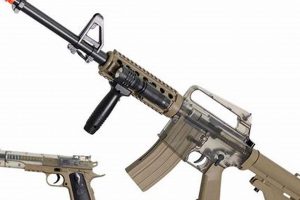
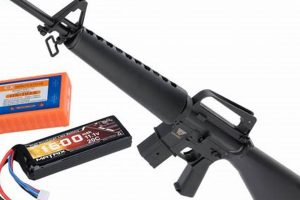
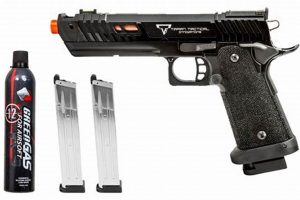
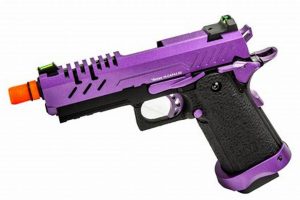
These replicas are non-lethal, scaled-down versions of the classic firearm, engineered to fire small, spherical projectiles typically made of plastic. The mechanism relies on compressed gas or a spring-loaded piston to propel these projectiles, providing a recreational shooting experience. Such devices often emulate the weight, feel, and operation of the original Colt 1911, catering to enthusiasts and those seeking training tools.
The appeal lies in their use for recreational target shooting, simulated combat scenarios (airsoft), and historical reenactments. Their design mirrors a renowned firearm, affording users a sense of realism without the risks associated with live ammunition. Furthermore, these replicas provide a safer and more accessible means to practice firearm handling and target acquisition skills.
The subsequent sections will delve into specific aspects, including the different power sources, available materials, and the legal considerations surrounding the ownership and use of these recreational devices. Further discussions will highlight the various manufacturers and modifications popular among airsoft enthusiasts.
Operation and Maintenance Tips
Proper handling and upkeep are crucial for ensuring longevity and optimal performance. Following these guidelines can mitigate potential issues and enhance the overall user experience.
Tip 1: Use Recommended Projectiles: Employ only high-quality, seamless projectiles of the correct caliber. Deformed or low-grade ammunition can cause internal damage and reduce accuracy.
Tip 2: Regular Cleaning is Essential: After each use, clean the barrel and internal components. Remove any debris or residue to prevent jamming and maintain consistent performance.
Tip 3: Lubrication is Key: Apply silicone oil to the moving parts as directed by the manufacturer’s instructions. Proper lubrication reduces friction and prolongs the life of the internal mechanisms.
Tip 4: Safe Storage Practices: When not in use, store the device in a secure location, away from extreme temperatures and direct sunlight. This prevents warping and deterioration of the materials.
Tip 5: Inspect Gas Seals Regularly: For gas-powered models, check the seals for leaks or damage. Replace worn seals promptly to maintain consistent gas pressure and performance.
Tip 6: Avoid Overfilling Magazines: Overloading magazines can damage the feeding mechanism and lead to malfunctions. Load only the recommended number of projectiles.
Tip 7: Handle with Care: Avoid dropping or mishandling the device, as this can cause internal damage and affect its accuracy. Treat it with the same respect as any precision instrument.
Adhering to these maintenance procedures will ensure reliable operation and extend the lifespan. Neglecting these practices can lead to performance degradation and costly repairs.
The following sections will address legal considerations and modifications, offering a comprehensive understanding of these replica firearms.
1. Realism and aesthetics

The appeal of these airsoft devices stems significantly from their replication of the genuine firearm’s visual and tactile properties. Manufacturers dedicate considerable effort to mirroring the original Colt 1911’s dimensions, weight distribution, and external detailing. This commitment to realism caters to collectors, historical reenactors, and airsoft players seeking an immersive experience. The presence of accurate markings, functioning safeties, and realistic magazine releases contribute to a convincing simulation of handling the actual firearm. The aesthetic fidelity enhances the perceived value and utility of the replica.
The degree of realism directly impacts its utility in training scenarios. Law enforcement and military personnel sometimes utilize these devices for force-on-force training exercises, where the realistic weight and operation provide a more authentic training environment than simpler alternatives. Film and television productions also employ highly realistic models as props, minimizing the risk associated with using real firearms. The attention to detail in the finish, such as parkerization or bluing emulations, further enhances their suitability for these applications.
Ultimately, the pursuit of realism and aesthetics serves as a critical factor driving consumer demand and influencing the perceived value. However, it is imperative to emphasize that this pursuit must be balanced with safety and responsible use. The close resemblance to a real firearm necessitates careful handling and storage practices to prevent confusion and misuse. The value derived from realistic design should not overshadow the fundamental responsibilities associated with ownership.
2. Power source variations

The operational mechanism of a Colt 1911 airsoft replica is significantly defined by its power source. Different power sources offer varying performance characteristics, influencing factors such as rate of fire, projectile velocity, and overall cost of operation. The choice of power source is therefore a primary consideration for users.
- Gas Blowback (GBB)
Gas Blowback systems utilize compressed gas, typically propane or CO2, to propel the projectile and cycle the slide, simulating the recoil of a real firearm. This offers a high degree of realism and satisfying user experience. However, GBB models can be more susceptible to temperature fluctuations, affecting gas pressure and performance. Maintenance is also more demanding, requiring regular lubrication and seal replacement.
- Non-Blowback (NBB)
Non-Blowback systems also use compressed gas, but they do not cycle the slide. This conserves gas, resulting in a higher number of shots per gas fill and more consistent projectile velocity. NBB models are generally more affordable and require less maintenance than GBB models. The trade-off is a reduced sense of realism due to the lack of slide movement.
- Electric (AEG – Automatic Electric Gun)
Electric models use a battery-powered motor to drive a piston, which in turn compresses air and propels the projectile. These models offer consistent performance, are less affected by temperature, and typically have a higher rate of fire. Electric replicas often require more initial investment, as they involve batteries and chargers, but they are generally cheaper to operate in the long run. A modified form is Electric Blowback (EBB)
- Spring-Powered
Spring-powered models rely on manually cocking a spring-loaded piston before each shot. This is the simplest and most affordable type of airsoft mechanism. However, spring-powered replicas are single-shot only, requiring manual cocking after each round. They are typically less powerful and accurate than gas or electric models, making them suitable primarily for casual target practice.
Each power source variation presents distinct advantages and disadvantages in the context of a Colt 1911 airsoft replica. Understanding these trade-offs allows users to select the model that best aligns with their priorities, whether that be realism, performance, cost-effectiveness, or ease of maintenance. The development of power sources continually reshapes the landscape of these devices, catering to diverse user needs and preferences.
3. Material Composition
The materials used in the construction of a Colt 1911 airsoft replica significantly influence its durability, weight, aesthetic realism, and overall performance. Material choices directly impact the user experience and the longevity of the device. Different materials are selected based on the intended balance between cost, realism, and functionality.
- Metal Alloys
Metal alloys, such as aluminum, zinc, and steel, are frequently used in the slides, frames, and internal components of higher-end replicas. These materials provide significant durability and contribute to a realistic weight and feel, mimicking the heft of a real firearm. For instance, a full metal slide and frame enhance the recoil simulation in gas blowback models. However, the use of metal alloys also increases the production cost and, depending on the specific alloy, may require more careful maintenance to prevent corrosion.
- High-Impact Plastics (ABS, Nylon Reinforced Polymers)
High-impact plastics, particularly ABS (Acrylonitrile Butadiene Styrene) and nylon-reinforced polymers, are commonly employed in the frames, grips, and certain internal components of mid-range replicas. These plastics offer a good balance between durability and cost-effectiveness. They are lighter than metal alloys, making the device more comfortable to handle for extended periods. Reinforced polymers can withstand significant stress and impact, making them suitable for airsoft skirmishes. However, plastic components generally lack the same level of aesthetic realism as metal parts and may be more prone to scratching and wear.
- Internal Component Materials (Steel, Brass, Aluminum)
The internal components, such as gears, pistons, and barrels, often consist of a combination of steel, brass, and aluminum. Steel is utilized in high-stress areas to ensure durability and longevity. Brass is often used for bushings and other friction-reducing components. Aluminum is chosen for its lightweight properties and corrosion resistance in certain applications. The specific combination of these materials is critical for achieving optimal performance and reliability. For example, a steel gear set in an electric airsoft gun increases its resistance to wear and tear during high-speed operation.
- Finishes and Coatings
The surface finishes and coatings applied to these replicas contribute to their aesthetic appeal and protect against corrosion and wear. Common finishes include anodizing, bluing (or simulated bluing), and various types of paint coatings. Anodizing aluminum components provides a durable and corrosion-resistant surface. Bluing, or a bluing-like finish, simulates the appearance of blued steel found on real firearms. High-quality paint coatings can replicate specific military finishes, such as parkerization. The choice of finish not only impacts the visual realism but also contributes to the overall durability and longevity of the replica.
In summary, the material composition of a Colt 1911 airsoft replica is a critical factor influencing its performance, durability, and overall value. Manufacturers strategically select materials to achieve the desired balance between realism, cost, and functionality, catering to a wide range of user preferences and budgetary constraints. The choice of materials directly affects the user’s experience and the suitability of the replica for various applications, from casual target practice to competitive airsoft games.
4. Accuracy and range
The precision and effective distance achievable by a Colt 1911 airsoft replica are critical performance characteristics that determine its suitability for various applications, ranging from target shooting to competitive airsoft scenarios. These parameters are influenced by a complex interplay of factors, including internal mechanics, projectile quality, and environmental conditions.
- Hop-Up System
The hop-up system imparts backspin to the projectile as it exits the barrel. This backspin generates lift, counteracting the effects of gravity and extending the effective range. Adjustable hop-up units allow users to fine-tune the amount of backspin, optimizing accuracy for different projectile weights and distances. A well-adjusted hop-up significantly enhances both the range and consistency of the replica. Failure to properly adjust the hop-up can result in significant accuracy degradation and reduced range.
- Barrel Quality and Length
The internal barrel’s quality, specifically its smoothness and internal diameter, plays a crucial role in determining accuracy. A smooth, consistent bore minimizes friction and ensures a uniform projectile trajectory. Longer barrels generally provide improved accuracy by increasing the time the projectile is stabilized within the barrel. However, excessively long barrels can reduce gas pressure and diminish projectile velocity. The optimal barrel length is often a compromise between accuracy and power.
- Projectile Quality and Weight
The quality and weight of the projectiles significantly impact accuracy and range. High-quality, seamless projectiles with consistent dimensions ensure uniform flight characteristics. Variations in projectile weight or shape can lead to unpredictable trajectories and decreased accuracy. Heavier projectiles generally offer greater stability in windy conditions but may require a more powerful power source to achieve optimal velocity and range. The appropriate projectile weight is dependent on the replica’s power source and intended use.
- Power Source Consistency
The consistency of the power source, whether gas or electric, is paramount for maintaining accuracy and range. In gas-powered models, fluctuations in gas pressure due to temperature variations or inadequate gas fill can lead to inconsistent projectile velocities and accuracy degradation. Electric-powered models offer more consistent performance, but battery voltage and motor performance can still influence projectile velocity and accuracy over time. Maintaining a stable and consistent power supply is essential for achieving reliable performance.
In conclusion, achieving optimal accuracy and range with a Colt 1911 airsoft replica requires careful consideration of numerous factors, from the hop-up system and barrel quality to projectile selection and power source consistency. The integration and fine-tuning of these elements are crucial for maximizing the replica’s performance and ensuring its suitability for its intended application. Understanding these interdependencies allows users to make informed choices and optimize their equipment for superior results.
5. Legal Compliance

The manufacturing, sale, ownership, and use of airsoft replicas are governed by a complex web of laws and regulations that vary significantly by jurisdiction. Adherence to these legal frameworks is paramount for responsible ownership and to avoid potential legal repercussions. These regulations often stipulate velocity limits, requiring replicas to fire projectiles below a certain speed (measured in feet per second or FPS). Exceeding these velocity limits can result in the replica being classified as a firearm, subjecting the owner to more stringent regulations and potential criminal charges. For example, in some municipalities, replicas must have a prominent orange tip affixed to the barrel to distinguish them from real firearms. Failure to comply with this marking requirement can result in confiscation of the replica and potential fines. Furthermore, brandishing an airsoft device in public in a manner that could be perceived as threatening can lead to charges of aggravated assault or similar offenses.
Many jurisdictions also impose age restrictions on the purchase and use of these devices. Selling or providing an airsoft replica to a minor may be illegal, and minors may be restricted from possessing or using them in public places without adult supervision. Moreover, some municipalities prohibit the use of airsoft replicas in certain areas, such as within city limits or near schools, even if they meet the velocity and marking requirements. It is imperative to research and understand the specific laws and regulations applicable in the relevant jurisdiction before purchasing, owning, or using such devices. Ignorance of the law is not a valid defense, and individuals may face significant legal consequences for non-compliance. Retailers selling these replicas have a responsibility to inform purchasers of relevant laws and regulations, but the ultimate responsibility for compliance rests with the individual owner.
In summary, legal compliance is an indispensable component of responsible airsoft replica ownership. The varied and often complex nature of these regulations necessitates thorough research and adherence to ensure legal and safe use. Failure to comply can result in fines, confiscation of property, and even criminal charges. Proactive engagement with local laws and regulations is therefore essential for all airsoft enthusiasts. This understanding reinforces the need for a responsible and informed approach to the hobby, prioritizing safety and adherence to the law above all else.
Frequently Asked Questions
The following addresses common inquiries regarding this type of airsoft device, providing factual information to inform purchasing decisions and promote responsible use.
Question 1: What are the primary differences between gas blowback and non-blowback models?
Gas blowback models simulate the recoil action of a real firearm, enhancing realism. Non-blowback models do not feature this action, resulting in greater gas efficiency and quieter operation. The choice depends on the user’s preference for realism versus practicality.
Question 2: What projectile weight is generally recommended for optimal performance?
Generally, projectiles ranging from 0.20g to 0.25g are considered optimal for most models. Lighter projectiles may exhibit greater velocity but are more susceptible to wind drift. Heavier projectiles offer improved stability but may reduce range if the device’s power source is insufficient.
Question 3: How often should a gas-powered device be lubricated?
Lubrication frequency depends on usage. However, as a general guideline, the internal components should be lubricated after each use or after every few magazines fired. Silicone oil is recommended to prevent damage to rubber seals and O-rings.
Question 4: Are metal slides and frames inherently more durable than plastic alternatives?
While metal construction generally offers greater resistance to physical impact, the specific alloy used and the quality of the manufacturing process are crucial factors. High-quality reinforced plastics can be remarkably durable and lighter than certain metal alloys. Metal construction primarily enhances realism, whereas durability varies depending on material quality.
Question 5: What safety precautions should be taken during storage?
The device should be stored unloaded, with the magazine removed, in a secure location inaccessible to unauthorized individuals, particularly children. Gas-powered models should be stored with a minimal amount of gas to prevent seal degradation. Avoid storing in extreme temperatures or direct sunlight.
Question 6: What is the typical effective range of these devices?
The effective range varies based on the power source, hop-up system, and projectile weight. Typically, an effective range of 50 to 100 feet can be expected under ideal conditions. However, wind and other environmental factors can significantly reduce this range.
Understanding the nuances of these devices promotes informed ownership and safe operation. Consistent maintenance and adherence to safety guidelines are essential for responsible use.
The subsequent section will address modification and customization options, exploring the possibilities for enhancing performance and aesthetics.
Concluding Remarks
This exploration has illuminated the multifaceted nature of the Colt 1911 airsoft gun. From its varying power sources and material compositions to the critical aspects of accuracy, range, and legal compliance, a comprehensive understanding is essential for responsible ownership and use. The device’s realism, achieved through meticulous replication, contributes significantly to its appeal, while maintenance procedures dictate its longevity and consistent performance.
The Colt 1911 airsoft gun, though a replica, demands respect and adherence to legal and safety guidelines. Its realistic design necessitates responsible handling to prevent misuse or misidentification. Continued advancements in materials and power systems promise further refinements in performance and realism, ensuring its continued relevance in recreational shooting and training simulations. A commitment to informed decision-making and safe practices is paramount for all enthusiasts and prospective owners.