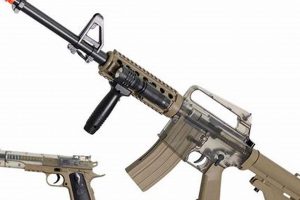
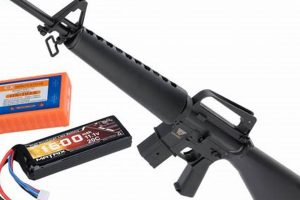
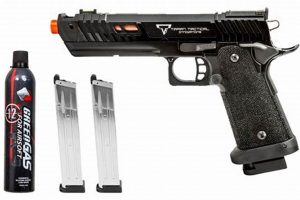
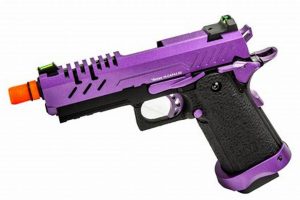
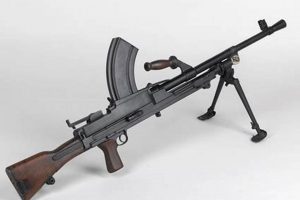
Close Quarters Battle (CQB) airsoft necessitates a specialized firearm. Selecting an optimal choice involves considering factors like maneuverability, rate of fire, and effective range within confined spaces. The ideal option prioritizes ease of handling and rapid target acquisition. For instance, a compact M4 variant or a submachine gun platform often serves as a practical and efficient tool in these environments.
Employing a suitable airsoft gun in CQB scenarios provides a distinct tactical advantage. Its compact nature allows for swift navigation through tight corners and doorways, minimizing exposure to opposing players. A higher rate of fire enables effective suppression, facilitating team advancements. Historically, shorter barrel airsoft replicas became popular as indoor airsoft arenas evolved, leading to dedicated designs optimized for close-range engagements.
Therefore, an informed decision requires examining specific gun types, power sources, and upgrade options. Subsequent sections will delve into popular models, explore the advantages and disadvantages of different power systems (electric, gas, spring), and address potential modifications to enhance performance in CQB settings. Examining internal components like hop-up units and trigger response mechanisms will also be crucial.
Essential Considerations for CQB Airsoft Gun Selection
Selecting an appropriate airsoft gun for Close Quarters Battle (CQB) requires careful assessment of several key attributes. These tips offer guidance to ensure optimal performance and tactical advantage in confined environments.
Tip 1: Prioritize Compact Size and Maneuverability: A shorter barrel length and overall smaller profile allow for quicker transitions and easier navigation through tight spaces. Consider models with retractable stocks or folding mechanisms to further reduce length when necessary.
Tip 2: Evaluate Rate of Fire (ROF): A higher ROF can provide a significant advantage in close-range engagements, enabling effective suppression and rapid target neutralization. Electric airsoft guns (AEGs) often offer adjustable ROF capabilities.
Tip 3: Assess Trigger Response: A responsive trigger allows for quicker follow-up shots and faster reaction times. Electronic trigger units (ETUs) can significantly improve trigger response compared to traditional mechanical systems.
Tip 4: Consider Power Source Reliability: AEGs provide consistent performance across a wide range of temperatures. Gas blowback (GBB) pistols and rifles offer enhanced realism but may experience performance fluctuations in colder conditions. Spring-powered guns are generally less suitable for CQB due to their lower ROF.
Tip 5: Upgrade Internal Components: Upgrading key internal components, such as the motor, hop-up unit, and inner barrel, can significantly enhance accuracy, range, and overall performance. Research reputable brands and seek professional installation when necessary.
Tip 6: Ensure Magazine Compatibility and Capacity: Select magazines that are readily available and compatible with the chosen airsoft gun. Consider high-capacity magazines to minimize the need for frequent reloading during engagements.
Tip 7: Test Ergonomics and Handling: Before purchasing, handle the airsoft gun to assess its ergonomics and ensure a comfortable grip and natural point of aim. Consider adding accessories, such as foregrips or vertical grips, to improve handling and control.
Adhering to these guidelines facilitates a more informed purchasing decision, leading to a CQB airsoft gun that effectively meets the demands of close-quarters combat.
The following sections will explore specific airsoft gun models and customization options in greater detail.
1. Compactness

Compactness is a primary determinant in selecting an effective CQB airsoft gun. Reduced dimensions facilitate ease of movement and target acquisition within confined spaces. The selection of the most effective airsoft gun for CQB invariably begins with its physical size; longer barrel lengths and overall larger profiles become liabilities in tight corners and doorways. For example, a full-length M16-style rifle presents significantly more difficulty in maneuvering through a narrow hallway compared to a submachine gun platform like an MP5 or a short-barreled M4 variant.
The importance of compactness directly impacts a player’s ability to clear rooms quickly and efficiently, reducing exposure time and enhancing tactical flexibility. This consideration extends beyond simply shortening the barrel. The presence of collapsible or folding stocks further contributes to compactness, allowing for further reduction in size when navigating extremely constricted areas. The ability to quickly shoulder and aim the airsoft gun is also tied to its overall length, where reduced size increases the responsiveness in quickly acquiring a target. Consider, for example, the difference in time required to bring a standard length rifle versus a pistol caliber carbine (PCC) to bear on a target in a close-quarters environment.
Ultimately, the effectiveness of an airsoft gun in CQB relies heavily on its compact nature. While other factors such as rate of fire and accuracy are undoubtedly important, the ability to swiftly move and engage targets within tight confines is paramount. Neglecting the attribute of compactness diminishes the airsoft gun’s practical utility in CQB scenarios, potentially hindering performance and tactical effectiveness. The optimization of internal components is rendered less useful if the user cannot effectively bring the weapon to bear in a timely fashion, which means all considerations for what makes the ideal choice are secondary to size and maneuverability.
2. Maneuverability

Maneuverability constitutes a critical factor in determining the suitability of an airsoft gun for Close Quarters Battle (CQB). The ability to swiftly navigate and engage targets within constricted environments hinges directly on the weapon’s handling characteristics. The concept of a CQB-optimized airsoft gun necessitates designs that prioritize ease of movement and rapid target acquisition.
- Weight Distribution and Balance
Weight distribution significantly impacts an airsoft gun’s maneuverability. Models with a balanced weight profile, often achieved through internal design and material selection, allow for smoother transitions between targets and reduced fatigue during prolonged engagements. A front-heavy airsoft gun, for example, can impede rapid aiming and increase strain on the operator’s arms, hindering overall mobility.
- Ergonomics and Grip
Ergonomic design elements, such as textured grips and adjustable stocks, enhance weapon control and maneuverability. A comfortable and secure grip enables quicker re-positioning and more accurate aiming while moving. The ability to manipulate the airsoft gun with one hand, when necessary, further emphasizes the importance of ergonomic considerations in CQB scenarios.
- Overall Length and Profile
As previously discussed in the context of compactness, overall length and profile directly influence an airsoft gun’s maneuverability. Shorter barrel lengths and a streamlined design minimize snagging on obstacles and facilitate easier navigation through tight spaces. A bulky or unwieldy airsoft gun can significantly impede movement and increase the risk of detection.
- Accessory Integration and Placement
The placement of accessories, such as optics, lights, and foregrips, impacts an airsoft gun’s overall maneuverability. Ill-placed or overly large accessories can increase weight and obstruct movement. Streamlined accessory integration, with components positioned close to the body of the airsoft gun, helps maintain a low profile and preserve maneuverability.
The aforementioned facets collectively define an airsoft gun’s maneuverability and dictate its effectiveness in CQB engagements. Achieving optimal maneuverability requires a holistic approach that considers weight distribution, ergonomics, overall length, and accessory integration. An airsoft gun that excels in these areas offers a distinct advantage in close-quarters environments, enabling quicker reactions, smoother transitions, and improved overall performance.
3. Rate of Fire

Rate of Fire (ROF) is a pivotal characteristic when evaluating an airsoft gun’s suitability for Close Quarters Battle (CQB). It directly influences the user’s ability to deliver rapid and sustained fire upon opposing players, making it a significant factor in determining overall effectiveness in confined environments.
- Suppression and Psychological Impact
A higher ROF facilitates effective suppression of enemy positions. The sheer volume of BBs directed towards a target can force opponents to remain in cover, hindering their ability to return fire or advance. The psychological impact of sustained fire can also create hesitation and disrupt enemy coordination. An airsoft gun with a low ROF may struggle to achieve the same level of suppression, potentially allowing opponents to gain the upper hand.
- Engaging Multiple Targets
CQB environments often involve engaging multiple targets in rapid succession. An airsoft gun with a high ROF allows for quicker target transitions and more efficient engagement of multiple threats. The ability to deliver multiple BBs in a short timeframe increases the likelihood of hitting each target, improving overall combat effectiveness. Conversely, a low ROF may limit the ability to engage multiple targets effectively, potentially leading to unfavorable outcomes.
- Compensation for Accuracy Deficiencies
In CQB, engagements typically occur at close range, where pinpoint accuracy is less critical. A higher ROF can partially compensate for minor accuracy deficiencies. By delivering a greater volume of BBs, even if not perfectly aimed, the user increases the probability of hitting the intended target. However, relying solely on ROF to compensate for poor accuracy is not a substitute for proper training and marksmanship skills.
- Ammunition Consumption and Practicality
While a high ROF offers distinct advantages, it also results in increased ammunition consumption. Users must consider the practical implications of carrying sufficient ammunition and reloading magazines frequently. Balancing the benefits of a high ROF with the logistical challenges of ammunition management is crucial for sustained performance in CQB scenarios.
The correlation between Rate of Fire and CQB airsoft effectiveness is undeniable. An airsoft gun with a balanced ROF, coupled with other essential attributes such as maneuverability and trigger response, provides a distinct advantage in close-quarters engagements. However, users must also acknowledge the trade-offs associated with a higher ROF, including increased ammunition consumption and the need for efficient reloading practices. Therefore, selecting an airsoft gun with an optimal ROF depends on individual playing style, preferred tactical role, and the specific demands of the CQB environment.
4. Trigger Response
Trigger response is a critical determinant in the effectiveness of an airsoft gun in Close Quarters Battle (CQB). It directly impacts the speed at which a user can engage targets, influencing reaction time and overall combat proficiency within confined spaces. The degree to which an airsoft gun offers instantaneous or delayed trigger response directly affects its suitability for fast-paced CQB scenarios.
- Mechanical Trigger Systems
Traditional mechanical trigger systems in airsoft guns rely on a physical connection between the trigger and the internal firing mechanism. These systems often exhibit inherent delays due to the travel distance and friction involved in the mechanical linkage. The longer the travel and the greater the friction, the slower the trigger response. In CQB situations, these delays can translate into missed opportunities and reduced effectiveness compared to systems with faster response times. Examples include standard AEG trigger mechanisms without electronic enhancements, which are slower than those enhanced by MOSFETs.
- Electronic Trigger Units (ETUs)
Electronic Trigger Units (ETUs) offer a significant improvement in trigger response by replacing the mechanical linkage with electronic signaling. When the trigger is pressed, an electronic signal is sent to a MOSFET (Metal-Oxide-Semiconductor Field-Effect Transistor) which then rapidly completes the circuit to activate the motor. This electronic pathway reduces travel distance and eliminates mechanical friction, resulting in near-instantaneous trigger response. ETUs also offer programmable features, such as pre-cocking and adjustable trigger sensitivity, further enhancing performance. Examples include Gate TITAN and Jefftron Leviathan, known for drastically improved response times.
- Pre-Cocking Functionality
Pre-cocking is an advanced feature offered by some ETUs that further enhances trigger response. Pre-cocking involves partially compressing the main spring before the trigger is pulled, reducing the distance the piston needs to travel before firing. This minimizes the delay between trigger pull and BB release, resulting in an almost instantaneous firing response. Pre-cocking can be particularly beneficial in CQB scenarios where fractions of a second can make a crucial difference in the outcome of an engagement. However, it can also increase stress on internal components. Examples of its use are often seen in competitive speedsoft builds.
- Motor and Gearbox Configuration
While ETUs primarily govern the electrical aspect of trigger response, the motor and gearbox configuration also play a significant role. A high-torque motor provides faster initial acceleration of the gears, reducing the delay between trigger pull and piston movement. A well-optimized gearbox with efficient gear ratios further contributes to faster response times. Upgrading the motor and optimizing gearbox shimming can complement the benefits of an ETU, resulting in a comprehensively enhanced trigger response. High speed motors such as those from ASG or Tienly are often paired with ETUs to maximize the trigger response.
The combination of these factors ultimately determines the effectiveness of trigger response in a CQB airsoft gun. While mechanical systems are often adequate for general use, ETUs, especially those with pre-cocking capabilities, provide a distinct advantage in the fast-paced environment of CQB. A responsive trigger system, optimized with a high-torque motor and efficient gearbox, allows for quicker reactions, more accurate follow-up shots, and improved overall combat effectiveness. Consequently, it makes it better option for close quarters combat. The user must carefully consider these features when seeking “what is the best cqb airsoft gun” for their purposes.
5. Power Source
The choice of power source constitutes a fundamental consideration in selecting a CQB airsoft gun. The operational characteristics of different power systems electric, gas, and spring exhibit distinct implications for performance in confined environments. Electric-powered airsoft guns (AEGs) typically offer consistent performance and are less susceptible to environmental temperature fluctuations. Gas-powered systems, while potentially offering higher initial velocity or realistic recoil, can suffer from performance degradation in colder temperatures, impacting gas pressure and consistency. Spring-powered airsoft guns, requiring manual cocking before each shot, are generally ill-suited for the rapid-fire engagements characteristic of CQB scenarios. As an example, a player relying on a gas-powered pistol in a cold indoor arena may experience drastically reduced velocity and effective range, negating any potential advantage offered by the system’s realism or recoil.
The reliability and maintenance requirements associated with each power source also warrant careful consideration. AEGs generally require less frequent maintenance than gas-powered systems, which can be more susceptible to leaks and require regular lubrication. Spring-powered systems, while mechanically simple, lack the rate of fire necessary for competitive CQB play. The availability and cost of consumables, such as batteries for AEGs and gas canisters for gas-powered systems, further influence the long-term operational costs. For example, a CQB player may choose an AEG due to the readily available and rechargeable battery technology, ensuring uninterrupted gameplay during extended sessions.
Ultimately, the optimal power source for a CQB airsoft gun depends on a balance of performance, reliability, maintenance, and cost. While gas-powered systems may offer advantages in specific areas, such as realism, AEGs generally provide the most consistent and practical performance for the demands of close-quarters combat. The selection of a suitable power source is not merely a matter of personal preference but a critical component in determining the overall effectiveness and reliability of the airsoft gun in CQB environments. The knowledge of the inherent strengths and weaknesses is key to find “what is the best cqb airsoft gun” to suit a user needs.
6. Upgradeability
Upgradeability represents a crucial element in the quest for an optimal CQB airsoft gun. The intrinsic characteristics of airsoft replicas often necessitate modifications to tailor performance to the specific demands of close-quarters battle. The ability to readily modify internal components, such as the motor, gears, hop-up unit, and barrel, directly influences the replica’s rate of fire, accuracy, and range, all critical for effective engagement in confined spaces. An airsoft gun with limited upgrade potential inherently restricts the user’s ability to fine-tune performance and adapt to evolving tactical requirements. For instance, an AEG with a proprietary gearbox design may severely limit the availability of aftermarket parts, hindering the user’s ability to enhance trigger response or increase rate of fire. Therefore, the extent to which a given platform supports modification is a primary consideration when deciding “what is the best cqb airsoft gun”.
Practical applications of upgradeability are readily apparent in the CQB airsoft community. Many players opt to replace stock motors with high-torque variants to improve trigger response and cycle time. Upgrading the hop-up unit and inner barrel can significantly enhance accuracy and range, extending the effective engagement distance in larger indoor arenas. Furthermore, the installation of electronic trigger units (ETUs) enables programmable firing modes, pre-cocking functionality, and adjustable trigger sensitivity, further optimizing the replica for CQB scenarios. Platforms like the TM spec M4 offer near limitless compatibility with readily available upgrade parts, and remain a highly regarded choice for a user wanting to create a gun tailored to exact specifications. Conversely, certain less common airsoft guns can be extremely difficult to source parts for, limiting longevity and upgrade capabilities.
In summary, upgradeability represents a significant factor in determining the suitability of an airsoft gun for CQB. The ability to readily modify internal components enables users to fine-tune performance, adapt to evolving tactical requirements, and extend the lifespan of their replica. While stock performance may be adequate for some users, the option to upgrade and customize the airsoft gun is a distinct advantage, allowing for continuous improvement and optimization. Ultimately, the choice of which upgrades, if any, a user may pursue depends on play style, field environment, and budget limitations, however the option to easily upgrade, or not, is a key decision in the search for “what is the best cqb airsoft gun”.
Frequently Asked Questions
The following section addresses common inquiries related to selecting an airsoft gun optimized for Close Quarters Battle (CQB) environments. The intent is to provide clear and concise answers based on established best practices and informed analysis.
Question 1: What constitutes a CQB-specific airsoft gun?
A CQB airsoft gun prioritizes maneuverability, a high rate of fire, and responsive trigger action within enclosed spaces. Compact size and lightweight construction are essential attributes, facilitating rapid target acquisition and swift movement through constricted environments.
Question 2: Is a high rate of fire always advantageous in CQB?
While a higher rate of fire can offer suppressive capabilities and rapid target engagement, it also leads to increased ammunition consumption. Maintaining a balance between rate of fire and ammunition capacity is crucial for sustained performance in prolonged CQB scenarios.
Question 3: Does the choice of power source significantly impact CQB performance?
The power source impacts consistency and reliability. Electric-powered airsoft guns (AEGs) offer consistent performance across varying temperatures, while gas-powered systems may experience performance fluctuations in colder conditions. Spring-powered guns are generally unsuitable due to their low rate of fire.
Question 4: How important is trigger response in CQB engagements?
Trigger response is critical, as it directly influences reaction time and the ability to engage targets quickly. Electronic trigger units (ETUs) offer significantly improved trigger response compared to traditional mechanical systems, providing a distinct advantage in fast-paced CQB scenarios.
Question 5: Does upgradeability play a significant role in CQB airsoft gun selection?
Upgradeability allows for performance customization, enabling users to fine-tune their airsoft gun to specific playing styles and tactical requirements. The ability to upgrade internal components, such as the motor, hop-up unit, and barrel, can significantly enhance accuracy, rate of fire, and overall performance.
Question 6: Are certain airsoft gun models inherently superior for CQB?
While some models, such as compact M4 variants and submachine gun platforms, are commonly favored for CQB due to their size and maneuverability, the optimal choice depends on individual preferences and playing style. Evaluating key attributes such as compactness, rate of fire, trigger response, and upgradeability is crucial in determining the most suitable option.
A thorough understanding of these factors enables a more informed decision-making process when selecting an airsoft gun tailored to the specific demands of Close Quarters Battle.
Subsequent sections will provide specific model recommendations and customization strategies for optimizing CQB performance.
Conclusion
The evaluation of “what is the best cqb airsoft gun” reveals a multi-faceted decision-making process. Factors such as compactness, maneuverability, rate of fire, trigger response, power source reliability, and upgradeability each contribute significantly to overall performance in confined environments. The optimal choice represents a balanced integration of these attributes, tailored to the user’s individual playing style and field conditions.
Continued advancements in airsoft technology will likely yield further refinements in CQB-optimized weaponry. Vigilant monitoring of emerging platforms, internal component upgrades, and tactical accessories remains crucial for maximizing effectiveness in close-quarters engagements. Prudent consideration of the attributes explored herein will aid in making informed decisions and achieving a competitive advantage.