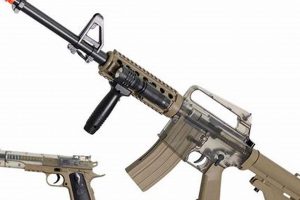
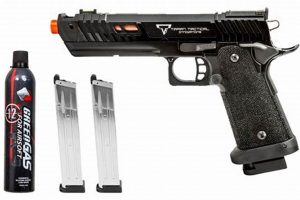
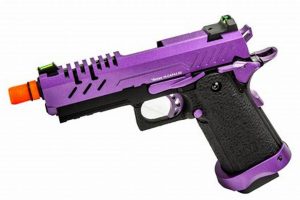
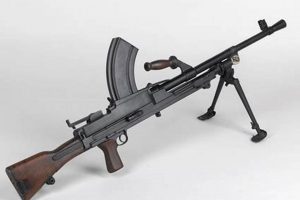
This type of recreational weapon replicates the appearance and functionality of real firearms, but uses compressed gas or electricity to propel plastic projectiles. Operation in a firing mode where multiple rounds are discharged with a single trigger pull distinguishes it from semi-automatic models. The rate of fire and ammunition capacity often contribute to its appeal for simulated combat scenarios.
The significance of such a device lies in its ability to provide a realistic training environment for tactical simulations and recreational activities. Historical context reveals the evolution from spring-powered models to those utilizing more advanced power sources, resulting in increased rates of fire and enhanced realism. The benefits encompass team-building exercises, skill development in target acquisition, and responsible recreation, all while adhering to safety regulations and guidelines.
This overview sets the stage for examining specific models, legal considerations, safety protocols, and best practices associated with these devices. Subsequent sections will delve into the technical aspects, explore different power sources, and address the importance of responsible ownership and usage within the airsoft community.
Mastering Usage
This section offers critical guidance for responsible and effective engagement with such equipment. These tips emphasize safety, performance optimization, and adherence to ethical play standards.
Tip 1: Prioritize Eye Protection: Full-seal eyewear designed specifically for airsoft is non-negotiable. The velocity of projectiles necessitates robust protection to prevent serious injury. Verify ANSI Z87.1 certification.
Tip 2: Understand Velocity Limits: Adherence to field-specific velocity restrictions is paramount. Chronograph testing before gameplay ensures compliance and prevents excessive force that could cause harm. Consider using a consistent weight of BB when testing for the most accurate results.
Tip 3: Maintain Proper Maintenance: Regular cleaning and lubrication are crucial for optimal performance. Disassembling the system according to the manufacturer’s instructions allows for inspection and replacement of worn components.
Tip 4: Utilize Appropriate Ammunition: The use of high-quality BBs is recommended to prevent jamming and damage to internal mechanisms. Bio-degradable options promote environmental responsibility and reduce long-term ecological impact.
Tip 5: Store Responsibly: Securing the device when not in use prevents unauthorized access and potential misuse. Store it in a locked case or location, separate from ammunition, to minimize risks.
Tip 6: Know the Rules of Engagement: Familiarity with field rules, including minimum engagement distances and permissible firing zones, is crucial for safe and fair gameplay. Understanding and adhering to these rules reduces the risk of accidental injury and ensures a positive experience for all participants.
Implementing these guidelines enhances user safety, promotes the longevity of the equipment, and cultivates a responsible approach to recreational activities. Prioritizing these factors contributes to a more enjoyable and secure environment for all involved.
Following these recommendations prepares the user for a deeper exploration of legal considerations and advanced techniques in subsequent sections.
1. Rate of fire

The rate of fire is a defining characteristic of fully automatic airsoft guns, directly influencing their tactical application and perceived realism. It quantifies the number of projectiles discharged per unit of time, typically expressed in rounds per minute (RPM), and significantly impacts the dynamics of simulated combat scenarios.
- Mechanical and Electrical Systems Influence
The rate of fire is intrinsically linked to the internal operating mechanisms. Electrically powered airsoft guns (AEGs) rely on motor speed and gear ratios to cycle the piston and deliver compressed air. Gas-powered variants utilize gas volume and valve timing to regulate projectile discharge. Alterations to these systems, such as upgrading the motor, gears, or gas regulator, directly affect the achievable rate of fire, potentially increasing or decreasing it depending on the modification.
- Ammunition Feed and Consistency
Maintaining a consistent flow of ammunition is critical for sustained high rates of fire. Magazine capacity and feeding mechanisms must be robust to prevent jams or misfeeds that interrupt firing. High-capacity magazines are often favored for automatic fire, but their design must ensure reliable projectile delivery. The quality and consistency of the BBs themselves also play a role; inconsistent size or shape can disrupt the feeding process and reduce the effective rate of fire.
- Power Source Demands and Limitations
Achieving and sustaining a high rate of fire places significant demands on the power source. AEGs require batteries with sufficient voltage and discharge rates to power the motor consistently. Gas-powered systems need adequate gas pressure and flow to cycle the action repeatedly. Insufficient power can lead to a noticeable drop in the rate of fire, particularly during extended bursts of automatic fire. The type and quality of the power source directly impact the airsoft gun’s overall performance and reliability.
- Tactical Implications and Game Play Impact
High rates of fire offer a tactical advantage in certain situations, such as providing suppressive fire or overwhelming opponents in close-quarters combat. However, they also consume ammunition rapidly and can be less accurate than semi-automatic fire. Players must balance the benefits of a high rate of fire against the need for ammunition conservation and target accuracy. Field rules and engagement distances often place limitations on the use of fully automatic fire to ensure fair and safe gameplay.
In summary, the rate of fire is a multifaceted attribute of fully automatic airsoft guns, intricately tied to their internal mechanisms, power source, ammunition feed, and tactical application. Understanding these interdependencies is crucial for both users and manufacturers to optimize performance, ensure reliability, and promote responsible usage within the airsoft community.
2. Gas/Battery Power
The functionality of a fully automatic airsoft gun is critically dependent on its power source, which is typically either compressed gas or electrical battery. These power sources dictate the mechanism’s capacity to repeatedly cycle, loading and discharging projectiles in rapid succession. The choice between gas and battery power significantly influences the weapon’s performance characteristics, operational cost, and maintenance requirements.
Gas-powered systems, often using compressed green gas, propane, or CO2, leverage the expansion of the gas to propel the projectile. These systems are characterized by a more realistic recoil sensation, appealing to users seeking enhanced simulation. However, performance can be sensitive to temperature variations, affecting gas pressure and, consequently, firing velocity. Furthermore, gas leaks and the need for regular refills contribute to ongoing operational costs. Battery-powered systems, employing rechargeable batteries to power an electric motor, offer greater consistency in firing velocity and are less susceptible to environmental factors. Battery capacity determines the number of shots possible before requiring a recharge. The initial investment in batteries and chargers, coupled with the eventual need for replacement, represents a significant consideration. An example, a NiMH battery on a airsoft gun can shoot a few hundred rounds before needing charging.
The power source directly influences the rate of fire, trigger response, and overall reliability of a fully automatic airsoft gun. While gas systems provide a more visceral experience, battery systems offer greater convenience and consistency. Understanding the characteristics and limitations of each power source is essential for selecting an appropriate airsoft gun for a specific application and ensuring its continued operation. The selection, maintenance, and responsible use of the power source directly impact the safety and enjoyment of the airsoft experience.
3. Legal restrictions
The legal landscape surrounding fully automatic airsoft guns is complex and varies significantly across jurisdictions. The primary concern driving these restrictions is the potential for misuse and confusion with actual firearms. Consequently, many regions impose strict regulations on their ownership, sale, and use. These regulations often stem from laws designed to control the possession of items that closely resemble or can be readily converted into functioning firearms. The defining characteristic of fully automatic functionalitythe ability to continuously fire projectiles with a single trigger pullfrequently triggers stricter scrutiny than semi-automatic or manually operated airsoft devices. For example, some countries classify airsoft guns based on projectile velocity and external resemblance to real firearms, leading to restrictions on import, sale, or public display.
The impact of legal restrictions on fully automatic airsoft guns is multi-faceted. Manufacturers and retailers must comply with varying labeling requirements, velocity limitations, and import/export regulations. Airsoft fields and organized events must operate within the confines of local laws, which may include restrictions on firing modes, minimum engagement distances, and insurance requirements. Individual owners are responsible for understanding and adhering to all applicable laws, including those related to transportation, storage, and permissible usage locations. Failure to comply can result in fines, confiscation of equipment, or even criminal charges. In some jurisdictions, modifications that increase the firing rate or power of an airsoft gun may be specifically prohibited, further complicating the legal considerations.
Understanding the legal restrictions pertaining to fully automatic airsoft guns is paramount for all stakeholders, including manufacturers, retailers, event organizers, and individual users. Adherence to these laws not only mitigates legal risks but also promotes responsible airsoft practices and fosters a positive perception of the sport. The ongoing evolution of airsoft technology and the potential for misuse necessitate a continuous evaluation and adaptation of legal frameworks to balance recreational opportunities with public safety concerns. Ultimately, a proactive approach to legal compliance is essential for the long-term sustainability and acceptance of the airsoft community.
4. Internal mechanisms

The operation of a fully automatic airsoft gun hinges upon the intricate interplay of its internal mechanisms. These components, working in concert, enable the rapid and continuous firing of projectiles with a single trigger action. The design and functionality of these mechanisms are paramount to the performance, reliability, and overall effectiveness of the device. Failure in even a single component can disrupt the entire firing cycle, rendering the weapon inoperable or significantly reducing its rate of fire. For instance, a worn piston head in an AEG will leak compressed air, reducing projectile velocity and potentially preventing fully automatic operation. The precise calibration and durability of these internal parts are, therefore, of utmost importance.
Practical applications of understanding these mechanisms include effective troubleshooting and maintenance. Knowledge of the gearbox components in an AEG, such as gears, motor, and electronic control unit (ECU), allows for targeted diagnosis and repair of malfunctions. Similarly, understanding the valve system and gas routing in a gas blowback (GBB) airsoft gun enables users to identify and resolve gas leaks or pressure inconsistencies. In competitive scenarios, a well-maintained and optimally tuned internal mechanism can provide a significant advantage in terms of rate of fire, accuracy, and reliability. Modifying or upgrading internal components requires a thorough understanding of their function and compatibility to avoid causing damage or compromising the weapon’s performance. Moreover, this understanding is key to safely disassemble, clean, and reassemble the equipment, thus ensuring its longevity.
In summary, the internal mechanisms are the heart of a fully automatic airsoft gun, dictating its ability to deliver rapid and sustained fire. A comprehensive understanding of these components is essential for effective operation, maintenance, and troubleshooting. The durability and precise interaction of these parts are crucial for achieving optimal performance and ensuring the long-term functionality of the airsoft gun. While advancements continue to refine these systems, the fundamental principles of their operation remain constant, underscoring the importance of a solid foundational knowledge for both novice and experienced users.
5. Simulated realism

The allure of a fully automatic airsoft gun often stems directly from its ability to provide a heightened degree of simulated realism. The incorporation of fully automatic firing capability significantly amplifies the immersive experience, replicating the operational characteristics of real firearms more closely than semi-automatic or manual counterparts. This element of realism is a primary driver for many airsoft enthusiasts, particularly those seeking to simulate military or law enforcement training scenarios. The capacity to deliver sustained suppressive fire, execute flanking maneuvers, and respond to simulated threats with the same firing cadence as real firearms contributes to a more engaging and tactically demanding simulation. A real-world example is the use of airsoft weapons in force-on-force training exercises by security personnel, where the realistic firing modes enhance the training value by mirroring real combat scenarios.
The importance of simulated realism extends beyond mere aesthetic appeal. It directly impacts the training value and tactical effectiveness of airsoft as a simulation tool. The accurate replication of firing mechanics allows participants to develop and refine skills related to weapon handling, target acquisition, and fire control. The psychological effects of engaging in simulated combat with fully automatic weapons can also contribute to a more realistic and stressful training environment, better preparing individuals for real-world situations. Furthermore, the ability to replicate the limitations and challenges of fully automatic fire, such as ammunition consumption and recoil management, enhances the learning experience and promotes responsible weapon handling techniques. For example, the M249 SAW replica (airsoft machine gun) has a high rate of fire that would require good trigger and fire control to be accurate.
In conclusion, simulated realism is an integral component of the appeal and practical utility of fully automatic airsoft guns. While challenges remain in achieving perfect fidelity to real firearms, the ongoing advancements in airsoft technology continue to blur the lines between simulation and reality. This pursuit of realism not only enhances the immersive experience for enthusiasts but also contributes to the value of airsoft as a training tool for military, law enforcement, and security personnel. The legal and ethical considerations surrounding the use of realistic-looking airsoft weapons must be carefully addressed to ensure responsible use and prevent misuse. The overall goal is to enhance the simulation, to learn the value and respect the tool in hand.
Frequently Asked Questions
This section addresses common inquiries and concerns regarding fully automatic airsoft guns, providing concise and factual information.
Question 1: What are the legal implications of owning a fully automatic airsoft gun?
The legality varies significantly by jurisdiction. Many regions have restrictions on the sale, possession, or use of fully automatic airsoft guns due to concerns about their resemblance to real firearms. Prior to purchasing or using such a device, local laws should be thoroughly researched and understood.
Question 2: What safety precautions should be taken when using a fully automatic airsoft gun?
Eye protection is paramount; full-seal goggles designed specifically for airsoft are essential. Adherence to field velocity limits and minimum engagement distances is crucial to prevent injury. Responsible storage and handling practices are also necessary to ensure safety.
Question 3: What is the typical effective range of a fully automatic airsoft gun?
The effective range depends on factors such as the airsoft gun’s power source, internal components, and projectile weight. However, generally, the accurate range is between 50 and 150 feet. Beyond this, accuracy diminishes significantly.
Question 4: What type of maintenance is required for a fully automatic airsoft gun?
Regular cleaning, lubrication, and inspection of internal components are essential. Gas-powered models require attention to seals and valves, while electric models need battery maintenance and gear lubrication. Following the manufacturer’s instructions for disassembly and maintenance is recommended.
Question 5: What types of ammunition are suitable for a fully automatic airsoft gun?
High-quality, seamless BBs of the correct weight are recommended. Using low-quality or improperly sized BBs can cause jams and damage to the internal mechanisms. Biodegradable BBs are environmentally responsible options.
Question 6: How does the rate of fire affect battery or gas consumption in a fully automatic airsoft gun?
A higher rate of fire directly correlates with increased battery or gas consumption. Fully automatic fire drains batteries more quickly and depletes gas canisters faster compared to semi-automatic fire. Users should be prepared for more frequent replacements or refills.
Key takeaways include the importance of legal compliance, safety precautions, and proper maintenance for responsible ownership and operation of these devices.
The next section will explore advanced customization and modification options available for fully automatic airsoft guns.
Fully Automatic Airsoft Gun
This examination has traversed the multifaceted landscape of the fully automatic airsoft gun, considering its operational mechanisms, legal ramifications, safety protocols, and the simulation aspects it offers. The importance of responsible ownership, stringent adherence to local laws, and the consistent application of safety measures have been continuously emphasized. Internal functionality, encompassing rate of fire, power source dynamics, and maintenance requirements, has been analyzed to provide a comprehensive understanding of the device’s operation and upkeep.
The ongoing evolution of this technology necessitates a continued commitment to education and responsible practices. As these devices become more sophisticated and realistic, the need for informed decision-making and ethical conduct within the airsoft community becomes increasingly critical. The future trajectory hinges upon balancing the recreational and training benefits with a proactive approach to safety and regulatory compliance, ensuring the continued responsible utilization of the fully automatic airsoft gun.