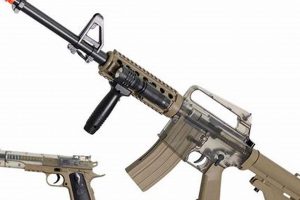
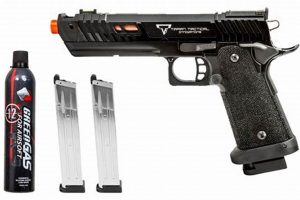
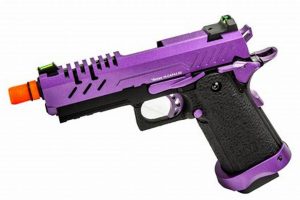
The term identifies a mechanism in airsoft guns designed to impart backspin to the projectile. This backspin creates a Magnus effect, resulting in an upward force that counteracts gravity and extends the effective range of the airsoft BB. It is typically achieved through an adjustable rubber bucking that protrudes slightly into the barrel, creating friction against the BB as it passes.
Its implementation is vital for optimizing airsoft gun performance. By increasing range and accuracy, it allows players to engage targets at greater distances and with improved consistency. Historically, prior to its wide adoption, airsoft guns were limited by the relatively short distance BBs could travel accurately. The introduction of this system revolutionized the sport, enabling more realistic and engaging gameplay.
Understanding its function is crucial for anyone involved in airsoft, whether as a player, technician, or retailer. Subsequent sections will delve into the different types available, how to adjust it for optimal performance, and common troubleshooting tips.
Optimizing Airsoft Gun Performance
Proper adjustment significantly impacts range and accuracy. The following guidelines provide insights into achieving optimal performance.
Tip 1: Understand the Adjustment Mechanism: Familiarize oneself with the specific adjustment type on the airsoft gun. Common types include rotary dials, sliding levers, and set screws. This knowledge is fundamental for making precise adjustments.
Tip 2: Start with Minimal Backspin: Begin adjustments with minimal backspin applied. Gradually increase the backspin until the BBs fly straight and level for the desired range. Over-hopping, characterized by BBs rising excessively, reduces range and accuracy.
Tip 3: Use Consistent Weight BBs: BB weight impacts optimal settings. Using consistent weight BBs ensures consistent performance. Switching to heavier BBs often requires increased backspin.
Tip 4: Observe BB Trajectory: Carefully observe BB trajectory during test firing. Look for signs of over-hopping (BBs rising too quickly), under-hopping (BBs dropping too soon), or curving left or right, indicating potential issues with the bucking or barrel alignment.
Tip 5: Fine-Tune for Environmental Conditions: Air density and wind conditions affect BB trajectory. Adjust settings accordingly. On windy days, slight adjustments might be necessary to compensate for wind drift.
Tip 6: Regular Maintenance is Essential: Periodically clean the barrel and bucking. Dirt and debris can accumulate, affecting performance and consistency. A clean barrel ensures consistent BB flight.
Tip 7: Consider Upgrading the Bucking: A higher-quality bucking can improve performance and consistency. Aftermarket buckings are available in various materials and designs, optimized for different BB weights and power levels.
By following these tips, airsoft gun owners can maximize their range and accuracy, leading to a more enjoyable and competitive experience. Consistent performance requires both proper adjustment and regular maintenance.
The following sections will address common problems and troubleshooting techniques to further refine airsoft gun operation.
1. Backspin creation

Backspin creation is fundamental to the operation. Without imparted spin, airsoft BBs would exhibit a drastically reduced effective range and accuracy due to gravity and air resistance. The following points detail key aspects of this process.
- Magnus Effect Application
The mechanism utilizes the Magnus effect, a phenomenon whereby a spinning object moving through a fluid (in this case, air) experiences a force perpendicular to both the direction of motion and the axis of rotation. In airsoft, backspin generates an upward force that counteracts gravity, extending the BB’s trajectory. For example, a BB fired without this effect might travel only a short distance before dropping significantly, while the same BB with adequate backspin can maintain a flatter trajectory over a much greater distance.
- Bucking as the Primary Component
The bucking, typically made of rubber or silicone, is the primary component responsible for imparting backspin. Its design incorporates a small protruding section that applies friction to the top of the BB as it passes through the barrel. The amount of friction, and therefore the backspin imparted, is adjustable in most airsoft guns. Different bucking materials and designs influence the efficiency of backspin creation; softer materials may provide more grip, while harder materials may offer greater durability.
- Adjustment Mechanisms and Fine-Tuning
Adjustment mechanisms allow users to fine-tune the amount of backspin applied to the BB. These mechanisms vary but often involve rotating dials or sliding levers that control the pressure exerted by the bucking on the BB. Optimal adjustment is crucial; too little backspin results in a dropping trajectory, while too much causes the BB to rise excessively. Finding the ideal setting depends on BB weight, air pressure, and environmental factors such as wind.
- BB Weight and Backspin Correlation
BB weight directly correlates with the amount of backspin required for optimal performance. Heavier BBs, due to their increased inertia, require more backspin to achieve the same level of lift as lighter BBs. For instance, a 0.20g BB may perform well with a minimal setting, whereas a 0.28g BB will necessitate a higher setting to maintain a flat trajectory. Correctly matching backspin to BB weight is critical for maximizing range and accuracy.
The controlled application of backspin enables airsoft guns to achieve realistic engagement ranges, making it a pivotal aspect of the sport. Understanding the mechanics of backspin creation, the role of the bucking, adjustment techniques, and the influence of BB weight are essential for maximizing the performance and effectiveness of any airsoft gun equipped with this system.
2. Range enhancement
Range enhancement represents a primary function. The backspin imparted on a BB directly counteracts gravitational pull, allowing the projectile to travel a greater distance than would otherwise be possible. Without an effective implementation, the practical engagement range of an airsoft gun is severely limited, reducing its tactical utility. Consider a scenario: two identical airsoft rifles, one with a functional mechanism and the other lacking it. The former rifle achieves accurate shots at targets 50 meters distant, while the latter struggles to reach 25 meters with comparable precision. This disparity highlights the critical impact on achieving effective range.
The degree of range enhancement achieved relies on proper adjustment matched to BB weight and environmental conditions. Over-hopping, or applying too much backspin, causes the BB to rise prematurely and lose energy, reducing overall distance. Under-hopping results in a rapid drop-off, also limiting range. Ideal adjustment ensures a relatively flat trajectory for a significant portion of the BB’s flight path, maximizing potential reach. Furthermore, aftermarket upgrades to the bucking or barrel can further enhance range capabilities. Tighter bore barrels, for example, improve air seal and consistency, contributing to increased projectile velocity and thus, extended range. Similarly, high-quality buckings with optimized designs promote more efficient backspin generation, maximizing lift with minimal energy loss.
In conclusion, range enhancement is inextricably linked to system effectiveness. It enables players to engage targets at greater distances, providing a significant tactical advantage. The relationship between precise adjustment, component quality, and environmental factors demonstrates the complexity of optimizing range within the realm of airsoft. The practical significance of this understanding lies in achieving superior performance on the field, emphasizing the importance of proper maintenance and informed upgrades.
3. Accuracy improvement
Accuracy improvement is a critical outcome stemming from the effective use of the adjustment mechanism. By imparting backspin to airsoft BBs, the device mitigates the effects of gravity and air resistance, leading to more consistent and predictable trajectories. This, in turn, enhances the user’s ability to target and engage opponents with greater precision.
- Flattened Trajectory and Predictability
The primary contribution to accuracy stems from the flattened trajectory achieved through backspin. A BB fired without backspin drops rapidly due to gravity, making accurate shots at longer distances challenging. With backspin, the BB maintains a more level path, simplifying aiming and reducing the need for significant elevation adjustments. This predictability is essential for consistent accuracy.
- Reduced Sensitivity to Wind Conditions
While not entirely eliminated, backspin reduces the BB’s sensitivity to wind. The spinning projectile exhibits gyroscopic stability, resisting deflection caused by crosswinds. This effect is subtle but noticeable, particularly at longer ranges where even slight deviations can significantly impact accuracy. Players using appropriately adjusted systems experience greater shot-to-shot consistency in varying wind conditions.
- Optimizing the BB Weight and Setting Match
Achieving optimal accuracy necessitates careful matching of the setting to the BB weight used. Lighter BBs require less backspin, while heavier BBs require more. Incorrect matching results in either over-hopping (BBs rising prematurely) or under-hopping (BBs dropping rapidly). The ideal setting produces a stable, flat trajectory for the chosen BB weight, maximizing accuracy at the intended engagement range.
- Component Quality and Consistency
Accuracy is directly influenced by the quality and consistency of the individual components, particularly the bucking and barrel. A worn or damaged bucking imparts inconsistent backspin, leading to erratic shot patterns. Similarly, imperfections in the barrel can disrupt airflow and negatively affect BB trajectory. Regular maintenance and the use of high-quality components are crucial for maintaining accuracy over time.
The improvements in accuracy are integral to the tactical advantages conferred by a properly configured airsoft gun. Whether engaging targets at medium range or attempting precise shots in adverse weather, a well-tuned system provides a marked advantage in consistency and predictability. This underlines the importance of understanding the interplay between settings, BB weight, component quality, and environmental factors in achieving optimal airsoft gun performance.
4. Adjustable mechanism
The adjustable nature is integral to the effective function within airsoft guns. This adjustability allows users to tailor the amount of backspin applied to the BB, optimizing its flight path and maximizing range and accuracy. Without this feature, airsoft guns would suffer from limited performance and adaptability to varying conditions and ammunition types.
- Fine-Tuning for BB Weight
The primary purpose of the adjustable mechanism is to allow users to compensate for different BB weights. Heavier BBs require more backspin to maintain a flat trajectory, while lighter BBs require less. The adjustable mechanism enables users to precisely calibrate the amount of backspin to match the BB weight, ensuring optimal performance. For example, switching from 0.20g BBs to 0.28g BBs necessitates an adjustment to increase backspin and maintain the desired range and accuracy. Failing to adjust would result in the heavier BBs dropping prematurely, negating their potential benefits.
- Compensation for Environmental Factors
Environmental conditions, such as wind and humidity, can also affect BB trajectory. The adjustable mechanism allows users to make subtle adjustments to compensate for these factors. In windy conditions, increasing backspin slightly can help the BB resist being pushed off course. Similarly, in humid conditions, adjustments may be necessary to account for changes in air density. This adaptability ensures consistent performance across a range of environmental conditions.
- Types of Adjustment Mechanisms
Various adjustment mechanisms exist, each offering different levels of precision and ease of use. Common types include rotary dials, sliding levers, and set screws. Rotary dials typically offer fine-grained adjustments, allowing for precise calibration. Sliding levers provide quick and easy adjustments, while set screws offer a more basic form of control. The choice of adjustment mechanism can influence the user’s ability to optimize settings for different scenarios.
- Impact on Hop-Up Performance and Longevity
The quality and design of the adjustable mechanism itself can impact the overall performance and longevity of the system. A well-designed mechanism provides smooth and consistent adjustments, while a poorly designed one may be prone to wear or malfunction. Regular maintenance, including cleaning and lubrication, is essential for ensuring the long-term reliability of the adjustable mechanism and the entire system.
In summary, the adjustable mechanism is a critical component of the system, enabling users to optimize performance for different BB weights and environmental conditions. The choice of adjustment mechanism, along with proper maintenance, influences the overall effectiveness and longevity of the system. Its absence would render the technology significantly less versatile and effective, underscoring its indispensable role in airsoft gun functionality.
5. Bucking influence

The bucking is a critical component directly responsible for imparting backspin. Its geometry, material composition, and interaction with the airsoft BB define the efficiency and consistency of the system. A properly designed and functioning bucking ensures repeatable backspin application, leading to enhanced range and accuracy. Conversely, a worn, damaged, or improperly installed bucking negatively impacts performance, resulting in inconsistent shot patterns and reduced effective range. For example, a split or torn bucking allows air to escape, reducing the velocity of the BB and disrupting the intended spin. This, in turn, causes erratic trajectories and decreased accuracy.
Furthermore, the durometer (hardness) of the bucking material influences its grip on the BB. Softer buckings tend to provide more grip, potentially generating greater backspin but may wear out more quickly. Harder buckings offer increased durability but may not impart sufficient backspin, particularly with lighter BBs. This interplay between material properties and intended use necessitates careful selection of the appropriate bucking for specific airsoft gun configurations and BB weights. The type of nub used, which applies pressure to the bucking, also affects performance. A well-designed nub distributes pressure evenly, resulting in consistent backspin. An improperly shaped or worn nub can lead to uneven pressure, causing BBs to curve left or right.
In conclusion, the bucking constitutes an indispensable element. Its influence on backspin generation directly affects the airsoft gun’s overall performance. Understanding the relationship between bucking design, material properties, nub configuration, and BB behavior is essential for optimizing range, accuracy, and consistency. Regular inspection, proper maintenance, and informed selection of aftermarket buckings contribute significantly to maximizing the potential of this vital component.
Frequently Asked Questions
The following frequently asked questions address common concerns and misconceptions regarding the system used in airsoft guns.
Question 1: What are the primary indicators of an improperly adjusted setup?
BBs curving significantly to the left or right, exhibiting excessive upward trajectory followed by a stall, or experiencing a rapid downward drop within a short distance all indicate improper adjustment. These issues can result from over-hopping, under-hopping, or inconsistencies in the bucking or barrel.
Question 2: Can the system be damaged by over-adjustment?
While not typically causing immediate catastrophic failure, excessive force applied through the adjustment mechanism can accelerate wear on the bucking and potentially damage the adjustment mechanism itself. Consistent over-adjustment should be avoided to preserve component longevity.
Question 3: How often should the bucking be replaced?
Bucking replacement frequency depends on usage and material quality. A decrease in performance, inconsistent shot patterns, or visible damage (tears, cracks) are indicators of a need for replacement. Regular inspection is advised, particularly for airsoft guns used frequently.
Question 4: Does the quality of the BBs impact its effectiveness?
BB quality significantly influences performance. Low-quality BBs with inconsistencies in size, shape, or surface finish can disrupt airflow and negatively affect backspin application, leading to inaccurate shots and potential damage to the internal components. High-quality, precision BBs are recommended for optimal results.
Question 5: Are there specialized tools required for adjusting or maintaining the system?
While some airsoft guns may require specialized tools for disassembly, basic adjustment typically requires only a small Allen wrench or screwdriver, depending on the adjustment mechanism design. Maintenance, such as cleaning the barrel, can be performed using a cleaning rod and appropriate cleaning solution.
Question 6: Can it be retrofitted to older airsoft guns that lack the feature?
Retrofitting requires significant modification and is not always feasible or cost-effective. The feasibility depends on the specific airsoft gun model and the availability of compatible upgrade parts. It is generally more practical to purchase an airsoft gun that already incorporates the functionality.
Proper understanding and maintenance are crucial for maximizing the performance and lifespan. This FAQ section provides insights into common issues and best practices related to this essential airsoft gun component.
The next article section will explore advanced tuning and modification techniques for experienced airsoft enthusiasts.
What is Hop Up for Airsoft Guns
This examination of what is hop up for airsoft guns has detailed its operational principles, influence on performance, and common considerations for its effective utilization. From backspin creation to accuracy improvement, the analysis underscores its essential role in optimizing airsoft gun capabilities. The adjustable mechanism and bucking influence further highlight the component-level factors that contribute to overall system efficiency.
Understanding its function and maintenance is paramount for maximizing airsoft gun performance and achieving a competitive edge. Continued advancements in design and materials promise further refinements, potentially expanding the boundaries of range and accuracy in the future. Commitment to informed usage and component care remains crucial for realizing the full potential of airsoft weaponry.