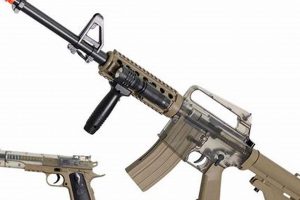
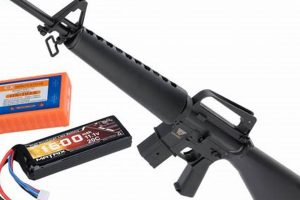
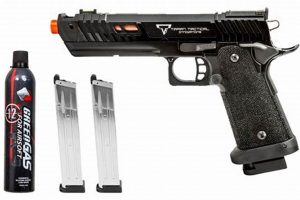
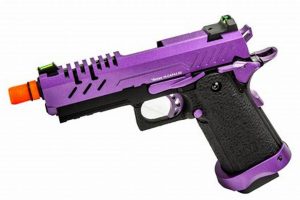
The external appearance of these recreational devices frequently mimics that of real firearms. Constructing materials can range from polymers and plastics to metals like aluminum alloy, depending on the manufacturer and price point. Features such as sights, rails, and magazines are typically present, further contributing to the resemblance to actual weaponry. The size and weight also often mirror their real-steel counterparts, enhancing the sense of realism for users.
This visual similarity is central to the appeal of airsoft, providing an immersive experience for players engaging in simulated combat scenarios. The realistic look allows for training exercises, film productions, and recreational activities that demand a high degree of verisimilitude. Historically, the initial development of these devices in regions with strict firearm laws allowed enthusiasts to engage in shooting sports without the restrictions associated with owning actual firearms. This aspect continues to be a significant factor in their global popularity.
Understanding the external characteristics of airsoft devices is foundational to appreciating their function and appropriate use. The following sections will delve into specific components, variations in design, and the safety considerations associated with these replicas.
Guidance Regarding Airsoft Device Identification
Effective understanding of the visual characteristics is crucial for responsible handling and differentiation from actual firearms. The following guidance aims to provide clarity regarding the appearance of these devices.
Tip 1: Material Composition: The external body is frequently constructed from durable polymers or plastics. While some models incorporate metal components, a predominant use of non-metallic materials often signifies an airsoft device.
Tip 2: Presence of an Orange Tip: Regulations in many jurisdictions mandate the inclusion of a blaze orange tip at the barrel’s end. This serves as a clear visual indicator to distinguish the device from a real firearm.
Tip 3: Absence of Manufacturer Markings: Actual firearms possess specific manufacturer markings, serial numbers, and proof marks. The absence or alteration of these markings can suggest a replica or airsoft counterpart.
Tip 4: Mode of Operation: While external features can be deceptive, the method of propulsion differs significantly. Airsoft devices typically utilize compressed gas (CO2 or green gas), electric motors, or spring mechanisms to propel projectiles.
Tip 5: Projectile Type: These devices discharge small, spherical plastic projectiles, commonly known as BBs. Real firearms utilize metallic ammunition with significantly different ballistic properties.
Tip 6: Internal Components: Disassembly will reveal the internal mechanisms, including the hop-up unit (for backspin), gas reservoirs (if applicable), and the absence of a firing pin mechanism characteristic of real firearms.
Tip 7: Quality and Finish: Lower-quality construction, particularly noticeable in the seams, plastic moldings, and overall finish, can indicate a replica rather than a genuine firearm.
Understanding the nuances of construction materials, mandated safety features, and internal operating mechanisms allows for a more informed assessment. Such assessment supports appropriate safety measures and responsible use.
With a firm grasp of these visual and functional differences, further discussion will address the legal ramifications and ethical considerations associated with airsoft devices.
1. Realistic Replicas
The verisimilitude achieved in modern airsoft devices directly shapes the answer to the question of “what does an airsoft gun look like.” The deliberate design choices aim to mimic real firearms, demanding a careful consideration of the visual characteristics to ensure proper identification and responsible handling.
- External Dimensions and Proportions
The dimensions and proportions of airsoft devices are frequently scaled to match their real-steel counterparts. This includes the length, height, and width of the device, along with the relative size and placement of components such as the barrel, receiver, and magazine. This close adherence to real firearm dimensions contributes significantly to the realistic look and feel. Examples include M4 carbine replicas and Glock pistol replicas, where the airsoft versions are nearly identical in size to the genuine articles. The dimensional accuracy is important in the training context and when used in movie production.
- Material Imitation and Surface Finish
While the internal mechanisms may differ, airsoft manufacturers often employ materials and finishes that simulate those found on real firearms. Polymers are used extensively to mimic the feel of polymer-framed pistols. Metal alloys, often aluminum, are used to replicate the weight and texture of metal-framed firearms. Surface treatments, such as anodizing or parkerizing, are sometimes applied to further enhance the realism. These material choices contribute to the overall visual impression, making it harder to distinguish an airsoft device from a real firearm at a glance. The material imitation is often a key marketing point.
- Cosmetic Details and Markings
To enhance realism, many airsoft devices incorporate cosmetic details and markings that mirror those found on actual firearms. This can include molded-in features such as mock ejection ports, bolt catches, and forward assists. Some manufacturers go further by licensing trademarks from real firearms manufacturers, allowing them to accurately reproduce logos, model numbers, and other identifying markings. However, removing or altering such trademarks is a legal violation. These cosmetic details, while non-functional, contribute significantly to the realistic appearance.
- Accessory Compatibility and Mounting Systems
The incorporation of standardized accessory mounting systems, such as Picatinny rails, further enhances the realistic appearance and functionality of airsoft devices. These rails allow users to attach a variety of accessories, such as scopes, red dot sights, flashlights, and foregrips, mirroring the customization options available for real firearms. The compatibility with these accessories blurs the line between real and replica, potentially contributing to misidentification.
In summary, the concerted effort to replicate the visual characteristics of real firearms defines the aesthetic. The accurate dimensions, material imitation, cosmetic details, and accessory compatibility combine to create replicas that require careful scrutiny to distinguish from the real article. The more convincingly it looks, the more important it is to exercise responsible behavior.
2. Orange Tip Indicator

The blaze orange tip affixed to the barrel of many airsoft devices serves as a primary visual cue to differentiate them from actual firearms. This indicator, often mandated by law, directly impacts the appearance, providing an immediate means of identification.
- Legal Mandates and Compliance
Jurisdictions frequently require airsoft devices to possess an orange tip, varying in size or placement based on local regulations. This requirement aims to reduce the risk of misidentification and subsequent law enforcement response. Failure to comply with these regulations can result in legal penalties for owners and retailers. For instance, the United States federal law mandates a minimum 6mm bright orange tip, though state and local laws can impose additional restrictions.
- Visibility and Public Perception
The high-visibility orange tip is designed to be readily noticeable, allowing law enforcement and the general public to quickly assess the device’s nature. This aspect is crucial in preventing accidental escalations or misunderstandings, particularly in public spaces. However, dependence on this single visual indicator carries inherent risks, as the tip can be easily removed or obscured. The presence of the indicator should prompt further scrutiny rather than serving as conclusive evidence of the device’s non-lethality.
- Variations in Application and Effectiveness
While the orange tip is the most common form of visual indicator, variations exist in its application. Some manufacturers incorporate a fully orange barrel or other brightly colored components. The effectiveness of the indicator depends on factors such as lighting conditions, distance, and the angle of observation. In low-light environments or at a distance, the orange tip may become less discernible, increasing the risk of misidentification. Devices with partially concealed tips offer limited benefit.
- Limitations and Potential for Misuse
The orange tip, while intended as a safety measure, is not foolproof. Individuals may intentionally remove or paint over the orange tip to create a more realistic appearance or to circumvent legal restrictions. This intentional alteration undermines the effectiveness of the indicator and increases the potential for misuse or criminal activity. The presence of an orange tip does not guarantee that the device is harmless or that the individual possessing it has lawful intentions.
The orange tip plays a significant role in shaping the appearance, providing a readily identifiable visual cue. However, reliance solely on this indicator is insufficient for accurate identification or safety assurance. Responsible use requires a comprehensive understanding of the visual characteristics, legal requirements, and potential limitations associated with airsoft devices.
3. Polymer Construction

The incorporation of polymer materials is a prominent feature shaping the external appearance of many airsoft devices. This construction choice influences factors ranging from weight and durability to manufacturing cost and aesthetic resemblance to real firearms.
- Material Composition and Weight
Polymer materials, typically high-density plastics, offer a lighter weight alternative to metal construction. This lighter weight enhances maneuverability during gameplay. The use of polymers, however, can affect the perceived realism, as the weight and heft of real firearms are often absent. Certain airsoft devices utilize reinforced polymers or metal-reinforced polymer blends to improve durability while maintaining a manageable weight. An example includes the use of ABS plastic for outer bodies and nylon-reinforced polymer for critical internal components.
- Manufacturing Processes and Cost
Polymer construction facilitates efficient and cost-effective manufacturing processes. Injection molding allows for the creation of complex shapes and intricate details with relative ease. The lower cost of polymer materials compared to metals contributes to a more affordable product. This affordability allows for wider accessibility within the airsoft community. However, the lower cost can also result in reduced quality or durability in some models, particularly those at the lower end of the price spectrum.
- Durability and Impact Resistance
The durability of polymer-constructed airsoft devices varies depending on the type of polymer used and the manufacturing quality. High-quality polymers exhibit considerable impact resistance, allowing them to withstand the rigors of airsoft gameplay. Lower-quality polymers can be more susceptible to cracking, breaking, or warping under stress. The selection of appropriate polymers is crucial for maintaining the longevity of the device. Drop tests and stress analyses inform this material selection. Glass-reinforced polymers, for instance, improve tensile strength and impact resistance.
- Aesthetic Realism and Imitation
The use of polymers allows manufacturers to replicate the appearance of real firearms with reasonable accuracy. Polymers can be molded to mimic the textures and contours of metal components. Certain polymers also accept surface treatments, such as paint or coatings, to further enhance the realistic appearance. The effectiveness of this imitation depends on the quality of the materials and the level of detail incorporated into the design. While polymers can approximate the look of metal, the feel and sound often differ, potentially impacting the overall sense of realism. High-end airsoft replicas employ polymers designed to replicate the visual and tactile properties of specific firearm materials.
The prevalence of polymer construction significantly influences the answer to “what does an airsoft gun look like?”. This construction affects the device’s weight, cost, durability, and aesthetic realism. An understanding of the properties and limitations of polymer materials is essential for evaluating the visual characteristics and overall quality of airsoft devices.
4. Accessory Rails

The integration of accessory rails significantly alters the external appearance of many airsoft devices. These standardized mounting platforms, commonly Picatinny or Weaver rails, enable the attachment of various tactical accessories, directly influencing the overall silhouette and perceived function. The presence of accessory rails implies modularity and adaptability, traits often associated with modern firearms. This feature enhances realism and expands the possibilities for customization, thus making the device visually akin to real-world military or law enforcement weaponry. An airsoft replica of an M4 carbine equipped with a quad rail system, for example, provides ample mounting space for sights, grips, and lights, closely mimicking the operational configuration of a genuine M4. The practical significance lies in the fact that these rails contribute to the functional aesthetics, further blurring the line between toy and tool.
Beyond aesthetic considerations, accessory rails impact practical application by allowing users to configure their airsoft devices for specific roles within a simulated combat scenario. A sniper rifle replica outfitted with a high-powered scope and bipod, mounted via accessory rails, presents a markedly different visual impression compared to the same replica in its base configuration. Similarly, an airsoft pistol equipped with a weapon-mounted light, also attached via accessory rails, conveys a readiness for close-quarters engagements. The ability to rapidly reconfigure the device based on the mission parameters enhances the user’s tactical flexibility, aligning the device visually and functionally with the equipment employed by real-world operators. This functionality translates to a heightened sense of immersion for the user. The accessory compatibility also allows for cross-compatibility with some real-world accessories (lasers are a good example), even though they might not be used to their fullest extent due to the non-lethal nature of airsoft.
In summary, accessory rails are a defining feature shaping the appearance, bridging the gap between replica and functional tool. The adaptability and customization options provided by these rails contribute significantly to the overall realism. However, this visual similarity also presents challenges. The enhanced realism necessitates increased diligence in distinguishing these devices from actual firearms, requiring adherence to safety protocols and responsible handling. The connection between accessory rails and “what does an airsoft gun look like” underscores the importance of understanding the aesthetic and functional aspects of these recreational devices.
5. Magazine Style
The magazine style contributes significantly to the overall appearance, directly informing the question of what an airsoft device resembles. Real firearms utilize magazines to feed ammunition into the firing chamber; correspondingly, airsoft replicas incorporate magazines to house and feed the plastic BBs. The visual similarity between airsoft and real firearm magazines is a critical factor in achieving a realistic aesthetic. High-capacity magazines, box magazines, and drum magazines, common in various firearm platforms, are replicated in airsoft form, mirroring the size, shape, and placement of their real-steel counterparts. For example, an airsoft replica of an AK-47 will typically feature a curved magazine, mimicking the distinctive appearance of the 7.62x39mm AK-47 magazine, while an AR-15 replica will typically employ a STANAG-style magazine. The presence and accurate representation of these magazines significantly enhance the realistic visual profile.
Beyond mere replication, the magazine style also influences the functionality and user experience associated with airsoft devices. Magazine capacity, loading mechanisms, and magazine release systems are frequently designed to emulate their real firearm equivalents, adding another layer of realism. Airsoft enthusiasts often seek magazines that are not only visually accurate but also functionally similar, allowing them to practice tactical magazine changes and reloading procedures. Certain high-end airsoft replicas feature magazines with realistic weight and dimensions, further enhancing the training value. The magazine style also dictates the compatibility with various pouch and carrier systems, again mirroring real-world tactical gear. The choice of magazine style and pouch accordingly affects the users overall kit layout, contributing to a more authentic impression during simulated combat scenarios.
In conclusion, magazine style is an essential element shaping the external appearance of airsoft devices. The realistic replication of magazine types, combined with functional similarities, contributes significantly to the overall realism, influencing user experience and tactical applications. While the external appearance may be highly accurate, it’s important to remember that airsoft magazines are fundamentally different in their internal mechanisms and purpose. The aesthetic and functional aspects of magazine style enhance the immersive experience, emphasizing the need for responsible use and careful differentiation from real firearms. The magazine style helps to define “what does an airsoft gun look like” at a glance.
6. Simulated Sights
The inclusion of simulated sights is a significant element in shaping the overall aesthetic of airsoft devices. These aiming devices, replicating their real firearm counterparts, contribute heavily to the realistic appearance and enhance the user’s simulated shooting experience.
- Iron Sights and Their Replicas
Many airsoft devices feature replicated iron sights, consisting of a front post and a rear aperture or notch. These sights, often adjustable for windage and elevation, provide a basic aiming method, mirroring the function and appearance of iron sights on real firearms. Their presence contributes to the device’s authenticity, particularly in historical or military-themed airsoft scenarios. The quality of these replicas varies; higher-end models closely mimic the materials and finish of real iron sights, further enhancing the illusion.
- Optical Sights and Red Dot Sights
Optical sights, such as magnified scopes, and red dot sights are frequently mounted on airsoft devices via accessory rails. These simulated sights offer enhanced aiming precision and target acquisition, mirroring the capabilities of their real firearm equivalents. Red dot sights, with their illuminated aiming points, are popular for close-quarters combat scenarios, while magnified scopes are preferred for longer-range engagements. The availability of realistic replicas of popular optical sights adds to the authenticity and tactical feel of the device.
- Laser Sights and Their Cosmetic Use
While functional laser sights are available for airsoft devices, many replicas feature simulated laser sights for cosmetic purposes. These devices, often lacking a functional laser beam, contribute to the tactical appearance of the device. The inclusion of simulated laser sights is a common modification, enhancing the visual realism without adding practical aiming assistance. However, it is important to distinguish between cosmetic laser sights and functional laser aiming devices, particularly regarding safety and legal considerations.
- Night Vision and Thermal Sight Replicas
Replicas of night vision and thermal sights, while not fully functional in most cases, are sometimes added to airsoft devices for visual enhancement. These accessories, often bulky and visually distinctive, create a more imposing and tactical appearance. While the simulated night vision or thermal capabilities are typically limited to aesthetic features, their presence contributes to the overall impression of advanced military or law enforcement equipment. The use of these replicas is prevalent in scenarios that simulate nighttime or low-light operations, further contributing to the immersive experience.
The inclusion of simulated sights is a pivotal element in answering the question “what does an airsoft gun look like.” These sights, whether iron sights, optical sights, or cosmetic laser sights, contribute significantly to the realism and tactical aesthetic. The choice and quality of simulated sights impact the overall impression, blurring the line between replica and functional tool. The heightened realism demands heightened responsibility and careful differentiation from real firearms, underscoring the importance of safety and awareness in the airsoft community.
Frequently Asked Questions
This section addresses common inquiries regarding the visual characteristics of airsoft devices, providing clear and concise answers to promote accurate understanding and responsible handling.
Question 1: Are airsoft devices designed to resemble real firearms?
Airsoft devices are often manufactured to closely mimic the appearance of real firearms. This replication extends to size, shape, and the presence of features such as sights, magazines, and accessory rails. This design choice enhances realism for training and recreational purposes but also necessitates caution in differentiating these devices from actual firearms.
Question 2: What is the purpose of the orange tip on some airsoft devices?
The blaze orange tip, often mandated by law, serves as a visual indicator to distinguish airsoft devices from real firearms. The presence of this tip aids in preventing misidentification by law enforcement and the general public. However, the orange tip can be removed or obscured, so it should not be the sole determinant of whether a device is an airsoft replica.
Question 3: Are all airsoft devices made of plastic?
While many airsoft devices incorporate plastic or polymer components, particularly in the external body, some models feature metal parts. Higher-end replicas may utilize metal alloys to replicate the weight and feel of real firearms. The material composition varies depending on the manufacturer, model, and price point.
Question 4: Can airsoft devices be easily modified to look more realistic?
Airsoft devices can be modified with aftermarket parts and accessories to enhance their realism. This may involve replacing plastic components with metal parts, adding realistic markings, or altering the external finish. Removing or altering mandated safety features, such as the orange tip, is illegal in many jurisdictions.
Question 5: How can one reliably distinguish an airsoft device from a real firearm?
Reliable differentiation requires a comprehensive assessment. Consider the presence of an orange tip, the material composition, the absence of manufacturer markings or serial numbers, the mode of operation (compressed gas, electric, or spring-powered), and the type of projectile used (plastic BBs). If in doubt, treat the device as a real firearm and contact law enforcement.
Question 6: Is it legal to openly carry an airsoft device in public?
Laws regarding the open carry of airsoft devices vary significantly by jurisdiction. In many areas, openly carrying an airsoft device in public is illegal or requires specific permits. Displaying an airsoft device in a manner that could cause alarm or be perceived as a threat can result in legal consequences. Consult local laws and regulations before transporting or using airsoft devices in public spaces.
Accurate identification based on visual characteristics is critical for promoting safety and responsible handling. Awareness of these distinguishing features can help prevent misidentification and ensure compliance with applicable laws.
Subsequent sections will examine the legal and ethical considerations surrounding the ownership and use of airsoft devices.
Visual Assessment and Airsoft Device Identification
This exploration has detailed the numerous elements contributing to the appearance, addressing the core question of “what does an airsoft gun look like.” The analysis spanned from mandated safety features like the orange tip to the realistic replication of firearms through polymer construction, accessory rails, magazine styles, and simulated sights. The pervasive effort to mimic real firearms necessitates a careful, multifaceted approach to identification, moving beyond reliance on any single visual cue.
Given the demonstrated potential for misidentification and the associated safety and legal ramifications, responsible handling is paramount. Consistent diligence in recognizing the nuances of airsoft devices promotes both individual and community safety. Continued awareness and education remain essential as technological advancements further refine the visual fidelity of these replicas. Vigilance will ensure a safer and more responsible approach to this increasingly realistic simulation.