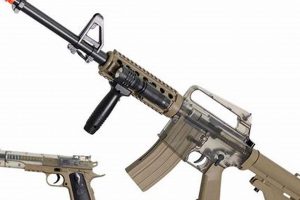
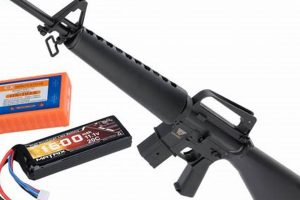
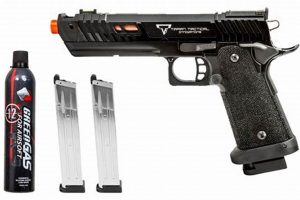
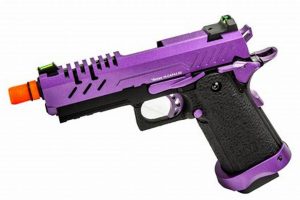
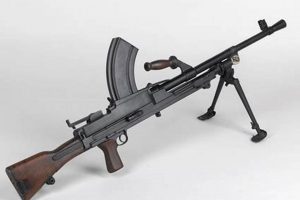
These are replica firearms designed to closely resemble those utilized by the United States Army. They are typically used in recreational simulations or training exercises, firing small plastic projectiles. Such equipment replicates the look and feel of standard-issue weaponry, providing a sense of realism.
The utilization of realistic-looking simulated firearms offers a range of advantages. This equipment allows for safe and controlled environments for training purposes. Participants can engage in tactical scenarios and team-building activities without the inherent dangers associated with live ammunition. Historically, the development of these items has been driven by both military training needs and the popularity of recreational skirmishes.
The article will now examine specific aspects of these replicated weapon systems, encompassing variations in models, common uses, safety considerations, and associated equipment. These factors contribute to a comprehensive understanding of this category of recreational and training equipment.
Tactical Deployment and Maintenance Strategies
This section provides essential advice for optimizing the use and lifespan of realistic simulated weapon systems. Adhering to these guidelines will maximize performance and minimize potential issues.
Tip 1: Ammunition Selection: Utilize only high-quality, seamless plastic projectiles of the correct caliber specified for the replica. Inconsistent or low-grade ammunition can cause internal damage and reduce accuracy.
Tip 2: Battery Management: For electrically powered models, employ smart chargers to prevent overcharging, which diminishes battery lifespan. Store batteries in a cool, dry place when not in use.
Tip 3: Regular Cleaning: Disassemble and clean the internal components after each extended use. Remove accumulated debris and lubrication buildup to maintain consistent operation.
Tip 4: Proper Storage: When not in service, store the replica in a padded case or container to protect it from physical damage and environmental factors such as humidity.
Tip 5: Hop-Up Adjustment: Fine-tune the hop-up system according to the weight of the ammunition being used. This adjustment optimizes the projectile’s trajectory and range.
Tip 6: Seal Maintenance: Inspect and lubricate air seals periodically to prevent air leaks, which can significantly reduce power and consistency. Silicone-based lubricants are generally recommended.
Tip 7: Gearbox Shiming (for advanced users): Correct shiming within the gearbox of electric models ensures smooth gear meshing, reducing wear and increasing efficiency. Professional assistance is advised for this procedure.
These strategic guidelines can greatly improve the reliability and performance of these weapon replicas, whether in a recreational or training context. Following these procedures will prolong the lifespan of the equipment.
The subsequent section will address safety protocols and legal considerations related to the use of simulated firearms.
1. Replica Realism

Replica realism constitutes a fundamental element in the design and utilization of simulated weaponry patterned after United States Army firearms. The degree to which these items replicate the appearance, handling, and operation of real firearms directly influences their effectiveness in training and recreational scenarios.
- External Appearance and Dimensions
The replication of external features, including dimensions, weight distribution, and material finishes, is paramount. Accurately reproduced dimensions allow for compatibility with standard tactical equipment, such as slings, rail systems, and optics. The visual similarity to actual firearms minimizes the cognitive dissonance for users familiar with real weapon systems, aiding in training transfer.
- Functional Similarity
The faithful reproduction of operating mechanisms, such as magazine changes, bolt cycling, and trigger pull, contributes significantly to the realistic simulation. Functionality that closely mirrors real firearms reinforces proper handling techniques, muscle memory, and procedural drills. Discrepancies in operation can detract from the training value and reduce the immersive experience.
- Material Composition and Durability
The materials used in construction impact both the realism and the durability of the replica. High-quality materials, such as reinforced polymers and metal alloys, contribute to a more authentic feel and enhance the lifespan of the equipment. Durability is crucial for withstanding the rigors of repeated use in training environments or recreational skirmishes.
- Markings and Nomenclature
The inclusion of accurate markings, such as manufacturer’s logos, serial numbers, and model designations, enhances the visual fidelity of the replica. These details contribute to a more authentic experience and can be important for users who appreciate historical accuracy or collectability.
These facets collectively determine the level of realism offered by simulated weaponry styled after those employed by the United States Army. Replicas that excel in these areas provide a more immersive and effective training or recreational experience, bridging the gap between simulation and reality.
2. Training Applications
The utilization of realistic simulated firearms significantly enhances training effectiveness across various domains. The primary causal relationship is the ability to safely replicate real-world scenarios. This allows personnel to practice tactics and decision-making under pressure without the risks associated with live ammunition. A critical component of this is the development of muscle memory and procedural proficiency in handling a weapon system resembling standard-issue firearms. For example, military units and law enforcement agencies employ these tools to rehearse room clearing, close-quarters combat, and other tactical procedures. Such drills improve response times and reduce the potential for errors in actual operational environments.
Moreover, the reduced cost and environmental impact compared to live-fire exercises make simulated firearm training an economically and ecologically sustainable option. Training scenarios can be easily modified and repeated, allowing for iterative improvement and the evaluation of different tactical approaches. Many private security firms utilize simulated weapon systems for training their personnel in firearm safety and conflict resolution techniques. These systems also provide a platform for leadership development, team cohesion, and communication skills training in realistic, but controlled, settings. Customization and modularity of these training systems can be adapted to cater to the specific needs of the organizations by varying the environments and the objectives of these simulated training scenarios.
In summary, simulated weapon systems provide a crucial tool for safe, cost-effective, and adaptable training. The development of practical skills, enhanced decision-making capabilities, and the promotion of teamwork are the key advantages. The challenge lies in maintaining a high level of realism and adapting training protocols to reflect evolving operational realities. It is critical that users always follow safety rules when using simulated firearms to avoid possible injuries.
3. Safety Protocols

Rigorous safety protocols are paramount in the utilization of replica firearms modeled after those used by the United States Army. The realistic appearance of these items necessitates adherence to stringent guidelines to prevent accidents and misuse. These protocols encompass equipment handling, usage environment, and protective gear requirements.
- Eye Protection Mandate
The wearing of ANSI-rated eye protection is a non-negotiable requirement. Projectiles, though relatively low in energy, can cause serious ocular injury. Full-seal goggles are recommended to prevent projectile entry from any angle. The absence of appropriate eye protection constitutes a critical safety breach.
- Muzzle Velocity Limits
Adherence to established muzzle velocity limits is crucial to minimize impact force. These limits, typically measured in feet per second (FPS) with a specified projectile weight, vary depending on the designated playing area. Chronograph testing of each device is necessary to ensure compliance. Exceeding these limits poses an unacceptable risk of injury.
- Designated Safe Zones
The establishment of clearly defined safe zones, where protective gear can be removed and replicas are disabled, is essential. Within these zones, replicas must have their magazines removed, be unloaded, and have a safety device engaged. These zones provide areas free from the risk of accidental discharge or engagement.
- Responsible Handling and Storage
Replicas must be handled with the same level of care and respect as real firearms. Pointing a replica at an individual who is not participating in the activity is strictly prohibited. Safe storage practices, including securing replicas in locked containers when not in use, are necessary to prevent unauthorized access or accidental discharge.
The consistent enforcement and strict adherence to these safety protocols are indispensable for the safe and responsible use of simulated weaponry styled after those employed by the United States Army. Failure to comply with these guidelines can result in serious injury or legal ramifications.
4. Legal compliance
Legal compliance constitutes a critical dimension in the ownership, use, and transportation of replica firearms styled after those used by the United States Army. The legal landscape governing these items varies significantly across jurisdictions, encompassing federal, state, and local regulations. Non-compliance can result in penalties ranging from fines and confiscation of equipment to criminal charges, depending on the severity of the infraction and the governing jurisdiction. Understanding these regulations is not merely advisable but a legal necessity. The causal relationship between knowledge of applicable laws and responsible use reduces the potential for legal challenges and enhances public safety.
Many jurisdictions require replica firearms to be visibly marked with orange tips or brightly colored markings to distinguish them from real firearms. Failure to comply with these marking requirements can lead to immediate confiscation and potential criminal charges. Further, some municipalities have outright bans on possessing or discharging these replicas within city limits. Transporting such replicas across state lines may trigger additional federal regulations, particularly if the replica closely resembles a real firearm and lacks the required markings. For example, New York City has stringent regulations concerning the possession and transportation of simulated firearms, while other states maintain a more lenient approach. The practical significance of comprehending these differing standards lies in preventing inadvertent violations and ensuring the safe and lawful use of the equipment.
In summary, legal compliance is an indispensable component of the responsible utilization of United States Army-styled replica firearms. Varied jurisdictions and a spectrum of legal repercussions emphasize the need for meticulous compliance with federal, state, and local laws. Individuals contemplating the acquisition or use of these replicas must familiarize themselves with the pertinent legal framework to avoid potential liability and to promote safe and responsible usage. A proactive approach, including consulting local law enforcement and reviewing relevant statutes, is highly advisable.
5. Maintenance requirements

The functionality and longevity of simulated weaponry patterned after those utilized by the United States Army are intrinsically linked to consistent and thorough maintenance protocols. The effective replication of real-world weapon handling and operational characteristics relies on the consistent performance of these systems. Neglecting maintenance leads to a degradation of performance, increased risk of malfunction, and a reduced lifespan. The causal relationship between maintenance and performance is direct and demonstrable. A well-maintained replica retains its accuracy, firing consistency, and overall operational integrity.
Consider, for instance, the impact of lubrication on gearbox performance in electrically powered models. Without regular lubrication, the gears experience increased friction, leading to reduced motor efficiency, increased heat generation, and eventual component failure. Similarly, neglecting the cleaning of the barrel can result in the accumulation of debris, impacting projectile trajectory and accuracy. The seals within the air compression system require periodic inspection and maintenance to prevent air leaks, which diminish power output. These examples underscore the practical significance of adherence to a comprehensive maintenance schedule. Routine tasks, such as cleaning, lubrication, and component inspection, are not merely optional but essential for sustaining the optimal performance and durability of the replica.
In summary, maintenance protocols constitute a fundamental component of ensuring the long-term reliability and operational readiness of United States Army-styled replica firearms. The practical significance lies in preserving the fidelity of the simulation, minimizing the risk of malfunction, and extending the lifespan of the equipment. Overlooking maintenance inevitably compromises performance and accelerates the degradation of these systems, undermining their value as training tools or recreational equipment. Therefore, diligent adherence to recommended maintenance procedures is paramount for maximizing the investment in, and realizing the full potential of, these simulated weapon systems.
Frequently Asked Questions
This section addresses common inquiries regarding the ownership, use, and maintenance of realistic simulated weapon systems. The answers provided are intended to offer clarity and promote responsible practices.
Question 1: What distinguishes these replica firearms from real firearms?
Replica firearms expel non-lethal projectiles, such as plastic BBs, and operate at significantly lower energy levels than real firearms. They are designed for recreational or training purposes and lack the capacity to fire live ammunition. Distinctive markings, often an orange tip, further differentiate them.
Question 2: Are there age restrictions on owning or using these replica firearms?
Age restrictions vary by jurisdiction. Many localities prohibit the sale or possession of these items to individuals under a certain age, typically 16 or 18. Adherence to local laws is essential. Parental or guardian supervision is recommended for younger users.
Question 3: What safety precautions are necessary when handling these replica firearms?
Mandatory eye protection is crucial to prevent ocular injuries. Muzzle velocity limits must be observed to minimize impact force. Responsible handling practices, including avoiding pointing the replica at non-participants, are also vital.
Question 4: Can these replica firearms be legally carried in public?
Laws pertaining to the public carry of these replicas vary widely. Some jurisdictions prohibit open carry, while others require them to be concealed and unloaded. It is imperative to consult local laws prior to transporting or carrying these items in public.
Question 5: How often should these replica firearms be maintained?
Maintenance frequency depends on usage. Regular cleaning, lubrication, and inspection of internal components are recommended after each extended use. More thorough maintenance, including gearbox servicing (for electric models), may be required periodically, depending on the intensity of use.
Question 6: What is the appropriate method for storing these replica firearms when not in use?
Safe storage practices are essential to prevent unauthorized access and accidental discharge. Replicas should be stored in locked cases or containers, away from children and individuals unfamiliar with safe handling procedures.
These FAQs offer a foundational understanding of critical aspects relating to these replicas. Continued adherence to safety and legal guidelines is key.
The next section will focus on purchasing considerations and reliable sources.
Concluding Remarks
This exploration has delineated the multifaceted nature of replica firearms modeled after United States Army weapons. Aspects ranging from replica realism and training applications to safety protocols, legal compliance, and maintenance requirements have been analyzed. Each element contributes to a comprehensive understanding of the equipment’s utility and responsible usage.
Continued adherence to established safety standards and legal frameworks remains paramount. As the technology evolves and the usage expands, maintaining a commitment to responsible practices will ensure the continued viability and positive impact of these simulation tools. The future efficacy of these devices depends on the user’s comprehension and execution of these essential guidelines.