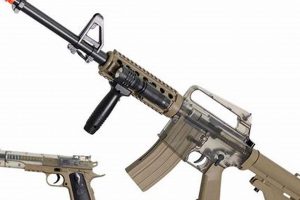
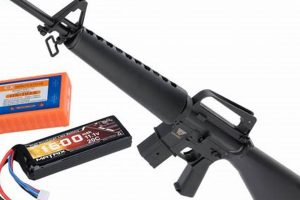
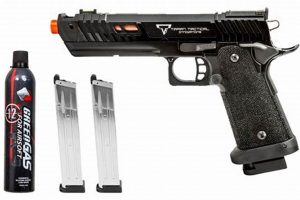
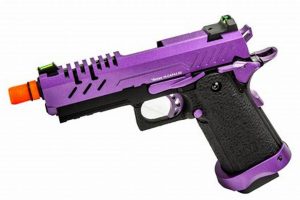
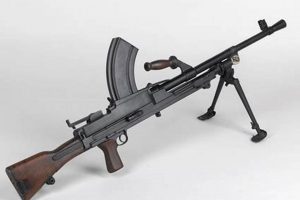
The optimal projectile weapon in the airsoft sport represents a convergence of performance, durability, and user preference. These highly sought-after models provide a competitive edge in simulated combat scenarios through accuracy, range, and reliability. An example includes a gas blowback rifle known for its realistic recoil and consistent firing rate.
Acquiring a superior airsoft rifle or pistol can significantly enhance a player’s effectiveness and enjoyment of the game. These top-tier offerings often incorporate advanced features such as adjustable hop-up systems for trajectory control and robust internal components designed to withstand the rigors of frequent use. Historically, the evolution of these devices has mirrored advancements in real firearms technology, albeit adapted for the constraints of the airsoft playing field.
The subsequent sections will delve into specific categories and features of high-performing airsoft weaponry, providing guidance on selecting the most suitable options based on individual playing styles and operational requirements. Factors such as power source, material construction, and upgrade potential will be carefully examined.
Optimizing Performance with Airsoft Projectile Weapons
The following guidelines offer insights into selecting and maintaining high-performance airsoft projectile weapons. Adherence to these recommendations can improve accuracy, extend lifespan, and enhance overall gameplay experience.
Tip 1: Prioritize Internal Component Quality: Examine the materials used in the gearbox and hop-up unit. Metal components, such as steel gears and aluminum hop-up chambers, often offer greater durability and consistent performance compared to plastic alternatives. High-quality internals contribute to reliability under prolonged use.
Tip 2: Invest in a Precision Inner Barrel: The inner barrel is a crucial factor in accuracy. Opt for tight-bore barrels, typically ranging from 6.01mm to 6.03mm, constructed from stainless steel or brass. A consistent inner diameter minimizes air leakage and promotes stable projectile flight.
Tip 3: Select Appropriate Projectile Weight: Projectile weight significantly affects range and accuracy. Heavier projectiles (0.25g or higher) generally perform better in outdoor environments where wind resistance is a factor. Lighter projectiles (0.20g) may be suitable for indoor CQB scenarios.
Tip 4: Maintain Consistent Hop-Up Adjustment: Properly adjusting the hop-up unit is essential for maximizing range and accuracy. The hop-up should impart backspin on the projectile, counteracting gravity. Adjust incrementally until the projectile flies straight and level without significant upward or downward deviation.
Tip 5: Regularly Clean and Lubricate: Consistent maintenance extends the lifespan and ensures consistent performance. Clean the inner barrel regularly using a cleaning rod and silicone oil. Lubricate the gearbox and other moving parts according to the manufacturer’s recommendations.
Tip 6: Consider Power Source and Consistency: Electrically powered (AEG) models offer consistent performance, while gas-powered (GBB) models provide realistic recoil and operation. Select a power source that aligns with playing style and environmental conditions, keeping in mind that gas performance can be affected by temperature.
Tip 7: Upgrade Strategically: Upgrades can improve performance, but selective modifications are more effective than indiscriminate parts replacement. Focus on upgrading components that directly address specific performance shortcomings, such as improving accuracy or increasing rate of fire.
These recommendations highlight the importance of careful selection, consistent maintenance, and strategic upgrades to optimize the performance of airsoft projectile weapons. By adhering to these guidelines, players can achieve improved accuracy, reliability, and overall effectiveness on the field.
The following sections will address specific model types and their suitability for various playing styles, further enhancing the ability to make informed purchasing decisions.
1. Accuracy and Range

Accuracy and range are critical determinants of an airsoft gun’s effectiveness, directly influencing its status as a top-tier option. Accuracy, defined as the consistency of projectile placement on a target at a given distance, enables precise targeting and engagement. Range, the maximum effective distance at which a target can be reliably hit, provides a tactical advantage in various gameplay scenarios. An airsoft gun considered among the best must exhibit both consistent accuracy and sufficient range to be competitive. The cause-and-effect relationship is clear: superior accuracy and range directly contribute to a player’s ability to eliminate opponents, control territory, and achieve mission objectives.
The internal components significantly impact accuracy and range. A tight-bore inner barrel, for instance, reduces air leakage around the projectile, resulting in increased velocity and more consistent trajectory. A well-tuned hop-up unit imparts backspin on the projectile, extending its range by counteracting gravity. Real-life examples include high-end airsoft sniper rifles utilizing precision barrels and advanced hop-up systems to achieve engagement ranges exceeding 200 feet with acceptable accuracy. The practical significance of this understanding lies in the ability to select airsoft guns with components and features optimized for specific playing styles and field environments. For example, CQB environments may prioritize accuracy at closer ranges, while outdoor fields demand both accuracy and extended range.
In conclusion, accuracy and range are inseparable attributes of a high-performing airsoft gun. While technological advancements and design innovations continue to refine these performance metrics, the fundamental principles of projectile trajectory and mechanical efficiency remain paramount. The ongoing challenge is to balance these factors within the constraints of airsoft regulations and user preferences. Understanding the interplay between accuracy, range, and internal components is essential for selecting an airsoft gun that aligns with individual needs and maximizes effectiveness on the playing field.
2. Durability of Construction

The longevity and sustained performance of an airsoft gun are directly linked to the robustness of its construction. “Airsoft best guns” are distinguished not only by their initial performance metrics but also by their ability to withstand the rigors of repeated use in demanding conditions. The materials and manufacturing processes employed are critical factors in determining an airsoft gun’s overall durability.
- Material Selection for Key Components
The choice of materials for internal components, such as the gearbox shell, gears, and piston, significantly affects long-term reliability. High-grade steel alloys and reinforced polymers provide superior resistance to wear and impact compared to lower-quality alternatives. For example, an airsoft gun with a steel gearbox shell is less prone to cracking under stress than one with a zinc alloy shell. Consequently, selecting an airsoft gun with durable materials in critical areas ensures consistent performance over time.
- Quality of Assembly and Manufacturing
The precision and care taken during the assembly process contribute significantly to an airsoft gun’s structural integrity. Properly aligned components and secure fasteners minimize stress points and reduce the likelihood of premature failure. Airsoft guns manufactured with tight tolerances and rigorous quality control measures exhibit greater resilience to the vibrations and impacts inherent in gameplay. An instance of this would be a correctly shimmed gearbox in an AEG.
- Resistance to Environmental Factors
Exposure to moisture, temperature fluctuations, and physical impacts can degrade airsoft gun components. Durable airsoft guns are often constructed with corrosion-resistant materials and protective coatings to mitigate environmental damage. Furthermore, reinforced outer bodies can withstand rough handling and accidental drops. The ability to function reliably under diverse environmental conditions is a hallmark of a well-constructed airsoft gun.
- Design for Serviceability and Repair
The ease with which an airsoft gun can be disassembled, serviced, and repaired impacts its overall lifespan. Modular designs and readily available replacement parts facilitate maintenance and extend the usable life of the gun. An “airsoft best guns” is generally designed for user accessibility to critical components. Airsoft guns designed with user maintainability in mind offer long-term value and reduce the total cost of ownership.
The durability of construction is a fundamental attribute that distinguishes high-quality airsoft guns from less reliable alternatives. While initial performance may be comparable, guns constructed with robust materials, precise assembly, environmental resistance, and serviceability are more likely to withstand the demands of regular use and provide sustained performance over an extended period. This longevity and reliability are crucial considerations for any serious airsoft player seeking a worthwhile investment.
3. Power Source Reliability

Power source reliability is a critical attribute in determining the suitability of an airsoft gun for competitive play. The most effective airsoft guns maintain consistent power output and operational readiness throughout a game, irrespective of environmental conditions or usage frequency. Variations in power output directly impact projectile velocity and trajectory, reducing accuracy and effective range. Guns with unreliable power sources may experience malfunctions, rendering them unusable during critical moments. The cause-and-effect relationship between power source and performance is therefore a significant factor in evaluating the merits of any airsoft gun model.
The implications of power source reliability differ based on the type of system employed. Electrically powered airsoft guns (AEGs) rely on battery voltage and motor efficiency to generate consistent power. Fluctuations in battery voltage, motor overheating, or wiring issues can lead to reduced performance or complete failure. Gas-powered airsoft guns (GBBs and CO2-powered models) are susceptible to temperature-dependent pressure variations. Low temperatures reduce gas pressure, decreasing projectile velocity and potentially causing malfunctions. Real-world examples include AEG users experiencing diminished performance as battery voltage drops during a game, or GBB users facing inconsistent firing rates in cold weather. Therefore, selecting a power source and associated components that are known for consistent output and resistance to environmental factors is paramount.
In conclusion, power source reliability is a non-negotiable characteristic of a top-tier airsoft gun. Consistent power output translates to enhanced accuracy, range, and overall effectiveness on the field. Challenges associated with power source reliability are primarily addressed through the selection of high-quality components, proper maintenance, and adaptation to environmental conditions. The ongoing pursuit of more reliable and efficient power sources remains a central focus in airsoft gun development, aiming to enhance the gameplay experience by minimizing performance inconsistencies.
4. Upgrade Potential

Upgrade potential significantly contributes to the classification of an airsoft gun as a top-tier option. The ability to modify and enhance various components enables users to tailor performance characteristics to specific gameplay requirements or personal preferences. An airsoft gun deemed among the best is often designed with aftermarket upgrades in mind, featuring readily accessible parts and a modular architecture that facilitates customization. The cause-and-effect relationship is evident: ample upgrade potential provides the opportunity to improve accuracy, range, rate of fire, and overall durability, thereby elevating the gun’s performance beyond its stock configuration. This adaptability extends the usable lifespan of the equipment, as users can address wear and tear or pursue enhanced functionality without replacing the entire unit. Examples include replacing the inner barrel with a tighter-bore variant for increased accuracy, installing a high-torque motor for a faster trigger response, or reinforcing internal components to withstand higher stress loads. The practical significance of this understanding lies in the long-term value and versatility offered by upgradeable platforms.
A key aspect of upgrade potential is the availability and compatibility of aftermarket parts. A gun that utilizes proprietary or uncommon components limits upgrade options and may result in higher costs and longer lead times for replacement parts. Conversely, guns based on widely adopted standards, such as the Tokyo Marui-compatible gearbox, benefit from a vast ecosystem of aftermarket components, providing users with a broad range of options for customization. Furthermore, the complexity of the upgrade process influences its accessibility to users with varying levels of technical expertise. Guns designed for easy disassembly and modification encourage user-driven customization, while those requiring specialized tools or advanced technical knowledge may limit upgrades to experienced technicians. The practical application of this understanding involves evaluating the availability, compatibility, and ease of installation of upgrades before making a purchasing decision. This ensures that the chosen platform can be effectively tailored to meet individual needs and preferences.
In conclusion, upgrade potential is a crucial factor in determining the long-term value and performance of an airsoft gun. This capability enables users to adapt their equipment to evolving gameplay scenarios, extend its lifespan through component replacement, and enhance its overall performance beyond stock limitations. The ongoing development of new and innovative upgrade components further underscores the importance of selecting a platform with ample customization options. Understanding the interplay between upgrade potential, aftermarket availability, and user accessibility is essential for selecting an airsoft gun that provides both immediate performance and long-term versatility.
5. Ergonomic Design
Ergonomic design is a critical, yet sometimes overlooked, element in the assessment of superior airsoft guns. The interface between user and equipment significantly impacts performance, fatigue, and overall user satisfaction. Guns considered among the best are often characterized by a design that prioritizes user comfort, control, and efficiency.
- Grip Comfort and Texture
The design and texture of the grip directly influence weapon handling and stability. Ergonomic grips mold comfortably to the hand, reducing muscle strain and improving trigger control. Aggressive texturing or stippling enhances grip security, especially in wet or gloved conditions. An example would be a pistol grip featuring finger grooves and a non-slip surface, facilitating a firm hold even during rapid firing sequences. The implications include enhanced accuracy and reduced fatigue during prolonged engagements.
- Weight Distribution and Balance
Proper weight distribution is essential for maintaining stability and minimizing user fatigue. Well-balanced airsoft guns distribute weight evenly across the body, reducing the tendency for muzzle dip or wobble. Forward-heavy designs can lead to arm fatigue, while excessively rear-heavy designs can be unwieldy. A balanced rifle, for instance, allows for quicker target acquisition and smoother transitions between targets. The result is improved maneuverability and reduced strain during gameplay.
- Adjustability and Customization
Adjustable features allow users to tailor the airsoft gun to their individual body size and preferences. Adjustable stocks, cheek rests, and foregrips enable a customized fit, optimizing comfort and control. A rifle with an adjustable stock, for example, can accommodate users of varying arm lengths, ensuring proper eye relief and shooting posture. This adaptability promotes consistent performance and reduces the risk of injury.
- Control Placement and Accessibility
The strategic placement and accessibility of controls, such as the magazine release, selector switch, and bolt catch, significantly affect operational efficiency. Ergonomically positioned controls allow for quick and intuitive manipulation, minimizing downtime and maximizing responsiveness. An example is an ambidextrous selector switch that enables seamless operation for both right- and left-handed users. Accessible controls facilitate rapid magazine changes and weapon manipulations, enhancing tactical effectiveness.
In conclusion, ergonomic design is a key differentiator among high-performing airsoft guns. By prioritizing user comfort, control, and efficiency, ergonomic designs contribute to improved accuracy, reduced fatigue, and enhanced tactical effectiveness. The combination of grip comfort, weight distribution, adjustability, and control placement creates an optimal interface between user and equipment, maximizing performance on the field.
Frequently Asked Questions
The following addresses prevalent inquiries regarding the selection, maintenance, and optimal usage of high-performance airsoft projectile weapons. This aims to clarify common misconceptions and provide factual insights for informed decision-making.
Question 1: What criteria define a top-tier airsoft gun beyond projectile velocity?
While projectile velocity is a relevant metric, the overall performance of an airsoft gun is determined by a combination of factors, including accuracy, range, durability, power source reliability, upgrade potential, and ergonomic design. A high-velocity gun that lacks accuracy or suffers from frequent malfunctions is not considered a top-tier option.
Question 2: How frequently should an airsoft gun’s inner barrel be cleaned for optimal performance?
The inner barrel should be cleaned regularly, ideally after each use or at least after every two to three games. Accumulated dirt and debris can degrade accuracy and reduce projectile velocity. Use a cleaning rod and silicone oil to remove residue from the inner barrel.
Question 3: What is the optimal projectile weight for maximizing range in outdoor airsoft scenarios?
Heavier projectiles, typically ranging from 0.25g to 0.30g, are generally recommended for outdoor play. The increased mass provides greater resistance to wind and maintains trajectory stability over longer distances. Experimentation with various projectile weights is recommended to determine the ideal option for specific airsoft gun models and field conditions.
Question 4: How does gas type (e.g., green gas, propane, CO2) affect the performance and maintenance of gas blowback airsoft guns?
Different gas types offer varying pressure levels and lubrication properties. Green gas and propane are generally milder and provide adequate lubrication, while CO2 offers higher pressure but may require more frequent maintenance to prevent component wear. Consult the manufacturer’s recommendations for the appropriate gas type for the specific airsoft gun model.
Question 5: What are the key indicators that an airsoft gun’s gearbox requires maintenance or repair?
Common indicators of gearbox issues include unusual noises (e.g., grinding, squealing), decreased rate of fire, inconsistent projectile velocity, and failure to cycle properly. Addressing these issues promptly can prevent further damage and extend the lifespan of the gearbox.
Question 6: How does hop-up adjustment influence the trajectory and range of airsoft projectiles?
The hop-up unit imparts backspin on the projectile, creating lift that counteracts gravity and extends the projectile’s range. Proper hop-up adjustment is critical for achieving optimal trajectory and accuracy. Adjust incrementally until the projectile flies straight and level without excessive upward or downward deviation.
These answers provide clarity on essential aspects of airsoft gun selection, maintenance, and performance optimization. This information serves as a valuable resource for both novice and experienced players.
The following sections will delve into specific airsoft gun models and provide detailed comparative analyses, furthering the ability to make well-informed purchasing decisions.
Airsoft Best Guns
This discourse has methodically examined factors defining optimal airsoft projectile weapons. It has elucidated that performance is not solely reliant on projectile velocity, but rather a synthesis of accuracy, durability, power source reliability, upgrade potential, and ergonomic design. A comprehensive understanding of these attributes is crucial for selecting equipment aligned with individual playing styles and operational demands. The selection process necessitates a critical evaluation of both internal mechanisms and external construction to ensure consistent and enduring performance.
The continuous pursuit of superior airsoft projectile weapons remains integral to the evolution of the sport. As technology advances, discerning players will prioritize informed decision-making, guided by comprehensive analyses of performance metrics and construction qualities. This ongoing refinement, driven by objective evaluation and a commitment to optimal performance, will define the future landscape of competitive airsoft.