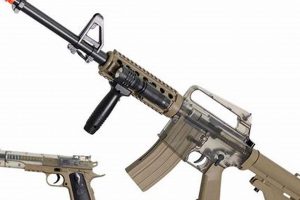
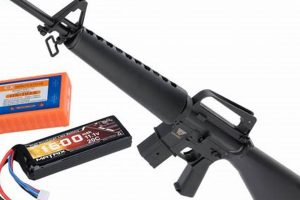
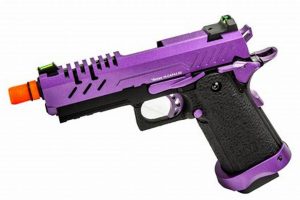
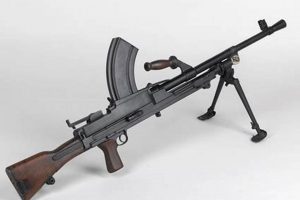
These recreational devices are designed to resemble authentic firearms, often replicating the look and feel of machine guns. They discharge non-lethal projectiles, typically 6mm or 8mm plastic BBs, propelled by compressed gas or electric mechanisms. They are primarily used in simulated combat scenarios for recreational and training purposes. For instance, an individual might use one during a weekend skirmish with friends at a designated airsoft field.
Their popularity stems from the immersive and tactical experience they offer, allowing participants to engage in strategic gameplay that mimics real-world military operations. This fosters teamwork, strategic thinking, and physical activity. Initially, they were utilized as training aids for law enforcement and military personnel due to their realistic appearance and safe operation. Over time, they transitioned into the recreational market, offering enthusiasts a safe and engaging alternative to paintball or other combat simulation activities.
The following sections will delve into the specifics of operation, safety considerations, legal ramifications, and the various types available, providing a complete understanding of these popular recreational items. These aspects will be explored in detail to give the reader comprehensive knowledge.
Airsoft Toy Machine Gun
Employing these replicas requires strict adherence to safety protocols and a thorough understanding of operational guidelines to ensure a positive and safe experience.
Tip 1: Eye Protection is Paramount: Always wear full-seal goggles or a mask specifically designed for airsoft. Projectiles can cause serious eye injury, even at relatively low velocities. Ensure the protective gear meets ANSI Z87.1 standards or equivalent.
Tip 2: Understand Field Regulations: Familiarize yourself with the specific rules and regulations of the airsoft field or event. These may include velocity limits (measured in feet per second – FPS), engagement distances, and prohibited areas.
Tip 3: Maintain Weapon Functionality: Regularly clean and lubricate the replica according to the manufacturer’s instructions. This will ensure consistent performance and prevent malfunctions during gameplay.
Tip 4: Prioritize Responsible Handling: Treat the replica as if it were a real firearm. Never point it at anyone you do not intend to engage in gameplay, and always keep the safety engaged when not actively in use.
Tip 5: Adhere to Velocity Limits: Chronograph the replica before each game to ensure it complies with the field’s FPS limits. Exceeding these limits can result in injury and potential expulsion from the event.
Tip 6: Use Appropriate Ammunition: Employ high-quality, seamless BBs designed for airsoft use. Low-quality BBs can damage the internal mechanisms and affect accuracy. Use the correct weight BB recommended for the device.
Tip 7: Safe Storage and Transportation: When not in use, store the replica in a secure location, out of reach of children. When transporting it, use a gun case or bag to conceal its appearance and comply with local regulations.
By adhering to these tips, users can minimize risks and enhance the enjoyment derived from these recreational activities. Responsible handling and consistent safety practices are crucial for maintaining a positive image for the airsoft community.
The subsequent sections will discuss legal implications and modifications, providing a more holistic understanding of this category of recreational equipment.
1. Realism

The degree of realism in these recreational devices directly affects their popularity and potential misuse. The faithful replication of authentic firearms, including weight, dimensions, and operational mechanisms, contributes significantly to the immersive experience sought by airsoft enthusiasts. This verisimilitude enhances the tactical training aspect, as participants can practice weapon handling and manipulation techniques in a manner closely mirroring real-world scenarios. However, this same realism introduces the risk of misidentification by law enforcement and the general public, necessitating responsible handling and visible differentiation from actual firearms.
The manufacturers pursuit of heightened realism has led to airsoft replicas that closely resemble specific military and law enforcement weapons. For example, models mirroring the M4 carbine or AK-47 assault rifle are widely available. Such faithful reproductions can blur the line between toy and weapon, potentially leading to dangerous situations if not handled responsibly. Law enforcement agencies have encountered instances where these replicas were mistaken for real firearms during incidents, highlighting the practical significance of understanding the inherent risks associated with their realistic design.
In summary, the connection between realism and these recreational devices is a double-edged sword. While it enhances the immersive experience and training value, it also introduces potential risks related to misidentification and misuse. The key insight lies in promoting responsible ownership, emphasizing visible differentiation from actual firearms, and educating both users and the public about the nature of these items to mitigate potential dangers and ensure their safe and appropriate use within legal boundaries.
2. Operation
The operational mechanics of these recreational devices dictate their performance, reliability, and overall user experience. Understanding the underlying propulsion systems and their associated characteristics is crucial for both safety and effective utilization. The following aspects detail the key operational facets.
- Gas Blowback Systems
Gas blowback systems utilize compressed gas, typically CO2 or green gas, to propel projectiles and simulate recoil. This mechanism enhances realism by mimicking the action of a real firearm, but it also requires regular maintenance and is sensitive to temperature variations. Examples include pistols and rifles employing a gas-powered piston to cycle the bolt after each shot. The complexity of these systems necessitates proper lubrication and careful handling to prevent leaks or malfunctions.
- Electric-Powered Systems (AEGs)
Automatic Electric Guns (AEGs) use an electric motor, battery, and gearbox to drive a piston, which in turn compresses air to propel projectiles. AEGs are known for their consistent performance, ease of use, and higher rates of fire compared to gas-powered systems. A common example is the M4 platform, widely available as an AEG. These systems require battery maintenance and may require gearbox upgrades for enhanced performance, such as increased rate of fire or durability.
- Spring-Powered Systems
Spring-powered systems rely on manually compressing a spring to generate the force needed to launch projectiles. These are typically found in single-shot rifles and pistols, offering simplicity and affordability but lacking the rate of fire of gas or electric systems. Bolt-action sniper rifles are a prominent example, requiring the user to manually cock the spring before each shot. Spring systems are generally robust and require minimal maintenance, but their single-shot nature limits their application in fast-paced skirmishes.
- Hybrid Systems
Hybrid systems combine elements of multiple propulsion methods, such as gas-powered systems with electronic control or spring systems with gas assist. These systems aim to leverage the advantages of each technology while mitigating their drawbacks. An example is a gas-powered rifle with electronic trigger control for improved responsiveness and consistency. Hybrid systems are less common than the other types, often requiring specialized knowledge for maintenance and repair.
The diverse operational methods significantly impact the overall experience. Each method presents a unique set of advantages and disadvantages. Consideration of these factors informs appropriate selection, use, and maintenance, ensuring both user satisfaction and safe functionality of this category of recreational devices. These operational aspects directly influence performance, reliability, and cost-effectiveness.
3. Safety

The responsible and safe handling of these recreational devices is of paramount importance. The realistic appearance and potential for misuse necessitate a comprehensive understanding of safety protocols to mitigate risks and prevent injuries. The following points detail key aspects of safety considerations in relation to airsoft usage.
- Protective Gear
The use of appropriate protective gear is non-negotiable. Full-seal eye protection, specifically designed to withstand the impact of projectiles, is essential to prevent eye injuries. Additional protective measures, such as face masks, gloves, and body armor, further reduce the risk of injury. The failure to wear adequate protective gear can result in serious and potentially permanent harm.
- Velocity Limits and Engagement Distances
Adherence to established velocity limits (measured in feet per second or FPS) and minimum engagement distances is critical. Exceeding velocity limits increases the risk of injury upon impact. Engaging targets at close range, below designated minimum distances, can also result in more severe injuries. Field regulations typically specify these parameters to ensure participant safety.
- Responsible Handling and Storage
Treating these devices with the same respect and caution as real firearms is imperative. This includes keeping the device pointed in a safe direction, engaging the safety mechanism when not actively in use, and storing it securely when not in operation. Responsible handling prevents accidental discharges and reduces the risk of misidentification by law enforcement or the general public.
- Field Rules and Regulations
Understanding and complying with the specific rules and regulations of the airsoft field or event is essential for maintaining a safe environment. These rules often cover topics such as prohibited areas, permissible firing modes, and procedures for handling malfunctions. Ignoring or violating field rules can lead to accidents, injuries, and expulsion from the event.
These facets of safety are interconnected and contribute to a safe and enjoyable airsoft experience. Neglecting any of these aspects can elevate the risk of accidents and injuries. Consistent adherence to established safety protocols is crucial for preserving the integrity of the sport and ensuring the well-being of all participants. The emphasis on responsible behavior reinforces the understanding that these are not merely toys, but rather recreational devices requiring careful and informed handling.
4. Legality
The legal status of airsoft replicas, particularly those resembling machine guns, varies significantly across jurisdictions. These variations impact ownership, sales, transportation, and usage. The determining factors often revolve around local definitions of firearms, imitation firearms, and toy regulations. Certain regions may classify these items as unregulated toys, while others subject them to stringent controls mirroring those applied to actual firearms. This discrepancy necessitates careful investigation of local laws before purchasing, transporting, or using such items.
For example, some countries require airsoft devices to be brightly colored to distinguish them from real weapons, while others demand specific markings or serialization. The transportation of these items across state or national borders may trigger specific legal requirements, such as being stored in a locked case and separate from ammunition (if applicable). Moreover, local ordinances may restrict their use to designated areas, prohibiting operation in public spaces or residential neighborhoods. Failure to comply with these regulations can result in confiscation, fines, or even criminal charges. Consider cases where individuals have unknowingly transported airsoft guns across state lines, leading to legal complications due to differing state laws regarding imitation firearms.
Therefore, a thorough understanding of applicable laws is crucial for responsible ownership and operation. Individuals should consult with legal experts or relevant authorities to ensure compliance with all local, state, and federal regulations. This proactive approach mitigates the risk of legal repercussions and promotes the safe and responsible use of these recreational devices. Understanding and respecting these legal boundaries is paramount for ensuring the continued availability and acceptance of airsoft as a legitimate recreational activity.
5. Modification
The alteration of airsoft replicas, especially those mimicking machine guns, represents a significant aspect of the hobby, influencing performance, aesthetics, and potential legal ramifications. Modifications range from simple cosmetic changes to complex internal upgrades affecting firing rate, accuracy, and overall reliability. While often intended to enhance the user experience, modifications can also compromise the device’s safety and legality if performed improperly or without adequate knowledge.
Common modifications include replacing internal components such as springs, gears, and motors to increase projectile velocity or rate of fire. External modifications involve adding accessories like scopes, sights, and tactical rails, improving handling and aiming capabilities. Examples of these alterations can be seen extensively within the airsoft community online, demonstrating a wide range of alterations with varied outcomes. Modifying the external appearance to more closely resemble a specific real-world firearm is another frequent practice. However, exceeding velocity limits established by airsoft fields or altering the device to closely resemble an actual firearm can lead to safety concerns and legal penalties. Understanding the potential consequences of each modification is critical for responsible users.
In conclusion, modification of these recreational devices presents both opportunities and challenges. While performance enhancements and aesthetic customization can increase user satisfaction, it’s imperative to prioritize safety and adhere to all applicable laws and regulations. Responsible modification requires thorough research, careful planning, and a commitment to maintaining the integrity and safe operation of the device. Ignoring these considerations can lead to negative consequences, undermining the recreational value and potentially resulting in legal repercussions. The interplay between modification, performance, legality, and safety must always be carefully balanced.
Frequently Asked Questions
This section addresses common inquiries regarding these recreational devices, providing factual information to promote understanding and responsible use.
Question 1: What constitutes an “airsoft toy machine gun” and how does it differ from an actual firearm?
An airsoft toy machine gun is a replica firearm designed to fire non-lethal plastic projectiles (BBs). The primary difference from an actual firearm lies in its intended use and projectile type. Airsoft devices are designed for recreational and training purposes, firing low-velocity plastic BBs, while firearms discharge lethal projectiles.
Question 2: Are “airsoft toy machine guns” legal to own?
Legality varies by jurisdiction. Some regions treat these devices as toys with minimal regulation, while others impose restrictions similar to those for actual firearms. Prospective owners must research and comply with local, regional, and national laws regarding ownership, transportation, and usage.
Question 3: What safety precautions are necessary when using an “airsoft toy machine gun?”
Eye protection is paramount. Full-seal goggles or masks designed for airsoft are essential. Additionally, adherence to field velocity limits, responsible handling practices (treating the device as if it were a real firearm), and using appropriate ammunition are crucial for safe operation.
Question 4: Can “airsoft toy machine guns” be modified?
Yes, modifications are possible, ranging from cosmetic changes to internal upgrades. However, modifications can affect the device’s safety and legality. Altering velocity, appearance, or functionality may violate field rules or local laws. Responsible modification requires careful research and adherence to safety guidelines.
Question 5: What is the appropriate age for using an “airsoft toy machine gun?”
Age recommendations vary, but typically, individuals should be at least 16 or 18 years old, depending on local regulations and parental guidance. Supervision is generally recommended for younger participants, even when within the legal age range.
Question 6: How should an “airsoft toy machine gun” be stored and transported?
When not in use, these devices should be stored securely, out of reach of children. Transportation requires concealment, preferably in a gun case or bag, to avoid alarming the public or attracting unwanted attention. Compliance with local transportation laws is essential.
These answers provide a basic understanding of relevant issues concerning “airsoft toy machine guns.” Continued vigilance and adherence to safety protocols are crucial for responsible enjoyment of this recreational activity.
The subsequent sections will delve into the ethical dimensions of this sport, ensuring responsible engagement.
Conclusion
The exploration of the “airsoft toy machine gun” reveals a complex interplay between recreation, realism, and responsibility. The preceding analysis detailed operational mechanics, safety requirements, legal considerations, and the potential impact of modifications. Emphasis was placed on understanding the nuanced relationship between the device’s realistic appearance and the need for responsible handling to prevent misuse or misidentification. Compliance with local laws and adherence to established safety protocols were underscored as critical factors for ensuring the continued viability of airsoft as a legitimate recreational activity.
The significance of responsible engagement with “airsoft toy machine guns” extends beyond individual enjoyment. It shapes public perception, influences legislative decisions, and ultimately determines the future of the sport. Continued education, strict adherence to safety guidelines, and proactive community involvement are essential for promoting a positive image and safeguarding the responsible use of these recreational devices. The future trajectory of airsoft hinges on the collective commitment to ethical conduct and the unwavering prioritization of safety within the airsoft community.