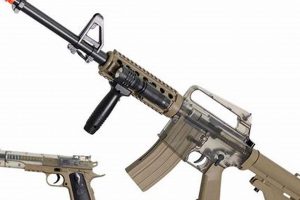
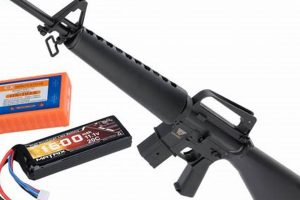
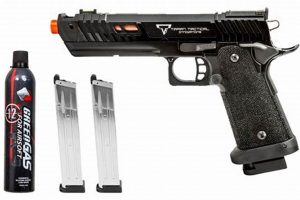
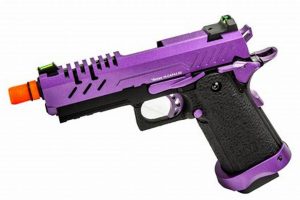
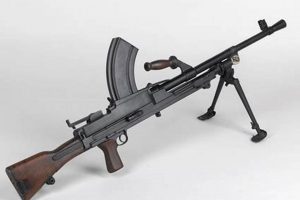
Modifications to airsoft guns are alterations or replacements of internal and external components that enhance performance, aesthetics, or ergonomics. These changes can range from simple barrel swaps to complete overhauls of the internal gearbox mechanism. For example, replacing a stock hop-up unit with a precision aftermarket unit can improve range and accuracy.
The practice of enhancing these replicas offers numerous advantages. Increased range, accuracy, and rate of fire contribute to a more competitive experience. Furthermore, personalization allows players to tailor their equipment to specific play styles or field environments. Historically, modifications have evolved from rudimentary adjustments to complex, technologically advanced enhancements, reflecting the growing sophistication of the sport.
Understanding the various types of enhancements, their installation procedures, and their impact on overall functionality is critical for maximizing the potential of an airsoft replica. Subsequent sections will delve into specific component categories and provide guidance on selecting appropriate modifications for different needs.
Airsoft Gun Enhancement Guidance
The following guidance focuses on maximizing the effectiveness of airsoft replicas through strategic component alterations. Prudent decision-making based on individual needs and field conditions is crucial.
Tip 1: Prioritize Internal Components. Addressing the gearbox and hop-up unit generally yields more significant performance gains than external cosmetic changes. Invest in quality gears, motors, and hop-up buckings before focusing on aesthetic modifications.
Tip 2: Research Compatibility Thoroughly. Before purchasing any component, verify compatibility with the specific airsoft gun model. Incompatible parts can lead to malfunction or damage. Consult manufacturer specifications and online resources.
Tip 3: Consider Professional Installation. Complex internal work, such as gearbox modifications, may require specialized tools and expertise. If inexperienced, consider professional installation to prevent damage and ensure proper function.
Tip 4: Focus on Air Seal Efficiency. Enhancing the air seal within the cylinder and piston assembly will maximize power and consistency. Inspect and replace O-rings and piston heads as needed.
Tip 5: Match Spring Strength to Field Regulations. Ensure the spring strength (measured in FPS) aligns with the field’s safety regulations. Exceeding the velocity limit may result in ejection from the game.
Tip 6: Evaluate Barrel Quality. A precision inner barrel can significantly improve accuracy. Stainless steel or tight-bore barrels are popular choices, but proper cleaning and maintenance are essential.
Tip 7: Test and Fine-Tune. After implementing any alterations, thoroughly test the replica in a controlled environment. Fine-tune the hop-up and other adjustable components to achieve optimal performance.
Strategic alterations, conducted with attention to detail and adherence to safety regulations, offer a notable advantage on the playing field. Selecting appropriate components based on specific requirements will increase overall effectiveness.
The subsequent section will outline the legal and ethical considerations associated with enhancing airsoft replicas. Prudent decision-making is paramount for maintaining responsible participation in the sport.
1. Precision

The concept of precision is paramount within the realm of airsoft gun modifications. It directly correlates to the accuracy and consistency of projectile delivery, influencing competitive performance and overall user satisfaction. Enhanced precision necessitates meticulous attention to detail throughout the component selection and installation process.
- Inner Barrel Tolerance
The internal diameter and surface finish of the inner barrel exert a significant influence on projectile trajectory. Tighter bore tolerances minimize projectile wobble, resulting in a more stable flight path. Stainless steel barrels, renowned for their smooth internal surfaces, exemplify this principle. Improved barrel quality enhances shot-to-shot consistency.
- Hop-Up Unit Adjustment
The hop-up unit introduces backspin to the projectile, counteracting gravity and extending range. Precise adjustments to the hop-up pressure are crucial for achieving optimal trajectory and maximizing effective range. Inconsistent hop-up application diminishes accuracy, regardless of other modifications.
- Air Seal Optimization
Leakage within the air compression system (cylinder, piston, nozzle) compromises power output and shot consistency. Precision air seal upgrades, such as O-ring replacements and tighter nozzle-to-hop-up interfaces, minimize air loss and ensure consistent projectile velocity. Consistent velocity translates directly to predictable trajectories.
- Trigger Response Enhancement
While not directly impacting projectile trajectory, improved trigger response enhances the user’s ability to deliver accurate shots in rapid succession. Precision trigger systems, with reduced travel and reset distances, minimize delay between trigger pull and firing, contributing to improved target acquisition and engagement times. Consistent trigger pull also reduces user-induced errors.
Collectively, these precision-focused modifications synergistically enhance the performance of airsoft replicas. Achieving optimal precision demands a holistic approach, addressing each potential source of inconsistency within the system. Prioritizing precision yields tangible improvements in accuracy, range, and overall competitive effectiveness. Neglecting precision ultimately limits the potential benefits of other modifications.
2. Durability
The concept of durability is intrinsically linked to airsoft gun modifications, particularly for individuals engaged in frequent or intense gameplay scenarios. The original components of many airsoft replicas, especially those at entry-level price points, may exhibit limitations in their ability to withstand prolonged stress and high operational tempo. Replacing these components with more robust alternatives directly addresses these shortcomings, preventing premature failure and extending the operational lifespan of the replica. For example, stock plastic gears within a gearbox are often a point of failure under the strain of high-torque motors or high-cycle rate-of-fire configurations. Replacing them with steel gears mitigates this risk, increasing reliability.
Enhancing durability through aftermarket modifications is not merely about preventing catastrophic failure; it also contributes to consistent performance over time. Wear and tear on internal components can lead to a gradual degradation in accuracy, power, and responsiveness. Upgrading to more durable materials, such as reinforced pistons, cylinder heads, or hop-up buckings, maintains consistent performance characteristics over extended periods of use. The practical significance is evident in competitive scenarios where consistent shot placement and reliable operation are paramount. An airsoft player who has reinforced the gears, piston, and cylinder head of his or her AEG will be able to withstand higher loads and operate longer than a player who has the stock parts.
In summary, prioritizing durability during airsoft gun modification is a crucial investment. It mitigates the risk of equipment failure, ensures consistent performance, and extends the operational lifespan of the replica. While initial modifications might seem costly, they ultimately reduce the long-term expense associated with frequent repairs or replacements. Challenges persist in accurately assessing the true durability of aftermarket components, necessitating careful research and consideration of manufacturer reputations. Overall, a focus on durability contributes to a more reliable and enjoyable airsoft experience.
3. Compatibility

The successful implementation of airsoft gun alterations hinges critically on component compatibility. The airsoft replica ecosystem comprises a multitude of manufacturers, each adhering to varying dimensional standards and design philosophies. This heterogeneity creates a scenario where ostensibly similar components may exhibit subtle but functionally significant incompatibilities. Failure to account for these discrepancies can result in compromised performance, mechanical failure, or outright inability to integrate the alteration into the host replica. For instance, a high-torque motor designed for a Version 2 gearbox may not physically fit or electrically interface correctly with a Version 3 gearbox, rendering the alteration useless and potentially damaging the electrical system.
The importance of compatibility extends beyond basic dimensional fit. Even when physically compatible, components may exhibit functional incompatibilities that degrade overall performance. A high-performance hop-up bucking designed for heavy BB weights may not function optimally with a low-power replica firing lighter BBs. The backspin imparted by the bucking may be insufficient to stabilize the lighter projectile, resulting in reduced range and accuracy. Similarly, pairing a high-discharge battery with a motor not designed to handle the increased current can lead to premature motor failure or trigger switch burnout. Thorough research, including consulting online forums, manufacturer specifications, and experienced technicians, is vital to ensure harmonious integration of all altered components. Understanding the nuances of gearbox versions, electrical system voltage and current requirements, and hop-up unit compatibility with specific BB weights is essential for achieving the desired performance enhancements without introducing unintended negative consequences.
In conclusion, compatibility serves as a foundational prerequisite for any successful airsoft replica alteration. Neglecting this critical aspect can negate the benefits of even the most advanced components and potentially damage the replica. A comprehensive understanding of component specifications, dimensional standards, and functional requirements is paramount to ensuring seamless integration and achieving the desired performance enhancements. The airsoft hobbyist must approach modifications with a discerning eye, prioritizing compatibility above all else to unlock the full potential of their replica.
4. Power
In the context of airsoft gun alterations, the term “power” typically refers to the kinetic energy imparted to the projectile, directly influencing its velocity and range. Increased power is often a primary objective of enthusiasts, though it necessitates careful consideration of field regulations and safety protocols. Maximizing power involves strategic alterations to the internal mechanisms responsible for air compression and delivery.
- Spring Strength Augmentation
The primary determinant of power output in many airsoft replicas is the mainspring. Replacing the stock spring with a stronger variant increases the force exerted on the piston, compressing a larger volume of air. The resulting higher pressure propels the projectile at a greater velocity. However, exceeding field-imposed velocity limits may render the replica unusable. Furthermore, increased spring tension places greater stress on other internal components, potentially accelerating wear or causing failure.
- Air Volume Optimization
Achieving optimal power output requires a balanced approach, considering both spring strength and air volume. Increasing the cylinder volume, either through the use of a longer cylinder or a cylinder with a ported design, allows for a greater quantity of air to be compressed. This can enhance the effectiveness of a given spring, particularly with heavier projectiles. However, an improperly matched cylinder volume can result in over- or undervoluming, leading to reduced efficiency and inconsistent performance.
- Motor Torque Enhancement
In electric-powered airsoft replicas, the motor plays a critical role in compressing the spring. Upgrading to a high-torque motor provides the necessary power to efficiently compress stronger springs, enabling higher power output. However, high-torque motors draw more current, potentially necessitating alterations to the battery and wiring harness to prevent electrical issues. Furthermore, an incompatible motor can place undue stress on the gears, leading to premature wear or failure.
- Air Seal Improvement
Regardless of spring strength or motor power, any leakage within the air compression system will diminish power output. Ensuring a tight seal between the piston head, cylinder head, nozzle, and hop-up unit is critical for maximizing efficiency. Alterations such as O-ring replacements and tighter tolerances between components can minimize air loss, ensuring that the maximum possible force is transferred to the projectile.
These alterations, when implemented judiciously and in conjunction with appropriate safety measures, can significantly enhance the power of airsoft replicas. However, it is imperative to prioritize adherence to field regulations and ethical gameplay standards. The pursuit of increased power should not compromise safety or fair play.
5. Accuracy

Accuracy, in the context of airsoft, refers to the degree to which a projectile consistently impacts a target at a designated range. It is a crucial performance metric directly affected by alterations to the replica. Internal and external airsoft gun alterations aim to reduce the variability in projectile trajectory, resulting in tighter groupings and increased hit probability. For example, a stock airsoft gun may exhibit a shot dispersion of 12 inches at 50 feet, whereas a modified version with a precision barrel and enhanced hop-up unit could reduce this to 4 inches at the same distance.
Several specific modifications exert a direct influence on accuracy. Precision inner barrels, characterized by tighter bore diameters and smoother internal surfaces, minimize projectile wobble and improve consistency. Hop-up unit alterations, such as bucking replacements or TDC (Top Dead Center) modifications, allow for finer adjustments to backspin, optimizing trajectory for various projectile weights and ranges. Furthermore, stabilizing the barrel and receiver assembly reduces vibration during firing, contributing to improved shot-to-shot consistency. Practical application lies in competitive scenarios, where accuracy directly translates to a tactical advantage, enabling players to engage targets effectively at greater distances and with greater precision.
The pursuit of accuracy through modifications presents challenges. Over-modification without a thorough understanding of component interactions can lead to performance degradation. Furthermore, external factors such as wind and projectile quality can still influence trajectory, even with advanced alterations. Nevertheless, a systematic approach to modifying an airsoft gun, focusing on barrel quality, hop-up optimization, and mechanical stability, yields significant improvements in accuracy, enhancing the overall effectiveness of the replica on the playing field. Understanding these dynamics is vital for airsoft players seeking a competitive advantage.
6. Customization
The implementation of airsoft gun alterations extends beyond mere performance enhancement; it frequently encompasses personalization through customization. The ability to tailor the appearance and ergonomics of an airsoft replica contributes significantly to the user experience, fostering a sense of ownership and reflecting individual preferences.
- External Accessory Integration
The attachment of external accessories constitutes a prominent aspect of customization. Rail systems, compatible with various optic sights, foregrips, and tactical lights, facilitate adaptation to diverse operational environments. Specific examples include the addition of a red dot sight for rapid target acquisition in close-quarters combat or the installation of a vertical foregrip to improve stability during sustained fire. These external modifications, while primarily aesthetic, can enhance functionality and user comfort.
- Cosmetic Component Alteration
Replacing stock components with aesthetically distinct alternatives offers another avenue for customization. The substitution of a standard pistol grip with an ergonomically enhanced version or the installation of a different stock configuration alters the replica’s appearance and feel. Color schemes can be modified through painting, hydro-dipping, or the application of camouflage patterns. These alterations contribute to the visual appeal of the replica, reflecting the owner’s individual style.
- Internal Component Color Coding
Although not externally visible, the incorporation of color-coded internal components represents a subtle form of customization favored by some enthusiasts. Replacing standard metal gears with brightly anodized versions or installing a piston with a distinctively colored head allows for easy identification of specific alterations during maintenance or repair. While primarily functional, this practice adds a personal touch to the replica’s internal workings.
- Simulation of Real-World Counterparts
A significant driver of customization is the desire to replicate the appearance and functionality of real-world firearms. Enthusiasts frequently modify their airsoft replicas to resemble specific military or law enforcement weapon systems, utilizing aftermarket components to achieve a high degree of visual accuracy. This practice often involves meticulous attention to detail, including the selection of appropriate accessories, markings, and finishes.
These facets of customization, while largely aesthetic, contribute significantly to the overall user experience. The ability to personalize an airsoft replica fosters a sense of ownership and reflects individual preferences, enhancing enjoyment of the sport. Furthermore, functional customizations can improve ergonomics and adaptability to specific gameplay scenarios.
Frequently Asked Questions
This section addresses common inquiries and misconceptions surrounding airsoft gun modifications, offering clarity and informed guidance.
Question 1: What constitutes a basic airsoft gun alteration?
A basic alteration typically involves replacing the hop-up bucking, enhancing the air seal around the cylinder head, or installing a tighter-bore inner barrel. These changes often yield noticeable improvements in range and accuracy without requiring extensive technical expertise.
Question 2: What safety precautions must be observed during alteration procedures?
Disassembling an airsoft gun requires adherence to stringent safety protocols. The replica should be unloaded, the battery disconnected (if applicable), and eye protection worn at all times. Internal components may be under spring tension and could cause injury if mishandled. A clear workspace and appropriate tools are essential.
Question 3: How does one determine component compatibility?
Component compatibility is ascertained by consulting manufacturer specifications, online forums, and user reviews. Gearbox versions, battery voltage requirements, and barrel threading standards must align for proper function. Incompatible components may lead to damage or malfunction.
Question 4: Are there legal restrictions on altering airsoft guns?
Legal restrictions vary by jurisdiction. Certain modifications, such as increasing projectile velocity beyond specified limits or altering the external appearance to resemble a real firearm too closely, may be prohibited. Local laws must be consulted to ensure compliance.
Question 5: What performance gains can be expected from altering an airsoft gun?
Performance gains depend on the scope and quality of the alterations. Precision inner barrels can improve accuracy. High-torque motors can increase rate of fire. Enhanced air seals can maximize power output. The cumulative effect of multiple alterations can be significant, but results may vary based on the replica’s original configuration.
Question 6: When should professional assistance be sought for airsoft gun alterations?
Professional assistance is recommended for complex internal work, such as gearbox overhauls or electrical system modifications. Inexperienced individuals risk damaging components or voiding warranties. A qualified technician possesses the expertise and tools necessary to perform alterations safely and effectively.
Successful airsoft gun alterations require a combination of technical knowledge, adherence to safety protocols, and an understanding of component compatibility. Consultation with experienced individuals or professional technicians can mitigate risks and maximize performance gains.
The next section will provide resources for further research and exploration of airsoft gun alteration techniques.
Airsoft Gun Upgrades
This exploration has illuminated the multifaceted nature of airsoft gun alterations. The significance of precision, durability, compatibility, power, accuracy, and customization in maximizing performance was established. A clear understanding of these aspects, coupled with adherence to safety regulations, forms the foundation for successful replica enhancement.
Continued advancements in component technology and modification techniques will undoubtedly shape the future of airsoft. Prioritizing informed decision-making and responsible implementation remains paramount. The judicious application of enhancements not only amplifies performance but also promotes a safer and more enjoyable playing experience.