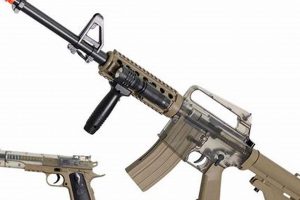
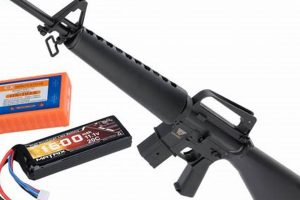
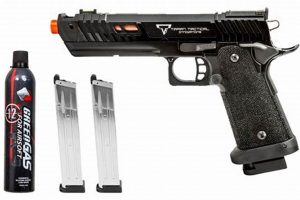
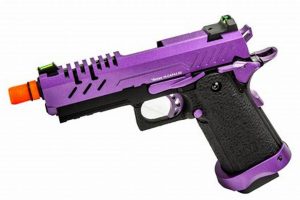
An imitation firearm replicates the appearance and function of the SIG SAUER SPEAR, modified to fire plastic projectiles. These devices are primarily used in recreational activities, such as skirmishes and target practice, simulating tactical scenarios. They offer a relatively safe and accessible way to engage in simulated combat.
The popularity of these replica firearms stems from several factors: their realism, their use in training exercises, and the enjoyment participants derive from simulated combat. Historical precedents for using simulated firearms for training and recreation can be traced back to military exercises and theatrical performances, eventually evolving into organized recreational activities.
The following sections will delve deeper into the specific features, operational mechanics, performance metrics, and considerations for ownership of these replica firearms. This will include examining their construction materials, power sources, and legal ramifications.
Enhancing Performance with the Replica SPEAR
Optimizing usage requires adherence to safety protocols and a nuanced understanding of its capabilities. The following tips aim to improve performance and user experience.
Tip 1: Ammunition Selection. Projectile quality significantly impacts accuracy and range. Employing high-grade, seamless projectiles minimizes barrel obstructions and ensures consistent trajectory. Experimentation with different projectile weights may yield optimal results based on specific environmental conditions and target distances.
Tip 2: Maintaining Internal Components. Regular cleaning and lubrication are essential for consistent operation. Disassembly and cleaning of the internal mechanism, including the barrel and hop-up unit, should be performed periodically to remove accumulated debris and residue. Silicone-based lubricants are recommended to minimize friction and prevent damage to internal seals.
Tip 3: Adjusting the Hop-Up Unit. The hop-up unit imparts backspin to the projectile, increasing range and accuracy. Incremental adjustments to the hop-up setting are necessary to compensate for variations in projectile weight, wind conditions, and target distance. Excessive hop-up can result in overspin and reduced range.
Tip 4: Optimizing Power Source. Battery selection and maintenance are crucial for consistent firing rates and power output. Using batteries with sufficient voltage and amperage ensures consistent performance. Proper battery storage and charging practices extend battery life and prevent damage.
Tip 5: Employing Correct Stance and Grip. A stable stance and consistent grip enhance accuracy and recoil management. Maintaining a balanced posture and consistent hand placement minimizes movement and reduces the impact of recoil on shot placement.
Tip 6: Implementing a Strategic Sight Alignment. Proper sight alignment is fundamental to accurate aiming. Focusing on the front sight and maintaining a consistent sight picture ensures repeatable shot placement. Experimentation with different sighting systems, such as red dot sights or holographic sights, may improve target acquisition and accuracy.
These guidelines offer a framework for improving the operational effectiveness of the replica firearm. Consistently implementing these practices will contribute to an enhanced user experience and improved performance.
The next section will discuss the various modifications and accessories available to further customize and enhance the device.
1. Realistic replica

The designation “realistic replica” signifies a design and construction philosophy centered on mirroring the aesthetic and functional characteristics of the actual SIG SAUER SPEAR firearm. This emphasis on verisimilitude serves a critical purpose beyond mere visual appeal. The accurate replication of dimensions, weight distribution, and operational controls directly impacts the training value and immersive experience associated with these devices. A high degree of realism enhances their utility in simulated tactical scenarios, allowing users to develop and refine skills applicable to real-world situations.
The practical significance of a realistic replica extends to training law enforcement and military personnel. By employing these devices, personnel can practice weapon handling, target acquisition, and tactical maneuvers in a safe and cost-effective environment. For example, the ability to practice reloading drills with a replica that accurately mimics the weight and manipulation of the actual firearm translates directly into improved performance in live-fire scenarios. Furthermore, the realistic simulation can aid in de-escalation training, allowing officers to experience the physical and psychological pressures associated with weapon deployment without the inherent risks.
However, the pursuit of realism presents inherent challenges. Balancing authenticity with the legal and ethical considerations surrounding replica firearms requires careful attention to detail. Markings, coloration, and other distinguishing features must be implemented to differentiate these devices from their real counterparts. Furthermore, the pursuit of perfect realism must be tempered by safety considerations to ensure the devices cannot be readily modified to fire live ammunition. The successful integration of realism within the “sig spear airsoft gun” enhances its training and recreational value, while adhering to responsible manufacturing and distribution practices.
2. Variable FPS

Variable FPS (Feet Per Second) denotes the adjustable muzzle velocity of the projectiles fired. This is a critical performance parameter. It dictates the projectile’s range, impact force, and suitability for various gameplay environments. A higher FPS typically equates to longer range and greater impact, but it also necessitates stricter adherence to safety protocols due to the increased potential for injury. The engineering behind a “sig spear airsoft gun” often incorporates mechanisms to regulate FPS, accommodating different field regulations and gameplay preferences. For instance, CQB (Close Quarters Battle) scenarios typically mandate lower FPS limits to minimize risk within confined spaces, while outdoor engagements may permit higher FPS for extended range engagements. This flexibility is often achieved through adjustable regulators, spring systems, or electronic control units (ECUs).
The practical significance of variable FPS manifests in several ways. It allows users to tailor performance to specific field rules, ensuring compliance and fair play. Furthermore, adjustable FPS enables customization to match individual playstyles and skill levels. New users may opt for lower FPS settings to prioritize safety and control, while experienced players may prefer higher FPS for enhanced range and accuracy. This adaptability significantly broadens the appeal of the equipment, catering to a diverse range of participants. Examples of real-world implementations include adjustable gas regulators in gas blowback (GBB) models and variable spring tension in electric-powered (AEG) variants.
In summation, variable FPS represents a crucial element of the equipment’s design, offering adaptable performance that aligns with diverse gameplay scenarios and user preferences. The challenges lie in maintaining consistency and reliability across the adjustable range, ensuring stable projectile velocity and accurate trajectory. Ultimately, the capacity to regulate FPS contributes significantly to the versatility, safety, and overall value of the “sig spear airsoft gun.”
3. Polymer/Metal Construction

The term “Polymer/Metal Construction” refers to the materials employed in manufacturing the external and internal components. This material selection is fundamental to the overall durability, weight, and performance characteristics of the “sig spear airsoft gun.” The use of polymer, typically high-density plastics, provides lightweight components that resist impact and environmental degradation. Metal, often aluminum alloys or steel, contributes structural rigidity and enhances the realism of the replica. The specific combination of these materials directly influences the device’s lifespan, handling, and aesthetic appeal. An example is the use of a polymer lower receiver for reduced weight coupled with a metal upper receiver for increased strength and durability in critical stress areas.
The material selection also affects the replica’s operational capabilities. Metal components in the internal mechanism, such as gears and piston assemblies, improve resistance to wear and tear from repeated use, enhancing reliability and longevity. Polymer components, while lighter, can be more susceptible to damage under high stress or temperature conditions. This is why high-stress parts should use stronger materials. The construction materials directly impact the cost of the device; all-metal construction typically raises manufacturing costs and retail prices. Furthermore, the balance between polymer and metal materials plays a crucial role in regulatory compliance, particularly in jurisdictions with specific requirements for replica firearm construction.
In conclusion, the “Polymer/Metal Construction” of this replica firearm is a critical determinant of its performance, durability, and cost. The strategic deployment of each material contributes to the overall balance between realism, functionality, and regulatory compliance. Understanding this relationship is essential for consumers to make informed decisions about purchasing and maintaining these devices.
4. Magazine Capacity
Magazine capacity, when considering a replica SIG SAUER SPEAR, directly impacts sustained firepower capability. The magazine is the component responsible for feeding projectiles into the firing mechanism. A higher capacity allows for more consecutive shots before requiring a reload, offering a tactical advantage in prolonged engagements. Conversely, a lower capacity necessitates more frequent interruptions for reloading, potentially exposing the user to vulnerability. Regulations governing the maximum allowable magazine capacity may influence the design and availability of these components, varying according to jurisdiction. For instance, some areas restrict magazine capacities to reduce the potential for misuse. The design of the magazine itself, including its material composition and feeding mechanism, affects its reliability and resistance to damage during gameplay.
The interplay between magazine capacity and overall gameplay experience is significant. In scenarios emphasizing rapid engagement and suppression, a high-capacity magazine is advantageous, allowing for sustained fire without interruption. In contrast, environments prioritizing realism may favor lower-capacity magazines to simulate real-world firearm limitations. This design consideration also influences training applications, where low-capacity magazines might be used to enforce responsible ammunition management and enhance tactical decision-making. The choice of magazine capacity can thus drastically shift playstyles, strategic advantages, and simulation fidelity.
In summary, magazine capacity is a crucial element in the functionality of a replica SIG SAUER SPEAR, directly influencing the rate and duration of fire. Regulatory constraints, simulation goals, and strategic advantages all factor into the selection of the appropriate magazine capacity. Challenges arise in balancing high capacity with reliable feeding and regulatory compliance. This element exemplifies the considerations when designing and utilizing the equipment.
5. Hop-Up Adjustment
Hop-up adjustment, a feature integrated into certain “sig spear airsoft gun” models, involves a mechanism designed to impart backspin on the projectile as it exits the barrel. This backspin generates an aerodynamic effect known as the Magnus effect, which counteracts the downward force of gravity, extending the projectile’s effective range and improving accuracy. The adjustable nature of this system allows users to fine-tune the amount of backspin applied, compensating for variations in projectile weight, atmospheric conditions, and target distance. Failure to properly adjust the hop-up system results in reduced range, inconsistent trajectory, and diminished accuracy. For instance, when using lighter projectiles, a lesser degree of hop-up is typically required, while heavier projectiles necessitate a greater degree of backspin to achieve optimal flight characteristics. This component is critical for achieving the desired performance from this specific equipment.
The practical significance of understanding and properly utilizing hop-up adjustment manifests in various scenarios. During simulated tactical engagements, effective hop-up adjustment allows participants to engage targets at extended ranges with greater precision. Law enforcement and military training applications also benefit from this feature, as it allows personnel to practice long-range marksmanship skills in a safe and controlled environment. The ability to adjust the backspin is also essential when using different types of projectiles. Adjusting hop-up appropriately mitigates these variables, and increases accuracy and range. This adjustment is a crucial element for maximizing the effectiveness of the device during operation.
In summary, the hop-up adjustment mechanism represents a critical component influencing the trajectory, range, and accuracy of the “sig spear airsoft gun.” Challenges exist in achieving consistent and repeatable adjustments, particularly in dynamic environmental conditions. Masterful manipulation and precise calibration is essential. Properly calibrating and utilizing this system maximizes performance potential. The presence and accurate use directly contributes to the overall effectiveness and user satisfaction derived from the device.
6. Accessory Compatibility

Accessory compatibility significantly extends the utility and customization options for the replica SIG SAUER SPEAR. This feature allows users to adapt the device to specific mission requirements, tactical preferences, or aesthetic considerations. The ability to integrate various accessories enhances its versatility in different simulated combat environments.
- Rail Systems and Mounting Platforms
Picatinny or M-LOK rail systems are integral to accessory attachment. These platforms enable the mounting of optics, such as red dot sights or magnified scopes, improving target acquisition and accuracy. Tactical lights can be affixed to enhance visibility in low-light conditions, while laser aiming modules offer precision targeting. Vertical grips and angled foregrips improve weapon handling and control, particularly during rapid firing or maneuvering. Examples of real-world applications include law enforcement or military simulations where specific accessories are required to replicate operational equipment.
- Optics and Sighting Systems
The compatibility with diverse sighting systems permits optimization for varying engagement ranges and lighting conditions. Red dot sights facilitate rapid target acquisition in close-quarters scenarios, while magnified scopes enhance accuracy at longer distances. Holographic sights provide a wide field of view and parallax-free aiming. Iron sights serve as a backup sighting option in the event of primary optic failure. The selection of appropriate optics contributes significantly to overall effectiveness in simulated combat scenarios.
- External Modifications and Ergonomic Enhancements
Accessory compatibility extends to ergonomic modifications that enhance user comfort and weapon handling. Adjustable stocks allow users to customize the length of pull for improved shouldering and stability. Pistol grips with enhanced textures or ergonomic designs improve weapon control and reduce fatigue. Custom trigger systems can modify trigger pull weight and travel, enhancing accuracy and responsiveness. These ergonomic enhancements contribute to a more personalized and comfortable shooting experience.
- Magazine and Ammunition Accessories
Magazine compatibility is essential for ensuring reliable feeding and sustained firepower. The availability of different magazine capacities allows users to adapt to various tactical situations. Speed loaders facilitate rapid magazine reloading, reducing downtime during simulated engagements. Magazine pouches and carriers provide convenient storage and access to spare magazines. The selection of appropriate magazine and ammunition accessories contributes to overall operational efficiency.
The accessory compatibility inherent in the replica SIG SAUER SPEAR significantly enhances its adaptability, allowing users to tailor the device to specific needs and preferences. By understanding the various accessory options available and their respective functionalities, users can optimize their simulated combat performance and overall experience.
Frequently Asked Questions
This section addresses common inquiries regarding the operation, maintenance, and regulatory considerations surrounding replica SIG SAUER SPEAR airsoft guns. The intent is to provide clear and concise information to enhance user understanding and promote responsible use.
Question 1: What differentiates a replica SIG SAUER SPEAR from a real firearm?
A replica SIG SAUER SPEAR is designed to fire plastic projectiles, typically 6mm in diameter, and lacks the capacity to discharge live ammunition. Construction materials, internal mechanisms, and regulatory markings distinguish it from a real firearm. It is imperative to observe all applicable laws and regulations regarding the ownership, handling, and use of replica firearms.
Question 2: What are the typical FPS (Feet Per Second) ranges for these devices, and how does FPS affect gameplay?
Typical FPS ranges vary depending on the model and intended application. Close-quarters battle (CQB) models often operate below 350 FPS to minimize risk, while outdoor models may exceed 400 FPS. Higher FPS values increase range and impact force, necessitating stricter adherence to safety protocols and field regulations. It is crucial to consult and comply with the FPS limits established by the specific playing field or organization.
Question 3: What maintenance procedures are recommended to prolong the lifespan and reliability of a replica SIG SAUER SPEAR?
Regular cleaning and lubrication are essential. The internal mechanism, including the barrel and hop-up unit, should be cleaned periodically to remove accumulated debris. Silicone-based lubricants are recommended for maintaining smooth operation and preventing damage to internal seals. Batteries should be stored properly and charged according to manufacturer specifications. Adherence to these procedures extends the lifespan and maintains the operational effectiveness of the device.
Question 4: What safety precautions should be observed when using this replica firearm?
Eye protection is mandatory at all times. A full-face mask is recommended, particularly during close-quarters engagements. Safe weapon handling practices, including keeping the muzzle pointed in a safe direction and treating the device as if it were loaded, should be consistently observed. Adherence to established field rules and regulations is paramount. Responsible and ethical conduct ensures the safety of all participants.
Question 5: Are there any legal restrictions or regulations governing the ownership and use of these devices?
Legal restrictions vary significantly by jurisdiction. It is essential to consult local laws and regulations regarding the ownership, transportation, and use of replica firearms. Some areas may require orange tips to distinguish them from real firearms, while others may impose age restrictions or prohibit their use in public places. Compliance with all applicable laws is the responsibility of the user.
Question 6: What types of accessories are compatible with the replica SIG SAUER SPEAR, and how do these accessories enhance performance?
Accessory compatibility is typically facilitated through Picatinny or M-LOK rail systems. Compatible accessories include optics (red dot sights, scopes), tactical lights, laser aiming modules, and ergonomic enhancements (vertical grips, adjustable stocks). These accessories enhance target acquisition, improve weapon handling, and adapt the device to specific mission requirements.
Understanding the nuances of operation, maintenance, and legal considerations is paramount for responsible ownership. Compliance with safety guidelines and adherence to applicable regulations ensures a safe and enjoyable experience.
The subsequent section will explore advanced customization options and performance-enhancing modifications.
In Summary
This examination of the replica SIG SAUER SPEAR has explored its operational mechanics, performance characteristics, and regulatory considerations. The analysis has underscored the importance of understanding material construction, magazine capacity, and hop-up adjustment for optimal utilization. Safety protocols and adherence to legal restrictions remain paramount for responsible ownership and operation. Accessory compatibility provides avenues for performance enhancement and customization.
The continued evolution of this device mirrors advancements in materials science and simulated combat technologies. Further research and development should focus on enhancing realism, improving performance, and promoting responsible use. The accurate replication and safe deployment of this replica weapon systems has applications across various industries.