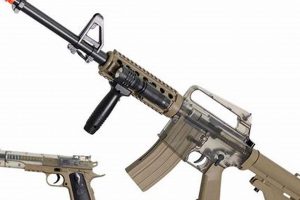
The functionality of an automatic electric gun (AEG) in airsoft revolves around a complex interplay of mechanical and electrical components. At its core, an AEG utilizes an electric motor to power a gearbox. This gearbox contains a series of gears that compress a spring. Once the spring reaches its maximum compression, it is released, propelling a piston forward. This forward movement of the piston forces a volume of air through a nozzle, which in turn, pushes a plastic pellet (BB) out of the barrel.
This mechanism provides several advantages. It offers a high rate of fire compared to spring-powered or gas-powered alternatives, allowing for sustained suppressive fire during gameplay. The consistent performance, relative ease of use, and widespread availability have contributed significantly to the popularity of AEGs within the airsoft community. Their historical development traces back to a desire for more reliable and easily maintainable alternatives to earlier airsoft weapon designs.
Understanding the specific elements within this system, such as the motor, gearbox, battery, and hop-up unit, provides a more in-depth understanding of its overall operation. Exploring these individual components elucidates how they contribute to the effective launching of projectiles.
Electric Airsoft Gun Operation
Optimizing the performance and longevity of an automatic electric gun requires adherence to specific operational and maintenance practices. Ignoring these guidelines can lead to diminished effectiveness or premature failure of components.
Tip 1: Battery Selection and Maintenance: Employ batteries specifically designed for airsoft AEGs, adhering to the voltage and current ratings recommended by the manufacturer. Overcharging or deep discharging batteries shortens their lifespan and can damage internal components. Store batteries in a cool, dry environment when not in use.
Tip 2: Gearbox Lubrication: Regularly lubricate the gearbox with appropriate synthetic grease. Insufficient lubrication increases friction, leading to wear and potential gearbox failure. Excessive lubrication can attract debris and impede performance.
Tip 3: Motor Maintenance: Inspect the motor brushes periodically for wear. Worn brushes reduce motor efficiency and can damage the commutator. Replace brushes as needed to maintain optimal performance.
Tip 4: Hop-Up Unit Adjustment: Fine-tune the hop-up unit to achieve optimal range and accuracy with the specific weight of BBs being used. Incorrect hop-up settings can result in reduced range, inconsistent shots, or BBs curving excessively.
Tip 5: Internal Cleaning: Periodically clean the inner barrel to remove accumulated debris. A dirty barrel degrades accuracy and can cause jams. Use a cleaning rod and appropriate cleaning patches designed for airsoft barrels.
Tip 6: Avoid Overloading: Refrain from using excessively heavy BBs beyond the AEG’s recommended weight range. Overloading the system can strain the motor and gearbox, leading to reduced performance and increased wear.
Tip 7: Consistent Trigger Discipline: Avoid rapidly “spamming” the trigger, especially with high-torque motors. Rapid firing can generate excessive heat within the motor and gearbox, potentially causing damage. Allow brief cooling periods between bursts.
Implementing these preventative measures contributes to the consistent and reliable functioning of an automatic electric gun, maximizing its effectiveness in airsoft skirmishes and extending its operational lifespan.
By understanding the nuances of AEG operation and maintenance, users can ensure their equipment remains in optimal condition, facilitating a more enjoyable and competitive airsoft experience.
1. Battery Power

Battery power serves as the fundamental energy source for an automatic electric gun (AEG), directly influencing its operational parameters. The battery’s capacity, voltage, and discharge rate dictate the AEG’s firing rate, trigger response, and sustained operational time. Understanding these factors is critical to comprehending its function.
- Voltage and Motor Speed
The battery’s voltage directly correlates with the rotational speed of the AEG’s motor. Higher voltage batteries generally yield a faster rate of fire (ROF), as the motor can complete more rotations per unit of time. Conversely, lower voltage batteries result in a slower ROF. Mismatched voltage can cause damage to the motor or gearbox, necessitating careful consideration of manufacturer specifications.
- Capacity and Sustained Use
Battery capacity, measured in milliampere-hours (mAh), determines the duration of sustained operation. A higher mAh rating indicates a greater energy storage capacity, enabling more shots to be fired before the battery requires recharging. Game scenarios involving prolonged engagement benefit from higher capacity batteries, reducing the need for frequent battery swaps.
- Discharge Rate and Trigger Response
The discharge rate, often denoted as a “C” rating, signifies the battery’s ability to deliver current rapidly. A higher discharge rate improves trigger response, reducing the delay between pulling the trigger and the AEG firing. High-performance AEGs, particularly those with upgraded internal components, often require batteries with higher discharge rates to ensure optimal responsiveness and prevent performance degradation.
- Battery Chemistry and Operational Safety
Common battery chemistries in AEGs include Nickel-Metal Hydride (NiMH) and Lithium Polymer (LiPo). Each chemistry exhibits distinct characteristics regarding energy density, discharge rate, and safety. LiPo batteries, while offering higher energy density and discharge rates, demand meticulous handling and charging to prevent damage or fire hazards. Adherence to proper charging and storage protocols is paramount for safe operation.
The selection and management of battery power are integral to the effective and safe utilization of AEGs. A comprehensive understanding of battery specifications and operational parameters ensures optimal performance and minimizes the risk of equipment damage or operational hazards.
2. Motor Rotation
Motor rotation is a pivotal element in the operation of an automatic electric gun (AEG). It is the initial mechanical action that translates electrical energy into the kinetic energy required to propel a projectile. The motors characteristics directly influence the AEGs rate of fire and trigger response.
- Torque and Gearbox Engagement
Motor torque, or rotational force, determines its ability to overcome the resistance within the gearbox. Higher torque motors are capable of driving heavier springs and gearsets, resulting in increased power and reliability. Insufficient torque can lead to motor stall, reduced rate of fire, and potential damage to the gearbox components.
- Motor Speed and Rate of Fire
The rotational speed of the motor, measured in revolutions per minute (RPM), directly affects the AEG’s rate of fire. Higher RPM motors cycle the gearbox more rapidly, enabling a greater number of shots to be fired within a given timeframe. However, excessive RPM can strain internal components and necessitate reinforced gearsets to prevent premature wear.
- Motor Type and Efficiency
Various motor types, such as ferrite and neodymium, exhibit differing efficiency levels. Neodymium motors, characterized by stronger magnets, generally offer higher torque and efficiency compared to ferrite motors. Efficient motors draw less current for a given level of performance, extending battery life and reducing heat generation.
- Motor Break-In and Maintenance
Proper motor break-in procedures, involving controlled operation at reduced voltage, can improve performance and longevity. Regular maintenance, including cleaning and lubrication of motor components, prevents corrosion and ensures smooth operation. Neglecting maintenance can result in reduced efficiency, increased heat generation, and eventual motor failure.
The characteristics of motor rotation, including torque, speed, efficiency, and maintenance, are critical determinants of AEG performance. Understanding these factors facilitates informed component selection and operational practices that optimize reliability and effectiveness. These components directly influence the functionality, reliability, and performance capabilities of the weapon system.
3. Gearbox Mechanics

Gearbox mechanics are integral to the operational functionality of automatic electric guns. The gearbox serves as the central processing unit of the AEG, translating the rotational energy of the motor into the linear motion required to compress the air that propels the projectile. Its internal components, including gears, pistons, and tappet plates, are meticulously engineered to coordinate and execute this process efficiently. A malfunction within the gearbox invariably results in a non-functional or poorly performing AEG, emphasizing its critical role in the overall system.
The specific configuration of the gearbox, particularly the gear ratio, directly impacts the AEG’s performance characteristics. Higher gear ratios typically yield increased torque, enabling the AEG to pull stronger springs and propel heavier projectiles. Conversely, lower gear ratios prioritize rate of fire, allowing for rapid cycling of the gearbox and a higher volume of shots per unit of time. The choice of gear ratio necessitates careful consideration, balancing power and speed to achieve optimal performance for the intended application. Furthermore, the durability and material composition of the gearbox components are paramount. High-stress environments inherent in AEG operation demand robust materials and precise manufacturing tolerances to withstand repetitive impact and prevent premature failure. A common example involves stripped gears, resulting from inadequate material strength or improper meshing, which renders the AEG inoperable until the damaged gears are replaced. The design and construction of the gearbox are thus fundamental to the AEG’s reliability and longevity.
In summary, the gearbox mechanics within an AEG represents a complex interplay of mechanical components that dictate its functionality. Its influence on power output, rate of fire, and overall durability underscores its importance as a core component. Understanding gearbox mechanics is thus essential for maintaining and optimizing the performance of electric airsoft guns. Challenges related to durability and optimal configuration continue to drive innovation and refinement within this area, highlighting its ongoing relevance to the broader field.
4. Piston Compression

Piston compression constitutes a critical phase within the operational cycle of an automatic electric gun. It directly converts the rotational energy imparted by the motor and gearbox into pneumatic energy, culminating in the propulsion of the projectile. The process commences when the sector gear within the gearbox engages the piston assembly, drawing it rearward against the resistance of the main spring. As the piston retracts, it compresses the air within the cylinder. The degree of compression achieved is directly proportional to the force that will subsequently be exerted on the BB located in the hop-up chamber. Ineffective piston compression leads to diminished range and power. This is evident in situations where a damaged or improperly sealed piston head allows air to leak during compression, reducing the volume of air available to propel the BB.
The efficiency of piston compression is influenced by several factors, including the seal between the piston head and the cylinder wall, the strength of the main spring, and the overall design of the piston assembly. An airtight seal is essential to prevent air leakage during compression, ensuring that all available air pressure is directed towards propelling the BB. The spring’s strength determines the maximum pressure that can be achieved within the cylinder; stronger springs generate higher pressures, resulting in increased projectile velocity. An example would be to upgrade a spring in an AEG to achieve a desired feet-per-second rating, but care must be taken not to use too strong of a spring that could damage other components. The piston assembly’s design, encompassing the piston head, piston body, and other ancillary components, dictates its overall structural integrity and its ability to withstand the forces generated during repeated compression cycles.
In summary, piston compression represents a crucial link in the chain of events that define the functionality of an automatic electric gun. Optimizing piston compression through careful component selection, proper maintenance, and adherence to manufacturer specifications is paramount to achieving consistent performance and maximizing the range and accuracy of the weapon system. Understanding these mechanisms is essential for diagnosing performance issues and implementing appropriate corrective actions.
5. Air Nozzle Action
Air nozzle action is a critical phase in automatic electric gun operation. The nozzle’s function is to precisely align and seal against the hop-up bucking while simultaneously delivering a metered volume of compressed air behind the BB. The nozzle’s movement is dictated by the tappet plate, a component connected to the gearbox. As the tappet plate cycles, it pulls the nozzle backward, allowing a BB to feed from the magazine into the hop-up chamber. Subsequently, the tappet plate pushes the nozzle forward, seating it against the hop-up bucking and creating an airtight seal. When the piston releases, the compressed air rushes through the nozzle, propelling the BB forward. Any disruption in this sequence compromises performance. For example, a cracked nozzle might not seal correctly, resulting in reduced velocity and inconsistent shots.
The design and material composition of the air nozzle directly impact its functionality and durability. Nozzles are often constructed from plastics, polymers, or metals. While plastic nozzles are cost-effective, they are more susceptible to wear and breakage. Metal nozzles offer increased durability but can introduce compatibility issues with certain hop-up units. Furthermore, the internal diameter of the nozzle influences the volume of air delivered to the BB. A nozzle with an excessively large internal diameter may result in wasted air and reduced efficiency. A nozzle with an insufficient internal diameter may restrict airflow, hindering performance. The length of the nozzle must also be precisely matched to the AEG’s cylinder head and hop-up unit. Incompatibility in these dimensions can lead to feeding problems or inconsistent air seal.
In summary, air nozzle action is a pivotal component of the functionality of automatic electric guns. Its precise alignment, sealing capabilities, and controlled air delivery are crucial for consistent shot velocity and accuracy. Malfunctions of the air nozzle directly impact AEG performance, necessitating careful component selection and regular maintenance to ensure reliable operation. Understanding the nuances of air nozzle design and functionality is essential for optimizing the effectiveness of electric airsoft weapons.
6. Hop-Up Adjustment
Hop-up adjustment significantly influences the trajectory and range of projectiles fired from electric airsoft guns. The hop-up unit imparts backspin to the BB as it exits the barrel. This backspin, through the Magnus effect, generates lift, counteracting the force of gravity and enabling the BB to travel a greater distance. The adjustment mechanism allows users to fine-tune the amount of backspin applied, optimizing the trajectory for different distances and BB weights. Without proper hop-up adjustment, a BB will typically exhibit a rapid downward trajectory, severely limiting its effective range.
The effectiveness of the hop-up system is contingent upon several factors, including the quality of the hop-up bucking (the rubber component that makes contact with the BB), the consistency of the air seal between the nozzle and the bucking, and the precise adjustment of the hop-up arm. Different BB weights require varying degrees of hop-up. Heavier BBs generally require more hop-up to achieve optimal lift, while lighter BBs require less. An over-adjusted hop-up unit can cause the BB to curve upwards excessively, reducing accuracy and range. Conversely, an under-adjusted unit will result in a low, arcing trajectory. Many hop-up units have numbered settings which makes fine-tuning easier.
Understanding hop-up adjustment is crucial for maximizing the performance of electric airsoft guns. Competent adjustment allows users to achieve greater range, improved accuracy, and enhanced consistency in their shots. Hop-up adjustment is a crucial part of airsoft gameplay.
7. BB Propulsion
BB propulsion represents the terminal stage in the operational sequence of automatic electric guns. This phase directly translates the accumulated pneumatic energy into the kinetic energy that launches the projectile. Understanding the mechanisms governing this stage is essential for comprehending its overall functionality.
- Air Compression and Volume
The volume of compressed air behind the BB dictates its initial velocity. A larger volume of air, propelled by the piston, exerts greater force on the BB. The compression is managed by the cylinder, piston, and cylinder head assembly. The fit and seal of these components directly impact the volume of air available to propel the BB and ultimately, it’s speed (FPS).
- Nozzle Seal and Air Efficiency
The seal between the air nozzle and the hop-up bucking is critical for efficient transfer of energy. An imperfect seal allows air to leak around the BB, reducing the force applied to it and leading to decreased velocity and inconsistent shots. The design and material of the nozzle directly contribute to the quality of this seal.
- Barrel Length and Bore Diameter
The length and bore diameter of the inner barrel influence the BB’s acceleration and trajectory. A longer barrel allows for a longer period of acceleration, potentially increasing velocity. However, an excessively long barrel can introduce friction, negating the benefits. The bore diameter must be precisely matched to the BB size to ensure optimal engagement and minimize air leakage. Typically tighter bore barrels can increase FPS.
- Hop-Up Unit Integration
The hop-up unit imparts backspin to the BB, extending its range and influencing its trajectory. The precise interaction between the hop-up bucking and the BB during propulsion determines the effectiveness of this system. Proper alignment and adjustment of the hop-up unit are crucial for achieving consistent and accurate shots. The hop-up unit can be adjusted for different weight BBs which in turn, affect propulsion.
These interrelated factors collectively define the effectiveness of BB propulsion within an electric airsoft gun. Optimizing these aspects is critical for achieving consistent projectile velocity, maximizing range, and enhancing overall accuracy. Understanding the intricacies of BB propulsion is crucial for diagnosing performance issues and implementing effective solutions that improve the AEG’s functionality.
Frequently Asked Questions
This section addresses common inquiries regarding the operational principles and performance characteristics of automatic electric guns (AEGs) used in airsoft.
Question 1: What is the primary power source for an electric airsoft gun?
The primary power source is a rechargeable battery, typically Nickel-Metal Hydride (NiMH) or Lithium Polymer (LiPo). The battery provides the electrical energy necessary to power the motor and initiate the firing cycle.
Question 2: How does the motor contribute to the firing process?
The motor rotates a series of gears within the gearbox. This rotational motion is converted into linear motion, which compresses a spring. Upon release, the spring drives a piston forward, generating the air pressure required to propel the BB.
Question 3: What is the function of the hop-up unit?
The hop-up unit imparts backspin to the BB as it exits the barrel. This backspin generates lift, counteracting gravity and increasing the effective range of the AEG.
Question 4: What factors influence the rate of fire of an AEG?
Rate of fire is influenced by battery voltage, motor speed, and the gear ratio within the gearbox. Higher voltage batteries and faster motors generally result in a higher rate of fire.
Question 5: What maintenance procedures are essential for AEG longevity?
Essential maintenance includes regular lubrication of the gearbox, inspection and replacement of worn motor brushes, cleaning of the inner barrel, and proper battery care.
Question 6: What causes inconsistent performance in an AEG?
Inconsistent performance can stem from several factors, including air leaks in the compression system, worn hop-up buckings, damaged nozzles, or insufficient battery power.
Understanding these fundamental aspects of electric airsoft gun operation is crucial for optimizing performance, maintaining equipment, and diagnosing potential issues.
The subsequent section delves into troubleshooting common AEG malfunctions and providing practical solutions.
Electric Airsoft Gun Functionality
This examination has elucidated the operational mechanics of automatic electric guns, detailing the energy conversion from battery power to projectile propulsion. Key components, including the motor, gearbox, piston, air nozzle, and hop-up unit, function in a coordinated sequence to achieve consistent performance. Understanding this system allows for informed maintenance and troubleshooting.
Continued inquiry into advanced technologies and optimized designs may lead to further improvements in efficiency, reliability, and overall effectiveness. The principles governing function underscore the importance of both informed usage and adherence to responsible operational practices. Further research may lead to additional advancements.