![DIY Airsoft Machine Gun: Mods & Upgrades [Guide]](data:image/svg+xml;base64,PHN2ZyB4bWxucz0iaHR0cDovL3d3dy53My5vcmcvMjAwMC9zdmciIHdpZHRoPSI0NzQiIGhlaWdodD0iNTYiIHZpZXdCb3g9IjAgMCA0NzQgNTYiPjxyZWN0IHdpZHRoPSIxMDAlIiBoZWlnaHQ9IjEwMCUiIHN0eWxlPSJmaWxsOiNjZmQ0ZGI7ZmlsbC1vcGFjaXR5OiAwLjE7Ii8+PC9zdmc+ "DIY Airsoft Machine Gun: Mods & Upgrades [Guide] Ultimate Airsoft Guide for Beginners, Tactics & Gear Reviews")
The construction of a simulated automatic weapon for airsoft games involves modifying existing airsoft rifles or designing custom mechanisms to achieve a higher rate of fire. This process often necessitates a deep understanding of airsoft gun internals, including gearboxes, motors, and pneumatic systems. The goal is to replicate the rapid firing capabilities of real-world automatic firearms within the safety and regulatory constraints of airsoft.
The appeal of such projects stems from the desire for a performance advantage in airsoft skirmishes, allowing for suppressive fire and area denial tactics. Historically, airsoft enthusiasts have pursued this avenue to enhance the realism and intensity of their gameplay. The benefits are a greater level of strategic options during gameplay and a more immersive experience; however, it demands significant technical expertise and responsible usage.
The following sections will explore the potential methods, challenges, and considerations involved in attempting this type of airsoft modification. Specific attention will be given to legal restrictions, safety precautions, and the technical skills required to achieve a functional and reliable outcome.
Essential Considerations for Airsoft Automatic Weapon Construction
The successful creation of a simulated automatic weapon for airsoft demands meticulous planning, skillful execution, and adherence to safety guidelines. These tips address crucial aspects of the process.
Tip 1: Prioritize Safety: Eye protection and appropriate gear are essential during construction and testing. Mishaps can occur, and mitigating potential harm is paramount.
Tip 2: Research Existing Platforms: Before undertaking a custom build, examine commercially available automatic electric guns (AEGs). Understanding their design principles informs effective modifications.
Tip 3: Upgrade the Power Supply: A higher voltage battery or improved battery connectors may be required to drive the motor and gearbox effectively at an increased rate of fire.
Tip 4: Enhance the Gearbox: Reinforce the gearbox shell and internal components to withstand the increased stress associated with rapid firing. Consider metal gears and a stronger piston.
Tip 5: Optimize Air Seal: An efficient air seal between the piston head, cylinder, and nozzle is vital for consistent performance and optimal power output. Conduct thorough testing to minimize air leaks.
Tip 6: Fine-Tune the Hop-Up Unit: The hop-up unit controls the backspin on the BB, affecting range and accuracy. Adjust it meticulously to achieve the desired trajectory at the modified firing rate.
Tip 7: Test Rigorously: Conduct extensive testing with various BB weights and under different environmental conditions to identify and address any potential issues or weaknesses.
These tips emphasize the importance of a deliberate and informed approach to the modification. Success relies on a combination of technical understanding, careful execution, and a strong commitment to safety.
The concluding section will provide a summary of the key principles discussed, highlighting the regulatory framework and ethical considerations surrounding airsoft weapon modifications.
1. Gearbox Reinforcement

Gearbox reinforcement is a critical component when considering increasing the rate of fire of an airsoft replica. The stock gearboxes in many airsoft guns are not designed to withstand the stresses imposed by rapid, continuous cycling. Therefore, to attempt such a modification without addressing the gearbox’s structural integrity risks catastrophic mechanical failure.
- Reinforced Gearbox Shells
The gearbox shell houses the internal components and absorbs the brunt of the force generated during operation. Upgrading to a reinforced shell, typically made from stronger metals like steel or high-grade aluminum, is essential. These shells are designed to resist cracking or warping under the increased stress, ensuring the gearbox maintains its structural integrity. For example, a standard zinc alloy shell might fracture after a few thousand rounds at a significantly elevated rate of fire, whereas a steel shell can withstand tens of thousands of rounds.
- High-Torque Gears
High-torque gears are constructed from durable materials such as hardened steel. When increasing rate of fire, standard gears can strip or break due to the increased rotational speed and stress. These gears are designed to withstand higher loads and provide greater reliability. The use of high-torque gears also necessitates proper shimming to ensure smooth and efficient operation and minimize wear on the gearbox components.
- Reinforced Piston and Piston Head
The piston is responsible for compressing air to propel the BB. At higher rates of fire, the piston experiences increased impact and stress. A reinforced piston with metal teeth and a durable piston head, typically made from aluminum or polycarbonate, is necessary to prevent premature wear or breakage. A reinforced piston head also contributes to improved air seal, enhancing the overall performance and efficiency of the airsoft gun.
- Spring Guide with Bearings
The spring guide stabilizes the main spring and assists in its compression and release. A spring guide with bearings allows the spring to rotate freely, reducing friction and torsional stress during operation. This reduces the risk of spring fatigue and breakage, ultimately increasing the lifespan and reliability of the mechanism. The bearings also contribute to smoother cycling and reduced wear on the other gearbox components.
In conclusion, gearbox reinforcement is not merely an optional enhancement; it is a fundamental requirement when increasing the rate of fire of an airsoft gun. It ensures the longevity and reliability of the airsoft mechanism. Addressing these structural weaknesses is essential for a safe and effective modification.
2. Motor Upgrade

Enhancing the motor constitutes a pivotal modification when pursuing an elevated rate of fire in airsoft replicas. The stock motors integrated into many airsoft guns are often inadequate for sustaining the increased cycling speed demanded by simulated automatic weapon configurations. A motor upgrade directly addresses this limitation, ensuring the replica can reliably achieve and maintain the targeted firing rate.
- Torque Enhancement
A high-torque motor generates greater rotational force, facilitating faster gear cycling and thus a higher rate of fire. Stock motors frequently lack the necessary torque to efficiently drive the gearbox at accelerated speeds, resulting in sluggish performance and potential motor burnout. Replacing it with a high-torque variant allows for quicker piston retraction and compression, critical for achieving a rapid firing rate. Examples of suitable motors include those featuring neodymium magnets and optimized armature windings designed for increased torque output. Using high-torque motor allow for high firing rate and not easy broken.
- Speed Augmentation
Complementary to torque, a motor’s rotational speed directly influences the cycling time of the gearbox. Motors designed for high-speed operation enable faster piston movement, contributing to a higher rate of fire. Selecting a motor that balances both speed and torque is crucial, as excessive speed without sufficient torque can lead to inefficient operation and premature wear on other internal components. For example, a motor with a higher turns-per-volt (TPV) rating will generally offer increased speed, but may require a higher current draw, necessitating careful selection of batteries and wiring.
- Heat Dissipation
Increased cycling speeds generate greater heat within the motor. Adequate heat dissipation is essential to prevent overheating, which can degrade performance and shorten the motor’s lifespan. Motors with integrated cooling features, such as ventilation ports or heat sinks, are advantageous in high-rate-of-fire applications. Furthermore, proper lubrication and maintenance can contribute to reduced friction and improved heat management.
- Electrical System Compatibility
A motor upgrade may necessitate modifications to the replica’s electrical system. Higher-performance motors often draw more current, requiring the use of higher-capacity batteries, thicker gauge wiring, and potentially an electronic trigger control system (ETU) to manage the increased electrical load. Failure to address these compatibility issues can result in electrical system failures, reduced performance, and potential damage to the motor or battery. Ensure the entire electrical path is optimized for the new motor’s power demands.
In summary, a motor upgrade is a foundational step toward creating a simulated automatic weapon. Balancing torque, speed, heat dissipation, and electrical system compatibility is essential for achieving the desired rate of fire without compromising reliability or component longevity. A carefully selected and properly integrated motor forms the core of a high-performance airsoft gun.
3. Rate-of-Fire Control
Rate-of-fire control is integral to any effort aimed at simulating automatic weapon functionality in airsoft. Without a dedicated control mechanism, modifications intended to increase firing speed may result in uncontrolled bursts, reduced accuracy, and potential damage to the airsoft replica’s internal components. The implementation of rate-of-fire control solutions is, therefore, a critical aspect of responsible modification.
- Electronic Trigger Units (ETUs)
ETUs represent a sophisticated approach to rate-of-fire management. These units replace the standard mechanical trigger system with electronic components, allowing for precise control over the firing cycle. ETUs can be programmed to limit the number of shots fired per trigger pull, enabling burst modes or restricting the maximum rate of fire to within acceptable limits. Furthermore, ETUs often incorporate active braking, which stops the motor immediately after firing, preventing overspin and contributing to more consistent shot-to-shot performance. An example is the Gate TITAN, which provides extensive customization options for rate-of-fire control and trigger response.
- Adjustable MOSFETs
Metal-Oxide-Semiconductor Field-Effect Transistors (MOSFETs) act as electronic switches, improving the electrical efficiency and trigger response of the airsoft gun. Adjustable MOSFETs offer additional functionality, including the ability to regulate the voltage supplied to the motor, thereby influencing the rate of fire. By reducing the voltage, the motor spins slower, resulting in a lower rate of fire. This method provides a simple, albeit less precise, means of controlling the firing speed. However, care must be taken not to reduce the voltage excessively, as this can lead to motor stall and potential damage.
- Delay Chips/Circuits
Delay chips or custom-built electronic circuits can be integrated into the wiring of the airsoft gun to introduce a time delay between each shot. These circuits typically employ resistors and capacitors to create a timed delay, effectively limiting the rate of fire. While less versatile than ETUs, delay circuits offer a relatively inexpensive and straightforward solution for reducing firing speed. The precision of the delay is dependent on the tolerance of the components used, and the design requires careful calibration to achieve the desired rate of fire.
- Mechanical Rate Reducers
Mechanical rate reducers function by physically limiting the movement of the trigger or the cycling of the gearbox. These devices can take various forms, such as adjustable stops or modified gears. While generally less precise than electronic methods, mechanical rate reducers offer a simple and reliable solution for limiting the rate of fire. The implementation of such a device may require modification of the gearbox or trigger mechanism, demanding careful planning and execution.
The selection and implementation of rate-of-fire control solutions depend on the desired level of precision, complexity, and budget. While electronic solutions offer greater flexibility and control, mechanical methods provide a more basic and often more affordable alternative. Regardless of the chosen method, rate-of-fire control is a crucial element in transforming an airsoft replica into a simulated automatic weapon while maintaining safety, reliability, and adherence to regulatory requirements.
4. Air Seal Optimization
Air seal optimization directly influences the effectiveness of converting an airsoft rifle into a simulated automatic weapon. An inefficient air seal diminishes the consistency and power output of each shot. In the context of creating such a device, this inefficiency is exacerbated by the increased rate of cycling. Consequently, the volume of air compressed and delivered to propel the BB becomes inconsistent, leading to decreased range, accuracy, and overall performance. Failure to optimize the air seal effectively negates many of the potential benefits derived from modifications intended to increase the rate of fire.
For example, a standard airsoft rifle might exhibit acceptable performance with a slightly imperfect air seal when firing in semi-automatic mode. However, upon modification to achieve automatic firing, the same imperfection becomes a significant detriment. The faster cycling rate amplifies the effect of even minor air leaks, resulting in substantial fluctuations in the BB’s velocity. Practical applications of optimization techniques, such as replacing worn O-rings, using Teflon tape on cylinder heads, and ensuring a tight fit between the nozzle and hop-up bucking, directly translate into more consistent and powerful shots at higher firing rates.
In conclusion, the correlation between air seal optimization and building an airsoft automatic weapon is crucial. A well-optimized air seal is not merely desirable but essential for achieving the intended performance gains and preventing a reduction in range and accuracy due to the increased cycle rate. Addressing air seal issues proactively is a fundamental step in any successful attempt to replicate automatic weapon functionality in airsoft, guaranteeing greater power and consistency. Optimizing air seal allow our airsoft machine gun is more dangerous for our enemies in gameplay.
5. Power Supply Augmentation

Power supply augmentation constitutes a critical element in projects focused on simulated automatic weapon construction within the airsoft domain. The increased demands placed upon electrical components by elevated rates of fire necessitate careful consideration of the power source. Inadequate power delivery can result in diminished performance, system instability, and potential component failure, directly hindering the functionality of the intended automatic firing mechanism.
- Battery Capacity and Discharge Rate
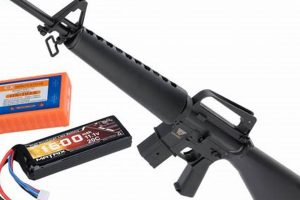
Battery capacity, measured in milliampere-hours (mAh), dictates the duration of operation. The discharge rate, measured in C-rating, indicates the battery’s ability to deliver current. Higher rates of fire demand batteries with both substantial capacity and high discharge rates. A low-capacity battery will quickly deplete, while a battery with an insufficient discharge rate will struggle to provide the necessary current, resulting in sluggish motor performance and inconsistent firing. Utilizing lithium polymer (LiPo) batteries, often preferred for their high energy density and discharge capabilities, necessitates proper handling and charging to mitigate safety risks such as fire or explosion.
- Wiring Gauge and Connectors
The gauge of the wiring determines its capacity to carry electrical current. Thinner wires offer greater resistance, impeding current flow and generating heat. Upgrading to thicker gauge wiring, typically 16AWG or 14AWG, reduces resistance and improves current delivery to the motor, enhancing performance and minimizing the risk of overheating. Similarly, the choice of connectors significantly impacts electrical conductivity. High-quality connectors, such as Deans or XT60 connectors, provide a secure and low-resistance connection, ensuring efficient power transfer. Standard Tamiya connectors, commonly found in stock airsoft guns, are often inadequate for the increased current demands of modified systems.
- Fuse Protection
A fuse serves as a safety mechanism, interrupting the electrical circuit in the event of an overcurrent condition. The fuse rating should be appropriately matched to the power requirements of the motor and other electrical components. An undersized fuse will frequently blow, disrupting operation, while an oversized fuse provides inadequate protection against electrical faults. Integrating a MOSFET (Metal-Oxide-Semiconductor Field-Effect Transistor) can further protect the system by regulating the current flow to the motor and preventing damage to the trigger contacts.
- Electronic Trigger Control Systems (ETUs)
ETUs not only enhance trigger response and provide programmable firing modes but also contribute to improved power management. These units often incorporate active braking, which stops the motor immediately after firing, preventing overspin and reducing battery drain. Furthermore, ETUs can offer low-voltage protection, automatically disconnecting the battery when it reaches a critical voltage level, preventing damage and extending its lifespan. Implementing an ETU enhances the overall efficiency and reliability of the electrical system in a simulated automatic weapon.
These power supply augmentation facets work in concert to guarantee a stable and sufficient power source for an airsoft automatic weapon. Each element, from battery selection to wiring upgrades and protective circuitry, plays a vital role in optimizing performance and safeguarding against potential electrical failures. Attention to these details is essential for a successful conversion, as a robust and reliable power supply underpins the functionality and longevity of the entire system.
6. Legal Compliance

The intersection of legal compliance and the construction of simulated automatic weapons for airsoft is a critical juncture, demanding meticulous consideration. The act of modifying an airsoft replica to mimic automatic firing capabilities frequently alters its operational characteristics, potentially bringing it into conflict with established regulations. These regulations, typically enacted at the local, regional, or national level, govern the permissible velocity, appearance, and usage of airsoft devices. Failure to adhere to these legal frameworks can result in severe penalties, including fines, confiscation of equipment, and even legal prosecution.
The specific laws governing airsoft weapons vary significantly across jurisdictions. Some regions impose restrictions on the maximum allowable muzzle velocity, often expressed in feet per second (FPS) or meters per second (MPS). Other regulations focus on the external appearance of the replica, prohibiting modifications that render it indistinguishable from a real firearm. Examples include restrictions on painting airsoft guns specific colors or altering their overall dimensions. Furthermore, many jurisdictions mandate the use of blaze orange barrel tips or other readily visible markings to clearly identify the device as a non-lethal training tool. Airsoft events and fields often have their own specific rules that build upon these legal requirements.
In conclusion, the pursuit of simulated automatic weapon functionality in airsoft must be tempered by a thorough understanding and unwavering adherence to all applicable legal requirements. Legal compliance is not merely a peripheral consideration but a fundamental prerequisite for responsible modification. Disregarding these legal constraints carries significant risks and undermines the legitimacy of the airsoft hobby as a whole. Therefore, diligent research and responsible modification practices are essential for ensuring legal and ethical participation in airsoft activities. The complexities involving “how to make a airsoft machine gun” demands more caution.
Frequently Asked Questions
This section addresses common inquiries regarding the technical aspects and potential challenges associated with modifying airsoft replicas to simulate automatic weapon functionality.
Question 1: Is it legally permissible to modify an airsoft gun to fully automatic?
The legality of such modifications varies considerably depending on jurisdictional regulations. Modifying an airsoft gun to fully automatic may violate laws pertaining to replica firearms or airgun classifications, potentially incurring legal penalties. It is incumbent upon individuals to research and comply with all applicable local, regional, and national laws before undertaking any modifications.
Question 2: What are the key components required for an airsoft automatic weapon conversion?
Essential components typically include a high-torque motor, reinforced gearbox, high-discharge battery, electronic trigger unit (ETU), and upgraded wiring. The selection and compatibility of these components directly impact the system’s performance and reliability. Proper component selection is crucial for avoiding malfunctions and ensuring optimal operation.
Question 3: How does gearbox reinforcement contribute to the functionality of the airsoft automatic weapon?
Gearbox reinforcement is essential due to the increased stress associated with rapid cycling. The gearbox shell, gears, piston, and spring guide are subjected to significantly greater forces at higher rates of fire. Upgrading these components with reinforced materials prevents premature wear, breakage, and catastrophic mechanical failure.
Question 4: What safety precautions should be observed during the modification process?
Eye protection is mandatory throughout the modification process. Working with electrical components necessitates caution to prevent short circuits or electrical shock. Adequate ventilation is required when using adhesives, lubricants, or solvents. It is prudent to thoroughly test the modified system in a controlled environment before using it in airsoft games.
Question 5: How does air seal optimization impact the performance of an airsoft automatic weapon?
An efficient air seal is critical for maintaining consistent power output and accuracy. Air leaks diminish the amount of air compressed and delivered to propel the BB, resulting in reduced range and velocity. Optimizing the air seal through component upgrades and meticulous assembly is essential for achieving the desired performance characteristics.
Question 6: What are the ethical considerations surrounding modifications to replicate automatic weapons?
Modifications should be performed responsibly and with consideration for the safety of oneself and others. Maintaining a clear distinction between airsoft replicas and real firearms is paramount to prevent confusion or misidentification. Modifications should not be used to circumvent legal restrictions or gain an unfair advantage in airsoft games. Promote safe use.
In summary, the construction of simulated automatic weapons within the realm of airsoft demands a thorough understanding of technical principles, a commitment to safety, and unwavering adherence to legal regulations.
The subsequent section will explore alternatives to direct modification, examining commercially available airsoft guns designed to replicate automatic weapon functionality.
Concluding Assessment
The endeavor to increase the rate of fire of an airsoft replica, often described as “how to make a airsoft machine gun,” presents a complex undertaking. Success hinges on technical proficiency, a meticulous approach to safety, and strict adherence to legal statutes. The aforementioned considerations surrounding gearbox reinforcement, motor upgrades, rate-of-fire control, air seal optimization, power supply augmentation, and legal compliance are not mere suggestions but foundational prerequisites for responsible and effective modification.
While the allure of a higher rate of fire in airsoft engagements is undeniable, the long-term consequences of irresponsible modification extend beyond mere performance degradation. Ethical considerations regarding safety, fair play, and the potential for legal repercussions must temper the pursuit of simulated automatic weapon functionality. Prudence, thoroughness, and a commitment to responsible practices should govern any attempt to alter the operational characteristics of airsoft replicas.