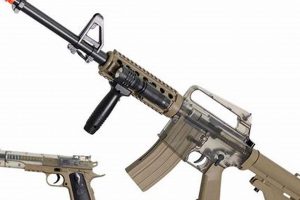
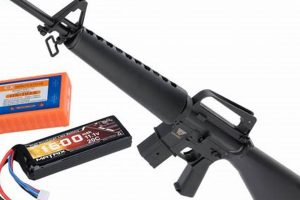
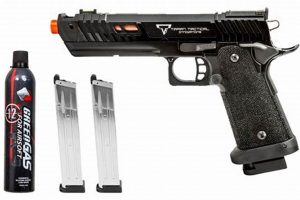
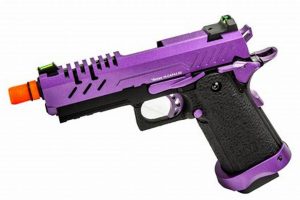
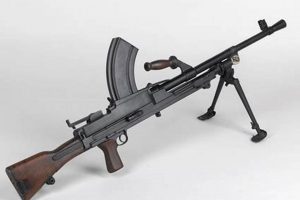
The term refers to a specific type of airsoft replica designed to resemble a light machine gun, often chambered in 6mm BBs. These replicas mimic the appearance and, to some extent, the function of squad automatic weapons employed in military and law enforcement contexts. A common example is a modified airsoft rifle with a high-capacity magazine and a bipod, intended for sustained suppressive fire during simulated combat.
The significance of these replicas lies in their role within airsoft skirmishes, providing players with the capability to lay down a high volume of fire. This can be strategically important for covering team advances, suppressing enemy positions, and controlling key areas of the playing field. Historically, these replicas have become increasingly popular as airsoft technology has advanced, allowing for higher rates of fire and greater accuracy in these support weapons.
The following sections will explore the selection criteria, operation, maintenance, and safety considerations related to these airsoft replicas in greater detail, offering a comprehensive guide for enthusiasts and experienced players alike.
Effective Utilization in Airsoft Skirmishes
This section presents practical guidance for optimizing performance when deploying a replica designed to mimic a light machine gun in airsoft scenarios. Understanding the nuances of its operation and tactical application is crucial for maximizing its effectiveness.
Tip 1: Prioritize Bipod Deployment: Stable firing platforms are critical for accuracy. Ensure the bipod is properly deployed on a level surface to minimize muzzle climb and maintain target acquisition during sustained fire.
Tip 2: Manage Ammunition Consumption: These replicas often have high rates of fire, leading to rapid ammunition depletion. Pre-planning and carrying sufficient magazines, or utilizing a box magazine, is essential to avoid being caught without the ability to engage.
Tip 3: Master Controlled Bursts: While capable of fully automatic fire, controlled bursts of 3-5 rounds maximize accuracy and conserve ammunition. This technique is particularly effective at medium to long ranges.
Tip 4: Understand Effective Range: These replicas typically have a shorter effective range compared to sniper rifles or DMRs. Utilize their suppressive capabilities to support advancing teammates within that range.
Tip 5: Maintain Awareness of Overheating: High rates of fire can cause some airsoft guns to overheat. Monitor performance and allow for cooling periods to prevent damage to internal components.
Tip 6: Communicate with Your Team: Coordinate firing patterns with teammates to provide continuous cover and prevent friendly fire incidents. Clear communication is paramount to successful utilization.
Tip 7: Adapt to the Environment: Adjust firing tactics based on the terrain and obstacles. Use cover and concealment to maximize survivability while maintaining suppressive fire.
Adhering to these guidelines will enhance the user’s proficiency and tactical effectiveness when utilizing an airsoft replica designed to mimic a light machine gun, contributing to improved team performance and overall gameplay.
The following sections will delve into the maintenance requirements and potential modifications for this type of airsoft gun, offering insights into optimizing its long-term performance and customization options.
1. Suppressive Fire Capability

The core function of an airsoft replica designed to mimic a squad automatic weaponoften identified by the keywordis its suppressive fire capability. This denotes the weapon’s ability to deliver a high volume of BBs downrange, effectively discouraging or pinning down opposing players. The practical effect is to create a tactical advantage, allowing teammates to advance, flank, or otherwise maneuver while the opposing force is forced to remain in cover. For example, a team might utilize this function to cover a breach into a fortified position, limiting the defenders’ ability to effectively target the advancing assault team.
The effectiveness of this capability is intrinsically linked to the airsoft gun’s design and construction. Factors such as rate of fire, magazine capacity, and hop-up system all contribute to the weapon’s ability to consistently and accurately deliver a barrage of BBs. A higher rate of fire translates to more BBs in the air per unit of time, increasing the likelihood of hitting the target and maintaining pressure. Larger magazine capacities reduce the frequency of reloading, allowing for sustained fire. A well-tuned hop-up system ensures consistent trajectory, increasing the probability of hitting targets at longer ranges. The interplay of these elements directly impacts the overall suppressive potential of the replica.
In conclusion, the suppressive fire capability is not merely a feature of this airsoft gun; it is the defining characteristic that dictates its role and value on the airsoft field. Understanding the mechanics behind this capability and how it is affected by various design elements is critical for both selecting an appropriate replica and employing it effectively in tactical scenarios. Challenges in achieving optimal suppressive fire often stem from balancing rate of fire with ammunition consumption, highlighting the need for careful planning and resource management during gameplay.
2. Magazine Capacity Limitations

The capacity of a magazine directly impacts the effectiveness of an airsoft gun designed to mimic a light machine gun. Limitations on magazine size constrain the weapon’s capacity for sustained fire, a crucial element of its intended role on the airsoft field.
- Reduced Suppressive Fire Duration
Lower capacity magazines necessitate more frequent reloading, disrupting the continuity of suppressive fire. This increased downtime allows opposing players to reposition or return fire, negating the advantage gained from the weapon’s high rate of fire. For example, a box magazine holding 2500 rounds will provide significantly longer suppressive fire duration than a standard hi-cap magazine holding 300 rounds.
- Tactical Reloading Requirements
Frequent reloads require meticulous planning and tactical awareness. The user must identify safe moments for reloading, potentially exposing themselves to enemy fire. Furthermore, the need to carry and manage a large number of magazines can add to the user’s encumbrance, affecting mobility and overall combat effectiveness. Consider a situation where the airsoft gunner is providing cover fire for their team’s advance. If they have to reload frequently, the team may be left vulnerable and lose their momentum.
- Impact on Role Performance
The role of an airsoft gunner using this type of airsoft replica is typically to provide sustained cover fire, suppress enemy positions, and control key areas. Limited magazine capacity directly hinders the ability to fulfill this role effectively. A gunner constantly reloading cannot effectively suppress the opposition, thus diminishing their value to the team. A balance must be struck between rate of fire and magazine size to optimize performance.
- Design and Legal Constraints
Magazine capacity is influenced by both design considerations and legal restrictions. Real-world firearms often have capacity limitations imposed by law, which are sometimes reflected in airsoft replicas for realism or to comply with local regulations. The internal mechanics of the replica, such as the feeding mechanism, can also limit the maximum capacity achievable. These combined constraints often require the user to adapt their playstyle to the limitations imposed by the magazine capacity.
Ultimately, the magazine capacity of this airsoft gun dictates the length of engagements possible without interruption. Balancing the desire for high capacity with the practical considerations of weight, reload time, and regulatory compliance is critical for optimal utilization of the replica on the airsoft field. Addressing these limitations, such as through careful magazine management or modifications within legal and ethical boundaries, can significantly improve the effectiveness of the replica in its intended role.
3. Rate of Fire Regulation

Rate of fire regulation in airsoft replicas designed to mimic squad automatic weapons is a critical factor influencing not only gameplay dynamics but also legality and the operational lifespan of the replica itself. Understanding the mechanics and implications of rate of fire is essential for responsible ownership and effective utilization.
- Mechanical and Electronic Limiting Mechanisms
Many airsoft replicas designed to mimic squad automatic weapons incorporate mechanisms to regulate the rate of fire. These mechanisms can be mechanical, such as adjustable tappet plates or modified gears, or electronic, using MOSFETs or electronic control units (ECUs) to control the firing cycle. For instance, an ECU might be programmed to limit the number of BBs fired per second, regardless of the trigger pull speed. The presence of these mechanisms allows players to adhere to field regulations or to prevent excessive wear and tear on the internal components of the airsoft gun.
- Field Regulations and Legal Restrictions
Airsoft fields frequently impose rate-of-fire limits, often expressed in BBs per second (BB/s) or rounds per minute (RPM), to ensure fair play and prevent injuries. Some jurisdictions may have legal restrictions on the maximum allowable rate of fire for airsoft guns. Failure to comply with these regulations can result in expulsion from the field or legal penalties. For example, an airsoft field might limit automatic weapons to 20 BB/s to minimize the risk of welts and injuries from close-range engagements.
- Impact on Internal Component Stress and Longevity
Unregulated high rates of fire can place significant stress on the internal components of the airsoft gun, leading to premature wear and potential failures. The gearbox, motor, and piston are particularly susceptible to damage from the rapid cycling associated with high rates of fire. Rate of fire regulation can mitigate this stress, extending the lifespan of the replica. For instance, limiting the rate of fire from 30 BB/s to 20 BB/s can drastically reduce the stress on the piston and gears, increasing their operational life.
- Trade-offs Between Rate of Fire and Accuracy
While a high rate of fire can be advantageous for suppressive fire, it can also negatively impact accuracy. At extremely high rates of fire, the hop-up system may not have sufficient time to consistently impart backspin to each BB, resulting in inconsistent trajectories and reduced accuracy. Furthermore, the user may find it more difficult to control the weapon and maintain a steady aim during sustained bursts of fire. Rate of fire regulation can help strike a balance between suppressive fire capability and accuracy.
These facets underscore the complex interplay between rate of fire, regulation, and the overall performance of an airsoft gun mimicking a squad automatic weapon. Responsible players and technicians must understand these considerations to ensure safe, fair, and sustainable utilization of these airsoft replicas.
4. Weight and Maneuverability
The physical attributes of weight and maneuverability profoundly influence the operational effectiveness of an airsoft replica designed to mimic a squad automatic weapon. The relationship is causal: increased weight diminishes maneuverability, and conversely, reduced weight enhances it. The importance of striking an appropriate balance between these two characteristics is paramount, as it directly impacts the user’s ability to effectively deploy the airsoft gun in diverse combat scenarios. A lighter replica allows for quicker transitions between firing positions and improved mobility in confined spaces, while excessive weight can lead to fatigue and reduced reaction times. For instance, a player navigating a dense, wooded area will benefit from a lighter, more maneuverable replica, enabling them to quickly engage targets from cover. Conversely, a heavier replica might offer greater stability and perceived realism but could hinder movement during prolonged engagements.
The material composition and design of the airsoft replica significantly contribute to its overall weight. Full metal constructions, while offering increased durability and a more realistic aesthetic, typically weigh considerably more than those constructed primarily from polymer. The inclusion of accessories such as scopes, bipods, and high-capacity magazines further adds to the total weight, influencing the user’s agility on the field. The placement of the center of gravity is also a critical factor; a replica with an uneven weight distribution can be unwieldy and difficult to control, especially during rapid movements or transitions. This practical significance is evident in competitive airsoft scenarios where players prioritize lightweight setups to maximize their speed and responsiveness. An example is choosing a polymer-bodied replica with a streamlined profile over a full-metal, heavily accessorized model to gain a tactical advantage in close-quarters combat.
In summary, weight and maneuverability are critical components that directly affect the usability and tactical value of an airsoft replica designed to mimic a squad automatic weapon. The challenge lies in achieving a balance that maximizes both the replica’s suppressive fire capabilities and the user’s ability to effectively maneuver and engage targets within the constraints of the airsoft environment. The informed user will carefully consider these factors when selecting and configuring their airsoft gun to optimize their performance on the field.
5. Bipod Deployment Stability

Bipod deployment stability is inextricably linked to the operational effectiveness of a saw airsoft gun. The core purpose of these replicas the simulation of sustained suppressive fire necessitates a stable firing platform. The instability introduced by inadequate bipod deployment directly undermines the accuracy and consistency required for effective suppression. If a bipod is deployed on an uneven surface or lacks a secure grip, the resulting movement during firing translates to dispersed BB impacts, rendering the airsoft gun less effective in its intended role. For example, attempting to use a saw airsoft gun with a poorly deployed bipod on loose gravel will invariably lead to inaccurate shots and a failure to effectively pin down opposing players.
The design and construction of the bipod itself also play a crucial role in achieving stability. Features such as adjustable leg lengths, rubberized feet, and robust locking mechanisms contribute to a more secure and adaptable platform. Furthermore, the interface between the bipod and the airsoft gun’s rail system must be solid and free from wobble. Insufficient tightening or a poorly designed mounting system can compromise stability, regardless of the terrain. This practical application is demonstrated by the contrast between a high-quality, adjustable bipod securely attached to a picatinny rail system and a cheap, flimsy bipod loosely clamped onto the barrel; the former provides a stable base for accurate fire, while the latter offers minimal improvement over firing unsupported.
In conclusion, bipod deployment stability is not merely a desirable attribute but a fundamental requirement for maximizing the performance of a saw airsoft gun. The consistent and accurate delivery of suppressive fire hinges on the ability to establish a stable firing platform. Challenges in achieving optimal stability, such as uneven terrain or inadequate bipod design, must be addressed through careful selection of equipment and diligent deployment techniques. This understanding reinforces the broader theme of responsible and effective utilization of airsoft replicas in simulated combat scenarios.
6. Ammunition Type Compatibility

Ammunition type compatibility is a critical determinant of performance and longevity for any saw airsoft gun. These airsoft replicas are specifically designed to operate with 6mm BBs, typically constructed from plastic or biodegradable materials. Deviations from this standard can lead to significant operational issues. The use of BBs that are too large can cause jamming, damage to internal components, and inconsistent firing. Conversely, BBs that are too small may not properly engage the hop-up system, resulting in reduced range and accuracy. For example, attempting to load 8mm BBs into a 6mm saw airsoft gun will almost certainly result in a malfunction and potential damage to the magazine and feeding mechanism.
The weight and quality of the 6mm BBs used also influence the overall performance of a saw airsoft gun. Heavier BBs, generally ranging from 0.25g to 0.30g, are often preferred for outdoor scenarios as they are less susceptible to wind drift and maintain their trajectory over longer distances. However, these heavier BBs may require a more powerful hop-up system to achieve optimal range and accuracy. Lighter BBs, such as 0.20g, are more suitable for indoor environments where shorter engagement distances and less wind interference are factors. The selection of appropriate BB weight is crucial for maximizing the effectiveness of the saw airsoft gun. A practical illustration involves choosing heavier BBs for an outdoor field with moderate wind conditions, ensuring that the replica maintains a consistent and accurate trajectory even when firing across longer distances, as opposed to lighter BBs that would be significantly affected by the wind.
In conclusion, ammunition type compatibility is not merely a technical specification; it is a foundational element that dictates the reliability, accuracy, and operational lifespan of a saw airsoft gun. Challenges in achieving optimal compatibility often stem from the use of substandard or incorrect ammunition. Adhering to the manufacturer’s recommended specifications regarding BB size, weight, and material composition is essential for ensuring consistent performance and preventing damage to the airsoft replica. This understanding reinforces the importance of informed decision-making and responsible ownership in the realm of airsoft.
7. Internal Component Durability
The operational lifespan and consistent performance of a saw airsoft gun are fundamentally determined by the durability of its internal components. These components, subjected to repeated stress during operation, must withstand significant forces to ensure reliable function. The following points detail key aspects of internal component durability in the context of these airsoft replicas.
- Gearbox Stress Resistance
The gearbox is the heart of a saw airsoft gun, housing the gears, piston, and other critical parts that drive the firing mechanism. A durable gearbox must withstand the high stress associated with the rapid cycling of these components, particularly during sustained automatic fire. Gearboxes constructed from reinforced materials, such as high-grade aluminum alloys, are better equipped to resist cracking or deformation under stress. The implementation of steel bushings or bearings further reduces friction and wear on the gears, enhancing their longevity. Inadequate gearbox durability can result in catastrophic failures, rendering the airsoft gun inoperable.
- Piston and Piston Head Integrity
The piston and piston head are subjected to repeated impact within the cylinder during each firing cycle. A durable piston must resist cracking, stripping, or deformation under these stresses. Pistons constructed from high-impact polymers or reinforced composites are commonly employed to enhance their resistance to wear. The piston head, responsible for sealing the cylinder and transferring energy to the BB, must also maintain its integrity over time. Using pistons with metal teeth helps prevent stripping, a common failure point in high-stress applications.
- Motor Endurance and Heat Dissipation
The motor provides the power necessary to drive the gearbox and initiate the firing cycle. A durable motor must withstand repeated use without overheating or experiencing premature failure. Motors with high-torque designs and efficient heat dissipation are better suited for sustained automatic fire. The use of high-quality brushes and windings further extends the motor’s lifespan. Overheating can lead to demagnetization of the motor, resulting in reduced performance or complete failure.
- Hop-Up Unit Material Strength
The hop-up unit imparts backspin to the BB, influencing its range and accuracy. A durable hop-up unit must maintain its shape and functionality over time, even with repeated adjustments and exposure to environmental factors. Units constructed from metal alloys are typically more resistant to wear and deformation than those made from plastic. The hop-up bucking, a small rubber component that contacts the BB, must also be durable enough to withstand repeated friction without tearing or losing its elasticity.
These facets underscore that internal component durability is paramount to the reliable and sustained operation of a saw airsoft gun. Compromises in component quality directly translate to reduced performance, increased maintenance requirements, and a shorter operational lifespan. Therefore, selection of a replica with robust internal components is a critical consideration for any airsoft enthusiast seeking long-term performance and reliability.
Frequently Asked Questions
The following questions address common concerns and provide clarity regarding the use, legality, and performance characteristics of airsoft replicas designed to mimic squad automatic weapons, sometimes referred to using the keyword.
Question 1: Is it legal to own a replica described by the keyword?
Legality varies by jurisdiction. Many regions permit ownership provided the replica is visibly marked with orange tips or other identifying features to distinguish it from a real firearm. Local laws should be consulted to ensure compliance.
Question 2: What is the typical effective range of a replica matching the keyword?
Effective range typically falls between 100-200 feet, depending on the model, hop-up configuration, and ammunition weight. Factors such as wind and terrain also impact range.
Question 3: How often does a replica described by the keyword require maintenance?
Maintenance frequency depends on usage. Regular cleaning after each use, lubrication of moving parts, and periodic inspection for wear are recommended to ensure optimal performance and longevity.
Question 4: Can a replica described by the keyword be modified to increase its rate of fire?
Modifications may be possible, but should be approached with caution. Increasing the rate of fire can place undue stress on internal components, potentially leading to premature failure. Additionally, exceeding field limits for rate of fire is often prohibited.
Question 5: What type of ammunition is recommended for a replica matching the keyword?
6mm BBs are the standard ammunition type. The weight should be chosen based on the intended use and environment, with heavier BBs generally preferred for outdoor scenarios with wind.
Question 6: What safety precautions should be observed when using a replica described by the keyword?
Eye protection is mandatory for all participants. Responsible handling, adherence to field rules, and awareness of surroundings are essential to prevent injuries and ensure safe gameplay. Never aim at individuals who are not participating in the airsoft activity.
These FAQs provide a foundational understanding of these types of airsoft replicas. Prioritize safety and responsible ownership above all else.
The following sections will offer guidance on responsible ownership, ethical gameplay, and ongoing education within the airsoft community.
Concluding Remarks
The preceding analysis has provided a comprehensive overview of the airsoft replica designed to mimic a squad automatic weapon. Key considerations include magazine capacity limitations, rate of fire regulation, weight and maneuverability, bipod deployment stability, ammunition type compatibility, and internal component durability. These factors directly influence the performance, reliability, and legal compliance of the replica, dictating its suitability for various airsoft scenarios.
The responsible ownership and utilization of any device in this category necessitate a commitment to safety, ethical gameplay, and adherence to local regulations. Continued education within the airsoft community remains crucial for fostering a culture of responsible practices and informed decision-making. The long-term viability of the sport depends on the integrity and conduct of its participants.