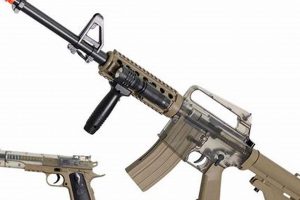
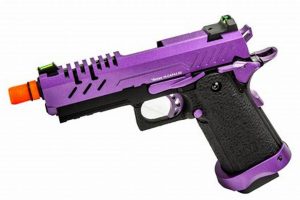
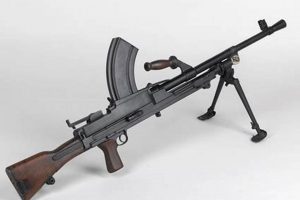
This specific type of replica firearm is designed to simulate the appearance and functionality of a designated marksman rifle, typically chambered in 7.62x51mm NATO. These replicas are commonly used in recreational simulations, military training exercises, and historical reenactments. They utilize compressed gas or electric power to propel plastic projectiles.
Such replicas allow enthusiasts to engage in tactical simulations and target shooting activities in a controlled environment. The weight, dimensions, and operational features offer a more realistic experience for those seeking to improve marksmanship skills or participate in scenario-based games. The use of this type of replica can also provide insights into the handling characteristics of the firearm it emulates, though it is critical to remember that these replicas do not possess the same lethality or destructive potential as their real-world counterparts.
The following sections will delve into the specifications, performance characteristics, customization options, and safety guidelines associated with this particular type of recreational firearm, providing a detailed overview for both novice and experienced users.
Essential Usage Considerations
This section offers imperative guidance on maximizing the performance and lifespan of the designated replica, along with crucial safety protocols for its responsible use.
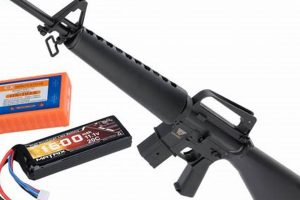
Tip 1: Battery Maintenance: Employ a smart charger designed for the specific battery type utilized (e.g., LiPo, NiMH). Overcharging or undercharging can significantly reduce battery capacity and lifespan. Regularly check battery voltage with a multimeter.
Tip 2: Hop-Up Adjustment: Fine-tune the hop-up unit to achieve optimal projectile trajectory. Excessive hop-up causes overspin and reduced range, while insufficient hop-up results in downward projectile trajectory. Gradual adjustments are recommended.
Tip 3: Barrel Cleaning: Regularly clean the inner barrel with a cleaning rod and silicone oil. Accumulation of debris can negatively impact accuracy and projectile velocity. Ensure the barrel is completely dry before reassembly.
Tip 4: Gearbox Maintenance: Periodically inspect the gearbox for signs of wear or damage. Re-lubricate gears with high-quality grease to minimize friction and extend component lifespan. Consider professional servicing for complex repairs.
Tip 5: Secure Storage: Store the replica in a secure location, away from unauthorized access. Remove the battery and magazine before storage. A padded case can prevent damage during transport.
Tip 6: Safety Gear: Always wear appropriate eye protection and face protection during use. This mitigates the risk of serious injury from projectile impact. Encourage other participants to do the same.
Tip 7: Ammunition Selection: Utilize high-quality, seamless projectiles of the recommended weight (typically 0.20g – 0.28g). Low-quality projectiles can damage internal components and negatively affect accuracy.
Adherence to these maintenance and safety procedures is paramount for ensuring both the longevity of the equipment and the well-being of all participants involved in recreational simulations.
The concluding section will summarize key characteristics and explore future trends within this area of recreational simulation.
1. Designated Marksman Role

The designated marksman role, in the context of simulated combat, defines a specific operational niche fulfilled by certain replica firearms. The selection of the replica is often predicated on its suitability for this role. This section explores key facets of this connection.
- Enhanced Range and Accuracy
The designated marksman role necessitates engaging targets at distances exceeding those typically addressed by standard assault rifle replicas. Replicas designed for this role, therefore, prioritize accuracy and range through features such as longer barrels, enhanced hop-up units, and the potential for magnified optics. This contrasts with standard rifle replicas, which are often optimized for close-to-medium range engagements.
- Support and OverWatch
The marksman provides supporting fire, offering overwatch for advancing teams. This replica facilitates that support by being able to engage targets that would otherwise pose a threat. An example is suppressing enemy positions to allow teammates to advance or flanking enemy players.
- Target Prioritization
Individuals utilizing these replicas are often tasked with prioritizing targets that pose a significant threat or offer a strategic advantage. These targets might include opposing marksmen, support gunners, or individuals holding key positions. The replica’s enhanced accuracy allows for precise engagement of these critical targets, shifting the balance of power within the simulation.
- Customization and Upgrades
The designated marksman role frequently necessitates extensive customization and upgrades to enhance the replica’s performance. This may involve installing precision inner barrels, reinforced gearboxes, or high-torque motors to improve accuracy, reliability, and range. Such upgrades transform a standard replica into a specialized platform optimized for the demands of the designated marksman role.
The aforementioned facets demonstrate the crucial link between the designated marksman role and the selection, configuration, and utilization of specific replicas. These examples illustrate how its enhanced range and accuracy, specialized training, target prioritization, and potential for customization collectively contribute to its effectiveness in this critical role within simulated combat environments. It should be compared to other replicas to assess which one is best for a certain role.
2. Realistic Replica Weight

The weight of a replica firearm is a significant factor contributing to its overall realism and user experience. In the context of a replica, this attribute goes beyond mere aesthetics; it influences handling, maneuverability, and training value.
- Enhanced Realism and Immersion
A weight closely approximating the real firearm enhances the sense of realism during recreational simulations or training exercises. This creates a more immersive experience, allowing participants to better replicate the challenges and nuances of handling the actual firearm. For instance, a properly weighted replica feels more authentic in the hands, encouraging more realistic manipulation and aiming techniques.
- Training and Muscle Memory Development
Replica weight plays a crucial role in developing muscle memory for proper firearm handling. The weight distribution affects how the firearm is shouldered, aimed, and controlled during movement. Consistent training with a replica of similar weight to the real firearm can translate to improved proficiency with the real firearm, particularly in areas such as recoil management and target acquisition. The weight can mimic this function.
- Impact on Maneuverability and Fatigue
A replica with a substantial weight can affect the user’s maneuverability and contribute to fatigue during extended use. Replicas that accurately reflect the weight of their real counterparts present a more accurate representation of the physical demands associated with carrying and operating the real firearm. This is particularly relevant for those engaged in tactical simulations or military training scenarios.
- Material Composition and Construction
Achieving realistic weight often necessitates the use of specific materials and construction techniques. Manufacturers may employ metal alloys, high-density polymers, or internal weighting mechanisms to replicate the heft and balance of the real firearm. The choice of materials directly impacts both the replica’s weight and its durability.
Therefore, the accurate replication of weight is a critical element in ensuring that these recreations provide a valuable and authentic experience, whether for recreational or training purposes. The weight contributes significantly to the overall realism, handling characteristics, and training potential of the replica, thereby enhancing its value to enthusiasts and professionals alike.
3. Upgrade Potential Assessment
The upgrade potential of a replica firearm is a significant consideration for many users. Assessing this potential involves evaluating the compatibility of internal and external components with aftermarket parts, the availability of those parts, and the complexity of the installation process. For a replica emulating a designated marksman rifle, such as the M110, the ability to enhance performance through upgrades is often a key factor in its long-term appeal and effectiveness in simulated scenarios. A comprehensive upgrade potential assessment informs the user about the feasibility of improving aspects like accuracy, range, reliability, and rate of fire. The assessment should involve researching available upgrade parts and consulting with experienced technicians.
Specifically, a user might consider upgrading the internal barrel for improved precision, replacing the hop-up unit for enhanced range adjustment, or installing a more robust gearbox to handle higher-stress applications. The frame should also be able to handle stress and more torque. Evaluating the ease with which these modifications can be implemented is crucial. Some replicas are designed with proprietary parts or require extensive modification for aftermarket components to function correctly. Thorough research of compatibility issues and the availability of detailed installation guides is essential before undertaking any upgrades. The purpose for each upgrade should also be a factor.
In summary, the upgrade potential assessment is an integral component of owning and maintaining a replica, and especially critical for a designated marksman rifle replica due to the performance demands associated with its role. The user must weigh the costs and benefits of each potential upgrade, considering the complexity of installation and the overall improvement to the replica’s capabilities. This assessment ensures the replica continues to meet the user’s evolving needs and expectations over time.
4. Gas/Electric Power Source

The operational mechanism of a replica designated marksman rifle critically hinges on its power source, typically categorized as either gas-powered or electric. These two power sources dictate fundamental aspects of the replica’s performance, maintenance requirements, and overall user experience. The choice between gas and electric is a primary determinant of factors such as projectile velocity, consistency, and the ability to operate under varying environmental conditions. As an example, a gas-powered replica often provides a more realistic recoil impulse, simulating the action of a genuine firearm, whereas an electric-powered replica typically offers greater consistency in projectile velocity due to its regulated power output.
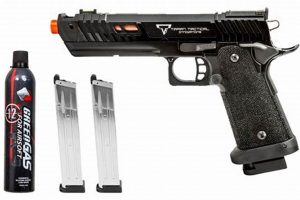
Gas-powered replicas utilize compressed gas, such as green gas or CO2, to propel projectiles. These systems often provide higher initial projectile velocities and a more pronounced recoil sensation, enhancing the realism of the simulation. However, performance can be affected by temperature variations; colder temperatures typically reduce gas pressure, leading to lower projectile velocities. Electric-powered replicas, conversely, employ rechargeable batteries to power an electric motor that drives an internal piston and air compression system. These replicas generally offer more consistent performance across a wider range of temperatures and require less frequent refilling compared to gas-powered models. The gas/electric source affects rate of fire, velocity, and range of a replica.
Ultimately, the selection of a gas or electric power source for a replica designated marksman rifle depends on the user’s priorities and intended application. Gas-powered replicas may be favored by those seeking a more realistic simulation experience, while electric-powered replicas may be preferred for their consistency and ease of maintenance. Understanding the specific characteristics and limitations of each power source is essential for making an informed decision and maximizing the performance and longevity of the replica. Both power sources provide their own set of advantages for different users.
5. Long-Range Accuracy Focus
The design and utilization of the replica in question are intrinsically linked to the pursuit of accuracy at extended ranges. This focus dictates specific design choices, operational considerations, and the overall effectiveness of the replica in simulated combat scenarios. Accuracy at extended ranges is not merely a desirable attribute; it is a defining characteristic of the role the replica is intended to fulfill.
- Enhanced Internal Components
Achieving long-range accuracy necessitates the integration of precision internal components, such as high-quality inner barrels with tight bores and consistent hop-up units. These components work in concert to minimize projectile deviation and maximize the effective range of the replica. The tight bore minimizes air leakage. A standard replica intended for close-quarters engagements would typically utilize less precise components optimized for rate of fire rather than accuracy.
- Optimized Hop-Up Systems
The hop-up unit plays a crucial role in extending the range of projectiles by imparting backspin, which counteracts the effects of gravity. Replicas designed for long-range accuracy often feature advanced hop-up systems that allow for precise adjustments, enabling users to fine-tune the projectile trajectory for optimal range and accuracy. An improperly adjusted hop-up can severely limit the effective range and accuracy of the replica.
- Stable Firing Platform
Maintaining a stable firing platform is essential for achieving consistent long-range accuracy. This can be accomplished through the use of bipods, sturdy stocks, and ergonomic grips that minimize movement during firing. A stable platform reduces the influence of user error, allowing the replica’s inherent accuracy to be fully realized. Without a stable platform, even the most accurate replica will struggle to deliver consistent results at extended ranges.
- High-Quality Projectiles
The quality of the projectiles used directly impacts the accuracy and range of the replica. High-quality projectiles exhibit consistent weight, shape, and surface finish, minimizing aerodynamic drag and ensuring a predictable trajectory. The use of substandard projectiles can lead to significant deviations in accuracy and range, negating the benefits of other performance-enhancing upgrades.
In summation, the emphasis on long-range accuracy fundamentally shapes the design, components, and utilization of this replica. The integration of precision internal components, optimized hop-up systems, a stable firing platform, and high-quality projectiles collectively contribute to its effectiveness in engaging targets at extended ranges. This focus distinguishes the replica from those designed for close-quarters engagements and defines its role as a designated marksman platform.
Frequently Asked Questions About the M110 Airsoft Gun
The following section addresses common inquiries and misconceptions regarding the M110 airsoft gun, providing factual information to aid in understanding its capabilities and limitations.
Question 1: What is the typical effective range of the M110 airsoft gun?
The effective range of the M110 airsoft gun varies depending on factors such as internal upgrades, hop-up adjustments, and environmental conditions. However, a well-maintained and properly upgraded model can typically achieve accurate shots at distances of 200 feet or more.
Question 2: Does the M110 airsoft gun require specialized maintenance?
Like all airsoft guns, the M110 benefits from regular maintenance to ensure optimal performance and longevity. This includes cleaning the inner barrel, lubricating internal components, and inspecting for wear or damage. Specific maintenance requirements may vary depending on whether the model is gas-powered or electric.
Question 3: What type of power source is commonly used in the M110 airsoft gun?
The M110 airsoft gun is available in both gas-powered and electric-powered variants. Gas-powered models typically utilize green gas or CO2, while electric models rely on rechargeable batteries. The choice of power source depends on user preferences and desired performance characteristics.
Question 4: Is the M110 airsoft gun suitable for beginners?
While the M110 airsoft gun can be used by beginners, its size and complexity may make it more challenging to handle than smaller, simpler models. Beginners should familiarize themselves with airsoft safety rules and gun handling techniques before using the M110.
Question 5: What types of upgrades are commonly performed on the M110 airsoft gun?
Common upgrades for the M110 airsoft gun include replacing the inner barrel with a precision barrel, upgrading the hop-up unit for improved range, and installing a more powerful motor or gearbox for enhanced performance. The specific upgrades performed will depend on the user’s goals and budget.
Question 6: What are the legal considerations surrounding the ownership and use of the M110 airsoft gun?
Airsoft guns are subject to various federal, state, and local laws. These laws may regulate the sale, possession, and use of airsoft guns, and may require certain safety precautions to be taken. Users should familiarize themselves with all applicable laws and regulations before purchasing or using an M110 airsoft gun.
In summary, the M110 airsoft gun represents a unique and specialized platform within the broader airsoft market. Its effective range, maintenance requirements, power source options, suitability for beginners, upgrade potential, and legal considerations all contribute to its overall value and appeal.
The next section will provide a conclusion, summarizing the key aspects of the M110 airsoft gun and its role within the airsoft community.
Conclusion
The preceding analysis has elucidated the multifaceted characteristics of the M110 airsoft gun. It functions as a replica firearm intended for recreational simulation, tactical training, and historical reenactment. Key attributes encompass the designated marksman role, attempts at realistic weight replication, potential for performance enhancements via aftermarket upgrades, options for gas or electric power sources, and a design emphasis on achieving accuracy at extended ranges. The M110’s unique attributes contribute to its niche within the broader landscape of recreational firearms.
Ultimately, a comprehensive understanding of the M110 requires a discerning evaluation of its capabilities, limitations, and responsible operational practices. Informed decision-making regarding its purchase, maintenance, and use will maximize its value and minimize potential risks. Continued adherence to established safety protocols and applicable legal regulations remains paramount for all users of this type of recreational equipment.