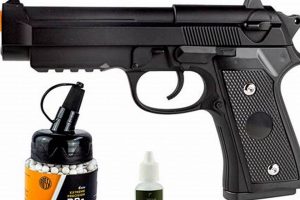
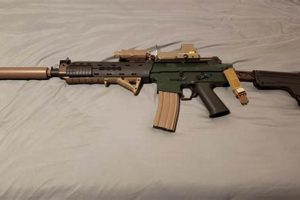
The replicated firearm, closely resembling the iconic Colt 1911 pistol, utilizes compressed gas or spring mechanisms to propel plastic projectiles. These replicas are frequently employed in simulated combat scenarios and target practice, offering a safe alternative to the live-fire version. A common example includes gas blowback models, which mimic the recoil action of the original firearm, enhancing realism during operation.
Its significance lies in providing a realistic training tool for law enforcement, military personnel, and recreational users alike. Benefits encompass honing firearm handling skills, practicing tactical maneuvers, and participating in competitive shooting events without the risks associated with conventional firearms. The historical context of the imitated design, a standard-issue sidearm for the U.S. military for many decades, adds to its appeal and widespread recognition.
Further discussion will address the various types available, performance characteristics, maintenance procedures, and legal considerations pertinent to their use and ownership. Subsequent sections will also delve into the accessories commonly associated with this type of replica and their impact on overall functionality and user experience.
1911 Airsoft
The following section provides valuable insights into optimizing the performance and longevity of 1911 airsoft replicas. Adhering to these guidelines will contribute to a more reliable and enjoyable experience.
Tip 1: Consistent Cleaning: Regular cleaning of the internal components, particularly the barrel and hop-up unit, is essential for maintaining accuracy. Use a silicone-based lubricant sparingly after cleaning to ensure smooth operation.
Tip 2: Proper Gas Selection: Utilizing the appropriate gas type, as specified by the manufacturer, is crucial. Overpressurized gas can damage internal mechanisms, while underpowered gas can result in poor performance.
Tip 3: Magazine Maintenance: Regularly inspect magazines for leaks or damage. Applying a small amount of silicone oil to the magazine valves can prevent leaks and ensure consistent gas flow.
Tip 4: Hop-Up Adjustment: Fine-tune the hop-up unit to achieve optimal range and accuracy with the selected BB weight. Experiment with small adjustments until the desired trajectory is achieved.
Tip 5: Secure Storage: When not in use, store the replica in a cool, dry place away from direct sunlight. This will prevent degradation of the plastic and rubber components.
Tip 6: Check for Loose Screws: Periodically inspect and tighten any loose screws on the frame, sights, or other attachments. Loose screws can affect accuracy and overall structural integrity.
Tip 7: Use Quality BBs: Employ only high-quality, seamless BBs to prevent jams and maintain consistent performance. Avoid using low-quality or reused BBs, as they can damage the internal components.
Implementing these tips will ensure consistent performance, increase lifespan, and provide more satisfaction when using a 1911 airsoft replica.
The subsequent section will cover troubleshooting common issues encountered with this type of replica and their corresponding solutions.
1. Realism

Realism is a paramount consideration in the design and functionality of 1911 airsoft replicas. The pursuit of accurate replication extends beyond mere aesthetics, influencing the training value and immersive experience offered by these devices. This section outlines several facets of realism intrinsic to the 1911 airsoft platform.
- External Appearance and Dimensions
The fidelity to the original firearm’s dimensions and external features is crucial. Manufacturers often strive to replicate the exact size, weight, and markings of the Colt 1911. Examples include faithfully reproduced slide serrations, grip textures, and safety mechanisms. Dimensional accuracy allows for compatibility with real-steel accessories and holsters, enhancing practical training applications.
- Operation and Handling
Realistic operation mirrors the functionality of the genuine firearm. Features such as functioning slide stops, thumb safeties, and grip safeties are frequently incorporated. Gas blowback systems emulate the recoil action, providing tactile feedback during firing. The trigger pull weight and travel distance are also often calibrated to approximate the feel of the original, enhancing the training experience.
- Field Stripping and Maintenance
The ability to disassemble and reassemble the airsoft replica in a manner analogous to the real firearm contributes significantly to realism. Many models allow for field stripping, enabling users to practice maintenance procedures and gain familiarity with the internal components. This aspect is particularly valuable for training purposes, fostering a deeper understanding of firearm mechanics.
- Materials and Construction
The choice of materials influences both the aesthetic and tactile realism of the replica. Metal slides, frames, and outer barrels are frequently employed to replicate the weight and feel of the original firearm. High-quality polymers are used to mimic grip textures and frame components. The overall construction should minimize visible seams and imperfections, further enhancing the authentic appearance.
The composite effect of these elements creates a level of realism that is crucial for both recreational users seeking an immersive experience and professional users employing the replicas for training. This detailed replication extends the utility beyond simple target practice, offering practical training opportunities in weapon manipulation and familiarization. The closer the replica adheres to the original’s characteristics, the greater its value as a training tool.
2. Gas Type
The selection of appropriate propellant gas is a critical determinant in the performance and operational longevity of 1911 airsoft replicas. Different gas types exhibit distinct pressure characteristics, influencing projectile velocity, cycling speed, and potential component stress. Adherence to manufacturer specifications regarding gas compatibility is essential to prevent damage and ensure reliable operation.
- Green Gas
Green gas, primarily composed of propane with silicone additives, is a commonly used propellant in 1911 airsoft replicas. Its moderate pressure output typically provides a balance between performance and component stress. The silicone content helps to lubricate internal components, reducing wear and friction. However, its performance can be temperature-dependent, with lower temperatures resulting in reduced pressure and velocity.
- CO2 (Carbon Dioxide)
CO2 cartridges offer a higher pressure output compared to green gas, resulting in increased projectile velocity. CO2 is typically employed in dedicated CO2-powered 1911 airsoft replicas designed to withstand the higher pressure. However, the increased pressure can also accelerate wear on internal components and seals. Models using CO2 often require more robust construction to accommodate the higher operating pressures.
- Red Gas / Top Gas
Red gas, a higher-pressure variant of green gas, is less common due to its increased potential for damaging standard 1911 airsoft replicas. Its elevated pressure output can cause premature wear or failure of internal components not designed to withstand the stress. Use of red gas is generally reserved for reinforced models specifically designed for high-pressure operation.
- HPA (High-Pressure Air)
HPA systems utilize external compressed air tanks connected to the airsoft replica via a hose. HPA offers adjustable pressure settings, providing greater control over projectile velocity and consistency. HPA systems typically require modifications to the 1911 airsoft replica and are generally more complex than using self-contained gas magazines or cartridges. The advantages are consistant power, reliability, and the option to adjust the pressure.
The proper selection and utilization of propellant gas are crucial for the optimal functioning of 1911 airsoft replicas. Consideration of gas pressure, temperature sensitivity, and compatibility with the replica’s construction is essential to maximize performance, minimize wear, and ensure user safety. Improper gas selection can lead to damage, reduced accuracy, and potential injury. Thus, adherence to manufacturer recommendations and informed decision-making are critical when selecting the appropriate gas type.
3. BB Weight

The mass of the projectile, expressed in grams, fundamentally impacts the performance characteristics of a 1911 airsoft replica. BB weight influences trajectory, range, accuracy, and energy retention. A lighter BB will exhibit a higher initial velocity but experiences greater air resistance, resulting in a shorter effective range and increased susceptibility to wind. Conversely, a heavier BB maintains momentum over a longer distance and resists wind drift more effectively, albeit with a potentially lower initial velocity. The optimal BB weight is contingent upon the replica’s power output, hop-up system, and intended use.
Example applications illustrate the practical significance of BB weight. For close-quarters engagements, lighter BBs, such as 0.20g or 0.23g, offer a flat trajectory and rapid target acquisition. In contrast, outdoor scenarios necessitating longer-range shots benefit from heavier BBs, such as 0.25g or 0.28g. Certain high-performance 1911 airsoft replicas, particularly those utilizing CO2 or upgraded internals, may effectively utilize even heavier BBs, such as 0.30g or 0.32g, to maximize accuracy and range. The hop-up system, a mechanism that imparts backspin to the BB, interacts directly with BB weight. Proper hop-up adjustment is crucial to counterbalance the effects of gravity and air resistance, optimizing trajectory for a given BB weight.
Selecting an inappropriate BB weight can lead to diminished performance and potential replica damage. Using excessively light BBs in a high-powered replica can result in over-hopping, causing the BB to curve upwards dramatically, thereby reducing range and accuracy. Conversely, using excessively heavy BBs in a low-powered replica may lead to under-hopping, causing the BB to drop prematurely. Furthermore, employing low-quality or improperly sized BBs can cause jams and damage to the replica’s internal components. Ultimately, informed selection of BB weight and proper hop-up adjustment are paramount to achieving consistent and effective performance with a 1911 airsoft replica.
4. Construction Material
The structural composition of a 1911 airsoft replica is a primary determinant of its durability, weight, aesthetic fidelity, and overall performance. The selection of materials directly impacts the replica’s resistance to wear, its handling characteristics, and the degree to which it emulates the feel of a real firearm.
- Metal Alloys (Steel, Aluminum)
Metal alloys, particularly steel and aluminum, are frequently employed in the construction of slides, frames, and outer barrels. Steel components offer superior durability and resistance to impact, contributing to the replica’s longevity. Aluminum alloys provide a balance between strength and weight reduction. The use of metal components enhances the realism of the replica, providing a weight and feel similar to that of the real firearm. Examples include full steel slide and frame kits designed to replicate the weight and handling characteristics of a real 1911.
- Polymers (ABS, Nylon-Reinforced)
Polymers, such as ABS (Acrylonitrile Butadiene Styrene) and nylon-reinforced plastics, are commonly used in the construction of grips, frames, and certain internal components. Polymers offer a lightweight and cost-effective alternative to metal alloys. Nylon-reinforced polymers provide enhanced strength and resistance to impact compared to standard ABS. Polymer grips offer comfortable ergonomics and can be textured to provide a secure grip. Polymer frames are often used in lower-cost models or in areas where weight reduction is a primary concern.
- Internal Components (Zinc Alloy, Brass)
Internal components, such as gears, pistons, and valves, are often constructed from zinc alloy or brass. Zinc alloy provides a balance between strength and cost-effectiveness. Brass offers good wear resistance and corrosion resistance. The selection of materials for internal components directly impacts the replica’s reliability and longevity. For example, reinforced steel gears are often used in high-stress applications to prevent premature failure.
- Finish and Coatings (Anodizing, Cerakote)
The application of finishes and coatings enhances the aesthetic appearance and protects the underlying materials from corrosion and wear. Anodizing is commonly used on aluminum components to provide a durable and corrosion-resistant finish. Cerakote, a ceramic-based coating, offers exceptional scratch resistance and is often used on slides and frames to replicate the look and feel of a real firearm’s finish. The application of a quality finish improves the overall durability and aesthetic appeal of the replica.
The interplay of these construction materials dictates the overall quality and performance of a 1911 airsoft replica. A well-constructed replica, utilizing appropriate materials for each component, offers enhanced durability, realistic handling characteristics, and consistent performance. Conversely, a poorly constructed replica, utilizing inferior materials, is prone to premature wear, malfunctions, and a diminished overall experience. Therefore, careful consideration of the construction materials is crucial when selecting a 1911 airsoft replica.
5. Accuracy

Accuracy in 1911 airsoft replicas is a multifaceted attribute encompassing the degree to which projectiles consistently strike a desired point of impact. Its relevance extends to both recreational target shooting and practical training scenarios, dictating the effectiveness of the replica as a simulation tool.
- Barrel Quality and Consistency
The internal barrel is a critical determinant of projectile trajectory. Consistent bore diameter and smooth internal finish minimize friction and turbulence, promoting stable flight. High-quality barrels, often constructed from precision-machined metal, contribute to improved accuracy. For example, tightbore barrels (6.01mm – 6.03mm inner diameter) can enhance consistency by reducing the space between the BB and the barrel wall, but also require better quality BBs to avoid jams. Irregularities in the barrel can impart spin or deviations, leading to inconsistent shot placement.
- Hop-Up System Efficiency
The hop-up system imparts backspin to the projectile, counteracting gravity and extending range. Effective hop-up units provide consistent backspin across multiple shots. Adjustable hop-up mechanisms allow users to fine-tune the backspin to optimize trajectory for different BB weights and ranges. Inefficient hop-up systems can result in inconsistent spin, leading to erratic shot patterns. Examples include rotary-style hop-up units known for their precise adjustments and consistent performance.
- Gas Consistency and Regulation
Consistent gas pressure is essential for uniform projectile velocity. Variations in gas pressure, particularly in gas blowback models, can lead to fluctuations in velocity and point of impact. Regulated gas systems maintain a consistent pressure output, improving accuracy. Models utilizing CO2 cartridges may exhibit greater velocity fluctuations compared to those utilizing green gas due to the inherent pressure characteristics of CO2.
- Sights and Aiming Devices
Accurate sighting systems facilitate precise aiming. Iron sights, red dot sights, and holographic sights are commonly used on 1911 airsoft replicas. Properly aligned and calibrated sights enable users to consistently align the replica with the intended target. Adjustable sights allow for fine-tuning to compensate for variations in range and environmental conditions. The stability and mounting of the sights are also critical, as loose or poorly mounted sights can compromise aiming accuracy.
The integration of these elementsbarrel quality, hop-up efficiency, gas consistency, and sighting systemsdefines the overall accuracy potential of a 1911 airsoft replica. Enhanced accuracy translates to improved performance in target shooting, enhanced realism in simulation scenarios, and a greater ability to replicate firearm handling skills. It is imperative to consider these factors when evaluating and selecting a 1911 airsoft replica intended for accuracy-dependent applications.
6. Maintenance

The operational lifespan and performance consistency of 1911 airsoft replicas are inextricably linked to diligent maintenance practices. Neglecting routine cleaning, lubrication, and inspection precipitates malfunctions, diminishes accuracy, and ultimately reduces the replica’s service life. Conversely, consistent adherence to established maintenance protocols preserves the replica’s functionality and reliability. A practical example includes regular cleaning of the barrel and hop-up unit to remove accumulated debris, ensuring consistent projectile trajectory. Furthermore, lubrication of moving parts reduces friction, preventing premature wear and maintaining smooth cycling.
Effective maintenance extends beyond mere surface cleaning. Disassembly, according to manufacturer guidelines, allows for thorough inspection of internal components, such as gears, pistons, and valves. Identifying and addressing potential issues, such as worn seals or damaged springs, prevents catastrophic failures during operation. For instance, replacing a worn piston o-ring can restore proper compression, maintaining consistent velocity and accuracy. Similarly, lubricating gas magazine valves prevents leaks, ensuring efficient propellant usage and consistent performance. Failure to maintain gas magazines can result in gas waste and inconsistent shot power. Furthermore, the external finish requires protection to prevent corrosion or damage, preserving the aesthetic and structural integrity of the replica.
In summary, maintenance is not merely a peripheral activity but an integral component of 1911 airsoft replica ownership. Its consistent application yields tangible benefits in terms of performance, longevity, and operational reliability. Overlooking maintenance introduces significant challenges, potentially rendering the replica unusable or necessitating costly repairs. Understanding the cause-and-effect relationship between maintenance practices and replica performance is crucial for maximizing the user experience and ensuring the continued functionality of the device.
Frequently Asked Questions
The following addresses prevalent inquiries regarding the 1911 airsoft platform, providing concise and informative answers to common concerns.
Question 1: What is the effective range of a typical 1911 airsoft replica?
Effective range varies depending on factors such as gas pressure, BB weight, and hop-up adjustment. Generally, a well-maintained replica can achieve accurate shots out to approximately 50-75 feet. Heavier BBs and upgraded hop-up systems may extend this range.
Question 2: What are the common causes of malfunctions in 1911 airsoft replicas?
Malfunctions can arise from several sources, including dirty barrels, worn seals, improperly lubricated components, and the use of low-quality BBs. Regular maintenance is crucial in preventing these issues.
Question 3: Is it possible to convert a gas-powered 1911 airsoft replica to HPA?
Conversion to HPA (High-Pressure Air) is possible, though it requires specialized equipment and technical expertise. This modification involves replacing the gas magazine with an adapter connected to an external air tank. HPA conversions provide consistent pressure and eliminate the need for gas refills.
Question 4: Are there any specific legal considerations regarding the ownership of 1911 airsoft replicas?
Legal regulations vary depending on the jurisdiction. Some regions may require orange tips to distinguish the replica from a real firearm. It is imperative to research and comply with all applicable laws and regulations in the relevant area.
Question 5: Can real firearm accessories be used on a 1911 airsoft replica?
Some real firearm accessories may be compatible with certain 1911 airsoft replicas, particularly those designed to closely mimic the dimensions of the real firearm. However, modifications may be required, and compatibility is not guaranteed. Caution should be exercised to avoid damaging the replica or voiding any warranties.
Question 6: How can the accuracy of a 1911 airsoft replica be improved?
Accuracy can be enhanced through several measures, including upgrading the inner barrel, fine-tuning the hop-up system, using high-quality BBs, and ensuring consistent gas pressure. Practice and proper aiming techniques are also essential factors.
These responses offer a foundational understanding of common inquiries pertaining to 1911 airsoft replicas. Further research and consultation with experienced users are recommended for more specific information.
The subsequent section will explore aftermarket upgrades and customization options available for 1911 airsoft replicas.
Conclusion
This discourse has explored various facets of 1911 airsoft replicas, encompassing their functionality, maintenance, performance, and legal considerations. From the realism achieved through meticulous design to the intricacies of gas selection and BB weight, a comprehensive understanding of these factors is crucial for informed decision-making. Maintenance protocols, accuracy enhancements, and common troubleshooting techniques were also addressed, providing practical guidance for users.
The 1911 airsoft platform serves multiple purposes, ranging from recreational target shooting to realistic training simulations. Continued adherence to safety guidelines and legal regulations remains paramount. Further exploration into advanced customization options and emerging technologies within the airsoft community is encouraged to fully appreciate the capabilities and potential of these replicas.